Services from United Kingdom

Services from New Zealand

Discover services in other countries
Australia
United Kingdom
United States of America
New Zealand
Portugal
Spain
Bangladesh
Brazil
Bulgaria
Canada
China
Colombia
Costa Rica
Croatia
Czech Republic
Dominican Republic
Ecuador
El Salvador
France
Germany
Greece
Hong Kong
Honduras
Hungary
India
Israel
Kuwait
Malta
Mexico
Netherlands
Norway
Pakistan
Panama
Paraguay
Peru
Philippines
Poland
Qatar
Saudi Arabia
South Korea
Switzerland
United Arab Emirates
Main Menu
RCMP Criminal Record Check
FBI Criminal Record Check
UK Apostille
Canada Apostille
New Zealand Apostille
Fingerprinting
RCMP Criminal Record Check
Canada Apostille
FBI Criminal Record Check
UK Apostille
New Zealand Apostille
FBI Apostille
Fingerprinting
RCMP Criminal Record Check
Authentication and Legalization
Canada Apostille
FBI Apostille
US Apostille
FBI Criminal Record Check
UK Apostille
New Zealand Apostille
RCMP Criminal Record Check
FBI Criminal Record Check
New Zealand Apostille
UK Apostille
RCMP Criminal Record Check
Canada Apostille
FBI Apostille
FBI Criminal Record Check
US Apostille
UK Apostille
New Zealand Apostille
RCMP Criminal Record Check
Canada Apostille
FBI Apostille
FBI Criminal Record Check
US Apostille
UK Apostille
New Zealand Apostille
Authentication and Legalization
FBI Apostille
RCMP Criminal Record Check
FBI Criminal Record Check
UK Apostille
New Zealand Apostille
RCMP Criminal Record Check
Canada Apostille
FBI Apostille
FBI Criminal Record Check
US Apostille
UK Apostille
New Zealand Apostille
RCMP Criminal Record Check
Canada Apostille
US Apostille
FBI Apostille
FBI Criminal Record Check
UK Apostille
New Zealand Apostille
RCMP Criminal Record Check
Certified Translation
Police Clearance Canada
Mobile Fingerprinting
Digital Fingerprinting
Police Clearance Certificate USA
Notarization in Canada
Authentication and Legalization
Canada Apostille
Calgary Apostille
Toronto Apostille
Vancouver Apostille
Ottawa Apostille
Ontario Apostille
US Apostille
FBI Apostille
FBI Criminal Record Check
UK Apostille
New Zealand Apostille
FBI Fingerprinting
RCMP Criminal Record Check
Authentication and Legalization
Canada Apostille
FBI Criminal Record Check
UK Apostille
New Zealand Apostille
RCMP Criminal Record Check
Canada Apostille
FBI Apostille
FBI Criminal Record Check
US Apostille
UK Apostille
New Zealand Apostille
RCMP Criminal Record Check
Canada Apostille
FBI Apostille
FBI Criminal Record Check
US Apostille
UK Apostille
New Zealand Apostille
Authentication and Legalization
RCMP Criminal Record Check
Canada Apostille
US Apostille
FBI Apostille
FBI Criminal Record Check
UK Apostille
New Zealand Apostille
RCMP Criminal Record Check
Canada Apostille
US Apostille
FBI Criminal Record Check
FBI Apostille
UK Apostille
New Zealand Apostille
RCMP Criminal Record Check
Canada Apostille
US Apostille
FBI Apostille
FBI Criminal Record Check
UK Apostille
New Zealand Apostille
RCMP Criminal Record Check
Canada Apostille
FBI Apostille
FBI Criminal Record Check
US Apostille
UK Apostille
New Zealand Apostille
US Apostille
FBI Apostille
FBI Criminal Record Check
RCMP Criminal Record Check
Canada Apostille
New Zealand Apostille
UK Apostille
RCMP Criminal Record Check
Canada Apostille
FBI Apostille
FBI Criminal Record Check
US Apostille
UK Apostille
New Zealand Apostille
RCMP Criminal Record Check
Canada Apostille
US Apostille
FBI Criminal Record Check
FBI Apostille
UK Apostille
New Zealand Apostille
RCMP Criminal Record Check
Canada Apostille
US Apostille
FBI Apostille
FBI Criminal Record Check
UK Apostille
New Zealand Apostille
RCMP Criminal Record Check
Canada Apostille
FBI Apostille
FBI Criminal Record Check
US Apostille
UK Apostille
New Zealand Apostille
US Apostille
FBI Apostille
FBI Criminal Record Check
RCMP Criminal Record Check
Canada Apostille
New Zealand Apostille
UK Apostille
RCMP Criminal Record Check
Canada Apostille
US Apostille
FBI Apostille
FBI Criminal Record Check
UK Apostille
New Zealand Apostille
RCMP Criminal Record Check
Canada Apostille
FBI Criminal Record Check
US Apostille
UK Apostille
New Zealand Apostille
RCMP Criminal Record Check
Canada Apostille
US Apostille
FBI Apostille
FBI Criminal Record Check
UK Apostille
New Zealand Apostille
Authentication and Legalization
RCMP Criminal Record Check
FBI Criminal Record Check
UK Apostille
New Zealand Apostille
Authentication and Legalization
RCMP Criminal Record Check
Canada Apostille
US Apostille
FBI Criminal Record Check
FBI Apostille
UK Apostille
New Zealand Apostille
RCMP Criminal Record Check
Canada Apostille
FBI Apostille
FBI Criminal Record Check
US Apostille
UK Apostille
New Zealand Apostille
RCMP Criminal Record Check
Canada Apostille
FBI Apostille
FBI Criminal Record Check
US Apostille
UK Apostille
New Zealand Apostille
RCMP Criminal Record Check
Authentication and Legalization
Canada Apostille
US Apostille
FBI Apostille
FBI Criminal Record Check
UK Apostille
New Zealand Apostille
RCMP Criminal Record Check
Authentication and Legalization
Canada Apostille
US Apostille
FBI Criminal Record Check
UK Apostille
New Zealand Apostille
FBI Apostille
RCMP Criminal Record Check
FBI Apostille
FBI Criminal Record Check
Canada Apostille
US Apostille
UK Apostille
New Zealand Apostille
RCMP Criminal Record Check
Canada Apostille
US Apostille
FBI Criminal Record Check
FBI Apostille
UK Apostille
New Zealand Apostille
RCMP Criminal Record Check
Canada Apostille
US Apostille
FBI Apostille
FBI Criminal Record Check
UK Apostille
New Zealand Apostille
FBI Apostille
RCMP Criminal Record Check
Authentication and Legalization
Canada Apostille
FBI Criminal Record Check
UK Apostille
New Zealand Apostille
RCMP Criminal Record Check
Canada Apostille
US Apostille
FBI Apostille
FBI Criminal Record Check
UK Apostille
New Zealand Apostille
Authentication and Legalization
FBI Apostille
RCMP Criminal Record Check
FBI Criminal Record Check
UK Apostille
New Zealand Apostille
Authentication and Legalization
FBI Apostille
RCMP Criminal Record Check
Canada Apostille
FBI Criminal Record Check
UK Apostille
New Zealand Apostille
RCMP Criminal Record Check
Canada Apostille
US Apostille
FBI Apostille
FBI Criminal Record Check
UK Apostille
New Zealand Apostille
RCMP Criminal Record Check
Canada Apostille
FBI Apostille
FBI Criminal Record Check
US Apostille
UK Apostille
New Zealand Apostille
Authentication and Legalization
RCMP Criminal Record Check
FBI Criminal Record Check
UK Apostille
New Zealand Apostille
State Apostille Service
State Apostille Services
California Apostille
Texas Apostille
Florida Apostille
New York Apostille
Pennsylvania Apostille
Connecticut Apostille
Washington Apostille
Nevada Apostille
North Carolina Apostille
Michigan Apostille
Minnesota Apostille
Georgia Apostille
South Carolina Apostille
Virginia Apostille
Ohio Apostille
New Jersey Apostille
New Hampshire Apostille
West Virginia Apostille
Illinois Apostille
New Mexico Apostille
Massachusetts Apostille
Missouri Apostille
Nebraska Apostille
Mississippi Apostille
Delaware Apostille
Maryland Apostille
Iowa Apostille
Indiana Apostille
Alabama Apostille
Alaska Apostille
Arizona Apostille
Arkansas Apostille
Colorado Apostille
Idaho Apostille
Montana Apostille
Hawaii Apostille
Kansas Apostille
Kentucky Apostille
Louisiana Apostille
Maine Apostille
North Dakota Apostille
Oregon Apostille
Rhode Island Apostille
Tennessee Apostille
Utah Apostille
Vermont Apostille
Wisconsin Apostille
Oklahoma Apostille
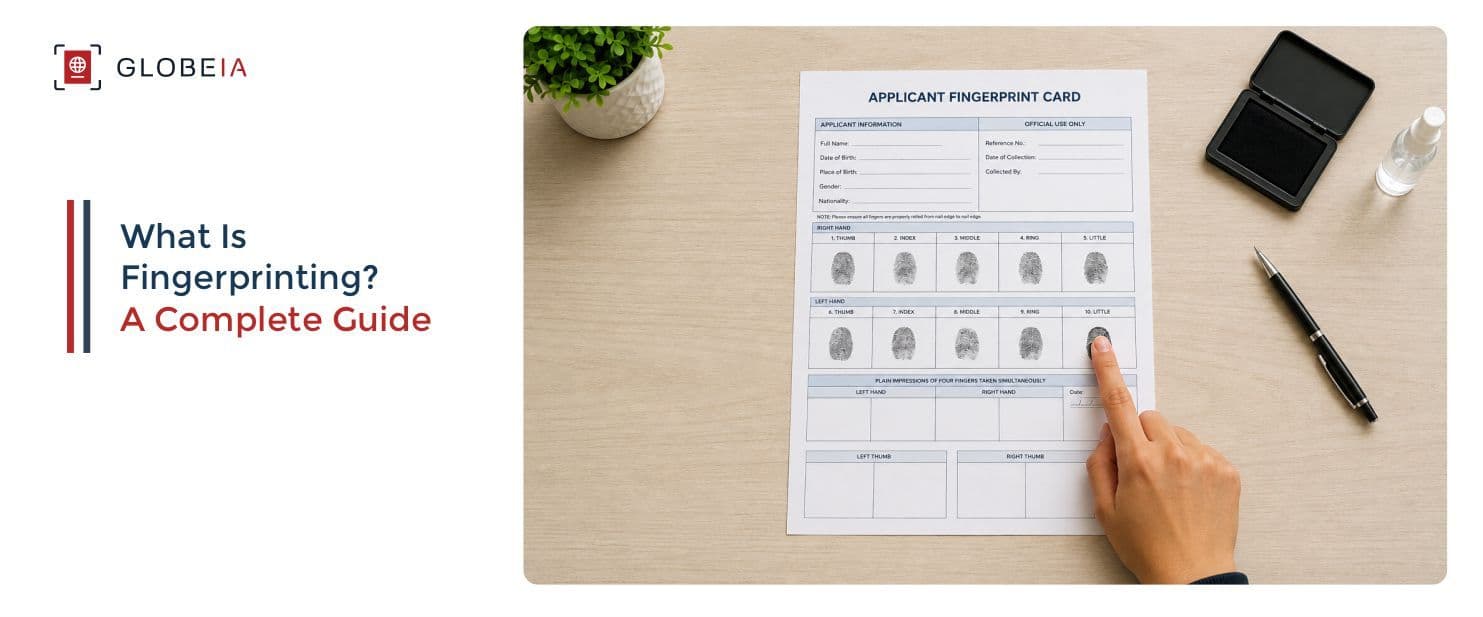
blog-banner
Fingerprinting Services
Fingerprint Background Check
Published on August 24, 2026 . Last updated on August 24, 2026
Muskan Aggarwal

What Is Fingerprinting?

Summary

Summary: Fingerprinting is the process of recording a person's unique finger ridge patterns, or, more broadly, using a distinct set of characteristics to identify a person, device, or substance.

Fingerprinting is a biometric method used to identify individuals based on the unique patterns on their fingertips. Widely used across law enforcement, background screening, and biometric security, it allows authorized agencies to compare a person's identity against official records.

But the term “fingerprinting” is no longer limited to physical fingerprints. It can also describe processes that identify people, devices, files, or substances by analyzing distinctive patterns or characteristics.

Fingerprinting can involve several steps, from capturing the fingerprints to preparing and submitting them to the relevant authority. Learn more about how fingerprinting works and what documents you may need for fingerprinting in our detailed guides.

What Are the Different Types of Fingerprinting?

The fingerprinting process can take different forms depending on what is being identified and how the information will be used. These include physical and forensic fingerprinting, digital and device fingerprinting, and scientific and biological fingerprinting.

1. Physical and Forensic Fingerprinting2. Digital and Device Fingerprinting3. Scientific and Biological Fingerprinting
Law Enforcement & Forensics: Collecting physical ridge impressions through ink cards or digital scans to investigate crimes, verify identities, or conduct fingerprint-based background checks.Browser & Web Tracking: Collecting information about a browser and device, such as screen resolution, operating system, fonts, and browser settings, to create a distinctive device profile for online tracking.DNA Profiling: Analyzing specific genetic markers to identify individuals, establish biological relationships, or assist with criminal investigations.
Biometric Security: Using unique fingerprint patterns to authenticate a person's identity for smartphone access, payment authorization, or entry to secure facilities.Cybersecurity & IT: Analyzing system characteristics, network responses, or file hashes to identify devices, detect security threats, or verify file integrity.Chemical & Spectrometric Analysis: Mapping unique molecular, protein, or light-absorption patterns to identify unknown substances and compounds.

Because physical fingerprinting remains the most established and regulated form, especially for identity verification and background checks, the rest of this guide focuses on how it works in practice.

Why Are Fingerprints Used for Identification?

Physical fingerprinting is widely used for identification because fingerprint ridge patterns are highly distinctive and remain stable throughout a person's lifetime.

  • Uniqueness: Even identical twins have different fingerprints, making them useful for distinguishing one person from another.
  • Persistence: Minor cuts or surface injuries may affect the skin temporarily, but the underlying ridge pattern remains unchanged.
  • Comparability: Fingerprints can be captured, digitized, and compared with known fingerprint records. Automated fingerprint identification systems can analyze distinctive features in a print to determine whether it corresponds with an existing record.

What Are the Main Types of Fingerprint Patterns?

Although every person's fingerprints are distinctive, most fingerprint patterns can be broadly classified into three basic types:

  • Loops: The ridges enter from one side, curve around, and exit from the same side.
  • Whorls: The ridges form circular, spiral, or concentric patterns around a central area.
  • Arches: The ridges enter from one side and rise in the center before leaving through the other side.

These broad classifications help describe fingerprint patterns, but identification does not depend on the overall pattern type alone. More detailed ridge characteristics are used when fingerprints are examined or compared.

When Is Physical Fingerprinting Used for Identification and Background Checks?

In law enforcement and administrative screening, physical fingerprints are used in:

1. Forensic Police Investigations

Forensic specialists may encounter three types of fingerprint impressions:

  • Latent prints: Usually invisible impressions left by natural oils and perspiration.
  • Patent prints: Visible impressions transferred through substances such as blood, ink, dirt, or paint.
  • Plastic prints: Three-dimensional impressions left in soft materials such as wax, putty, or fresh paint.

Analysts can then use methods such as ACE-V (Analysis, Comparison, Evaluation, and Verification) to compare recovered prints with known fingerprints.

2. Employment and Background Check Screening

blog-image

Unlike forensic investigations which analyze partial or smudged prints from a crime scene, background checks require a full, intentionally captured set of prints from an applicant.

  • The Collection: Applicant prints are captured using either traditional ink rolled onto paper cards or via modern digital scanners known as Live Scan.
  • The Submission: Depending on the background check, fingerprints are submitted electronically or sent on the required fingerprint card to the relevant government agency or authorized processing channel.
  • The Match: The receiving agency compares the fingerprints against its records to identify a possible match and produce the required background-check result.

Key Distinction: 

  • Forensic fingerprinting is reactive. It asks, “Who left this fingerprint at a crime scene?”
  • Background-check fingerprinting is proactive. It asks, “Does this applicant's identity correspond to records held by the relevant authority?”

How Are Fingerprints Collected?

Fingerprints are collected primarily using ink and digital methods.

When people think of fingerprinting, they often picture a person pressing inked fingers onto a fingerprint card. That is broadly correct, but there is an important distinction between flat impressions and rolled impressions.

Flat vs. Rolled Fingerprints

A flat or plain impression is made by pressing the finger straight down onto the fingerprint card. It captures the ridge patterns from the portion of the finger that touches the card but does not record the entire side-to-side surface of the fingertip.

A rolled fingerprint, by contrast, is captured by placing the inked finger on one edge of the nail and carefully rolling it across the fingerprinting area to the opposite edge. This records a larger portion of the fingertip and provides more ridge detail for examination and comparison.

Rolled impressions are commonly required on official fingerprint cards used for international background checks. Cards such as the FBI FD-258 and RCMP C-216C include designated spaces for rolled impressions as well as plain impressions.

Why Are Rolled Impressions Used?

Rolling the finger allows the fingerprint specialist to capture ridge detail across the full width of the fingertip. This can provide a more complete impression for the authority conducting the fingerprint comparison.

A properly captured rolled print should show clear ridge patterns without excessive pressure, gaps, smudging, or overlapping areas. The provider must control the direction and movement of the finger while keeping the fingertip in contact with the card throughout the roll.

Fingerprint cards may also include plain impressions, usually taken by pressing several fingers straight down together. These impressions provide an additional reference for verifying that the correct fingers were captured and that the rolled impressions are properly associated with each finger.

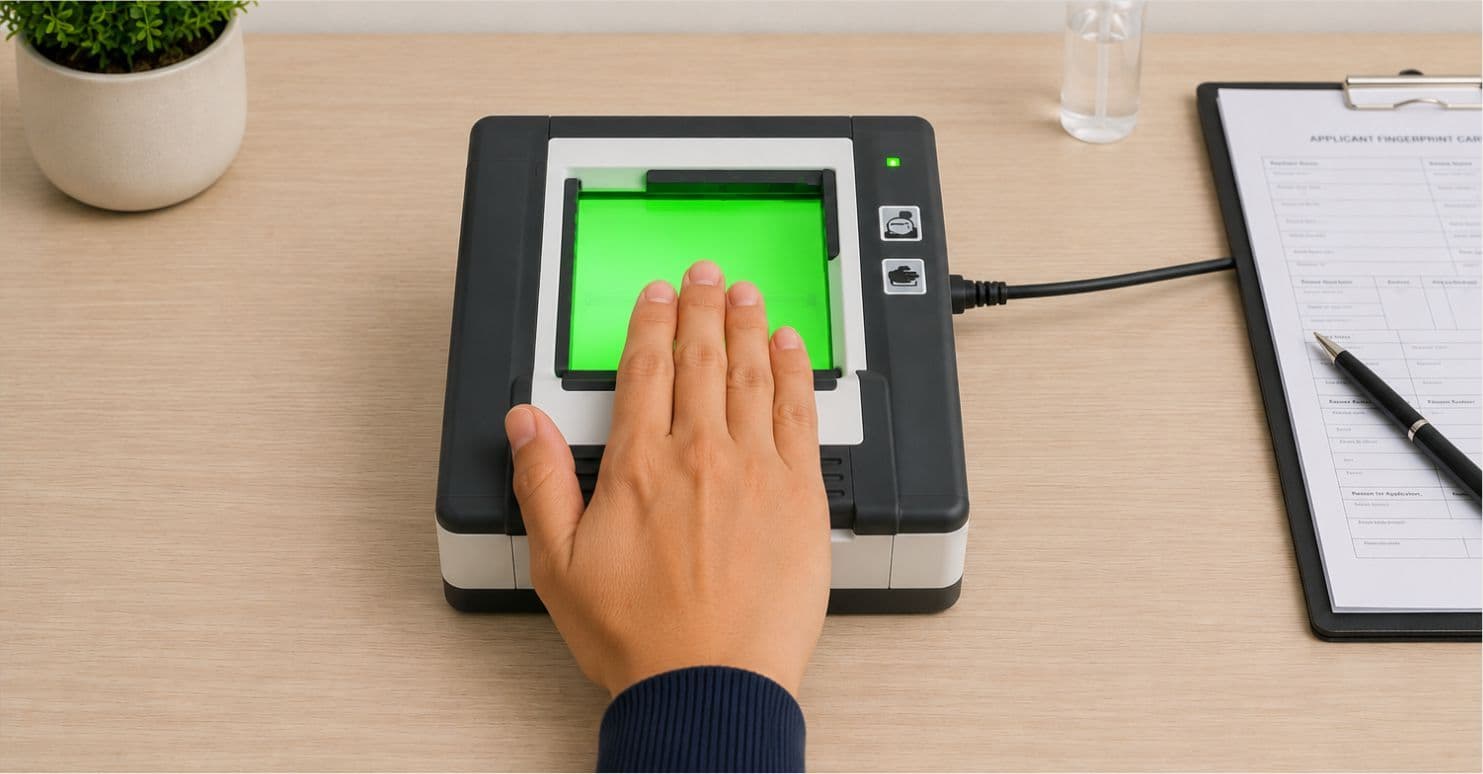
Digital Fingerprinting

blog-image

Fingerprints can also be captured electronically using a digital fingerprint scanner. Instead of transferring ink to paper, the scanner records the fingerprint ridge patterns as a digital image.

Digital capture can allow the provider to check the quality of an impression immediately and recapture a finger if the image is unclear. Where the receiving authority accepts electronic submissions, the fingerprint data can then be transmitted through the required system.

The required capture method depends on the specifications of the organization receiving the fingerprints. Some international background checks continue to require fingerprints on a specific physical card, while others accept electronic submissions.

What Makes a Fingerprint Usable?

A fingerprint must contain enough clear ridge detail for reliable examination or comparison. Several factors can affect fingerprint quality, including:

  • Insufficient ink or pressure, which can produce faint or incomplete ridge patterns.
  • Excessive ink or pressure, which can cause the ridges to blur together.
  • Moisture, sweat, or dirt, which can interfere with the clarity of the impression.
  • Dry or damaged skin, which may make individual ridge details difficult to capture.
  • Movement during capture, which can create smearing or distortion.

For this reason, fingerprint collection is not simply a matter of placing a finger on paper or a scanner. The provider must be skilled in the technicalities of the method.

What to Consider Before Getting Fingerprinted

The fingerprinting process can vary based on why the fingerprints are being collected and which organization will receive them. Before making an appointment, it is important to confirm:

  • the required fingerprint format,
  • whether ink or electronic capture is accepted, and
  • where the completed fingerprints need to be submitted.

For international applications like FBI background checks and RCMP criminal record checks, these requirements can differ between countries and agencies. A fingerprint card accepted for one background check may not be suitable for another. So, applicants should follow the instructions provided by the receiving authority.

Because these requirements differ by country, it helps to work with a provider experienced in international applications.

Globeia, for example, helps individuals arrange fingerprinting for international background checks and identity-verification requirements. These include applications to authorities in countries like the United States, Canada, Australia, the United Kingdom, New Zealand, Singapore, Hong Kong, Japan, France, Italy, Spain, Portugal, and more.

Conclusion

A fingerprint is a small physical detail, but it can carry significant meaning. The same idea of a distinctive “fingerprint” now extends from the patterns on our fingertips to devices, DNA, files, and other forms of identification. In each case, the purpose is similar: using distinctive characteristics to establish what something is, or who it belongs to. For individuals completing a background check or official application, that simple principle becomes a practical tool for proving identity and connecting it to the right records.

FAQs

Is fingerprinting the same as a background check?

No. Fingerprinting is a method of capturing your biometric identity. A background check is the process of searching records using that identity. Fingerprints are often used as part of a background check because they are more reliable than name and date of birth alone, but they are not the entire check.

What are the requirements for fingerprinting?

Fingerprinting requirements depend on the organization requesting the fingerprints and the purpose of the check. Requirements may include a specific fingerprint card, an approved capture method, identification documents, application forms, and a particular submission process. Always check the requirements of the receiving authority before getting fingerprinted.

Is my fingerprint data secure?

Reputable agencies and government bodies store fingerprint data in secure, restricted systems. Access is usually limited to authorized personnel for identity verification, criminal history checks, or law enforcement purposes. But since fingerprints are biometric data, you should only provide them to trusted agencies or authorized service providers and ask how they handle and dispose of the information.

Is fingerprinting required for a Criminal Record Check?

Some Criminal Record Check or criminal record checks require fingerprints, while others can be completed using personal information such as your name, date of birth, and address. The requirement depends on the country, issuing authority, and type of Criminal Record Check being requested.

Is ink fingerprinting different from electronic fingerprinting?

Yes, but the end result is the same. Ink captures a physical impression on a card; electronic scanners capture the same ridge detail digitally, often with the added benefit of immediate quality checks. Which method you'll need depends entirely on what the receiving agency accepts.
Written by :globeia-logo
We are a background screening and document verification agency in Toronto. While we cover the Greater Toronto Area for in-person appointments, the bulk of our clientele uses our online services from different countries of the world. Globeia makes it simple and cost-effective for companies and individuals to navigate governmental red tape without breaking the bank.
Recommended by Globeia
Globeia Offices
Canada
Canada
1185 Victoria Park Avenue, Scarborough, ON M4B 2K5, Canada
USA
USA
1901 Pennsylvania Ave NW, Unit 801, Washington, DC, 20006-3405
Office Location
Send
Globeia Logo
Globeia is your simple and secure background checks and identity solution
©2026 Globeia.com. All rights reserved.