By Sejal Jain · Updated September 11, 2026
Reviewed by Vasu Singla
When you neede to use a British document abroad, whether it is a birth certificate, a degree, a marriage certificate, or any other document, you will know about the term apostille. For many people, it is a new and slightly intimidating term, and the process of obtaining one can seem bureaucratic and confusing at first.
But here is the truth, the apostille process is actually one of the most organised systems in the world of international document legalisation. Once you understand what it is, why it exists, and how it works, the whole thing becomes much more manageable. And that is exactly what this guide is here to help you do.
Whether you are a British retiree buying a home in Marbella, a student heading to a Spanish university, a professional seeking recognition of your UK qualifications, or a business owner setting up a Spanish subsidiary, this guide helps to get your UK apostille from start to end.
An apostille (pronounced ah-po-STEEL) is a certificate attached to a public document to verify its authenticity for use abroad. Under the 1961 Hague Apostille Convention, it confirms that a document is genuine and issued by a legitimate authority.
Think of an apostille as a passport stamp for documents it proves the document is valid and internationally trusted. It usually appears as a stamp or separate certificate showing:
All apostilles follow the same standard format worldwide, making them universally recognized.
Spain, a Hague Convention member since 1978, accepts apostilled UK documents as legally authentic. Spanish authorities, notaries, registries, universities, and government offices cannot independently verify UK documents. The FCDO apostille provides an official chain of authentication, avoiding the long and costly full legalization process.
Not every document needs an apostille. Only public documents issued by government authorities, courts, or notaries require one. Private letters, contracts, or internal business communications are generally excluded.
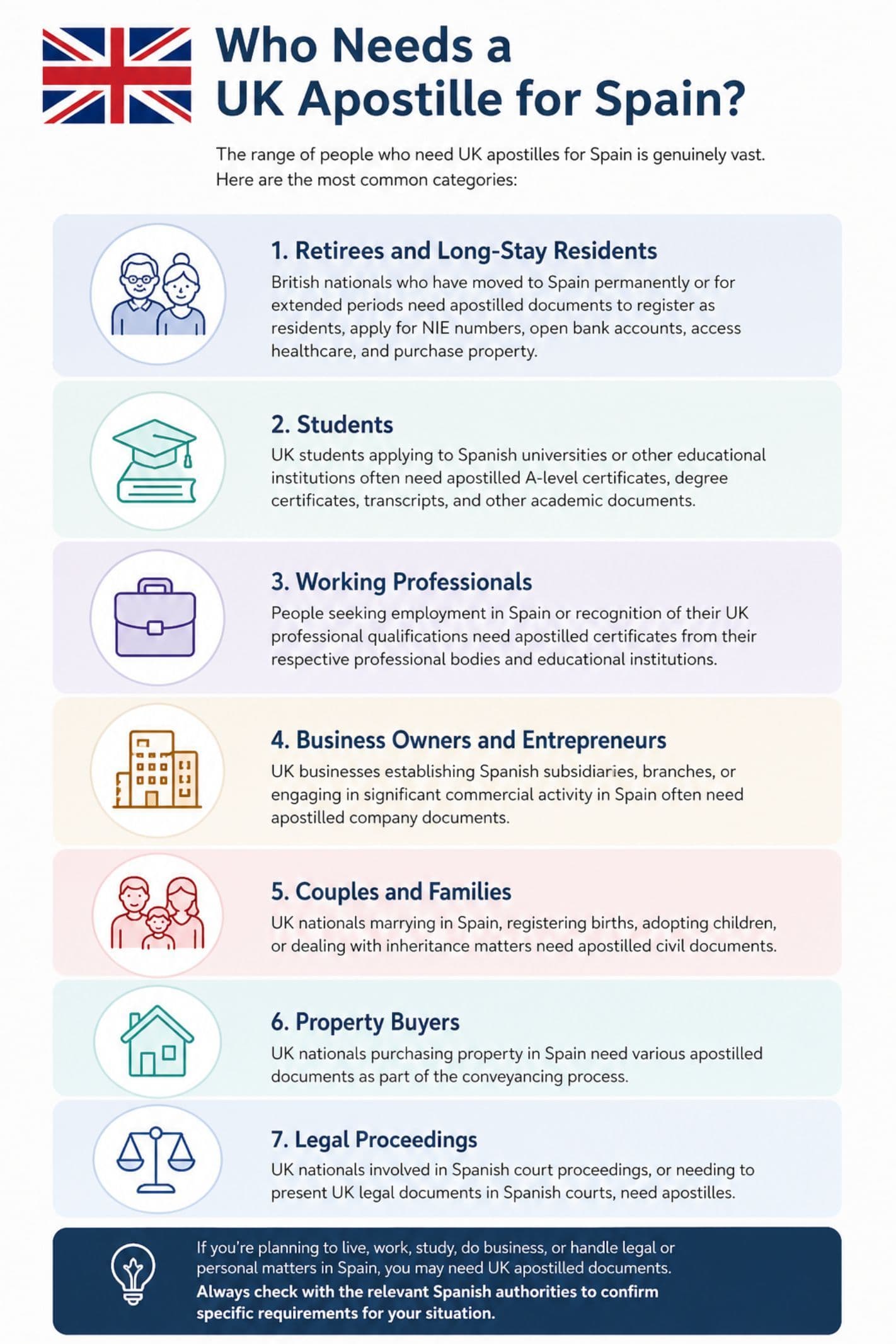
The range of people who need UK apostilles for Spain is genuinely vast. Here are the most common categories:
British nationals who have moved to Spain permanently or for extended periods need apostilled documents to register as residents, apply for NIE numbers, open bank accounts, access healthcare, and purchase property.
UK students applying to Spanish universities or other educational institutions often need apostilled A-level certificates, degree certificates, transcripts, and other academic documents.
People seeking employment in Spain or recognition of their UK professional qualifications need apostilled certificates from their respective professional bodies and educational institutions.
UK businesses establishing Spanish subsidiaries, branches, or engaging in significant commercial activity in Spain often need apostilled company documents.
UK nationals marrying in Spain, registering births, adopting children, or dealing with inheritance matters need apostilled civil documents.
UK nationals purchasing property in Spain need various apostilled documents as part of the conveyancing process.
UK nationals involved in Spanish court proceedings, or needing to present UK legal documents in Spanish courts, need apostilles.
The apostille system was created to simplify international document verification. Before 1961, authenticating a document for use abroad required multiple steps approval from the issuing country, legalization at the foreign consulate, and sometimes further certification. This process was slow, costly, and inconsistent.
The 1961 Hague Apostille Convention introduced a single, standardized certificate the apostille recognized by all member countries. Today, over 120+ countries, including the UK and Spain, are members. This makes international document authentication faster, reliable, and globally accepted.
How the Convention Works
Key points of the convention:
The UK and Apostilles
The UK has been a member since 1965. Brexit did not affect UK membership in the Hague Convention, so UK apostilles remain fully valid in Spain. What changed is only which documents Spanish authorities now require from UK nationals for visas, residency, or other administrative purposes.
Spain and Apostilles
Spain joined the convention in 1978. Spanish authorities notaries, universities, courts must accept apostilled UK documents. Spain also participates in the e-Apostille program, allowing digital verification of documents from the UK.
Documents That Qualify
Under the Hague Convention, only public documents can be apostilled:
Private contracts or letters do not qualify unless notarized; in that case, the apostille covers the notary’s certification, not the private document itself.
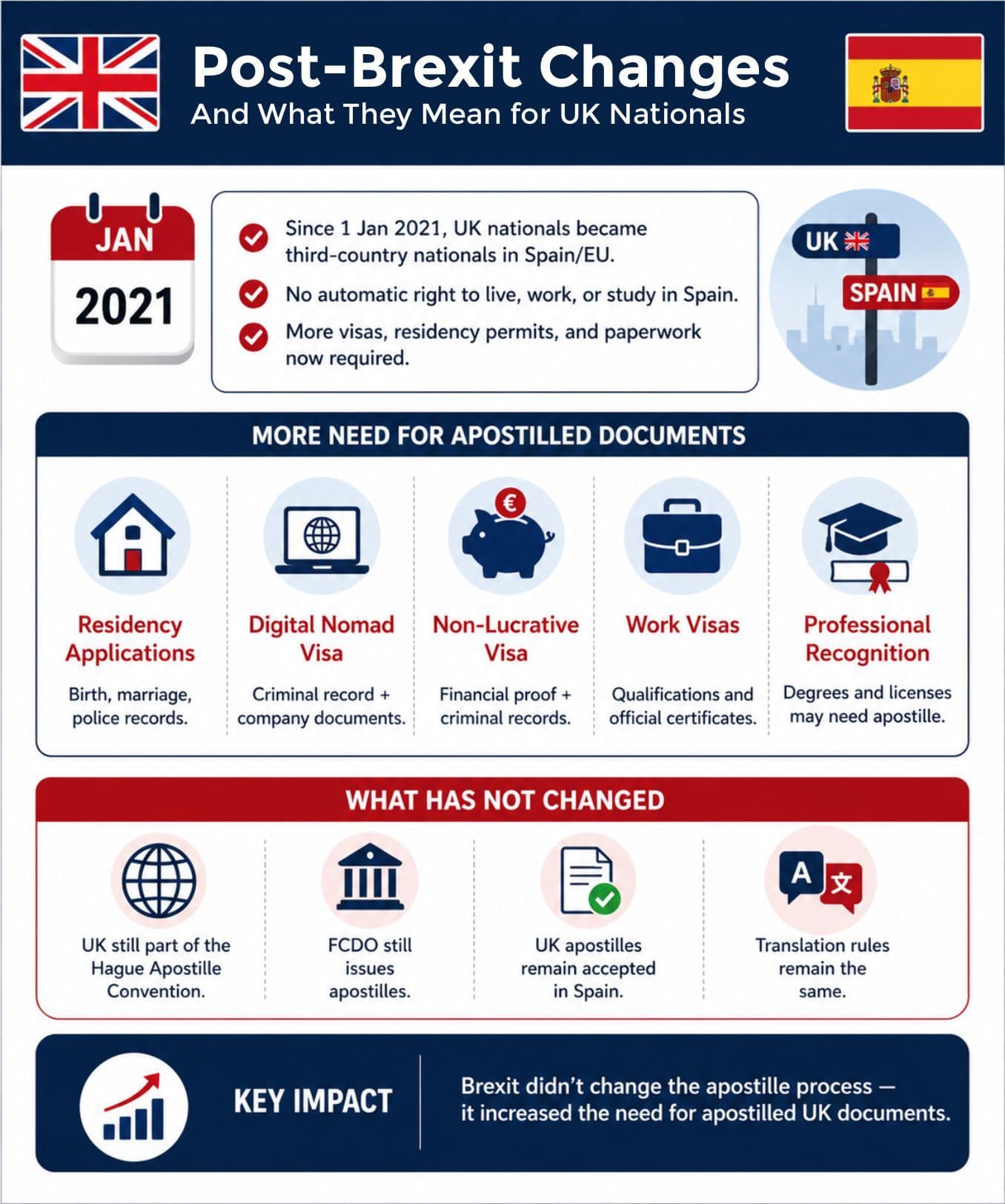
On 31 January 2020, the United Kingdom formally left the European Union, with the transition period ending on 31 December 2020. From 1 January 2021, UK nationals became “third-country nationals” in Spain and the EU, losing the automatic right to live, work, or study under EU freedom of movement rules.
Existing UK residents in Spain remain protected under the Withdrawal Agreement, but new arrivals now face visa requirements, residency applications, and more documentation. As a result, many more UK nationals need apostilled documents for official submissions that were not necessary before Brexit.
Post-Brexit Changes Affecting Apostille Requirements
Residency Registration: Before Brexit, UK nationals only needed to register locally for a Certificado de Registro de Ciudadano de la Unión. Now, new arrivals must apply for Spain’s visa and residency categories, which often require multiple apostilled UK documents.
Digital Nomad Visa: Introduced in 2023, this visa allows remote workers to live in Spain while working for foreign companies. Applicants need apostilled birth certificates, criminal records, and company documents.
Non-Lucrative Visa: For retirees or financially independent individuals, this visa requires apostilled criminal records and supporting documents from the UK. It is now the main route for UK nationals who want to live in Spain without working.
Work Visas and Recognition of Qualifications: Employment in Spain now usually requires a work permit, and recognising UK professional qualifications often requires apostilled documentation.
Driving Licences: Since July 2021, UK driving licences can no longer be exchanged automatically in Spain, adding more document requirements, though licences themselves are not apostille-eligible.
What Has Not Changed:
Practical Impact: Brexit has increased demand for apostilles, not because the process changed, but because UK nationals now require official documents for visas, residency, employment, and qualifications. The FCDO reports a noticeable rise in apostille applications, and professional services have expanded to assist applicants.
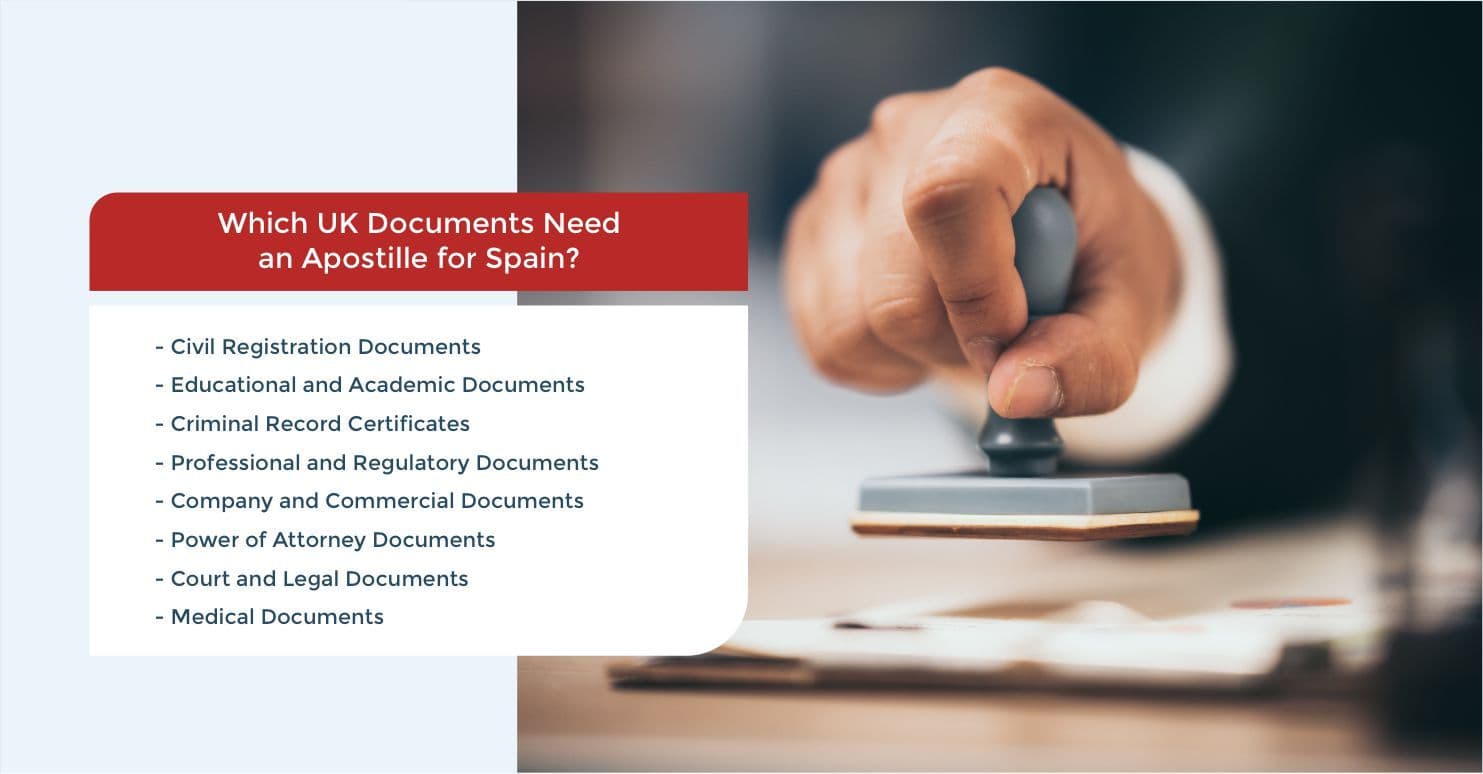
When people ask which UK documents need an apostille for Spain, the honest answer is: it depends entirely on what you are trying to do in Spain. The apostille requirement is driven by which Spanish authority or institution is receiving the document and for what purpose.
Here are certain documents that come up again and again in the most common scenarios.
Civil registration documents are some of the most commonly required documents when dealing with Spanish authorities. Whether applying for residency in Spain, handling inheritance, getting married, or registering for services, UK nationals are often asked to provide apostilled civil documents.
Criminal record certificates are often required for Spanish visas, residency applications, work permits, and roles involving children or vulnerable adults.
DBS Check (Not Accepted for Spain)
The UK DBS check is commonly used for employment in the UK but is not suitable for use in Spain. Spanish authorities generally do not accept DBS certificates for immigration or legal purposes.
ACRO Police Certificate (Required for Spain)
Spain requires an ACRO Police Certificate, which provides an official record of your criminal history (or confirms you have none). This document can be apostilled and is commonly needed for Non-Lucrative Visa, Digital Nomad Visa, Golden Visa, and other residency applications.
For roles involving children or vulnerable adults, Spain may also request the ACRO International Child Protection Certificate (ICPC).Professional documents may be required when seeking recognition of UK qualifications in Spain.
These documents are often required for business activities in Spain.
Power of Attorney documents are commonly used to authorise someone in Spain to act on your behalf for property purchases, legal matters, or business transactions.
In the United Kingdom, Apostilles are issued only by the Foreign, Commonwealth & Development Office (FCDO). This is the sole government authority responsible for legalising UK documents for international use under the Hague Apostille Convention. Solicitors, notaries, or private agencies cannot issue Apostilles themselves they can only assist with preparation and submission.
The FCDO Legalisation Office verifies all documents before issuing an Apostille. They confirm that signatures, seals, and official marks are genuine and match their official register of UK authorities. Once verified, the Apostille certificate is attached, ensuring the document is legally recognised in Spain and other Hague Convention countries. This process provides reliability and legal acceptance for visas, residency, work permits, or official transactions.
The Apostille process is centralised, but the FCDO accepts documents from all UK regions:
This ensures applicants across the UK can access Apostille services without regional restrictions.
For many UK nationals, the idea of waking up to Mediterranean sunshine without the obligation to work locally is very appealing. The Non-Lucrative Visa (NLV) makes this possible for those who have enough savings or a steady income to support themselves.
Applicants need to show Spanish authorities that they are financially stable, healthy, and law-abiding. Among the documents, the ACRO police certificate, which must be apostilled, is the most critical as it verifies you have no criminal record. Other documents include:
Practical tip: Begin gathering your documents well in advance, as some consulates may request additional apostilled evidence of income. This visa is ideal for retirees, remote savers, or anyone wanting to enjoy Spain’s lifestyle without local employment obligations.
For those moving to Spain for employment, the Work Visa provides the legal framework to live and work in the country. Often, your Spanish employer will act as your sponsor, but you still need to demonstrate your suitability and lawful background.
Key documents include:
Why apostilles matter: They allow Spanish authorities to accept your qualifications and criminal record without additional checks, preventing delays that can stall your move. This visa is especially important for professionals transferring within multinational companies or filling roles in sectors requiring formal recognition of credentials.
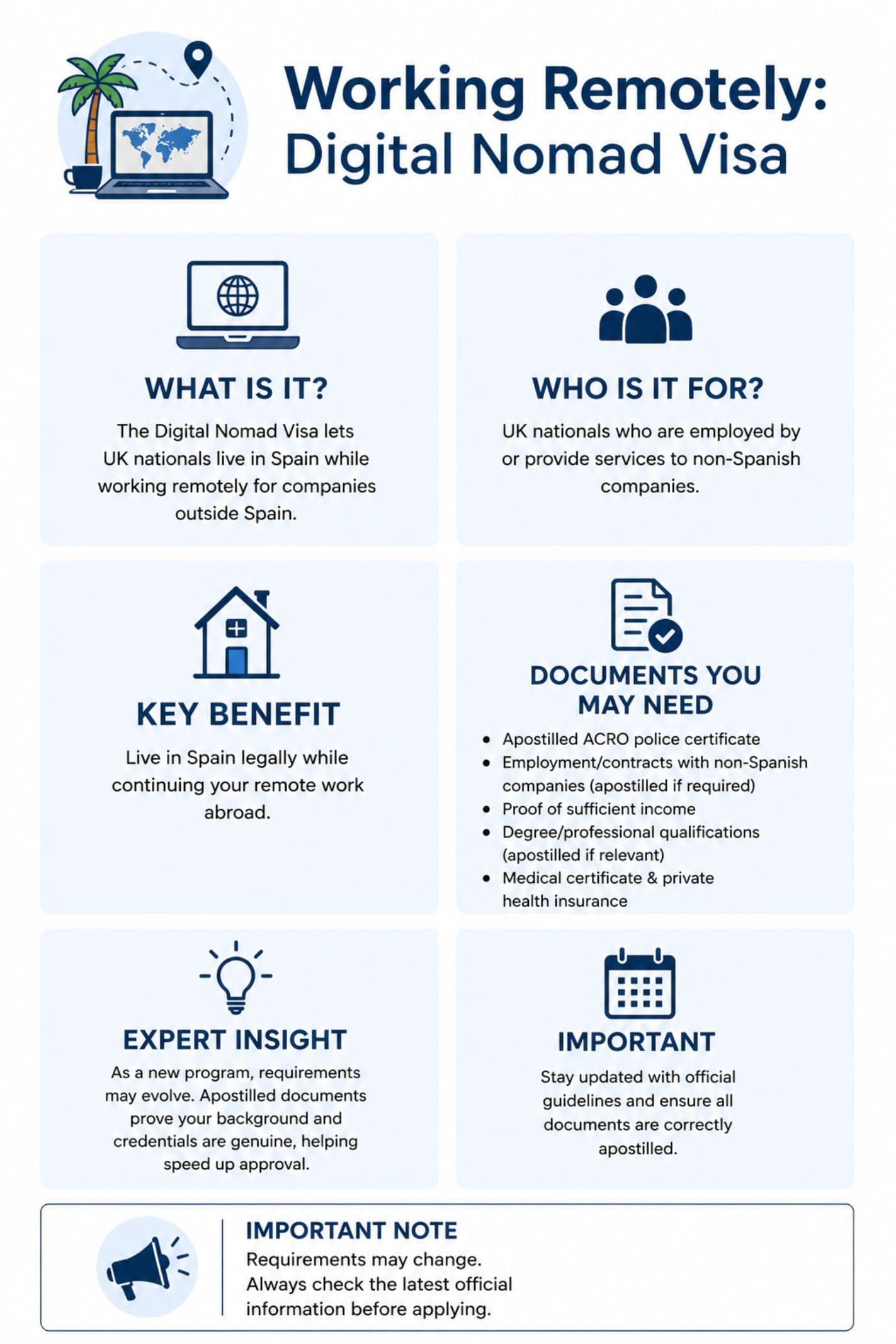
Spain has recognised the growing trend of remote work with the Digital Nomad Visa, aimed at UK nationals who provide services or are employed by companies outside Spain. This visa allows you to live in Spain while legally working remotely.
Documents you may need:
Expert insight: Since this visa is relatively new, requirements may change as the program evolves. Apostilled documents are critical, as they show Spanish authorities that your background and professional credentials are genuine, which can speed up approval.
Buying property in Spain is more than a lifestyle choice it’s a legal process that often requires interaction with a Spanish notary (notario). If you are not in Spain, a notarised and apostilled Power of Attorney allows a representative to complete the purchase on your behalf.
Essential documents include:
Practical insight: Apostilled Powers of Attorney are essential for remote property purchases. They give your lawyer legal authority and prevent the transaction from being delayed due to missing documentation.
Planning to marry in Spain? Both civil and religious ceremonies recognised by the Spanish state require official documentation submitted to the Registro Civil. Apostilled documents confirm your identity, legal status, and marital eligibility.
Key documents include:
Why this matters: The Certificate of Single Status is crucial to prove you are legally free to marry. Civil registry processing can take several months, so it’s important to gather apostilled documents early to avoid unnecessary delays.
For UK students aiming to attend Spanish universities, the Student Visa ensures your legal residence while pursuing studies. Apostilled academic certificates are often necessary to validate qualifications.
Commonly required documents:
Tip: Some universities require homologación, the official recognition of UK qualifications by the Spanish Ministry of Education. Apostilled documents are usually part of this process, ensuring your academic achievements are recognised.
UK nationals establishing a business in Spain (Sociedad Limitada) or registering as self-employed (autónomo) must provide documentation to confirm identity, professional qualifications, and company legitimacy. Apostilles play a critical role in validating UK documents in Spain.
You may need:
Practical note: Business formation involves notaries, the Commercial Registry (Registro Mercantil), and tax authorities. Apostilled documents help prevent delays and ensure your credentials are legally recognised.
If a UK national dies leaving assets in Spain, or if a UK national inherits from someone who had assets in Spain, the Spanish inheritance process will require apostilled UK documents including:
Important: Spanish inheritance law differs from UK law. Apostilled documents ensure that UK legal documents are recognised, but expert legal advice from a lawyer familiar with both systems is strongly recommended to avoid disputes or delays.
Notarisation in the UK is the process of having a document authenticated, certified, or witnessed by a Notary Public a specially qualified legal professional whose role is specifically focused on authenticating documents for use abroad and in other formal contexts.
UK Notaries Public are different from ordinary solicitors, although they are often legally qualified. The notarial profession in England and Wales dates back centuries and is regulated by the Faculty Office of the Archbishop of Canterbury making it one of the oldest regulated legal professions in the country. In Scotland and Northern Ireland, slightly different notarial systems operate, but the function is similar.
A UK notary's signature and seal are recognised internationally, and crucially, notaries' signatures should be registered with the FCDO so that the FCDO can apostille notarised documents.
Notarisation is NOT required for documents that already bear the official signature and seal of a UK public authority. Birth certificates from the GRO, degree certificates bearing the university's seal, and ACRO police certificates can all be apostilled directly without notarisation.
Notarisation IS required in the following situations:
The Society of Notaries maintains a directory of notaries in England and Wales. The Royal Faculty of Procurators in Glasgow covers notaries in Scotland. For Northern Ireland, the Law Society of Northern Ireland can assist.
When looking for a notary for Spain-related documents, it is advisable to find one who has experience with international documents, particularly for Spain. They will be familiar with the requirements and will know to produce the notarial act in a form that the FCDO can apostille and that Spanish authorities will accept.
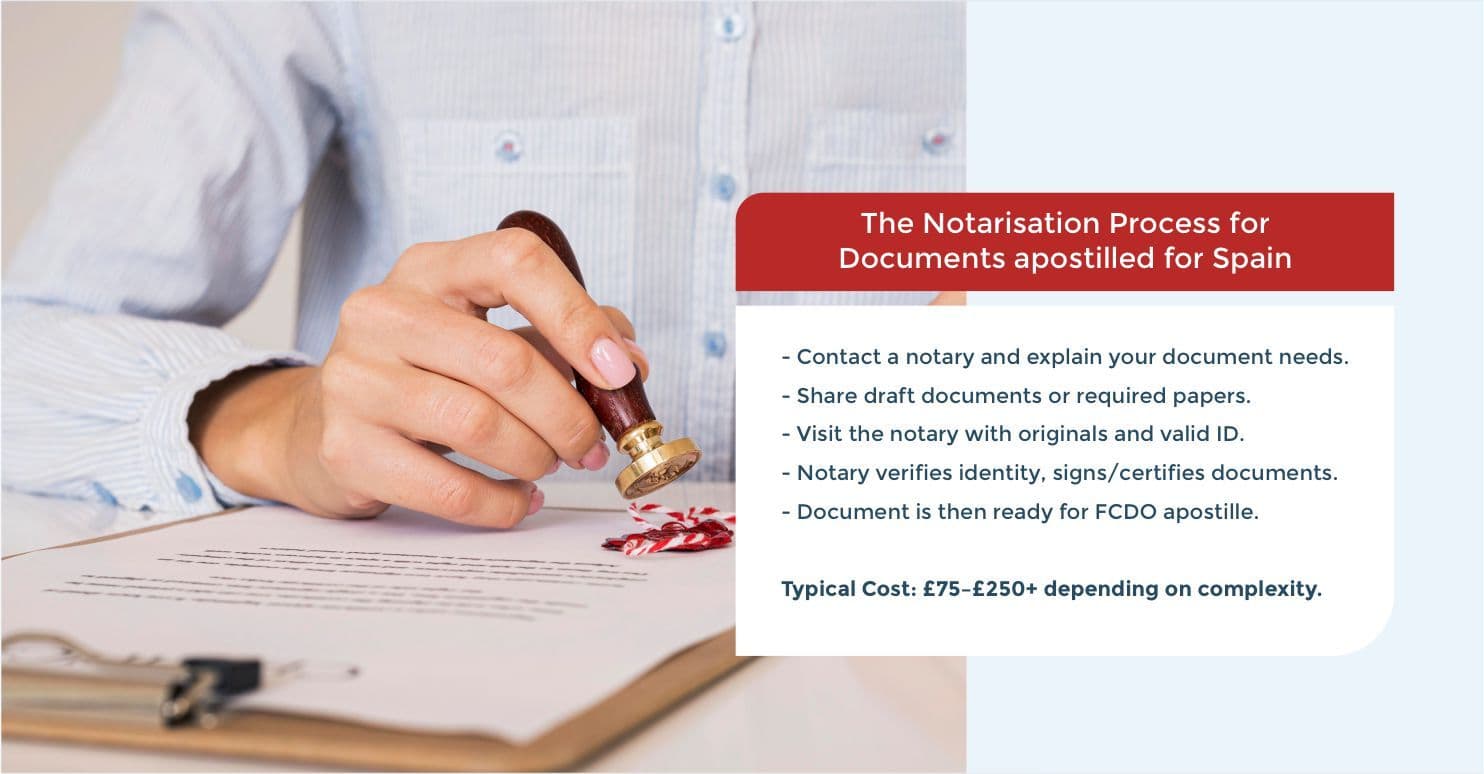
The typical process for notarising a document that will be apostilled for Spain is:
1. You contact the notary in advance and explain what you need (e.g., a Power of Attorney for property purchase in Spain, or a certified copy of your degree certificate)
2. The notary may ask you to provide a draft of the document or to bring specific materials3. You attend the notary's office (or in some cases, the notary can attend you) with your original documents and valid ID4. The notary reviews the document, checks your identity, witnesses your signature (or certifies the document), and prepares the notarial act5. The notarised document is then ready to be submitted to the FCDO for apostillingFees vary by notary but between £75 and £250 for a standard notarisation, more for complex documents.
There are some differences in how notarisation works in Scotland compared to England and Wales. Scottish notaries (who are solicitors who have been admitted as notaries public) work within a slightly different legal system. However, for the purposes of apostilling documents for Spain, documents notarised by a properly qualified Scottish notary are just as valid as those notarised in England and Wales.
Before you get an apostille, you might need something else first: solicitor certification. This is where things can get confusing, so let's break it down clearly.
A solicitor certification is a formal statement from a qualified solicitor (a lawyer in the UK) confirming that they've verified your document. The solicitor checks that the document is genuine, hasn't been altered, and matches what they've seen in person.
Think of it as a lawyer putting their professional reputation behind your document. They're saying: "I've looked at this, I've checked the original, and I can confirm it's legitimate."
Not all apostille requests require a solicitor certification first. It depends on:
Your best move is to check with the country or organisation that will receive the document. They'll tell you exactly what they need.
When a solicitor certifies your document, they verify:
The solicitor then signs and stamps a certification statement on the document or its copy. This certification is what some countries want to see before they'll accept the document.
| Feature | Notarisation | Solicitor Certification |
| Purpose | Verifies signatures and witnesses the signing of a document | Verifies the authenticity of a document and confirms that a copy matches the original |
| Who Performs It | Notary public (qualified legal professional) | Solicitor (legal professional licensed to certify documents) |
| Focus | Identity of the signer and authenticity of the signature | Accuracy and genuineness of the document itself |
| Process | Confirms identity of signatories- Witnesses signatures- Verifies the signature is genuine- Applies official seal and signature | Examines the original document in person- Confirms the copy matches the original exactly- Verifies the document hasn’t been tampered with- Signs and stamps a certification statement |
| Typical Documents | Power of attorney, consent forms, legal declarations, agreements | Birth certificates, marriage certificates, educational records, other official documents |
| Key Difference | Focused on signatures and witnessing | Focused on document authenticity |
| Possible Overlap | Some documents may require notarisation after solicitor certification | Some documents may need certification first, then notarisation if a signature needs verification |
| Requirement Determined By | The receiving authority or foreign country’s regulations | The receiving authority or foreign country’s regulations |
The UK issues two types of apostilles, and understanding the difference will help you choose the right one for your situation.
The paper apostille is the traditional, physical version. Here's what you get:
Physical form: A separate sheet of paper (or attached to the back of your document) that contains the official apostille certificate.
What it includes: The apostille certificate has specific information:
How it works: The paper apostille is physically attached to your document (usually stapled to the back of your original or certified copy). When you send the document internationally, the apostille goes with it.
Best for: Most standard situations. Many countries and organisations still accept and prefer paper apostilles. If you're unsure which type to use, paper is usually the safe choice.
Timeline: Paper apostilles can be issued within 5 to 10 working days, depending on the issuing authority and how you submit your request.
The e-apostille is the modern alternative. It's a digital document that serves the exact same legal purpose as a paper apostille.
Digital form: A digital PDF certificate that's stored electronically and can be transmitted online.
What it includes: The same information as a paper apostille, but in digital format:
How it works: Instead of a physical document, you receive a PDF file. You can email this file, store it digitally, or print it if needed. The document maintains its legal validity in digital form.
Best for:
Timeline: E-apostilles are often available within 1 to 3 working days, making them faster than traditional paper apostilles.
Important note: Not all countries or organisations accept e-apostilles yet. Some older institutions or traditional industries still require the physical paper version. Always check what the receiving party will accept before choosing.
Here's the important part legally, they're identical. An e-apostille has the same legal force and validity as a paper apostille. Both prove that your document is genuine and authenticated by the UK.
The only real difference is the format. The choice between them usually comes down to:
Many countries now accept both. But some countries, particularly those with older legal systems, may require the physical paper version. Always verify before ordering.
Certain UK documents are not eligible for an e-Apostille and require a paper apostille instead, including:
People often confuse apostille and legalisation, and the terms are sometimes used interchangeably. However, they refer to different processes, and understanding the distinction is important when using UK documents abroad including in Spain.
An apostille is used when both the issuing country and receiving country are members of the Hague Apostille Convention. The process involves one certification from the designated authority in the issuing country.
For UK documents being used in Spain, this means obtaining a single apostille from the FCDO. The apostille process is simpler, faster, and more cost-effective, which is why it is the correct route for almost all UK documents intended for Spain.
Full legalisation is required when one or both countries are not members of the Hague Convention. This process usually involves multiple steps, such as:
Because Spain is a Hague Convention member, full legalisation is not required for UK documents going to Spain. In most cases, only an apostille is needed.
Legalisation terminology may still appear in some situations:
Terminology Note: If a Spanish authority asks you to legalise your UK documents, they almost always mean obtain an apostille. In the UK-Spain context, the correct and practical solution is to get an FCDO apostille.
Once your documents are ready for legalisation, you can submit your UK Apostille application through several methods. Each option offers different turnaround times, costs, and levels of convenience. Choosing the right method is important, especially if you are preparing documents for Spain visa applications, residency, work permits, or property matters where timing can affect your plans.
The e-Apostille is one of the most convenient ways to obtain a UK Apostille, particularly if you prefer a digital process or are applying from outside the UK. With this option, you complete your application online and upload scanned copies of your documents in PDF format. Once your documents are reviewed and approved, the Apostille certificate is issued electronically and can be downloaded or shared directly with the receiving authority in Spain.
This method is useful for digitally issued documents, business paperwork, academic certificates, and notarised documents that do not require a physical seal. The main advantage of the e-Apostille is speed, as it removes postal delays and allows you to complete the entire process remotely. However, some Spanish authorities may still request paper Apostilles, particularly for original documents such as birth certificates, marriage certificates, and police checks. For this reason, it is always recommended to confirm whether a digital Apostille will be accepted before choosing this option.
Postal submission is the most commonly used method for UK Apostille applications. This traditional approach involves sending your original documents to the Legalisation Office, where the Apostille certificate is attached physically to the document and then returned to you by post. This option is reliable and widely accepted for Spain visa and residency applications.
When submitting by post, you should include your original documents, a covering letter listing the documents and their intended use, payment details, and a prepaid tracked return envelope. Using tracked delivery is strongly recommended, as original documents can be difficult to replace if lost. Postal applications usually take several working days, depending on demand, and may take longer during busy periods. This option is ideal for applicants who are not in a rush and prefer a straightforward, cost-effective solution.
For applicants who need faster processing or prefer to submit documents directly, the in-person counter service is another option. This allows you to take your documents to the Legalisation Office and submit them in person. In some cases, documents may be processed the same day, while others may require collection at a later time depending on the type of document and workload.
This method is particularly useful if you have an urgent visa appointment, residency deadline, or property transaction in Spain. It also reduces the risk of postal delays and allows you to confirm any issues immediately. However, appointments may be required, and same-day processing is not always guaranteed. This option is best suited for applicants located within travelling distance who need quicker turnaround times.
Using a professional Apostille service in the UK is one of the easiest and most convenient ways to obtain your Apostille, particularly if you are applying from overseas, managing multiple documents, or working within tight deadlines. Professional Apostille providers specialise in handling the entire legalisation process and submitting documents directly to the UK Legalisation Office on your behalf.
In the UK, there are established Apostille service providers who regularly work with the FCDO Legalisation Office and are familiar with the document requirements for countries such as Spain. These professionals can review your documents before submission, helping you avoid common mistakes that may cause delays or rejection. Many also assist with notarisation, solicitor certification, document translation, and courier return services, making the process more straightforward.
This option is particularly helpful if you are unsure whether your documents are ready for Apostille or if you need guidance on Spain-specific requirements. Professional Apostille services can manage the full process from start to finish, ensuring your documents are correctly prepared, submitted, and returned securely. Although these services include an additional service fee alongside the official Apostille cost, many applicants find the added support and reduced risk of delays worthwhile.
If you are working within a tight deadline, urgent Apostille services or same-day Apostille processing may be available. These services are offered by professional Apostille providers who handle priority submissions and fast-track processing.
Urgent Apostille services are commonly used when applicants need documents quickly for Spain visa appointments, job offers, residency applications, university enrolment, or property purchases. Depending on availability, urgent options may include same-day Apostille, next-day processing, or express turnaround services.
These priority services are usually arranged through professional Apostille providers who are experienced in handling urgent requests. Because the documents are processed more quickly and handled as a priority, additional service fees apply. However, this option can reduce waiting times and help prevent delays in your visa or relocation plans.
If you know you will need your documents quickly, planning for urgent Apostille services in advance can save time and reduce stress. Choosing a reliable professional Apostille provider ensures your documents are processed efficiently and aligned with your Spain visa or relocation timeline.
1. The signature or seal cannot be verified
2. You submitted a photocopy
3. Insufficient payment
4. The document is in poor physical condition
5. No return envelope or courier label included
6. Notarisation is missing from a document that requires it
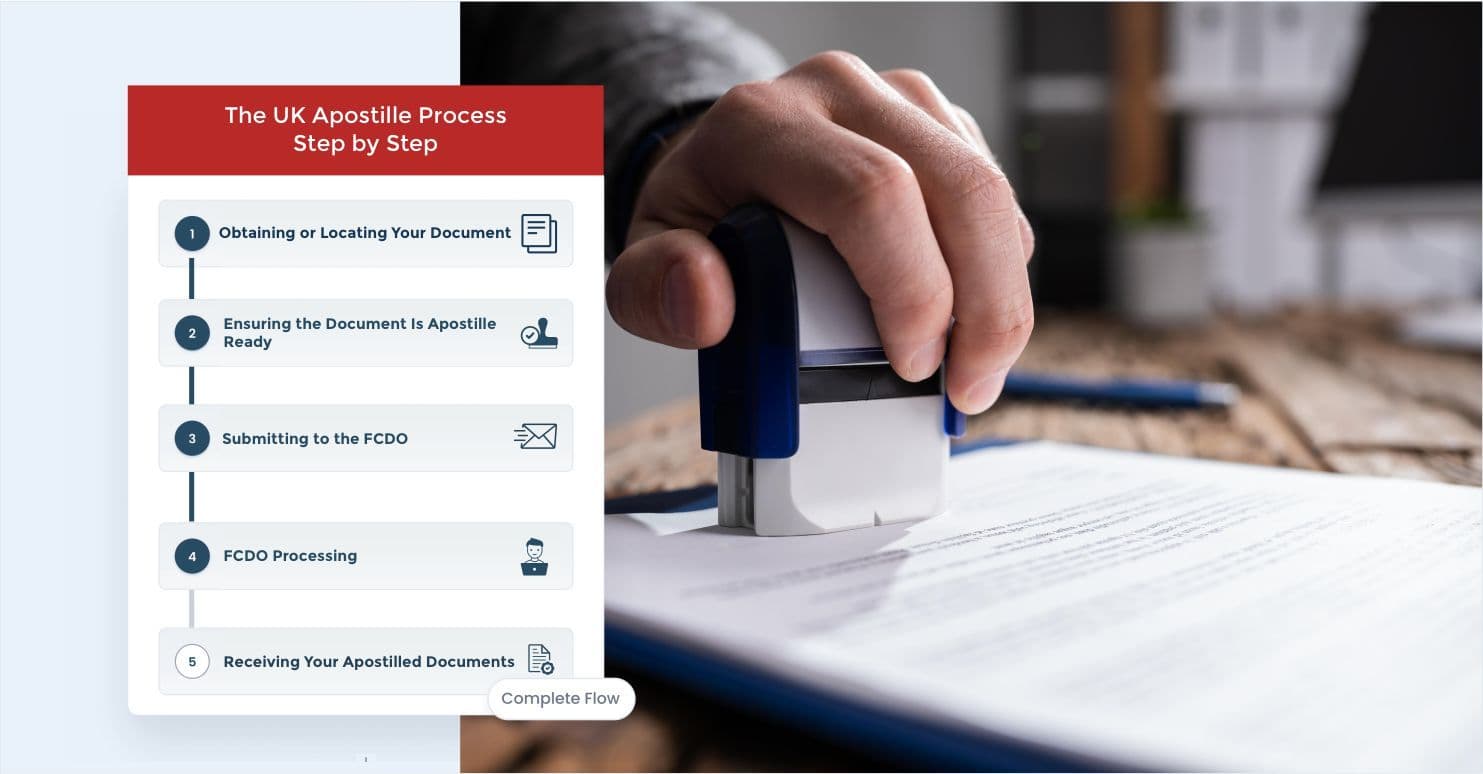
The process of obtaining a UK apostille for use in Spain involves a specific sequence of steps, and understanding the sequence upfront will save you time, money, and frustration. The most common mistake people make is to start the process in the wrong order, or to submit documents that are not in the right condition to be apostilled.
The basic sequence is: Obtain the document → Ensure it is in apostille-ready condition → Submit to the FCDO → Receive apostilled document → Arrange translation if needed → Submit to the Spanish authority.
Before you can get anything apostilled, you need the actual document. This sounds obvious, but it is worth spending a moment on because the condition of your document matters enormously.
If you already have the original document (for example, your marriage certificate is in a file at home), check its condition carefully. It needs to be an official original or a certified copy not a photocopy, not a scan, not a photographed version. It must have the original signature and/or seal of the issuing authority.
If you do not have the original, you will need to obtain a new copy from the issuing authority. For birth, marriage, and death certificates, this means ordering from the General Register Office (GRO) for England and Wales, the National Records of Scotland, or the General Register Office for Northern Ireland. For degree certificates, contact your university's registry. For criminal record certificates, apply to ACRO.
Allow time for this step ordering replacement documents can take days or weeks depending on the issuing authority.
The FCDO has specific requirements about which documents it can apostille. The key requirement is that the document must bear the authentic signature and/or seal of a UK public official. The FCDO verifies apostilles against its register of known signatures and seals from UK authorities.
Documents that are apostille-ready from the outset (no additional steps needed):
• Official civil registration certificates (birth, marriage, death, civil partnership) obtained directly from registry offices• Certificates from government departments bearing official stamps and signatures• ACRO police certificates• Companies House documents with official sealsDocuments that need to be notarised before they can be apostilled:
• Private documents you want to use abroad (contracts, declarations, etc.)• Some educational certificates that lack an identifiable official signature• Medical reports from private practitioners• Certified copies made by a solicitorNotarisation means having the document signed or authenticated by a UK Notary Public. Notaries Public are different from ordinary solicitors they are specifically trained in international document law. A notary can certify a copy of a document, authenticate a signature, or provide other attestations that make a document suitable for apostilling.The Foreign, Commonwealth & Development Office is the UK's sole competent authority for issuing apostilles on UK documents. There are several ways to submit documents to the FCDO.
Current FCDO postal address for apostilles: FCDO Legalisation Office, PO Box 6255, Milton Keynes, MK10 1XX.
Note: Address details occasionally change, and it is always advisable to check the current official FCDO website for the most up-to-date submission address and requirements before applying.
Once the FCDO receives your documents, they verify the signature and/or seal on the document against their register. The UK government maintains a comprehensive register of the signatures and seals of UK public officials whose documents are eligible for apostilling.
If the FCDO can verify the document, they issue the apostille a certificate that is either stamped directly onto the document, attached to it, or provided as a separate sheet. The apostille bears the FCDO's seal and signature of an authorised official.
If the FCDO cannot verify the document (usually because the signature or seal is not on their register, or the document is in poor condition), they will return it to you with an explanation.
When your apostilled documents are returned to you, check them carefully. Verify that the apostille has been correctly applied to each document, that the information on the apostille is accurate, and that the document itself is in good condition.
Store your apostilled documents carefully. While there is no expiry date on apostilles under the Hague Convention itself, receiving authorities may have their own validity requirements. Some Spanish authorities require apostilled documents to be no more than 3 or 6 months old at the time of submission so timing your apostille application correctly relative to your Spanish deadline is important.
Apostilled UK documents in English will need to be translated into Spanish for use with Spanish authorities.
Birth certificates are among the most commonly apostilled documents for Spain, and they come up in almost every category of Spanish administrative process. Here is everything you need to know.
Which Birth Certificate Do You Need?
There are two main types of birth certificate in England and Wales: the short certificate and the full certificate (also called a long certificate or full extract). For Spanish purposes, you should almost always obtain the full certificate, which includes the names and details of both parents, the parents' occupations, and other information. The short certificate only shows the child's name, date, and place of birth and is insufficient for many Spanish purposes.
Where to Obtain a Birth Certificate
Apostilling a Birth Certificate
A freshly issued birth certificate from the GRO, NRS, or GRONI should be apostille-ready it will bear the signature of the Registrar General or a deputy, which the FCDO can verify. Simply submit the certificate to the FCDO with the appropriate fee.
When Spain Will Ask for an Apostilled Birth Certificate
• Residency applications under various visa categories• Marriage in Spain (registrar/civil registry)• Registering births of children born to UK nationals in Spain• Inheritance and estate proceedings• School enrollment for some institutions• Applications for Spanish nationalityMarriage certificates follow essentially the same process as birth certificates, with a few specific considerations.
You need the full marriage certificate the one showing both parties' details not just a commemorative certificate. Commemorative certificates issued by the church or venue are NOT official documents and cannot be apostilled. You need the certified copy from the civil register.
For church marriages in England and Wales, the marriage register is held by the church but a certified copy can be obtained from the local register office or the GRO. The certificate needs to bear the official signature of the superintendent registrar or equivalent.
Religious marriages celebrated abroad but with UK registration may require specific handling consult the GRO or the FCDO if your marriage has any international elements.
Educational certificates from UK universities and awarding bodies present some interesting considerations for apostilling.
Most UK universities issue degree certificates bearing the signature of the Vice-Chancellor or equivalent, along with the university seal. The FCDO should hold the signatures and seals of all established UK universities and major awarding bodies.
However, some certificates from smaller or newer bodies may not be immediately on the FCDO register. In these cases, the FCDO will usually require you to have the certificate countersigned or endorsed by the awarding body in a form they can verify.
Important: Original degree certificates can be irreplaceable. Many people choose to have a certified copy made by a notary public and have the notarial copy apostilled, rather than risking their original certificate. However, some Spanish institutions specifically require the original apostilled certificate, so check the requirements of the receiving authority first.
The ACRO Criminal Records Office provides police certificates for UK nationals, which can be apostilled for use abroad. Here is the complete process:
• Apply to ACRO at www.acro.police.uk for an international criminal record check• ACRO will conduct a check of the Police National Computer and issue a certificate• The certificate will show any cautions, reprimands, or convictions, or confirm that you have no relevant criminal record• Submit the ACRO certificate to the FCDO for apostillingProcessing time from ACRO is 10 to 20 working days for a standard application. Rush processing may be available for an additional fee.Spanish authorities require an ACRO certificate that has been issued within the last 3 to 6 months (requirements vary by visa type and authority). Plan your apostille timing carefully, especially if you are applying for a visa through a consulate that has a specific validity window.
For most Spain visa categories particularly the Non-Lucrative Visa and Golden Visa you need to show sufficient income or financial means. The question of whether those income documents need apostilling is one of the most frequently misunderstood parts of the process.
The rule is straightforward in principle: if the document was issued by a UK public authority (a government department, an official body), it may need apostilling. If it is a private document (a bank statement, a letter from your financial adviser), it does not need apostilling.
Documents that need apostilling for Spain income requirements:
Documents that do not need apostilling:
One important practical note: even when a document does not require an apostille, it will need a sworn Spanish translation if it is going to a Spanish authority. The sworn translation requirement applies regardless of whether the document has been apostilled.
DWP letters and similar government documents follow the same apostille process as other public documents apply to the FCDO with the original letter, pay the fee per document, and allow 3–15 working days for processing.
Powers of Attorney (POA) for use in Spain are among the most commonly notarised and apostilled UK documents. They are needed when you authorise someone in Spain ( a Spanish lawyer) to act on your behalf for property purchases, sales, legal proceedings, or other matters. The process for a Spanish POA is:
1. You and your UK solicitor or notary public draft the POA (ideally in both English and Spanish, though English-only can work if it will be translated)2. You sign the POA before a UK Notary Public, who certifies your signature3. The notarised POA is submitted to the FCDO for apostilling4. The apostilled POA is sent to Spain, where your authorised representative can act for youSpanish property lawyers are very familiar with this process. A Spanish abogado will draft the POA for you, have it signed in the UK, and walk you through the entire process. The FCDO apostille confirms to the Spanish notary (notario) that the UK notary who certified your signature is legitimate.
For UK companies doing business in or with Spain, several types of company documents may need apostilling:
| Document | Typical Use in Spain |
| Certificate of Incorporation | Setting up Spanish branch; commercial contracts |
| Certificate of Good Standing | Bank account opening; contract execution |
| Memorandum & Articles of Association | Shareholder agreements; corporate transactions |
| Director/Shareholder Resolutions | Authorising transactions; real estate purchases |
| Registered Office Certificate | Tax registration; regulatory applications |
Companies House documents can usually be downloaded from the Companies House website, but for apostilling purposes, you may need a certified or signed version rather than a simple download. Check with the FCDO and Companies House about the appropriate format.
UK adoption orders and related documents for use in Spain (for example, in inheritance proceedings involving adopted children, or when an adopted UK national needs to establish their legal identity in Spain) need to be apostilled. Adoption orders are court documents and the FCDO should be able to apostille them if they bear the court seal and registrar's signature.
UK wills, grant of probate documents, and letters of administration are frequently needed in Spanish inheritance proceedings, particularly when a UK national has left assets in Spain. These are court or official documents that can be apostilled. Given the complexity of cross-border inheritance law (which involves both Spanish and UK law, and potentially EU succession regulations), professional legal advice from a lawyer experienced in both jurisdictions is strongly recommended.
Spain's official language is Castilian Spanish (castellano), and Spanish authorities, from the civil registry to the notary to government departments, work in Spanish. An apostilled document in English, while legally authenticated, still needs to be in a language the receiving authority can read and process.
This means that almost all apostilled UK documents will need to be accompanied by a certified Spanish translation before they can be used with Spanish authorities.
There is an important distinction, however, between different types of translations:
It is critical that you use only sworn translators for documents destined for Spanish official use.
In Spain, sworn translators (Traductores e Intérpretes Jurados) are individuals who have passed a rigorous examination administered by the Spanish Ministry of Foreign Affairs and have been officially appointed and sworn in. They are authorised to produce certified translations that are legally equivalent to the original document in Spain.
Importantly, a UK-based translator, however qualified, cannot produce a sworn translation for Spanish official use unless they hold the specific Spanish sworn translator appointment. This is a common source of confusion. A translator who is an accredited member of the Chartered Institute of Linguists in the UK, or who has a degree in translation, does not automatically qualify as a jurado translator for Spanish purposes.
You have two main options for getting properly sworn translations for Spain:
The Official Sworn Translator List
The Spanish Ministry of Foreign Affairs maintains a list of officially appointed sworn translators. This list is publicly accessible and can be found on the Ministry's website. When using a translation agency for Spain-bound documents, ask them to confirm that the translator holds the Spanish sworn translator appointment and ask for their registration number.
What Needs to Be Translated?
In general, all UK documents you submit to Spanish authorities should be accompanied by sworn Spanish translations. This includes:
Some documents that are simple and follow a standard format (such as birth certificates) may occasionally be accepted without a separate translation if the Spanish authority is familiar with the format, but you should not rely on this. Always provide the translation unless specifically told it is not required.
The Apostille on the Translation
A common question is: does the Spanish translation itself need an apostille? The answer in most cases is no the apostille is on the original UK document, and the sworn translator's certification on the translation is sufficient authentication for the translation itself. The sworn translator's stamp and signature serve as the authentication of the translation.
However, if the translation has been produced by a notary (rather than a sworn translator), the notarised translation may need to be apostilled separately. This situation is less common but can arise in certain contexts.
Practical Translation Tips
Over the years, thousands of people have navigated the UK apostille for Spain process, and certain mistakes have come up repeatedly. Most of them are avoidable with the right knowledge. Here is a comprehensive guide to the most common pitfalls and exactly how to sidestep them.
Ordering the short birth certificate instead of the full certificate, or getting a commemorative marriage certificate instead of the registered copy, is an extremely common mistake. Short certificates are cheaper and faster to obtain, but they contain insufficient information for official Spanish use.
Solution: Always check what version of a certificate is required before ordering. For Spain, the full version with complete parental and other details is almost always needed.
Many people assume that their DBS certificate which they have used for UK employment checks is the correct criminal record certificate for Spanish visa applications. It is not. Spanish authorities and Spanish visa applications require an international certificate from ACRO, not a DBS.
Solution: Always apply for an ACRO International Police Certificate, not a DBS check, for Spanish purposes.
The full apostille process takes longer than most people expect. With document ordering, FCDO processing, translation, and submission to Spanish authorities, you are looking at a minimum of 2 to 4 weeks in most cases and up to 8 weeks or more if any step has delays.
People frequently miss visa application deadlines, property completion dates, or university enrollment windows because they underestimated the time needed.
Solution: Start the process earlier than you think you need to. If your deadline is 8 weeks away, start now, not in 4 weeks.
Some people pay a notary to certify documents that are already apostille-ready directly. Official civil registration certificates do not need to be notarised before apostilling they can go straight to the FCDO.
Solution: Before paying for notarisation, check whether the document already has an official signature/seal that the FCDO can verify. For GRO certificates, ACRO certificates, and most government documents, notarisation is not needed.
Providing a Spanish translation that was done by a bilingual friend, a general commercial translation service, or even a CIOL-accredited translator without Spanish sworn translator status is a very common and costly mistake. Spanish authorities will simply reject documents accompanied by non-sworn translations.
Solution: Only use translators who hold the official Spanish sworn translator (Traductor/Intérprete Jurado) appointment from the Spanish Ministry of Foreign Affairs.
Obtaining an ACRO certificate, getting it apostilled, and then discovering that the Spanish consulate requires it to be no more than 3 months old and yours is now 4 months old is an agonising and expensive mistake.
Solution: Check the validity requirements of the specific Spanish authority before you begin the document process. Time your applications accordingly.
The FCDO cannot apostille photocopies. They must be original documents or certified copies. Sending a photocopy to the FCDO will result in it being returned to you, causing delays.
Solution: Always submit original documents or, where necessary, certified copies made by a notary.
If you do not include a prepaid return envelope or courier label with your postal application to the FCDO, they will not be able to return your documents to you, causing significant delays.
Solution: Always include a prepaid, tracked return envelope when submitting by post.
While the Hague Convention does not put an expiry date on apostilles, many receiving authorities have their own rules. Some Spanish institutions require documents to be apostilled within the last 3 or 6 months. Others do not have strict time limits.
Solution: Check the specific authority's requirements and time your apostille application accordingly.
Sending original documents through the post always carries a risk of loss, however well you package them. If an irreplaceable original is lost, the consequences can be severe.
Solution: Keep high-quality scans of every document before posting. For truly irreplaceable documents, consider having notarised copies made so that the originals never need to be posted.
| Mistake | Consequence | Solution |
| Wrong certificate type | Rejection by Spanish authority | Order full certificate, check requirements |
| DBS instead of ACRO | Visa application rejected | Apply to ACRO for international certificate |
| Starting too late | Missing deadlines | Start 8+ weeks before your deadline |
| Unnecessary notarisation | Wasted money | Check FCDO requirements first |
| Non-sworn translation | Document rejected | Use Spanish Ministry-certified jurado translator |
| Ignoring validity windows | Expired documents rejected | Check validity requirements before starting |
| Submitting photocopies | FCDO returns documents | Always use originals or certified copies |
| No return postage | Documents stuck at FCDO | Always include prepaid return envelope |
| Not keeping copies | Loss of irreplaceable docs | Scan everything before posting |
While most apostille requests follow a straightforward process, some situations involve special circumstances or edge cases. Understanding these scenarios can help avoid delays when preparing UK documents for use in Spain.
UK nationals who were born outside the UK (for example, in a former colony, or to expatriate parents) may have birth certificates that were issued by a foreign country rather than by a UK authority. In this case:
British citizens who were naturalised from another country may have documentation that spans multiple countries. Their UK naturalisation certificate (or certificate of registration as a British citizen) can be apostilled by the FCDO. This document may be useful in Spain to prove their British citizenship if other evidence is unclear.
People with both UK and Spanish nationality are in an interesting position. For Spanish purposes, they are Spanish citizens and would normally use their Spanish documents. However, if they have UK-issued documents that are relevant (for example, a marriage that took place in the UK), those documents may need apostilling just as for any other UK national.
Documents for children often involve apostilles birth certificates for children born in the UK to parents moving to Spain, school records, or other documents. The apostille process is the same regardless of whether the subject is an adult or a minor. However, some Spanish processes involving minors (such as school enrollment or healthcare registration) may have specific requirements beyond the apostille.
Occasionally, people need to apostille historical documents for example, to establish genealogy for Spanish citizenship applications based on grandparental descent (the democratic memory law), or for inheritance claims involving older estates.
Historical civil registration documents can generally be ordered from the GRO or other registries as certified copies bearing current official signatures, which can then be apostilled. The FCDO has historical records of signatories and should generally be able to apostille documents with older signatures where the signatory's details are on their register.
The Channel Islands (Jersey and Guernsey) and the Isle of Man are Crown Dependencies they are not part of the United Kingdom. Their documents are not apostilled by the FCDO. Each has its own competent authority for apostilles under the Hague Convention. If you have documents from Jersey, Guernsey, or the Isle of Man that need to be used in Spain, you need to obtain apostilles from the relevant Crown Dependency authority.
Documents from British Overseas Territories (such as Gibraltar, the Cayman Islands, or Bermuda) are also not apostilled by the FCDO. Each territory has its own apostille arrangements. Gibraltar is a special case because it is geographically part of the Iberian Peninsula and has specific arrangements with Spain.
If an apostilled document you have submitted to a Spanish authority is lost or mishandled, you may need to obtain and apostille a replacement. Unfortunately, apostilles cannot simply be reissued each apostille is tied to a specific physical document. If the document has been lost, you will need to obtain a new original or certified copy and go through the apostille process again. This underlines the importance of keeping copies of everything and using tracked delivery.
If you receive back an apostilled document and notice an error in the apostille certificate itself (such as an incorrect date or name spelling), contact the FCDO as soon as possible. Errors in the underlying document are more complex the apostille cannot be transferred to a corrected document; you would need a corrected document to be reissued and then separately apostilled.
The cost of getting UK documents apostilled for Spain involves several components, and the total can vary depending on how many documents you need, whether you use an agent, whether you need notarisation, and whether you need translation. Let us break down every potential cost.
FCDO Apostille Fee
The FCDO charges a standard fee per apostille. This fee is the same regardless of the document type or the country where it will be used. Check the current fee on GOV.UK as it may be subject to change, but has historically been around per document for postal applications.
Document Procurement Costs
If you need to obtain the original document before apostilling, there will be procurement costs:
Notary Public Fees
If notarisation is required (for powers of attorney, private documents, or some educational certificates), UK notary fees vary by location and notary. In London, fees are higher. Budget around £75 to £200 or more for a standard notarisation, depending on complexity.
Agent Fees
If you use an apostille agent, they will charge a service fee on top of the FCDO fee. Agent fees range from £25 to £75 or more per document, but the tradeoff is faster turnaround and not having to deal with the process yourself.
Translation Costs
Sworn translation from English to Spanish by a certified translator costs roughly £50 to £120 or more per page or per document, depending on length, complexity, and the translator's rates. Some documents (like a birth certificate) are short and translation may cost £50-£70. Longer documents (company articles, court judgments) will cost more.
Courier and Postage
You will need to send documents to the FCDO and have them returned to you. Use tracked and signed-for delivery. Budget around £5 to £15 for each posting, more if sending internationally.
| Scenario | Estimated Total Cost |
| Single birth certificate apostilled (postal, DIY) | £30 FCDO + document cost + postage ≈ £50-£60 |
| Single birth certificate apostilled (via agent) | £30 FCDO + £35-50 agent fee + postage ≈ £75-£90 |
| Power of Attorney (notarised + apostilled) | £100-200 notary + £30 FCDO + postage ≈ £150-£250 |
| Full Non-Lucrative Visa document set (3-5 docs) | £150-£400 depending on docs and agents/notaries used |
| Degree certificate apostilled + translated | £30 FCDO + £60-80 translation + postage ≈ £110-£130 |
| ACRO certificate apostilled + translated | £45 ACRO + £30 FCDO + £60-80 translation ≈ £150-£170 |
These are estimates only. Costs vary by provider, location, and specific circumstances. Always get a full quote from any service provider before committing.
How to Save Money
There are several legitimate ways to manage costs without compromising on quality:
The UK's internal legal geography creates some document-handling differences that most people ignore. If your documents come from Scotland, Wales, Northern Ireland, or the Crown Dependencies, there are specific things you need to know.
Scottish civil registration documents birth certificates, marriage certificates, death certificates are issued by National Records of Scotland (NRS) rather than the General Register Office. You can order them through the ScotlandsPeople service online or in person at the NRS offices in Edinburgh.
The key practical difference: NRS-issued certificates carry the signature of the Registrar General for Scotland, which the FCDO verifies separately from the Registrar General for England and Wales. In practice, this means NRS certificates are fully apostille-eligible and the process is identical you simply send the certificate to the FCDO as you would any other public document.
Scottish notarial practice differs slightly from England and Wales. Scottish Notaries Public are solicitors who have been admitted as notaries, rather than standalone notarial practitioners. Their certifications are fully valid for apostilling purposes. The Society of Notaries of Scotland maintains a directory.
For Scottish educational certificates from University of Edinburgh, University of Glasgow, and other Scottish universities the apostille process is the same as for English universities. The FCDO holds seals and signatures for all established UK universities.
Welsh documents present one specific issue: official documents may be in Welsh, bilingual Welsh-English, or English-only.The FCDO can apostille documents in Welsh Welsh is a recognised official language and Welsh public documents are valid for apostilling. However, for use with Spanish authorities, you will need a sworn translation of the Welsh content.
A translator translating from bilingual documents should work from the Welsh text if that is what the official document contains, though in practice most will work from whichever language version is clearer. Welsh civil registration certificates are issued through the same GRO system as English certificates and carry the same signatures, so there is no procedural difference in the apostille process.
Northern Irish civil registration documents are issued by the General Register Office for Northern Ireland (GRONI). Birth, marriage, and death certificates from GRONI are fully apostille-eligible through the FCDO in the same way as GRO documents.
For educational certificates from Queen's University Belfast and Ulster University, the FCDO process is identical to other UK universities. Northern Irish notaries operate under a different system from England and Wales. The Law Society of Northern Ireland can assist with finding a notary if notarisation is needed before apostilling.
This is a point where people regularly make costly mistakes. Jersey, Guernsey, and the Isle of Man are Crown Dependencies they are not part of the United Kingdom. The FCDO does not apostille documents issued by these jurisdictions.
Each Crown Dependency has its own competent authority for apostilles under the Hague Convention:
If you hold a birth certificate, marriage certificate, or other official document issued in Jersey, Guernsey, or the Isle of Man and need to use it in Spain, you must apply to the relevant Crown Dependency authority not the FCDO. Sending these documents to the FCDO will result in them being returned.
Gibraltar: Gibraltar occupies a unique position it is a British Overseas Territory geographically on the Iberian Peninsula, and it has its own apostille arrangements. Documents issued in Gibraltar are not apostilled by the FCDO. The Supreme Court of Gibraltar serves as the competent authority for Gibraltar apostilles.
Use this comprehensive checklist to manage your apostille process from start to finish.
For the most current and authoritative information, always consult:
Most people who go through the UK apostille process for Spain encounter at least one delay they could have avoided. Not because the process is unreliable, but because one step depends on another and the bottleneck is rarely where you expect it.
The most common delay point is not the FCDO their processing is generally predictable. The most common delay is ACRO. The ACRO criminal record certificate is required for virtually every Spain visa, and ACRO's standard processing time of 10–20 working days is a firm floor, not a guideline. During busy periods, it stretches further. Add postage time to the FCDO and back, then translation, and you are looking at 6–8 weeks minimum for just this one document.
If you are working to a Spanish consulate appointment, a property completion date, or a university enrollment deadline: apply to ACRO first. Before anything else. Order the ACRO certificate on day one. Then work on the rest of your documents while it processes.
That one sequencing decision is the difference between hitting your deadline with a week to spare and scrambling at the last minute.
Applying for a Schengen visa from India in 2026? Get the full process, document checklist, fees, processing times, and rejection-proof tips in one guide.

Planning a move to Portugal from the USA? Learn about visas, documents, housing, banking, taxes, healthcare, and settling in with a step-by-step guide.

Everything you need for a UK apostille in 2026 - FCDO process, fees, timelines, document types, non-Hague countries, and common rejection fixes.
Need help with your application or background check?
Contact us now and speak with a dedicated Globeia expert today.