
By Sejal Jain · Updated September 11, 2026
Reviewed by Vasu Singla
More Americans are seriously looking at Australia right now, not just for a holiday, but to actually move and build a life there. Many are drawn to the idea of a better work-life balance, including four weeks of annual leave and a steady job market with unemployment around 4%.
Thousands of Americans already live in Australia, going through the same process of visas, job searches, and adjusting to a new way of life. This guide covers the visa pathways for moving to Australia from USA, job market, cost of living, tax obligations, and daily practicalities for US citizens making the move. It also covers what most guides skip: the parts that are harder, slower, or more expensive than expected.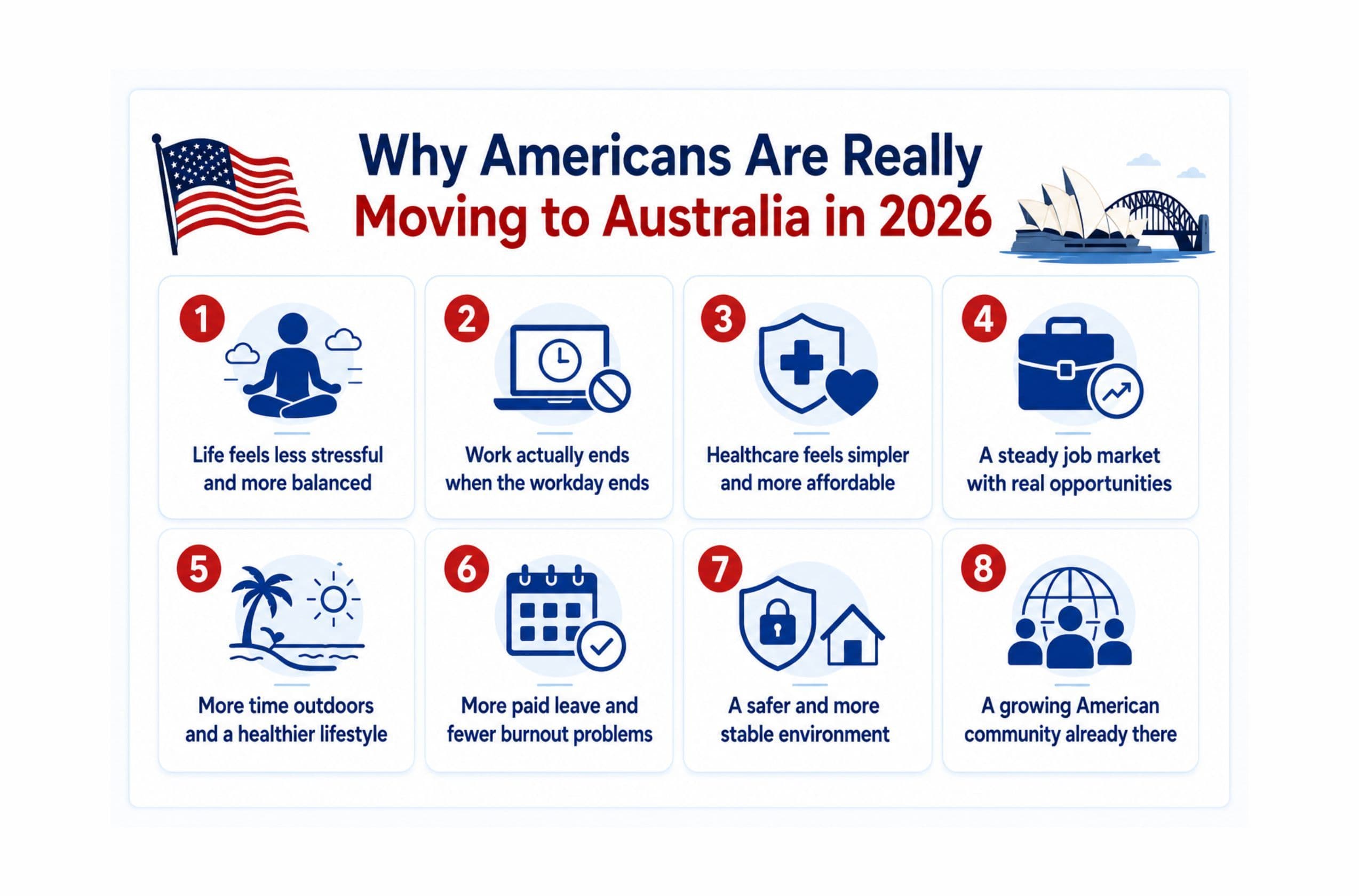
The main reason people think about moving to Australia from the USA, isn't just the beaches. It's that daily life in Australia feels less exhausting. Less rushed. Like, there's actually time for things outside of work.
Everyday life is just calmer. You're not constantly rushed. Work stays at work. Most people say they didn't expect how big that change would feel.
When work ends, it ends. No one expects you to reply to emails at 9 pm. That boundary is real and most Americans say it takes a few weeks to actually believe it.
If you qualify for Medicare, seeing a doctor doesn't involve a bill at the end. For most Americans, that alone is a huge mental shift. Instead of worrying about big medical bills, people can focus on actually getting care when they need it.
The 4% unemployment figure sounds like a statistic until you're applying for jobs and actually getting callbacks. Many Americans moving to Australia from USA find job opportunities in fields like healthcare, construction, IT, engineering, education, and hospitality.
You walk more. Not because you planned to, but because the suburb you live in puts you five minutes from a decent beach, a harbour walk, or a trail that goes somewhere worth going. Most Americans say they got healthier without trying.
Four weeks of paid leave, not two, and people actually use them. It's not seen as lazy. It's just normal.
Fewer guns. Lower violent crime. A political news cycle that, compared to the US, feels almost boring. Whether that boredom is a feature or a bug is entirely up to you.
101,309 Americans already live there ( In 2021 according to ABS census). That's enough to find expat groups in every capital city, get real advice on the visa process, and have someone warn you about the suburb you were about to move into before you signed the lease.
Australia doesn't let you just show up and figure it out. Every visa requires proof your job, your relationship, your savings, your skills. The bar is real. Points cut-offs for popular skilled occupations now run well above the 65-point minimum on paper. State nomination is competitive. Processing times are measured in months.
The Australian visa for US citizens is points-based and carefully controlled. You must meet requirements like age, skills, English level, health, and background checks. Even strong candidates are not guaranteed approval, so planning is essential.
Some pathways are temporary, while others can lead to Australian permanent residency (PR) over time. Choosing the wrong visa can delay your long-term plan, so understanding visa structure early is critical for anyone moving to Australia from USA.
The distance is real. Flights home take 15–22 hours and cost a lot. When something happens back home, whether it be a wedding, a funeral, or a bad week - you can't just drive over.
Cities like Sydney and Melbourne have expensive rental and property markets. Many expats rent long-term before even thinking about buying. For anyone researching the cost of living in Australia for Americans, housing is usually the biggest expense.
Even after relocating, US citizens must still file annual US tax returns. The US taxes worldwide income, so moving to Australia does not remove IRS filing requirements. Most expats use exclusions or credits, but compliance remains mandatory.
Australia’s retirement system, called superannuation, requires employer contributions into a pension fund. For Americans, this can create cross-border tax complexity, especially in reporting and long-term planning.
Australian immigration policies are not fixed. Occupation lists, visa salary thresholds, and eligibility rules change often. This means Australia visa requirements for US citizens must always be checked with updated official sources before applying.
Recent changes include tighter property rules for foreign buyers and updated visa income thresholds. These updates directly impact people planning how to move to Australia from the US in 2026–27, especially skilled workers and long-term migrants.
| Why Australia Works in Your Favour (Pros) | What You Need to Plan For (Cons) |
| No language barrier – English is spoken everywhere | Visa system is strict – points-based and rules-heavy |
| Cultural familiarity with the US – easy adjustment for most Americans | Long-distance life – 15–22 hour flights to the US |
| Strong healthcare & public services – high-quality Medicare system | Emergency travel is expensive and time-consuming |
| Good pay for skilled workers – strong wages in key industries | US taxes still apply – annual IRS filing required |
| High demand for US-skilled migrants – many visa pathways | Superannuation complexity – extra tax/reporting rules |
| Top global liveability cities – e.g. Melbourne ranks #4 (2025) | Housing is expensive – especially Sydney & Melbourne |
| Dual citizenship allowed – you can keep your US passport | No transfer of US credit history – you start from zero |
| Affordable prescriptions (PBS system) | Pet relocation is slow & costly (6+ months planning) |
Australia has over 120 visa types, but only a small number actually matter if you are planning moving to Australia from USA.
Electronic Travel Authority (ETA) - Subclass 601
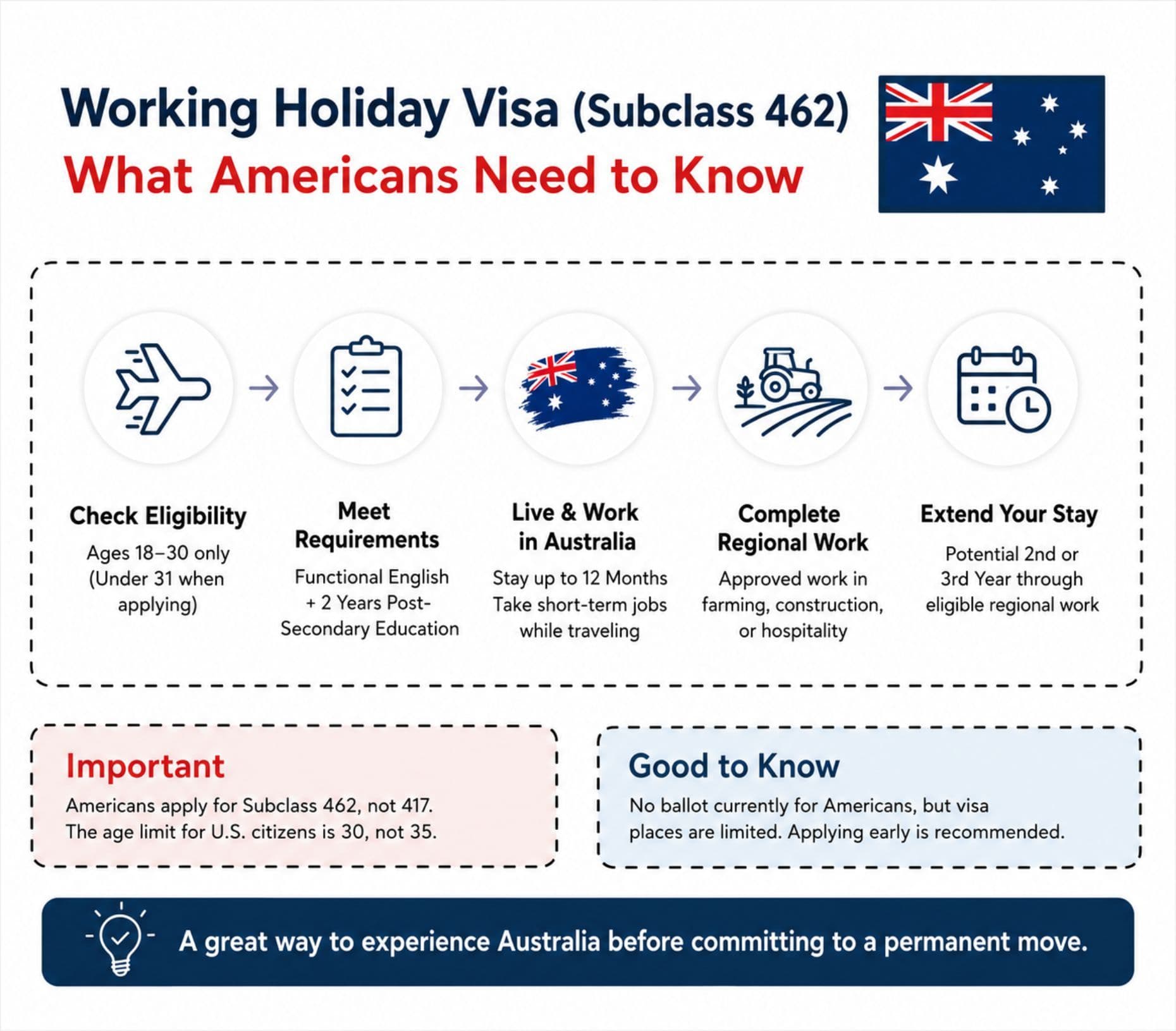
The ETA is the simplest entry visa for Americans visiting Australia. It is mainly used for tourism, short visits, or seeing family and friends. It allows stays of up to three months per visit and is usually approved quickly online or through an app. The cost is low, and the process is simple.Just keep in mind you can't work on this visa, and it won't lead to permanent residency. It's a tourist visa, nothing more. Using repeated back-to-back stays is not a long-term solution and can raise immigration concerns.Working Holiday Visa - Subclass 462The Working Holiday visa is one of the most popular options for young Americans who want to experience life in Australia. It is available to people aged 18 to 30 (who are under 31 years of age at the time of application) and requires basic financial proof to support your arrival. This visa allows you to live in Australia for 12 months and take short-term jobs to fund your stay. Many people extend it for a second or third year by completing approved regional work in industries like farming, construction, or hospitality.
Americans use the 462 (Work and Holiday), not the 417 (Working Holiday). The distinction matters because the 35-year age limit that applies to applicants from Canada, Denmark, France, Ireland, Italy, and the UK does not extend to Americans. US citizens cap at 30 with no exception. If you have read about the 35-year limit elsewhere and assumed it applies to you, it does not. The 462 also has additional requirements compared to the 417: you must demonstrate functional English (IELTS 4.5 or equivalent) and show evidence of at least two years of post-secondary education. Some nationalities on the 462 face annual caps or ballot systems - Americans are not currently subject to a ballot, but the cap exists, so applying early in the program year is sensible.This visa won't put you on the path to PR by itself, but lots of people use it to test Australia before committing to a full move.Student Visa - Subclass 500The Student visa is for Americans who want to study in Australia at an approved institution. You must first receive a Confirmation of Enrolment from a registered school or university before applying.Applicants must show proof of financial support and meet English language requirements in most cases. The visa allows part-time work during study periods and more flexible work during breaks.After completing studies, many students move on to a Temporary Graduate visa, which can open the door to skilled migration pathways. Common documents required include academic records, financial statements, and proof of genuine study intent.Skills in Demand Visa - Subclass 482The Skills in Demand (SID) visa is the main route into Australia if you already have a job offer. It replaced the old Temporary Skill Shortage visa on 7 December 2024, keeping the 482 subclass number but restructuring it into three streams.Core Skills covers around 456 occupations on the Core Skills Occupation List - healthcare, IT, engineering, trades, education, and more. The minimum salary is AUD $76,515, rising to $79,499 on 1 July 2026. A skills assessment is required for most roles in this stream.Specialist Skills is for high earners in senior roles. No occupation list applies - the salary floor does the filtering. The minimum is AUD $141,210 until 30 June 2026, then $146,717. Processing can be as fast as seven days.Labour Agreement covers industries with specific government-negotiated arrangements, aged care, agriculture, and regional sectors where standard streams don't apply.All streams are employer-sponsored, meaning your visa is tied to your job. If that changes, you have 180 days to find a new approved sponsor. After two years with an eligible employer, most holders can transition to permanent residency through the Employer Nomination Scheme (subclass 186).Temporary Visa Options for Americans (Quick View)
| Visa | Subclass | Who It’s For | Duration | Work Rights | Path to PR |
| Electronic Travel Authority | 601 | Tourists and short visits | Up to 3 months per visit | Not allowed | No |
| Working Holiday | 462 | Young Americans (18–30) | 12 months (up to 3 years with regional work) | Yes, short-term jobs allowed | No direct path |
| Student Visa | 500 | International students | Length of study + short extension | 48 hrs per fortnight | Possible via graduate visa |
| Temporary Graduate | 485 | Recent graduates in Australia | 2–6 years | Full work rights | Yes, skilled pathway |
| Skills in Demand | 482 | Skilled workers with job offer | Up to 4 year(varies by stream) | Sponsored role only | Yes → 186 visa |
Skilled Independent Visa - Subclass 189
The 189 gives you permanent residency the moment it's approved. No job offer needed, no state sponsor. Just your points score.Instead, you apply through a points-based system that considers age, work experience, education, and English ability. Although the minimum requirement is 65 points, actual invitation scores are often higher due to competition.This visa allows you to live and work anywhere in Australia without restrictions. Required documents include skills assessments, English test results, employment records, and identity verification documents.Skilled Nominated Visa - Subclass 190The 190 visa is similar to the 189 but requires nomination from an Australian state or territory. In exchange, you receive additional points toward your application.Each state has its own occupation list and selection criteria, meaning eligibility depends on where your skills are needed most. Applicants are usually expected to live and work in the nominating state for a minimum period after approval.Documents include a state nomination approval, skills assessment, employment history, and proof of qualifications.Skilled Regional Visa - Subclass 491The 491 visa is designed for people willing to live and work in regional Australia. It is a temporary visa that can lead to permanent residency after meeting specific requirements.You receive extra points for choosing regional areas, which increases your chances of approval. After three years of living and working in a regional area, you may become eligible for permanent residency.This visa requires state or family sponsorship, proof of skills, and a commitment to regional residence.Partner and Spouse Visas - Subclass 820/801 and 309/100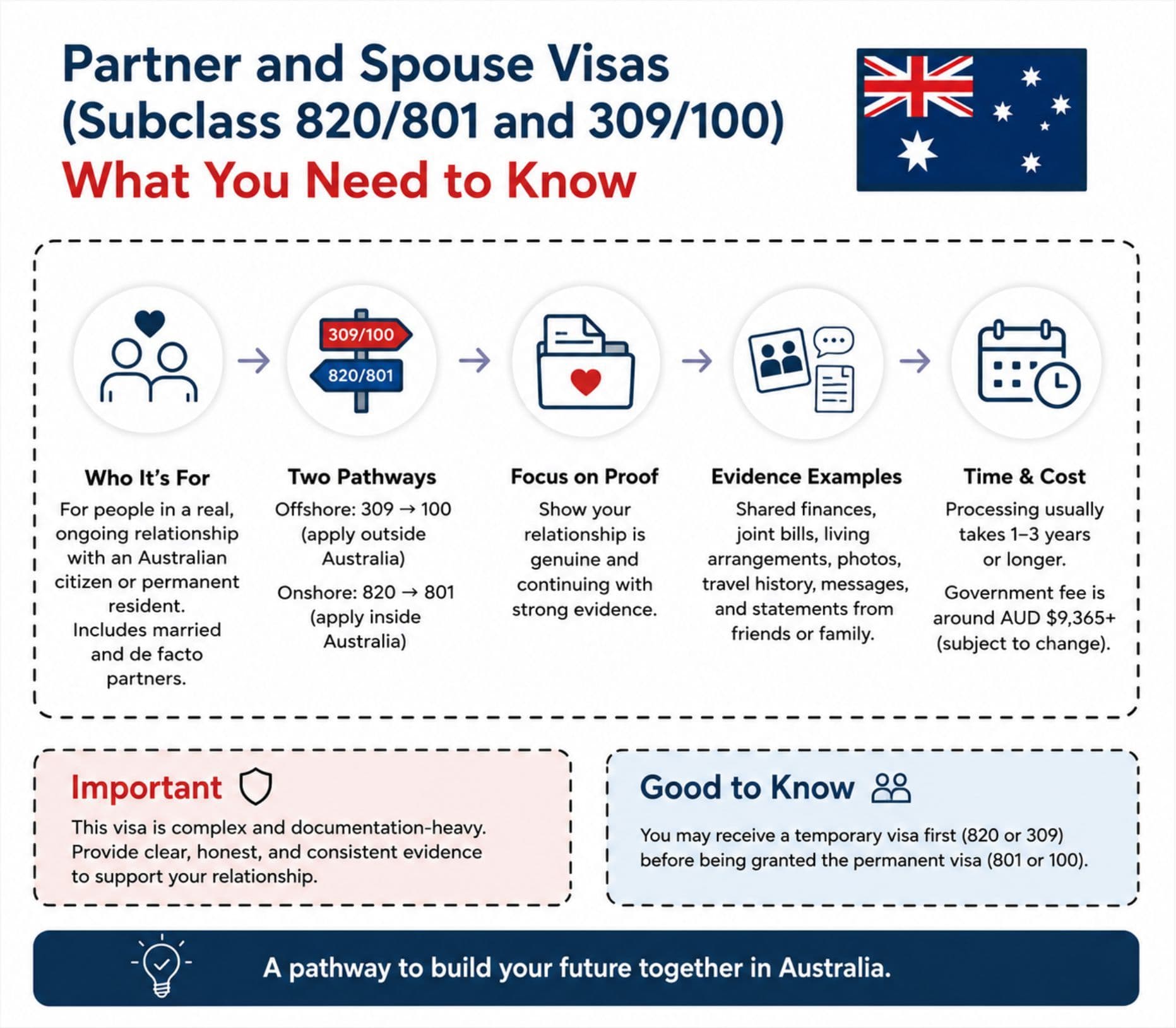
The Partner visa is for people who are in a real, ongoing relationship with an Australian citizen or permanent resident. This includes both married couples and de facto partners. There are two main pathways. The offshore visa (subclass 309 leading to 100) is for people applying from outside Australia. The onshore visa (subclass 820 leading to 801) is for people already living in Australia.
This visa is heavily focused on proof. You must clearly show that your relationship is genuine and continuing. This usually includes shared bank accounts, joint bills, living arrangements, photos over time, travel history together, messages, and written statements from friends or family who know your relationship.The process is detailed and takes time. Most applications take around 1 to 3 years or longer to fully process. The government fee is also high, usually around AUD $9,365 or more depending on updates.Parent VisasParent visas are for people whose children are Australian citizens or permanent residents. These visas allow parents to move to Australia, but they are extremely slow and highly regulated. The standard parent visa has very long waiting times, often 20 to 30 years due to limited places and high demand. This makes it unrealistic for most people.There is a faster option called the contributory parent visa. This version moves through the system more quickly, usually in several years, but the cost is very high and can exceed AUD $48,000 for one applicant. To qualify, you must show a genuine parent-child relationship and meet financial and eligibility requirements. For most families, the contributory visa is the only practical option if they want to move within a reasonable timeframe.Global Talent Visa - Subclass 858The Global Talent visa is designed for highly skilled individuals who are recognised internationally in their field. It is aimed at people working in industries like technology, science, engineering, finance, advanced manufacturing, health, and creative sectors.To apply, you must first secure an endorsement from an eligible Australian organisation or a prominent Australian citizen in your field. This endorsement step is what stops most GTI applications before they start. Reaching out directly to Australian research institutions, professional peak bodies, or industry organisations in your field is the typical route to securing an endorsement. Unlike other visas, there is no points test. Instead, you must show strong evidence of your achievements, such as awards, leadership roles, major projects, publications, or global recognition in your industry. This visa is fast-tracked compared to most other pathways and can lead directly to permanent residency. It is highly competitive and is intended for people at the top level of their profession.Retirement Visas - Subclass 405 and 410Australia does not offer a simple or open retirement visa like some other countries. The existing retirement visa options are very limited. They are generally only available to people who are older (usually 55 and above) and who can show strong financial resources to support themselves without working.These visas are temporary and do not allow employment. They are also being reduced or phased out over time, making them less accessible for new applicants. Because of these limits, most people who want to retire in Australia instead use family-based visas, such as partner or parent visas, if they qualify.Permanent Residency Visa Options for Americans (Overview)
| Visa | Subclass | Sponsor Needed | Points Test | Cost (AUD) | Timeframe |
| Skilled Independent | 189 | No | Yes | ~$4,770+ | 3–18 months |
| Skilled Nominated | 190 | State govt | Yes | ~$4,770+ | 4–18 months |
| Employer Nomination | 186 | Employer | No | ~$4,770+ | 6–18 months |
| Skilled Regional | 491/191 | State/relative | Yes | ~$4,045+ | 3–5 years total |
| Partner Visa | 820/801 | Partner | No | ~$9,365+ | 2–4 years |
| Parent Visa | 143 | Child sponsor | No | $48,000+ | 4–10+ years |
| Global Talent | 858 | No | No | Varies | Weeks to months |
Australia scores everyone and invites the top scorers first. You don't just apply you submit your details, get ranked, and wait to be invited. Higher score means faster invite. Things like your age, work experience, English level, education, and partner skills all add up to a total points score.
You need at least 65 points to submit an Expression of Interest (EOI). But in reality, many jobs are competitive, and successful applicants often need 80–90+ points to receive an invitation.| Factor | Requirement | Points |
| Age | 25–32 years | 30 points (best range) |
| 18–24 years | 25 | |
| 33–39 years | 25 | |
| 40–44 years | 15 | |
| English | Basic level | 0 |
| Good (IELTS 7+) | 10 | |
| High (IELTS 8+) | 20 | |
| Work experience (overseas) | 5–7 years | 10 |
| 8–10 years | 15 | |
| Work experience (Australia) | 3–4 years | 10 |
| 5+ years | 15–20 | |
| Australian study | 2+ years course | 5 |
| Partner skills | Skilled partner | 10 |
| State nomination (190 visa) | Government support | 5 |
| Regional study | Study in regional area | 5 |
| Professional Year | Approved industry program | 5 |
What This Really Means
The system is competitive, not automatic. For example, a typical American skilled worker (like a software engineer) might score:When people start looking into Australian skilled migration, they usually focus on things like points scores, state nomination, or how long visas take to process. These are important, but they come later in the process. The very first and most important step is the skills assessment. This step decides whether you are even allowed to continue with your visa application.
Without a positive skills assessment, you cannot:What the assessment actually checks is your daily job duties against Australia's ANZSCO occupation classification system. Not your job title, not your years of experience. They assess what you actually did, every day, and whether those tasks match what Australia says the job involves.
Australia uses a system called ANZSCO (Australian and New Zealand Standard Classification of Occupations). This system lists all jobs and breaks them down into detailed tasks and responsibilities.So instead of only looking at your job title or how many years you worked, the assessor checks:Each occupation is checked by a specific authority. You must apply to the correct one, or your application may be refused or delayed.
Here are the main assessing bodies:There are two main things that assessors review:
1. Your EducationThey check if your degree or qualification is equal to Australian standards. For example, a 4-year bachelor’s degree from the USA is usually acceptable, but it must be related to your nominated occupation.2. Your Work ExperienceThis is the most important part of the assessment. Assessors do not just read your job title. They carefully check your actual daily work tasks. Your experience must clearly match the tasks listed under your ANZSCO occupation.For example:How Long Does the Skills Assessment Take & Why You Should Start Early
Processing times depend on the authority and your case: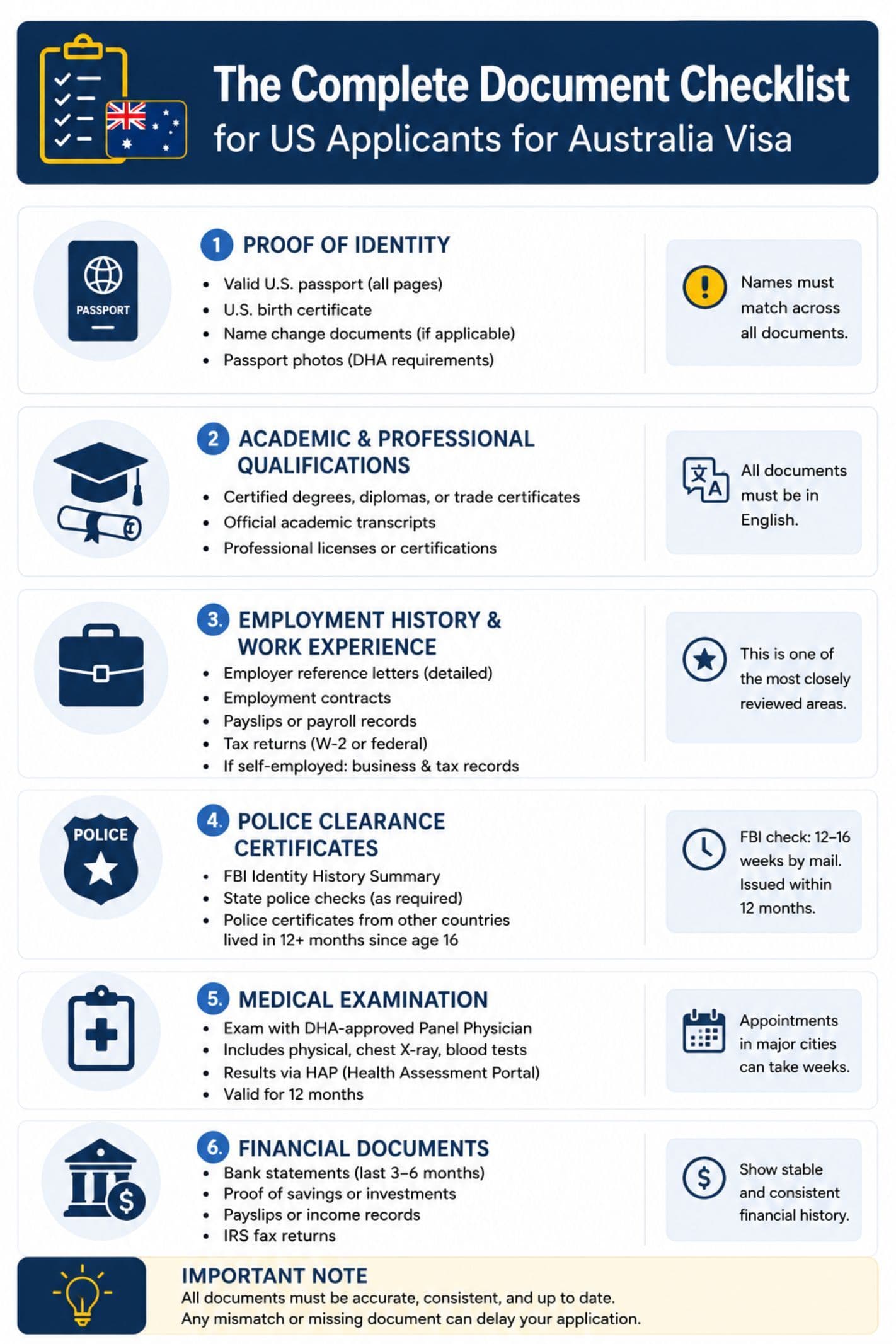
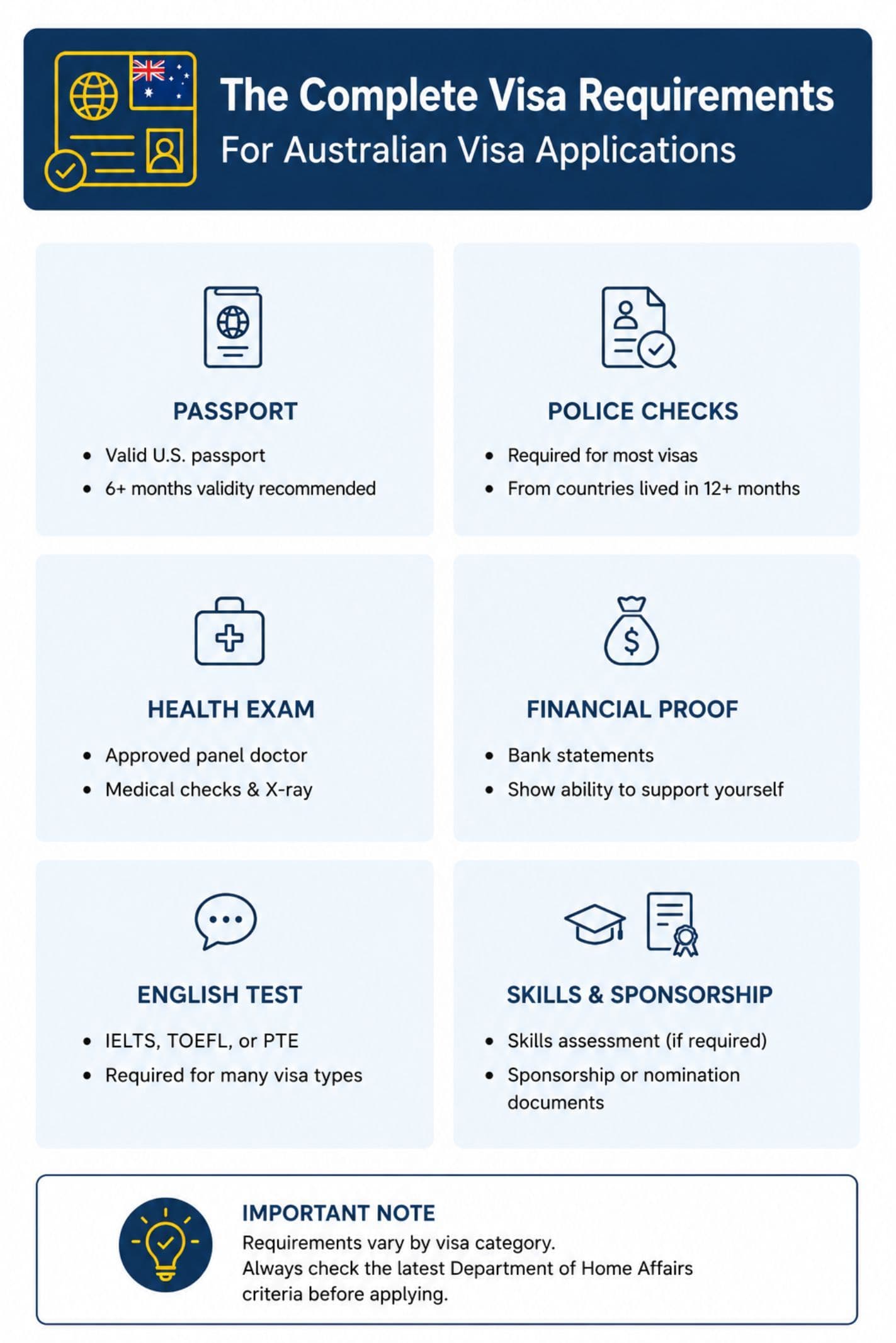
Having the documents isn't enough they all need to match each other. One name spelled differently across two forms can hold your whole application up. In many cases, this leads to requests for additional information, which can add weeks to processing times.
Your passport is the main identity document for your entire application. You must submit all pages, not just the photo page, as immigration officers review travel history, entry and exit stamps, and previous visas as part of identity and character checks.
You will need:Australian assessing authorities review your qualifications based on two main factors: the level of education and how relevant it is to your occupation. The reputation of your university does not matter. A degree from a small college and a top university are treated the same if they meet the required standard.
You will need:This is one of the most closely reviewed parts of your application. The way your work experience is described can determine whether your skills assessment is approved or refused, regardless of how strong your career is.
You should prepare:Australia has strict character requirements, and police checks are required for all applicants. US applicants often need more than they expect.
You will need:All applicants must complete a medical exam through an Australian government-approved Panel Physician. You cannot use your regular doctor.
The medical exam usually includes:Financial documents are mainly required for student and temporary visas, but they may sometimes be requested for skilled migration applications.
You may need:| Document | Purpose | Key Requirement |
| US Passport | Identity - all visa types | Full document, all pages |
| Birth Certificate | Identity verification | State vital records office |
| Degree / Diploma | Education assessment | Certified copy |
| Academic Transcripts | Education assessment | All subjects and grades |
| Employer Reference Letters | Work experience - skilled visas | ANZSCO-aligned duties, specific detail |
| FBI Identity History Summary | Character clearance | Within 12 months; order early |
| State Police Checks | Character clearance | Depends on residence history |
| International Police Certificates | Character clearance | Required for 12+ months abroad |
| Medical Exam (HAP) | Health requirement | Approved Panel Physician only |
| Bank Statements | Financial verification | 3–6 months, consistent history |
| IRS Returns / W-2s | Income and employment verification | Multiple years may be requested |
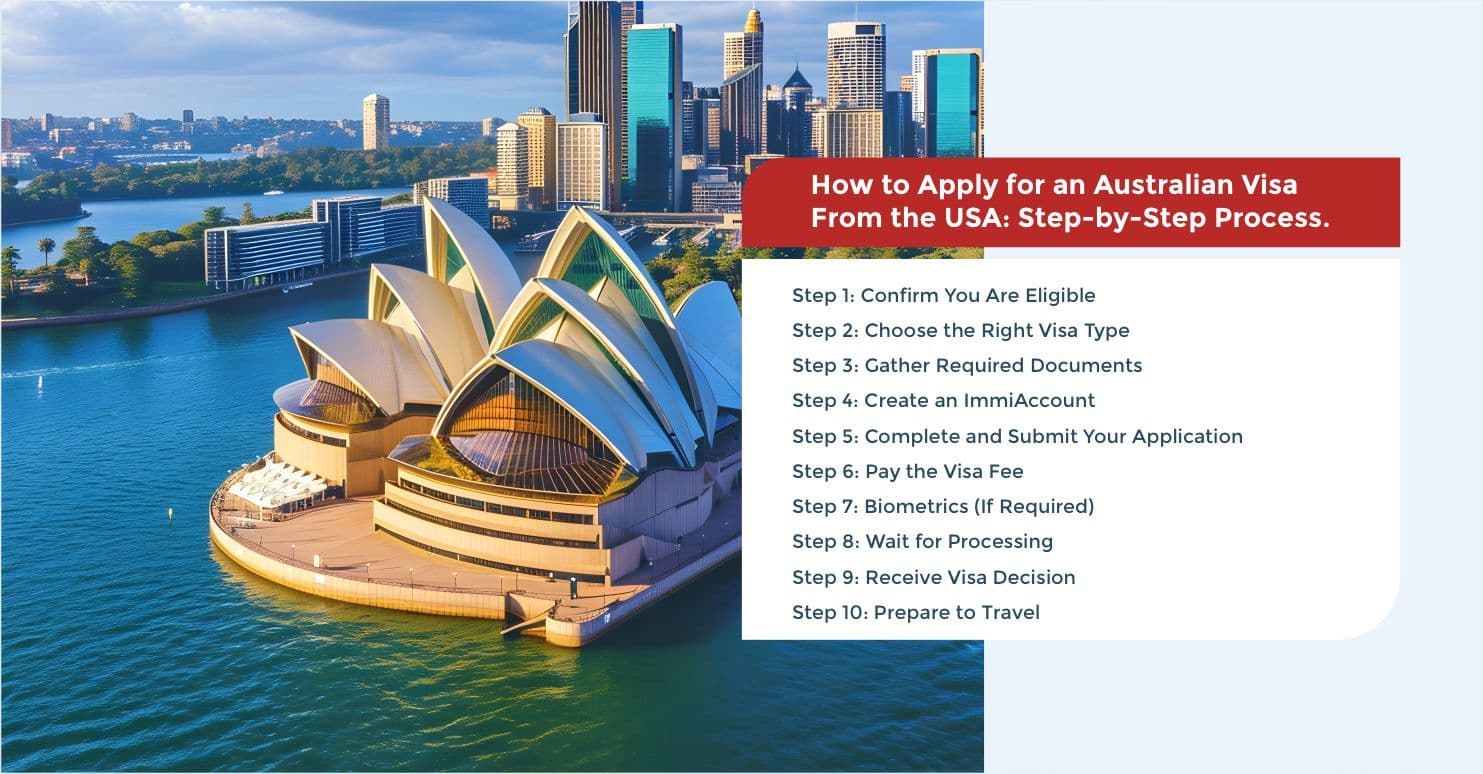
Getting an Australian visa from the United States is a structured process managed by the Department of Home Affairs. Everything is done through official systems, and following each step correctly helps avoid delays or refusals. You should not book flights or make travel plans until your visa is granted, as approval is never guaranteed.
Before anything else, check if you're actually eligible. Some visas also require proof of financial stability, especially for students and workers. If you have a criminal record or previous visa refusal, your application may need extra documents or a different visa pathway.
Australia offers many visa options, so selecting the correct one is essential. A Visitor Visa (subclass 600) is for tourism and short stays, while eligible US citizens may also use the ETA app for quick visits. Work visas like subclass 482 are for people with job offers in Australia. Skilled migration visas (189, 190, 491) are for applicants with in-demand skills and work experience, and are based on a points system. Student visas (subclass 500) allow you to study in Australia, while partner visas (820/801) are for those in relationships with Australian citizens or residents. Choosing the wrong visa can delay or affect your application.
Once you know your visa type, you must collect all supporting documents before applying. These usually include your passport, recent photos, bank statements, employment records, education certificates, English test results, and police clearances. Some visas may require additional documents like job offers or sponsorship letters. All documents must be clear, accurate, and in the correct format, usually PDF or JPEG, to avoid delays during processing.
All Australian visa applications are submitted online through ImmiAccount, the official Department of Home Affairs portal. You must create a free account using your personal details and email address. Once set up, you can start your application, upload documents, and track your progress. This system is also used for official communication, including requests for extra information and visa decisions.
After logging into ImmiAccount, you fill out your visa application with accurate personal, travel, work, and education details .Answer everything honestly. Lying on an Australian visa application is taken seriously; it can get you refused and banned. Check everything twice before you submit.
Each visa has its own application fee, which must be paid before submission or during the application process. Fees vary depending on the visa type, such as visitor, student, work, or partner visas. Payment is made online using a credit or debit card, and you will receive a receipt confirming payment. Keeping this receipt is important for your records.
Some applicants are asked to provide biometrics, which include fingerprints and a digital photograph. If required, you will receive instructions on where and how to complete this step. Biometrics are used to confirm identity and support background checks. Not all applicants need to complete this step, but if requested, it should be done as soon as possible.
After submission, your application enters the processing stage. Timeframes vary depending on the visa type and individual circumstances. During this period, the Department may request additional documents or clarification. Check your ImmiAccount regularly. If they ask for something and you go quiet, your application stalls.
If your application is approved, you will receive a visa grant notice. This document explains your visa type, conditions, validity period, and travel rights. Australian visas are electronic and linked directly to your passport, so no physical label or stamp is issued. If refused, you will receive reasons for the decision and possible next steps.
Once your visa is granted, you can prepare for your move to Australia. This includes arranging accommodation, booking flights, and organizing essentials like a Tax File Number, bank account, and mobile SIM card. Some visas also allow access to Medicare. It is important to understand your visa conditions before arriving to ensure a smooth transition into Austral.
Australia offers very different lifestyles depending on where you live. Cost of living, job opportunities, weather, and daily pace can change a lot from city to city. Choosing the right place early makes a huge difference in how easy your move feels.
Sydney is expensive, loud, and a little bit exhausting and for a lot of Americans, that's exactly why it feels like home. The CBD grinds like New York with better weather. Finance, tech, and media money concentrates here, and if you're chasing a corporate career or trying to break into an international firm's APAC office, you'll find more doors here than anywhere else in the country. Bondi is genuinely as good as it looks in photos. The rent isn't. A one-bedroom in Surry Hills runs $600–$750 a week, and landlords aren't apologetic about it.
The trade-off is the cost of living in Sydney, which is the highest in Australia. Rent, housing, and daily expenses are expensive, especially close to the city center. Many newcomers feel this immediately. What makes it worth it for many people is the lifestyle. You get world-famous beaches like Bondi and Manly, a beautiful harbor, and a strong social scene. It’s one of the few cities where you can combine a serious career with outdoor living.Best for: Career-focused professionals, tech and finance jobs, expatsNot ideal if: You want affordability, space, or a quieter lifestylePopular areas: Bondi Junction, Manly, Mosman, Surry Hills, Newtown, CoogeeMelbourne is often seen as Australia’s cultural capital. It’s known for coffee, food, art, music, and sports. Many Americans who compare Sydney vs Melbourne end up preferring Melbourne for its lifestyle and atmosphere.
It also ranked among the most liveable cities globally, which reflects its strong quality of life.Job opportunities are solid across healthcare, education, finance, and creative industries. Housing is still expensive, but more affordable than Sydney. Rent and home prices are slightly lower, making it a more balanced option.The one thing to be aware of is the weather. Melbourne is famous for unpredictable conditions you can experience sunshine, rain, and wind all in one day. Winters can feel cold and grey, while summers can get very hot.Best for: Families, creatives, food lovers, healthcare and education workersNot ideal if: You want consistent warm weatherPopular areas: Fitzroy, St Kilda, Richmond, South Yarra, Northcote, BrunswickBrisbane is quickly becoming one of the best places to live in Australia. It’s growing fast, especially with the upcoming 2032 Olympics, which is driving new infrastructure and job opportunities. The city has a warm, subtropical climate, meaning plenty of sunshine and outdoor living year-round. Compared to Sydney and Melbourne, Brisbane is more affordable, especially for housing.
Job opportunities are strong in IT, banking, healthcare, and construction. It’s also close to popular destinations like the Gold Coast and Sunshine Coast, both about an hour away.Brisbane used to be seen as a slower-paced city, but it has developed into a modern, vibrant place with great restaurants and lifestyle options.Best for: Families, remote workers, professionals seeking affordability and lifestyleNot ideal if: You want a fast-paced global city like SydneyBig advantage: Lower cost of living + strong future growthPerth is one of the most isolated major cities in the world, which can be either a benefit or a drawback depending on your priorities. It’s far from other Australian cities, so travel can take time and planning.
However, this isolation has helped Perth build a strong local economy and community. It’s especially strong in mining, engineering, and natural resources, with some of the highest salaries in Australia in those sectors.Cost of living is lower than Sydney, and housing is more affordable. The city is also known for safety, clean environments, and access to beaches and nature.Best for: Engineers, mining professionals, families wanting space and safetyNot ideal if: You want easy travel between cities or frequent international tripsLifestyle highlight: Beaches, outdoor living, less stressAdelaide is often overlooked, but it offers one of the best quality-of-life experiences in Australia, especially for families. It’s more affordable than most major cities, with less traffic and a slower pace of life. Day-to-day living is simple and manageable, which many people appreciate after living in larger cities.
Adelaide has strong industries in healthcare and defense, along with growing food and wine culture. It’s also close to famous wine regions like Barossa Valley and McLaren Vale. The city hosts major events like the Adelaide Fringe, giving it a lively cultural side without the chaos of bigger cities.Best for: Families, retirees, budget-conscious moversNot ideal if: You want a fast-paced, big-city career environmentBig advantage: Lower costs + high quality of lifeIf your main goal is lifestyle, beaches, and a relaxed pace, these coastal areas are strong options. The Gold Coast is a large, growing city with over 700,000 people and expanding job opportunities in tourism, healthcare, and tech. The Sunshine Coast is quieter but growing quickly as well.
Housing is more affordable than in Brisbane for similar properties, and the lifestyle is hard to beat beaches, outdoor activities, and warm weather all year. The main trade-off is job availability. Some industries are less developed here, so this option works best if you have a remote job or flexible income.Best for: Remote workers, entrepreneurs, lifestyle-focused moversNot ideal if: You rely on a traditional corporate job marketLifestyle highlight: Beach living, outdoor lifestyle, less pressureHousing will likely be your largest expense and one of the more challenging parts of settling in Australia. Here’s what Americans need to know about renting and buying.
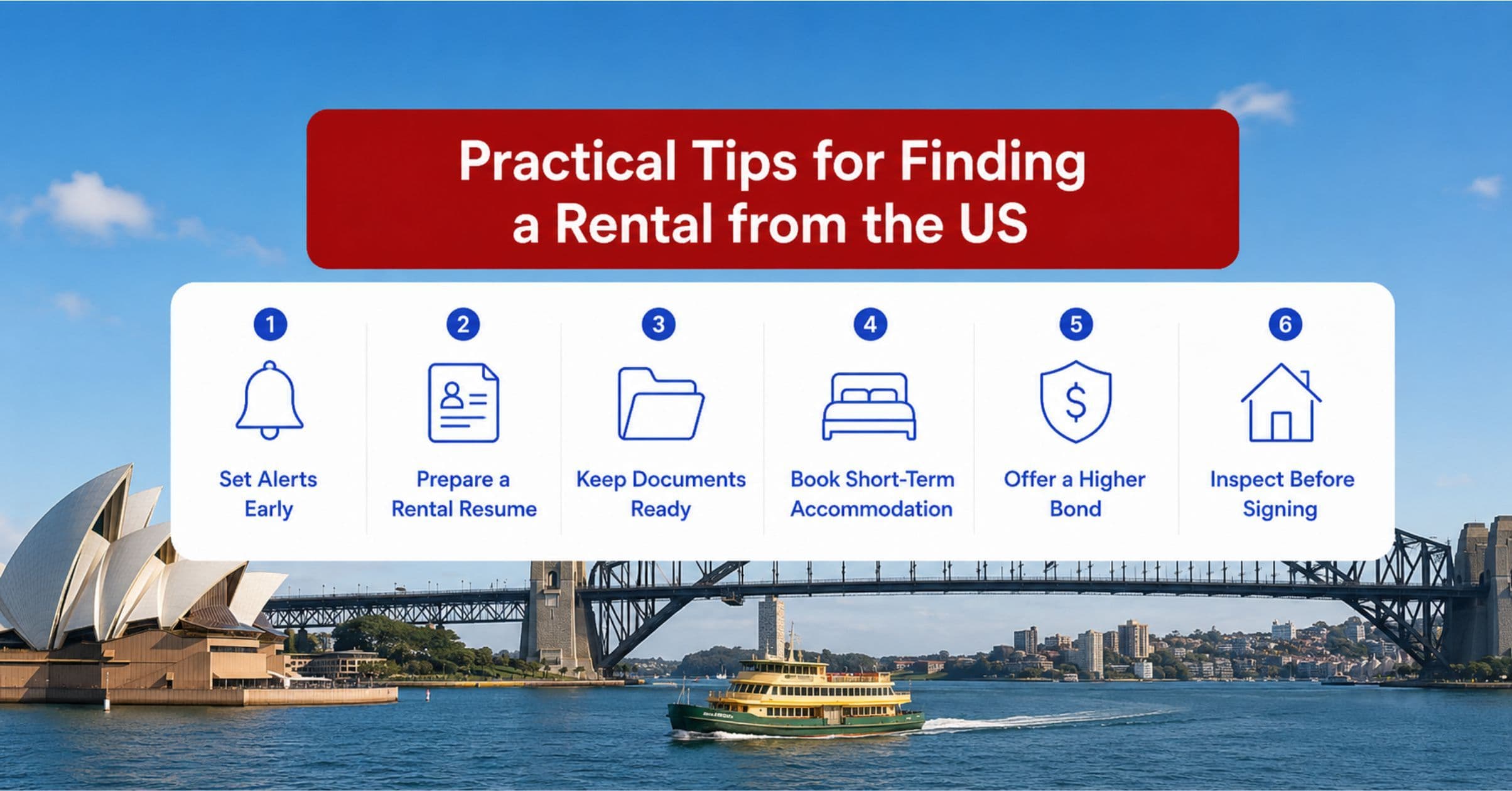
Moving to Australia from USA begin with renting, and that’s usually the right approach. Rentals are often unfurnished, which means essentials like a couch, bed, and sometimes even a fridge are not included. Lease terms are 6 or 12 months.
A standard bond (security deposit) is around four weeks’ rent. It is held by a state bond authority rather than the landlord, which provides legal protection. Rental markets in major cities are highly competitive. According to Domain’s September 2025 Rental Report, Sydney’s average weekly rent is $750 for units and $780 for houses, both record highs. Vacancy rates remain low across most capitals, and it’s common for multiple applicants to compete for the same property.Applications are assessed based on several factors: proof of income (usually at least three times the weekly rent), rental history, employment stability, and overall presentation. The main platforms for listings are Domain.com.au and Realestate.com.au. Nearly all available rentals are listed there, and applications are increasingly submitted online before inspections, which can be useful if you’re still overseas.Practical tips for finding a rental from the USAustralia has one of the least affordable housing markets in the world. PropTrack data shows affordability hit record lows in late 2024, with only 14% of median-income households able to afford a home, dropping to 10% in Sydney. It now takes the average Australian about 11 years to save a 20% deposit, and longer in Sydney.
For Americans, purchasing property depends heavily on visa status and foreign investment rules.Permanent residentsPermanent residents (including visas such as 189, 190, 186, 801, and 100) can buy property on similar terms to Australian citizens. They do not need Foreign Investment Review Board (FIRB) approval for a primary residence.Temporary residents and non-residentsTemporary visa holders and non-residents must apply for FIRB approval before purchasing residential property. Fees start at AUD $13,200 for properties up to $1 million (2025 schedule) and increase with property value. Temporary residents are limited to buying new dwellings or vacant land, rather than established homes.2025–2027 foreign buyer banFrom April 1, 2025 to March 31, 2027, foreign buyers, including most temporary residents, are not allowed to purchase established homes. The policy aims to ease pressure on housing availability for residents and first-home buyers.New dwellings and vacant land remain available with FIRB approval during this period, with some exceptions depending on visa type and property category.Key Property Market Figures
| City | Median House Price |
| Sydney | ~$1.4–$1.72 million |
| Melbourne | ~$800,000–$950,000 |
| Brisbane | ~$625,000–$850,000 |
| Perth | ~$700,000–$800,000 |
| Adelaide | ~$780,000–$830,000 |
| Hobart | Most affordable major capital |
Getting a mortgage as an American in Australia is possible, but comes with stricter requirements. Lenders do not consider your US credit history, instead they focus on your Australian credit file, income, visa status, and deposit size.
Most banks require at least a 20% deposit for expats without established Australian credit. Citizens and long-term residents with strong credit may qualify with smaller deposits. A stable employment history and at least two years of Australian tax returns significantly improve approval chances.FIRB approval is required before exchanging contracts for temporary residents, and processing takes around 30 days, which should be factored into any purchase timeline.The cost of living in Australia is broadly similar to the United States, but it varies a lot depending on where you’re coming from and where you settle.
If you’re moving from high-cost US cities like New York, San Francisco, or Boston, Australia may feel roughly comparable in overall lifestyle cost. If you’re coming from lower-cost US regions, major Australian cities will likely feel more expensive, especially for housing.Housing is usually the biggest expense in Australia. In Sydney and Melbourne, rent is high by global standards. A one-bedroom apartment in a central area ranges from AUD $2,400 to $3,800 per month. Family homes in good suburbs often go above AUD $4,000 per month in Sydney.
Cities like Adelaide and Hobart are generally more affordable, with noticeably lower rent and less housing pressure.Daily living costs are steady but slightly higher in some areas compared to the US. Groceries are a bit more expensive overall, especially fresh produce and meat. A single person usually spends around AUD $400–$600 per month on food.
Eating out also adds up quickly. A casual meal is about AUD $20–$30, while a dinner for two at a mid-range restaurant can easily reach AUD $100 or more in major cities.Public transport is widely used in cities like Sydney and Melbourne and is generally reliable, though not cheap. Monthly transport costs in Sydney are around AUD $250.
Utilities such as electricity, water, and gas usually range between AUD $200 and $340 per month for a standard apartment. Internet and mobile plans are fairly close to US pricing.| City | Single Person (incl. rent) | Family of 4 (incl. rent) | 1BR Rent | 3BR Rent |
| Sydney | AUD $3,000–$4,500 | AUD $8,000–$12,000 | $2,400–$3,800 | $5,000+ |
| Melbourne | AUD $2,700–$4,200 | AUD $7,000–$11,000 | $2,200–$3,500 | $3,500–$4,200 |
| Brisbane | AUD $2,500–$3,800 | AUD $6,500–$10,000 | $2,200–$3,200 | $3,200–$4,000 |
| Perth | AUD $2,600–$3,900 | AUD $6,800–$10,200 | $2,100–$3,000 | $3,000–$3,800 |
| Adelaide | AUD $2,300–$3,500 | AUD $6,000–$9,500 | $1,800–$2,200 | $2,400–$3,200 |
| Hobart | AUD $2,000–$3,200 | AUD $5,000–$8,000 | $1,600–$1,900 | ~$2,081 |
A realistic comfortable budget in a major Australian city looks like this:
The job market is solid. But Australian employers care a lot about local experience and local references, a strong US resume won't automatically open doors. Budget 3–6 months for your job search.
According to the Australian Bureau of Statistics, the unemployment rate was 4.1% in April 2025, with employment at 64.4% and underemployment at 6.0%. The labour force sits at roughly 14.6 million people. These figures point to a stable and active job market.
The national minimum wage is AUD $24.95 per hour as of July 1, 2025, which is significantly higher than the US federal minimum. Salaries in skilled professions are broadly competitive with mid-tier US cities. While top-end US salaries in cities like New York or San Francisco may be higher, Australia offsets this with mandatory superannuation, paid leave, and universal healthcare access for eligible residents, which changes the overall compensation picture.Australia’s migration system is designed to address workforce shortages, with occupations listed on the Core Skills Occupation List (CSOL) and Specialist Occupation List offering clearer visa pathways.
HealthcareThere is strong demand for registered nurses, general practitioners, specialists, physiotherapists, pharmacists, mental health professionals, and aged care workers. Nursing roles require registration with AHPRA (Australian Health Practitioner Regulation Agency), which involves assessment of qualifications but is generally achievable for US-trained nurses.TechnologySoftware engineers, cybersecurity specialists, data scientists, cloud engineers, DevOps professionals, AI/ML engineers, and IT project managers are in high demand. Sydney is the largest tech hub, followed closely by Melbourne, with Brisbane growing quickly as well.EngineeringCivil, structural, mechanical, electrical, mining, and chemical engineers remain consistently in demand, along with construction managers. Ongoing infrastructure investment across Australia continues to support these roles.EducationPrimary and secondary teachers, along with early childhood educators, are needed across the country, especially in regional areas. US qualifications require assessment and some additional Australian-specific training.TradesElectricians, plumbers, carpenters, automotive technicians, and construction workers are in steady demand. Most trades require local licensing or skills assessment through state authorities before you can work.Many Americans secure work before arriving, often through employer sponsorship or roles aligned with visa pathways such as the 482 visa.
| Occupation | Typical Salary (AUD) | Approx. USD |
| Software Engineer (mid-level) | $100,000–$160,000 | $62,500–$100,000 |
| Software Engineer (senior) | $150,000–$220,000 | $93,750–$137,500 |
| Registered Nurse | $75,000–$110,000 | $46,875–$68,750 |
| General Practitioner | $200,000–$400,000+ | $125,000–$250,000+ |
| Civil/Structural Engineer | $95,000–$160,000 | $59,375–$100,000 |
| Financial Analyst | $90,000–$140,000 | $56,250–$87,500 |
| Teacher (secondary) | $75,000–$105,000 | $46,875–$65,625 |
| Marketing Manager | $100,000–$150,000 | $62,500–$93,750 |
| Accountant | $80,000–$140,000 | $50,000–$87,500 |
| Mining Engineer | $130,000–$220,000 | $81,250–$137,500 |
Figures reflect major cities in 2025 and vary by experience and industry. Remote mining roles often pay an additional AUD $15,000–$25,000 or more. Exchange rate is approximately 0.625 USD.
Apply for your Tax File Number (TFN) as soon as you land. Without one, your employer has to tax you at 47%. It takes about a week to come through.
You should apply through the Australian Tax Office (ATO) as soon as you arrive, and in some cases it can be arranged before departure. With it, you are taxed according to standard income brackets. Delaying this creates unnecessary deductions from your pay.Working remotely in Australia for a US employer is possible, but it is not straightforward and depends on visa and tax rules. Most short-term visas, such as tourist visas and the ETA, do not allow any work in Australia, even if the employer is based overseas. Some long-term visas, such as skilled visas (189, 190, 485), generally allow full work rights, including remote work for overseas employers.
If you stay in Australia long enough, you may become an Australian tax resident, meaning you could be required to pay Australian tax in addition to US tax obligations. Australia applies a multi-factor tax residency test, though spending around 183 days in the country is often used as a general guideline.There are also employer-side risks. In some cases, if an employee works from Australia in a way that creates a “permanent establishment”, the US employer may become subject to Australian corporate tax obligations. This is a real compliance issue that can affect whether companies allow long-term remote work arrangements. Because of these legal and tax complexities, it is important to carefully check your visa conditions and consult both your employer’s HR or legal team and a cross-border tax professional before relying on remote work in Australia.Australia has its own retirement system called superannuation. Employers must contribute 12% of your earnings into your superannuation fund. This rate has been in effect since 1 July 2025 and applies for the full 2025–26 financial year. These contributions happen pre-tax up to the concessional cap, and withdrawals become tax-free once you reach preservation age.
Your preservation age ranges between 55 and 60 based on your birth year. You cannot access your super before this age unless you meet specific conditions. These include terminal illness, severe financial hardship, temporary resident status, lost or unclaimed super balances below the ATO threshold (currently AUD $6,000), or compassionate grounds. Illegal early access schemes exist and trigger severe penalties.But the IRS creates complications Americans don't expect. US tax authorities don't recognize Australian superannuation as a qualified retirement plan. This means contributions and growth may be taxable income for US purposes even though Australia taxes the fund itself at 15%. FBAR applies if your total foreign accounts exceed USD $10,000 at any point during the year.Temporary residents leaving Australia can claim their super as a Departing Australia Superannuation Payment after your visa expires, though you must submit the claim after leaving the country. New Zealand citizens don't qualify for DASP. Cross-border tax specialists are essential for managing this dual-country retirement complexity.Important for Americans: US citizens pay a 65% tax on the taxable part of their DASP payment, instead of the usual 35%. The US–Australia tax treaty does not reduce this. This makes DASP less tax-efficient for US citizens, so it’s best to get tax advice before applying.Moving to Australia from US doesn't end your US tax obligation. The US taxes you on your worldwide income, no matter where you live. You'll file two tax returns every year one for each country.
Australia's tax year runs from July 1 to June 30 not the calendar year like in the US. Tax returns are due by October 31 following the end of the tax year, or later if you use a registered tax agent. The Australian Taxation Office (ATO) manages all tax collection. Australian residents for tax purposes are taxed on worldwide income at the following 2025–26 rates:
Australian Resident Tax (2025–26)| Income range | Tax on this income |
| $0 – $18,200 | No tax |
| $18,201 – $45,000 | 16% over $18,200 |
| $45,001 – $135,000 | $4,288 + 30% over $45,000 |
| $135,001 – $190,000 | $31,288 + 37% over $135,000 |
| $190,001+ | $51,638 + 45% over $190,000 |
Foreign Resident Tax (2025–26)
| Income range | Tax rate (simple) |
| $0 – $135,000 | 30% |
| $135,001 – $190,000 | 37% + fixed base ($40,500) |
| $190,001+ | 45% + fixed base ($60,850) |
Am I an Australian Tax Resident?
Yes, you can become an Australian resident for tax purposes without having permanent residency. Generally, if you live in Australia for more than 6 months continuously, you are likely to be treated as a tax resident by the ATO. The domicile test, the 183-day test, and the superannuation test are all ways the ATO determines residency. Once deemed a tax resident, you are taxed on your worldwide income including any US income, investment income, or rental income from US properties.You also need to comply with reporting rules like FBAR (Foreign Bank Account Report) and FATCA (Foreign Account Tax Compliance Act). These are not optional and are often missed by people who move abroad.The penalties for not complying can be severe. FBAR penalties alone can reach up to $10,000 per account per year for non-willful violations, and much higher for willful cases potentially the greater of $100,000 or 50% of the account balance per year.The US–Australia tax treaty is designed to reduce double taxation. In practice, most Americans in Australia rely on the Foreign Tax Credit (FTC). This means you pay tax in Australia first, then claim a credit on your US return for taxes already paid. Because Australian tax rates are often similar to or higher than US rates, this often reduces or eliminates US tax owed.
The difficulty comes from how different the two systems are. The tax years do not align (Australia runs July–June, the US runs January–December), and certain financial structures are treated very differently. For example, Australian superannuation is not treated the same way as US retirement accounts. Investment income and capital gains are also reported on different timelines, which can create mismatches.PFIC Rules - A Common Problem for InvestorsOne of the biggest issues for Americans in Australia is the US treatment of Passive Foreign Investment Companies (PFICs). Many common Australian investments including managed funds and ETFs, fall into this category under US tax law.The result is complicated reporting, higher tax rates on gains, and additional paperwork. In some cases, the compliance cost is higher than the return itself. This can make standard Australian investment options inefficient for US citizens.What This Means in PracticeMost Americans in Australia need two separate tax professionals: one for US tax filing and one for Australian tax obligations. The systems operate independently but still overlap in important ways.US expat tax specialists handle FBAR, FATCA, FTC calculations, and PFIC reporting. Costs usually range from about $1,500 to $5,000 per year, depending on complexity. On the Australian side, a registered tax agent handles local filings.This dual system is one of the most common frustrations for Americans living long-term in Australia, both in terms of cost and ongoing administrative work.Citizenship Decisions and Long-Term ConsiderationsSome Americans eventually choose to renounce US citizenship after becoming Australian citizens, mainly to avoid ongoing tax filing obligations. This is a serious and irreversible decision. It also comes with a fee (currently around USD $2,350) and may trigger an exit tax depending on assets. It is not a step to take lightly and usually requires detailed financial planning.Superannuation is another area of uncertainty. The US does not clearly align it with standard retirement accounts under the tax treaty. As a result, the treatment of contributions and investment earnings can be complex.
In simple words, some tax professionals treat contributions and growth as deferred under treaty interpretations, but this is not fully settled in US tax law. Because of this, reporting approaches tend to be cautious and conservative.Superannuation withdrawals in retirement may also be taxed in the US as ordinary income, which can create mismatches between the two systems.Failing to meet US tax obligations can lead to serious consequences. These include ongoing penalties, complications with passport renewal under IRS compliance rules, and potential issues when dealing with visas or financial accounts.
Even if you owe nothing, you still have to file. Skip it and the fines stack up and the IRS can block your passport renewal. A zero-liability return still counts as compliance, and that alone can prevent most penalties.Healthcare is one of the most significant differences Americans experience when moving to Australia from US. Understanding how the system works and what you get to at each visa stage is essential.
Medicare is Australia's public healthcare system, funded through a combination of general taxation and a Medicare Levy (2% of taxable income for most residents). It covers the large majority of costs for GP visits, specialist consultations, hospital treatment as a public patient, pathology tests, and certain imaging and diagnostic procedures. For most services, patients pay nothing or a small gap between the Medicare rebate and the doctor's actual fee.
Permanent residents are eligible to enroll in Medicare immediately upon receiving their PR visa. Enroll at a Services Australia (Centrelink) office with your passport and visa documentation.However, temporary visa holders, including 482 visa workers and their families, are generally not eligible for Medicare. Australia does not have a reciprocal healthcare agreement with the United States. This means most Americans in Australia on temporary visas need private health insurance from day one.Private health insurance in Australia covers two distinct categories:
Hospital cover: Private hospital accommodation, choice of doctor, and faster access to elective procedures. Without private cover, as a public patient, you have no choice of specialist and elective surgery wait times can stretch to months or years.Extras cover: Dental, optical, physiotherapy, chiropractic, and other allied health services not covered by Medicare. Even permanent residents often choose extras cover because Medicare does not include these services.| Cover Type | Approx. Monthly Cost |
| Basic hospital cover (single) | AUD $80 – $180 |
| Comprehensive hospital + extras (family) | AUD $250 – $450 |
Australia’s Pharmaceutical Benefits Scheme (PBS) helps reduce the cost of prescription medicines by subsidising most of the price.In 2025, the typical patient costs are:
In Australia, your first point of contact for healthcare is usually a GP (General Practitioner). They act as the main gateway to the system. If you need to see a specialist, you need a referral from a GP first. It’s worth looking for a bulk-billing GP, where the doctor bills Medicare directly and you don’t pay out of pocket. In big cities, these clinics are common, although they can be busy and harder to book quickly. In regional areas, bulk-billing options are more limited.
Dental care for adults is not covered by Medicare. You will need to pay for it yourself or use private health insurance that includes dental coverage.Australia has four major banks the Big Four: Commonwealth Bank (CBA), ANZ, Westpac, and NAB. All four allow account opening before you arrive in Australia. The Commonwealth Bank and ANZ in particular, have streamlined online applications for people relocating internationally. You will need a valid passport, your Australian address or planned address, and in some cases your Tax File Number (which you can apply for separately).
Many Americans open accounts with both a traditional bank and a fintech like Wise or Revolut for the multi-currency flexibility during the transition period.Never use a bank wire transfer as your primary method for moving large amounts of money between the US and Australia. Banks charge AUD $15–$30 per transfer plus use exchange rates that may be 2–3% below the real mid-market rate. On a $50,000 transfer, that is potentially $1,000–$2,000 in hidden losses.
| Service | Typical Fee | Exchange Rate | Best For |
| Wise (TransferWise) | 0.4%–1% | Mid-market rate | Regular transfers, up to $50,000 |
| OFX | No fee (built into rate) | Close to mid-market | Larger transfers $10K+ |
| Western Union | Varies | Varies | Speed when needed |
| US Bank Wire | $25–$45 flat | 1.5–3% below mid-market | Avoid for large transfers |
| FX Broker (large sums) | Negotiable | Best available for $100K+ | Property purchase, large moves |
Your credit score, whether 800 or 580 is invisible to Australian lenders and landlords. You begin building Australian credit from zero on the day you arrive. Australian credit reporting works through Equifax Australia, Illion, and Experian Australia none of which have access to your US credit file.
To build Australian credit quickly: get an Australian credit card (start with a low limit from your bank), pay it in full every month, maintain stable address history, and ensure utilities are in your name. Within 12–18 months, you will have a credit file that lenders can assess. For rental applications, bring printed bank statements and a letter from your US bank confirming your financial history.Keep at least one US bank account open you will need it for IRS refunds, residual US income, and managing any US-based investments or property. Charles Schwab Bank and Capital One 360 are widely used by US expats because they do not charge foreign transaction fees and have no foreign ATM fees. Schwab refunds all ATM fees worldwide.
Update your US bank with your Australian address and explain you are moving overseas. Some banks restrict online account access from foreign IP addresses resolve this before you leave. Consider setting up a VPN for accessing US banking services if needed.The fundamental question is whether to ship your belongings, fly with the most important items and buy the rest in Australia, or some combination. Here is the framework:
Ship if you have: Furniture you love, specialty items that are hard to replace, books, an extensive wardrobe, kitchen equipment, or sentimental items. A 20-foot container ( holds a 2–3 bedroom home's contents) shipped sea freight from Los Angeles to Sydney or Melbourne runs approximately USD $2,600–$3,200 for the freight component alone. Door-to-door service with packing, customs clearance, and delivery can run $6,000–$10,000 or more. Transit times are 4–8 weeks from the US West Coast, 6–10 weeks from the East Coast.Consider buying new if: Your electronics are US-only voltage (110V, whereas Australia uses 230V/50Hz), your furniture is bulky and replaceable, or you are doing a lighter lifestyle move. Everyday furniture, appliances, and household goods are readily available in Australia at comparable prices. IKEA, Harvey Norman, and The Good Guys are the equivalent of big-box furniture and electronics stores.Australia has some of the world's strictest biosecurity rules. Items that are prohibited or require declaration include:
Australia uses 230V/50Hz power with Type I plugs (the angled three-pin plug). The US uses 110V/60Hz. Any US device rated only for 110V will not work safely in Australia without a step-down voltage converter. Modern electronics such as most laptops, phone chargers, and cameras are dual-voltage (100–240V) check the label on the charger or adapter. Appliances like hair dryers and kitchen appliances are not dual-voltage and should be left behind or replaced.
Australia is rabies-free and intends to remain so. The pet import process is strict and time-sensitive. Begin this process at least 6 months before your planned move date some steps have specific timing requirements that cannot be rushed.
Your US driver's license is valid for driving in Australia upon arrival, but only temporarily. How long depends on the state you are living in:
| State / Territory | On a temporary visa | Once you become a permanent resident | Conversion process for US licence holders |
| New South Wales (Sydney) | Must convert within 6 months if intending to reside in NSW for 6+ months | Must convert within 3 months of establishing NSW residency | No knowledge test, no driving test. Attend a Service NSW centre in person with your US licence, passport, and proof of address. |
| Victoria (Melbourne) | Can drive on your US licence for the full duration of your visa | Must convert within 6 months of becoming a Victorian resident | No knowledge test, no driving test. Apply at a VicRoads Customer Service Centre. |
| Queensland (Brisbane) | Can drive on your US licence for the full duration of your visa | Must convert within 3 months of becoming a Queensland resident | No knowledge test, no driving test. Apply at a TMR Customer Service Centre or QGAP office. |
| Western Australia (Perth) | 3 months from arrival in WA, after which you must convert regardless of visa type | Same 3-month rule applies | No knowledge test, no driving test. Apply at a WA Department of Transport centre. |
| South Australia (Adelaide) | Can drive on your US licence for the full duration of your visa | Must convert within 3 months of becoming a South Australian resident | No knowledge test, no driving test. Apply at a Service SA centre. |
If you are moving with children, schooling is one of your most important planning considerations. Australian schools are excellent but operate differently from US schools in several important ways.
Australia's school year runs from late January to mid-December the reverse of the northern hemisphere. There is a long summer break from December to late January. The school system is compulsory from age 5 (or 4 in some states) through to age 17.
Australian state (government/public) schools are free for Australian citizens and permanent residents. School quality varies by location but the average standard is high. State schools are co-educational and follow state-based curriculum frameworks.
Temporary visa holders including 482 visa workers must pay tuition at state schools. Fees range from approximately AUD $5,000–$15,000 per child per year depending on the state and year level.Australia has a robust independent school sector both Catholic systemic schools (which are subsidised and relatively affordable) and elite independent schools. Catholic school fees range from AUD $2,000–$8,000 per year. Elite independent school fees run AUD $25,000–$40,000 or more per year.
Sydney, Melbourne, Brisbane, and Perth each have established international schools often following an International Baccalaureate (IB) curriculum that are popular with expat families. IB schools in Australia charge AUD $20,000–$35,000 per year in tuition.
Australia has 43 universities, of which seven consistently rank in the global top 100. The Group of Eight (Go8) research universities are among the world's most respected institutions:
Australia is close enough in language and general culture to feel manageable, but different enough that every American who moves there gets at least a few genuine surprises. The good news is that they are mostly pleasant ones.
You will understand it all eventually, but the first few weeks can feel like a second language.
| Australian Term | US Equivalent | Notes |
| Thongs | Flip-flops | Do not confuse. Very important at the beach. |
| Arvo | Afternoon | See you this arvo = this afternoon |
| Servo | Gas station | Short for service station |
| Bottle-o | Liquor store | Short for bottle shop |
| Brekky | Breakfast | Standard truncation |
| Barbie | BBQ/grill | The food, not the doll |
| Rego | Vehicle registration | Got my rego renewed |
| Chemist | Pharmacy / drugstore | Where you get prescriptions filled |
| Footpath | Sidewalk | Walking path beside a road |
| Capsicum | Bell pepper | Will cause menu confusion |
| Esky | Cooler / ice chest | Essential for beach days |
| No worries | No problem / You're welcome | Universal Australian response |
| She'll be right | It'll be fine | Optimistic Australian outlook |
| Reckon | Think / Believe | I reckon it'll rain this arvo |
| Flat out | Very busy | Been flat out all week |
| Chockers | Completely full | The train was chockers |
Australia is in the Southern Hemisphere. Seasons are reversed from the US. Different states also have dramatically different climates:
Australians are genuinely warm but take time to open up into real friendship. The first few months can feel lonelier than expected. What actually works:
Many American movers describe the outdoors as the most surprising and sustaining aspect of daily life in Australia. Not just the beaches but the entire relationship with outdoor space. National parks within 90 minutes of every capital city. World-class surfing. Hiking. Wine regions. Desert stargazing. The Great Barrier Reef. The Kimberley. Uluru. The Blue Mountains.
Australians have a deep cultural relationship with outdoor space and weekend adventures that shapes daily life in ways that feel different from most American cities. For many Americans who move there, this becomes one of the most important aspects of their contentment.Most Americans who move to Australia do not just want to visit for a year. They want to stay. Here is what it takes to make Australia your permanent home.
Australian Permanent Residency (PR) is not citizenship, but it is close to it in most practical ways. As a permanent resident you can:
After receiving PR, the pathway to citizenship involves:
Australia does not require you to renounce your US citizenship to become an Australian citizen. You can hold both passports simultaneously. In practice, tens of thousands of Americans hold dual US-Australian citizenship without issue. An Australian passport provides visa-free or visa-on-arrival access to 185 or more countries.
Realistic Timeline - From Decision to Citizenship
| Pathway | Visa to PR | PR to Citizenship Eligible | Total Estimated Timeline |
| Skilled Independent (189) | Immediate on grant | 4 years after first lawful entry | 5–7 years (incl. SkillSelect wait) |
| 482 to 186 (Employer) | 2–3 years | 4 years from first lawful entry | 5–8 years |
| Partner (820 to 801) | 2–4 years | 4 years from first lawful entry | 5–8 years |
| Working Holiday then skilled | Varies | Depends on next visa | 6–10 years |
Treating the move as temporary
Moving to Australia isn’t something you can easily undo. Between visa fees, rental deposits, shipping, and time spent settling in, the costs add up quickly. People who approach it as a short trial often underestimate how hard it is to reverse. It’s better to plan as if you’re staying longer, even if you’re unsure.Expecting an easy job searchStrong US experience helps, but it doesn’t guarantee quick results. Employers often look for local experience and references, and it can take time to build both. Many people need three to six months to secure a role, especially in competitive fields. A financial buffer makes a big difference here.Moving without tax planningUS and Australian tax systems don’t align neatly. Residency rules, foreign income, and reporting requirements can get complicated fast. Early decisions, like visa choice or how you structure income, can affect you for years. Getting advice before you move saves a lot of trouble later.Signing a lease too quicklyIt’s easy to rush into a rental, especially in tight markets. But suburbs can feel very different once you’re living there. Starting with short-term accommodation gives you time to explore and choose a place that actually fits your routine.Losing balance with relationshipsSome people try to keep up with everyone back home and burn out. Others cut ties too quickly and feel isolated. A better approach is to stay in touch with a few key people while slowly building new connections in Australia.Underestimating bureaucracyThings take time, visas, tax numbers, healthcare registration, even license transfers. The process is often slower than expected and requires more paperwork than you’d think. Building in extra time helps avoid unnecessary stress.Not bringing medical recordsYour US medical history doesn’t transfer automatically. Bringing copies of prescriptions, vaccination records, and specialist notes makes it much easier to continue care. Without them, you may need to start parts of the process again.If you’re in the US and need official assistance, Australian consulates can help with passports, notarial services, and general information. They do not process visas, but they can guide you to the right government resources.
Here are the main Australian consulates in the United States:Move planning is a project. Treat it like one. Here is your timeline, working backwards from departure day.
Australia is a good move, but only if you go in with your eyes open. The visa is real work. The job search takes longer than you think. The distance hits harder than expected. At the same time, it comes with real costs, strict visa rules, and a clear adjustment period.
People who tend to do well are those who are flexible, patient, and open to adapting to a new system. They plan their visa, finances, and work in advance and accept that building a life takes time. Those who struggle often underestimate the distance, job timelines, or cultural differences. Start with the visa first if you are moving to Australia from USA. Everything else comes later.
Applying for a Schengen visa from India in 2026? Get the full process, document checklist, fees, processing times, and rejection-proof tips in one guide.

Planning a move to Portugal from the USA? Learn about visas, documents, housing, banking, taxes, healthcare, and settling in with a step-by-step guide.

Everything you need for a UK apostille in 2026 - FCDO process, fees, timelines, document types, non-Hague countries, and common rejection fixes.
Need help with your application or background check?
Contact us now and speak with a dedicated Globeia expert today.