State Apostille Services from USA
Apostille Services in California
Apostille Services in Texas
Apostille Services in Florida
Apostille Services in Washington
Services from Canada
Services from United Kingdom
Services from New Zealand

FINRA fingerprint rejections can happen because of smudged prints, incorrect finger placement, missing signatures, mismatched personal details, and other card errors. This blog covers 10 common reasons for rejection, how to avoid each one, and what happens to your registration if you need to submit a fresh set of prints.
FINRA fingerprints can be rejected for several reasons, including smudged or incomplete prints, incorrect finger placement, missing information, and errors in the details written on the card. Some rejections happen because the fingerprints are difficult to read, while others have nothing to do with print quality.
The tricky part is that a card can look perfectly fine to the person submitting it and still fail the quality checks. Even a small mistake can mean another fingerprinting appointment, thereby putting pressure on your registration deadline. Keep reading to learn about the 10 common reasons FINRA fingerprints get rejected and what you can do to avoid each one.

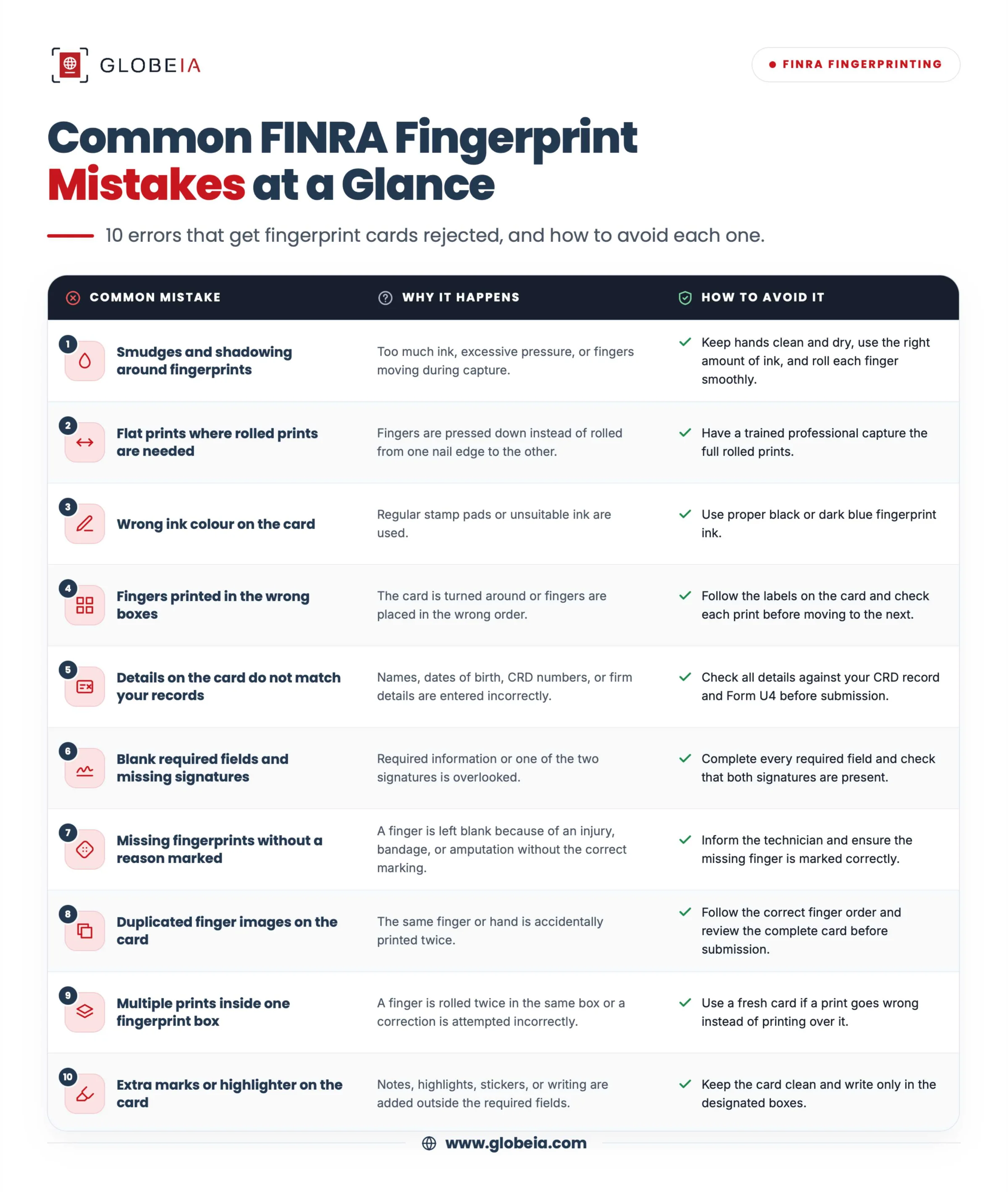
Common Mistakes | Why That Happens | How to Avoid It |
Smudges and shadowing around fingerprints | Too much ink, excessive pressure, or fingers moving during capture. | Keep hands clean and dry, use the right amount of ink, and roll each finger smoothly. |
Flat prints where rolled prints are needed | Fingers are pressed down instead of rolled from one nail edge to the other. | Have a trained professional capture the full rolled prints. |
Wrong ink colour on the card | Regular stamp pads or unsuitable ink are used. | Use proper black or dark blue fingerprint ink. |
Fingers printed in the wrong boxes | The card is turned around or fingers are placed in the wrong order. | Follow the labels on the card and check each print before moving to the next. |
Details on the card do not match your records | Names, dates of birth, CRD numbers, or firm details are entered incorrectly. | Check all details against your CRD record and Form U4 before submission. |
Blank required fields and missing signatures | Required information or one of the two signatures is overlooked. | Complete every required field and check that both signatures are present. |
Missing fingerprints without a reason marked | A finger is left blank because of an injury, bandage, or amputation without the correct marking. | Inform the technician and ensure the missing finger is marked correctly. |
Duplicated finger images on the card | The same finger or hand is accidentally printed twice. | Follow the correct finger order and review the complete card before submission. |
Multiple prints inside one fingerprint box | A finger is rolled twice in the same box or a correction is attempted incorrectly. | Use a fresh card if a print goes wrong instead of printing over it. |
Extra marks or highlighter on the card | Notes, highlights, stickers, or writing are added outside the required fields. | Keep the card clean and write only in the designated boxes. |
Once your fingerprints are captured, they do not go straight to the FBI. Every submission, whether it was taken on a card or on a livescan machine, first goes to Sterling. Sterling is FINRA’s designated fingerprint provider, now part of First Advantage Biometrics.
Sterling runs a quality check using the latest FBI specifications. It looks at two things:
First, whether the image itself is clear and complete.
Second, whether the personal details are filled in and match your record in FINRA’s Central Registration Depository (CRD).
If something fails here, the submission never reaches the FBI and nothing is updated in your CRD record.
Prints that pass are sent to the FBI, which checks them again. The FBI wants each finger rolled fully from nail to nail, with the center of the print and the area around it visible. It also checks that the fingers are in the right order and that no finger is repeated or missing without a reason. The flat prints at the bottom of the card act as a cross check for the rolled prints above them.
The FBI then searches its records and returns a result, which FINRA posts to CRD. FINRA says results are usually posted within 24 to 36 business hours after the FBI receives the prints. FINRA does not send an email when this happens, so the person’s firm has to check the status in CRD or FINRA Gateway.
Learn More Fingerprinting for FINRA Registration
Not every problem is the same, and FINRA treats two of them differently. A rejection and an illegible result both mean you need new prints, but they happen at different points and carry different consequences:
Parameter | Fingerprint Rejection | Fingerprint Marked Illegible |
Who decides | Sterling, before the FBI, or the FBI itself (shown as REJT). | The FBI only (shown as ILEG). |
What it means | Something is wrong with the card, the details or the basic image quality. | The FBI reviewed the prints, but the ridges were not clear enough to use. |
What you see in CRD | A Sterling rejection posts nothing. The vendor or firm gets a notice by email. An FBI rejection posts REJT. | ILEG is updated in the CRD record. |
Effect on registration | A Sterling rejection does not change the status, so the original 30 day deadline keeps running. REJT sends the status back to Approved Pending Prints with a fresh 30 days. | The status goes back to Approved Pending Prints with a fresh 30 days. |
New prints needed? | Yes | Yes |
After repeated attempts | No Name Check route. | After a third illegible result, FINRA requests an FBI Name Check at no fee. |
In this blog, we will walk through the 10 most common FINRA fingerprinting mistakes that cause cards to be rejected, and how to avoid each one.

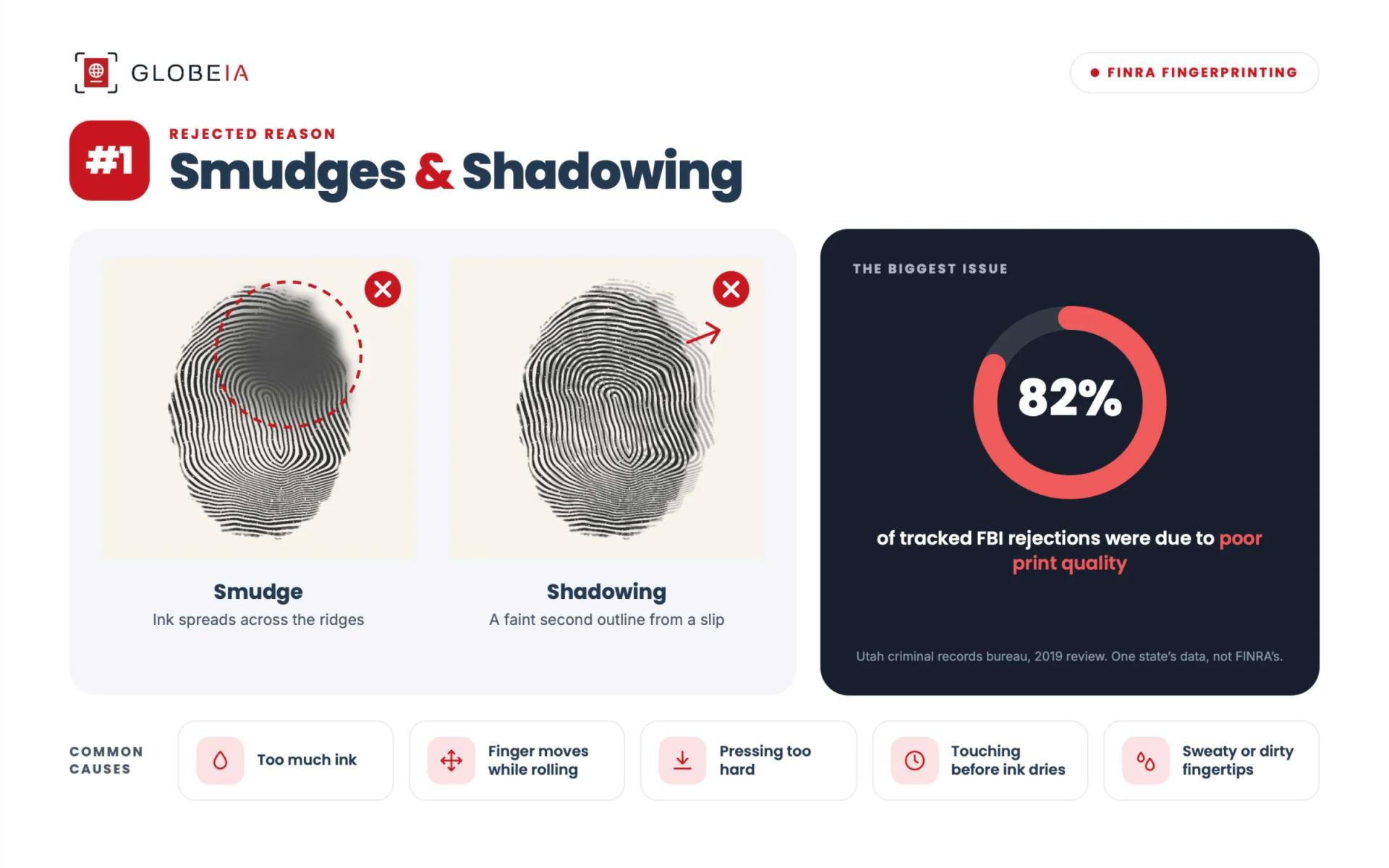
A smudge is a blurred patch where ink has spread across the ridges of a print. Shadowing is a faint second outline beside the print, which happens when the finger slips or shifts for a moment while it is being rolled. In both cases the fine lines the FBI reads become hard to separate.
FINRA names smudged prints as a reason for rejection. It also lists prints that are too dark or too light. This is the biggest issue in the data we could find. A 2019 review by Utah’s criminal records bureau found that poor print quality was behind 82% of the FBI rejections it tracked. That is one state’s numbers, not FINRA’s, but it shows where most trouble starts.
Smudges usually come from too much ink, a finger that moves while rolling, pressing too hard, or touching the card before the ink dries. Sweaty or dirty fingertips add to the problem.
Most smudges can be prevented in the ten minutes before the appointment and the few minutes during it.
Before the appointment - Wash your hands with warm water and soap, and dry them completely. FINRA points to dry or unwashed hands as a common cause of poor image quality. Skip heavy hand cream on the day itself. Many fingerprint providers also suggest keeping skin moisturised the night before, and avoiding alcohol sanitiser right before capture because it dries the skin.
During the capture -
Relax your hand and let the technician guide each finger.
Do not press down or help. Pressing spreads the ink.
Roll in one smooth motion without pausing halfway.
Ask the technician to check each print as it is made.
After the capture - Hold the card by its edges and let the ink dry before it is touched or placed in an envelope. Do not stack cards while they are still wet.
If a print has a smudge or a shadow, ask for a fresh card instead of wiping it or rolling again in the same box. Keeping a few spare FINRA cards on hand also saves time when a retake is needed.

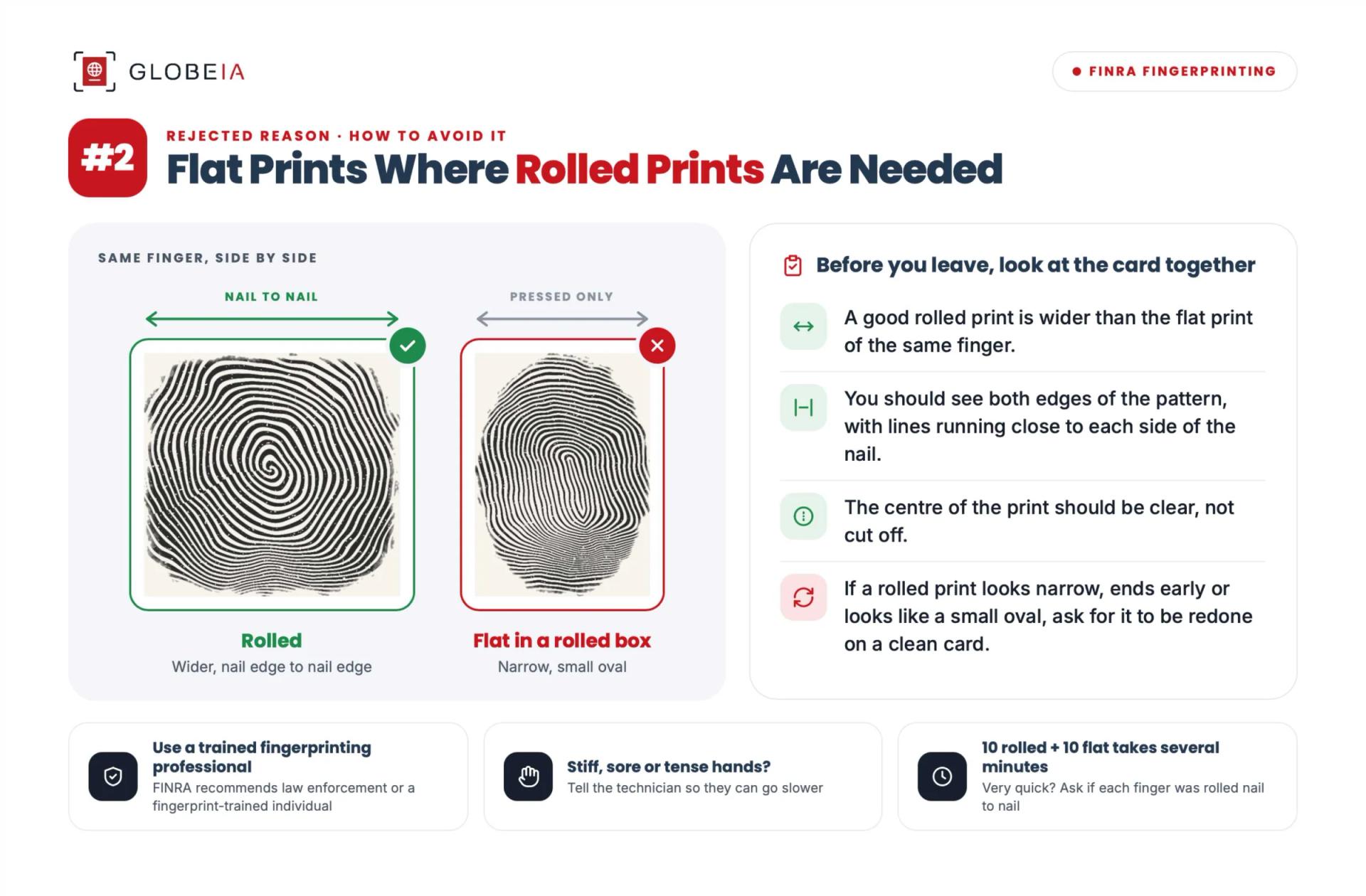
A FINRA approved card has separate sections for rolled prints and flat prints, covering all ten fingers. A rolled print is taken by turning the finger from one edge of the nail to the other, much like rolling a stamp. It records the full pattern. A flat print is pressed straight down, like touching a phone screen, and records only the middle part of the finger.
The mistake is pressing the finger down in the rolled box instead of rolling it. The result is a small oval with the sides missing. FINRA lists “flats captured when rolled fingerprints are expected” as a reason for rejection, and it also lists partial prints. The FBI looks for each finger to be rolled fully from nail to nail, with the centre of the pattern and the area where the ridges split apart both visible. When the rolled area is too small, the FBI reports it as insufficient pattern area.
Both kinds of print matter, but they do different jobs. The rolled prints give the detail needed to search records. The flat prints work as a cross check, confirming that each rolled print sits in the right box. If only flats are recorded, or the rolled prints are partial, there is not enough information to proceed.
This usually happens when:
The person capturing the prints is not trained.
The person being printed holds their finger stiff, or tries to help by pressing.
Someone is in a hurry and the line behind them is long.
Ask a trained fingerprinting professional to take your prints. FINRA itself recommends a law enforcement agency or a fingerprint trained individual for hardcopy capture. Someone who does this daily knows how much pressure to use and how to turn each finger smoothly.
Before you leave, look at the card together:
A good rolled print is wider than the flat print of the same finger.
You should see both edges of the pattern, with lines running close to each side of the nail.
The centre of the print should be clear, not cut off.
If a rolled print looks narrow, ends early or looks like a small oval, ask for it to be redone on a clean card.
Also tell the technician if your hands are stiff, sore or tense, so they can go slower. The full set of ten rolled and ten flat prints should take several minutes. If it feels very quick, you should ask them whether each finger was rolled from nail to nail.

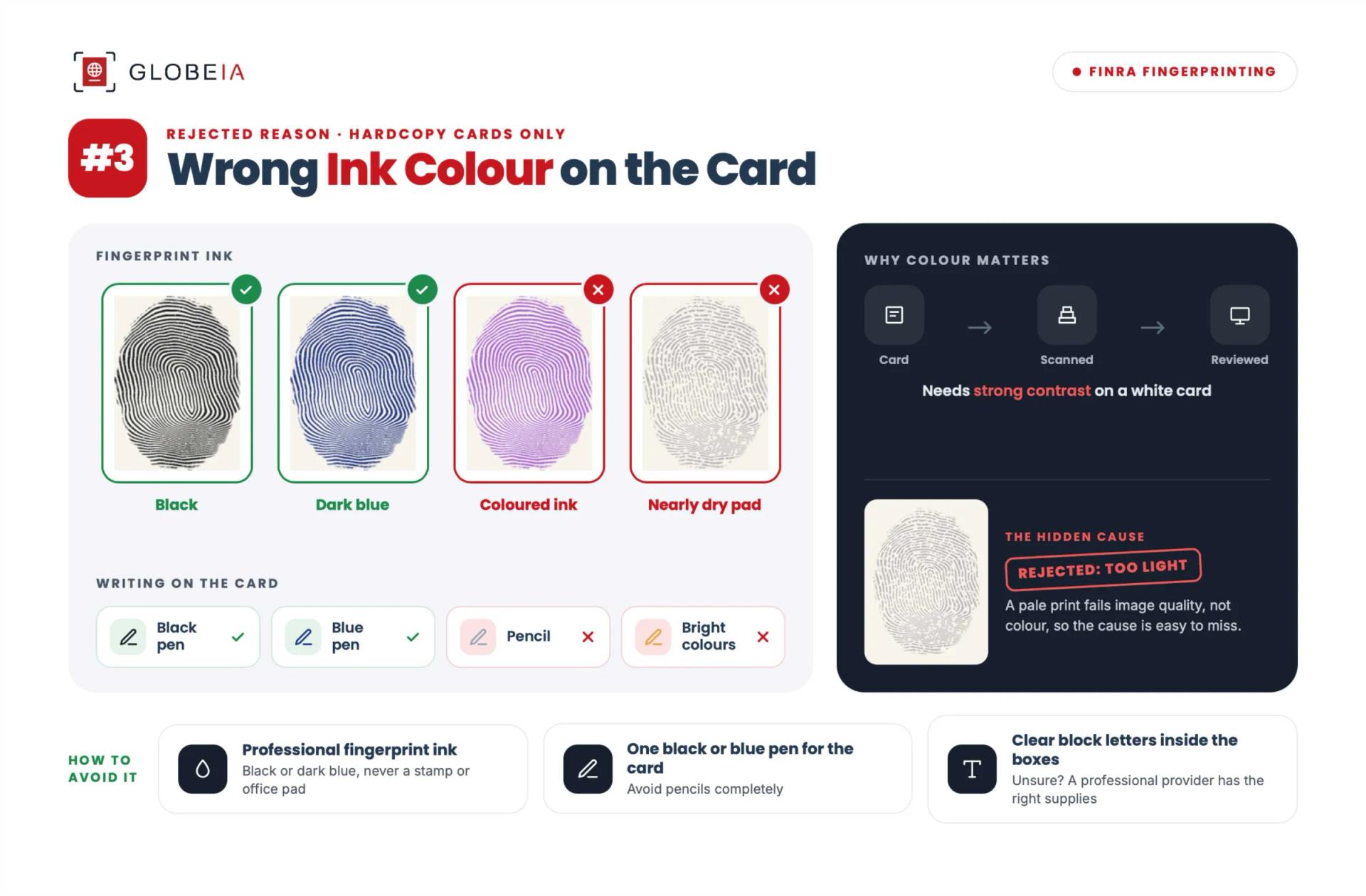
This one applies to hardcopy cards only. FINRA requires that all fingerprints on a card be taken in black or dark blue ink. The card is scanned and the image is sent for review, so the print needs strong contrast against the white card. Light or coloured ink makes the ridges harder to read, and an ink pad that is nearly dry gives faint prints.
The same care applies to anything you write on the card. FBI guidance flags pencil, and ink other than blue or black, as a reason for rejection. Pencils can smear or fade, and bright colours do not scan well.
It sounds like a small thing, but it is a real cause of rejection. It happens when a card is filled in with whatever pen is on the desk, when someone uses an office stamp pad in place of fingerprint ink, or when old ink is used past its best.
A wrong ink colour also shows up as a quality problem. A pale print can look like the “too light” issue FINRA mentions, so the card is rejected for image quality, not for colour, and the cause is easy to miss.
Use proper fingerprint ink from a professional kit, in black or dark blue. Do not use a regular stamp pad or an office ink pad, since they are made for stamping, not for capturing fine detail.
For the written details, keep one black or blue pen aside for the card and avoid pencils completely. Write inside the boxes in clear block letters. If you are unsure about the ink, a professional fingerprinting provider will already have the right supplies.
Also Check What Is the Difference Between Ink and Digital Fingerprinting?

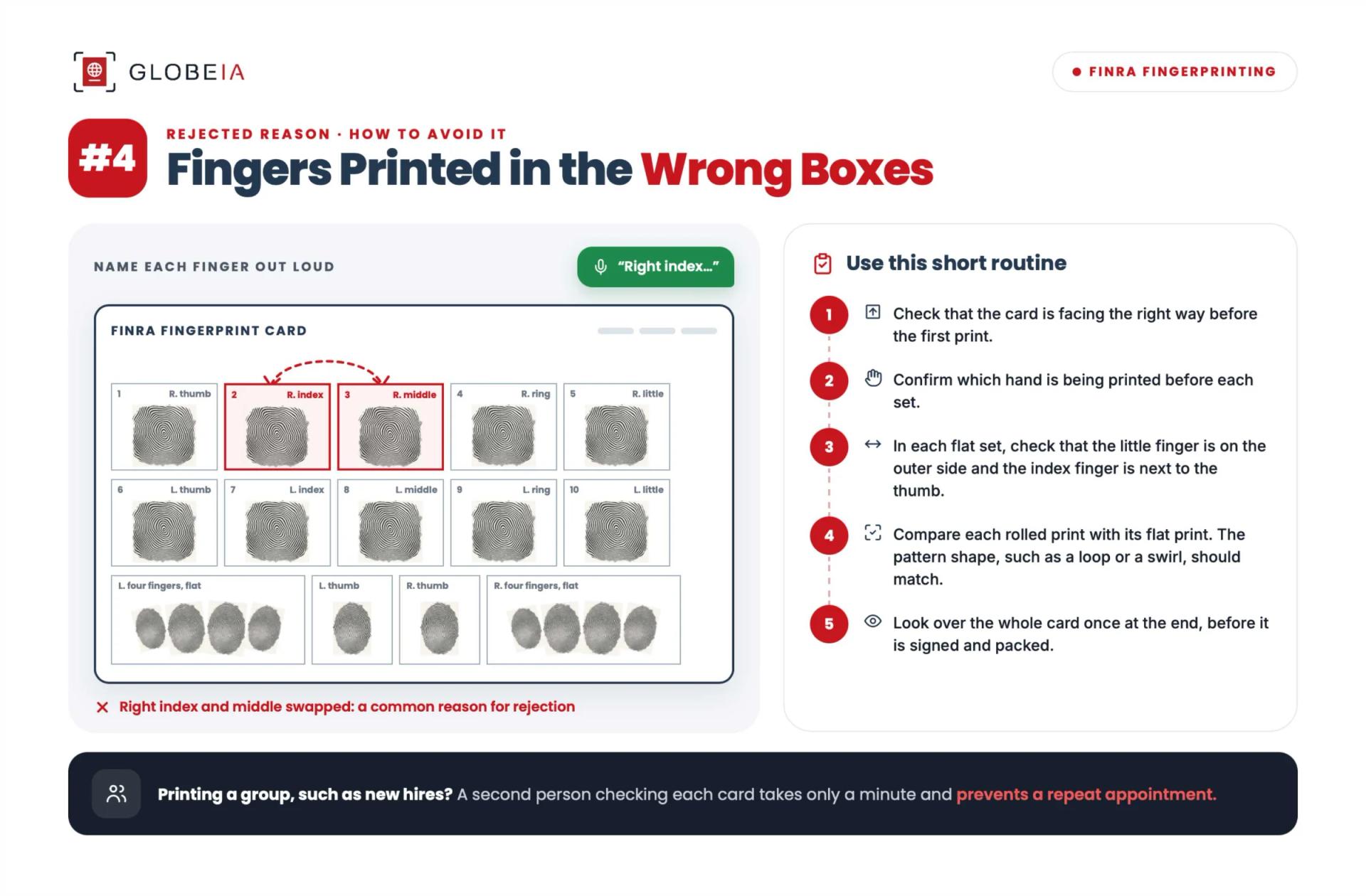
Every box on the card is meant for one specific finger. On a standard ten print card, the rolled prints run in a set order across the top, starting with the right thumb and moving through the right hand, then the left hand. The flat prints at the bottom have their own order, with the four fingers of each hand pressed together and the thumbs recorded separately. Follow the labels printed on your own card, since each box is marked.
When a print lands in the wrong box, the FBI sees the card as out of sequence. The reject code for this, L0118, also covers fingers printed twice and fingers missing without a reason. In Utah’s review, out of sequence was the most common problem its own system corrected before cards even reached the FBI, at 62% of fixes. The most common version was the left and right flat prints being swapped.
One easy sign is that the little finger ends up next to the thumb in the flat section, when the index finger should be there. The system works by checking whether each rolled print matches the finger shown in the flat section, so a swapped set cannot be matched.
It usually happens because the card was turned around, the technician was working fast, or the person lost track of which finger was next.
Slow down and name each finger out loud as it is printed. It sounds simple, but it keeps both people focused on the same finger.
Use this short routine:
Check that the card is facing the right way before the first print.
Confirm which hand is being printed before each set.
In each flat set, check that the little finger is on the outer side and the index finger is next to the thumb.
Compare each rolled print with its flat print. The pattern shape, such as a loop or a swirl, should match.
Look over the whole card once at the end, before it is signed and packed.
If many people are being printed in one session, such as a group of new hires, a second person checking each card takes only a minute and prevents a repeat appointment.

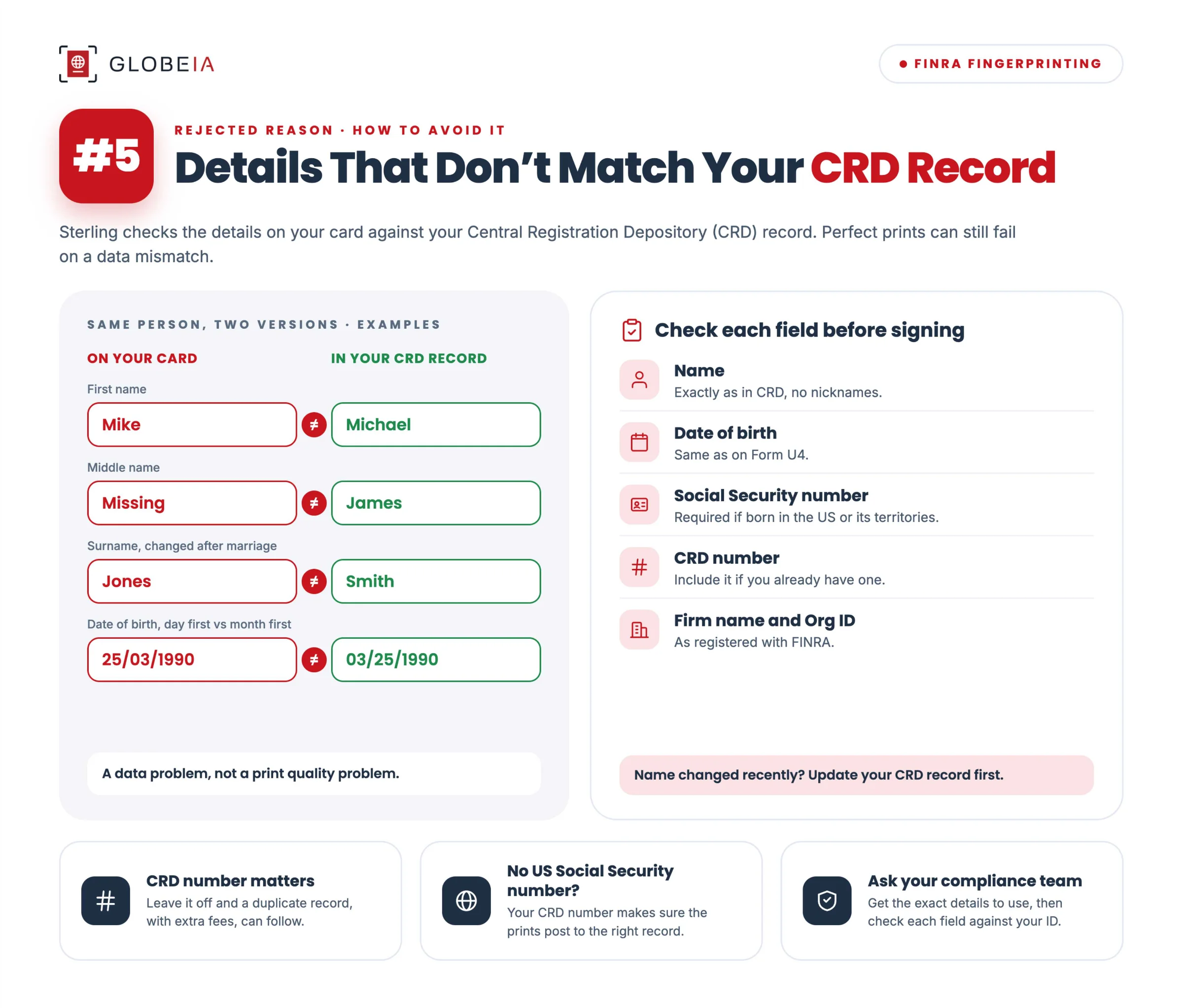
Sterling checks the personal details on your card against your record in the Central Registration Depository, known as CRD. FINRA says submissions can be rejected when the information provided does not match exactly with the individual’s CRD record. This is a data problem, not a print quality problem, so the fingerprints themselves can be perfect and the card still fails.
The CRD number deserves special attention. FINRA asks for it on every submission for people who already have one. If the number on the card does not match what FINRA holds, Sterling raises a validation error, and the firm has to check the details in CRD before the cards can move forward. If the number is left off, a second fingerprint record can be created for the same person, which can mean duplicate CRD records and extra fees.
The CRD number matters even more for people without a US Social Security number. A Social Security number is required for anyone born in the United States or its territories. For everyone else, the CRD number is what makes sure the prints post to the right record. Foreign nationals and foreign residents are not exempt from fingerprinting.
In real life, the mismatches are small. A nickname instead of a legal first name, a missing middle name, a surname that changed after marriage, or a date written day first when the record has it month first.
Fill in the card using the same details your firm used on Form U4. If your name recently changed, make sure your CRD record has been updated first. Check below a few details FINRA asks for on a hardcopy card:
Detail | What to Check |
Name | Exactly as it appears in CRD, with no nicknames. |
Date of birth | Same as on Form U4. |
Social Security number | Required if born in the US or its territories. |
CRD number | Include it if you already have one. |
Firm name and Org ID | The firm’s details, as registered with FINRA. |
Race | A one letter code such as A, B, I, U or W. |
Hair and eye color | Three letter codes, for example BRO for brown. |
Height and weight | Height from 4'00" to 7'11" and weight from 000 to 499. |
Before the appointment, ask your firm’s compliance team to send you the exact details to use. Check each field against your ID before signing.

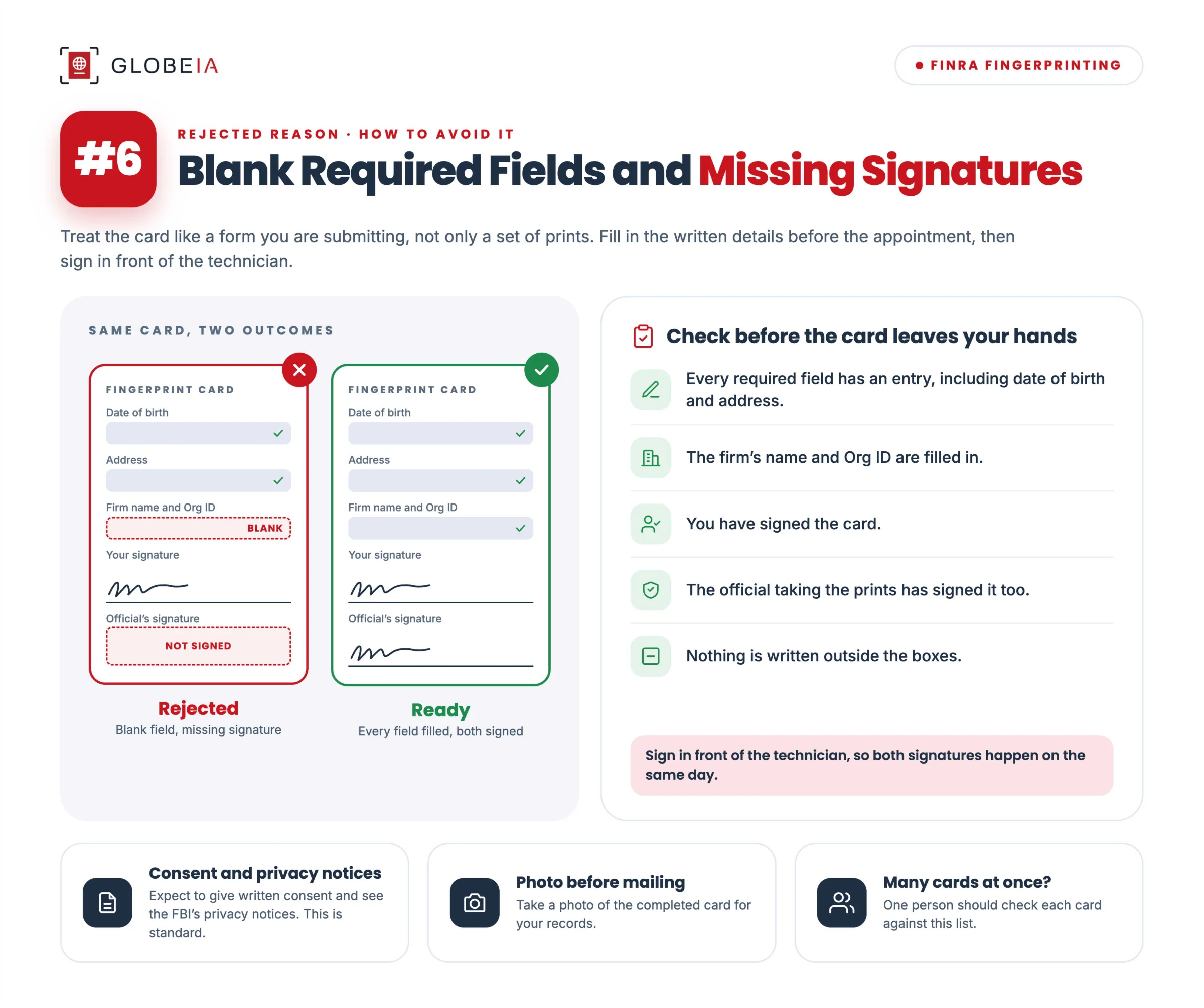
A card with a missing detail cannot be processed. FINRA lists the required fields as date of birth, address, printed name, the firm’s name and Org ID, and the required signatures. The Social Security number is also required for people born in the US or its territories. FBI guidance goes further and says that a card with a required field left blank may be rejected immediately without further processing.
There are two signatures on a FINRA card. One is from the person being fingerprinted and the other is from the official taking the prints. Missing either one is enough to stop the card. The official’s signature is easy to forget because it sits apart from the person’s own details.
FINRA also states that firms are responsible for submitting fingerprints with every required field completed. Sterling or FINRA may try to contact the firm to confirm a missing detail when they can, but a deficient card is not returned. That means it cannot be corrected by hand and resubmitted, and a new card has to be taken.
This tends to happen when a card passes through several people. One person fills in the details, another takes the prints, and the card goes in the mail without a final check.
Treat the card like a form you are submitting, not only a set of prints. Fill in the written details before the appointment, then sign in front of the technician so both signatures happen on the same day.
Use this check before the card leaves your hands:
Every required field has an entry, including date of birth and address.
The firm’s name and Org ID are filled in.
You have signed the card.
The official taking the prints has signed it too.
Nothing is written outside the boxes.
At the appointment, you will also be asked for written consent to be fingerprinted and shown the FBI’s privacy notices. This is a standard FBI requirement, so it is normal. Before mailing, take a photo of the completed card for your records. When a firm handles many cards at once, one person should be responsible for checking each card against this list.

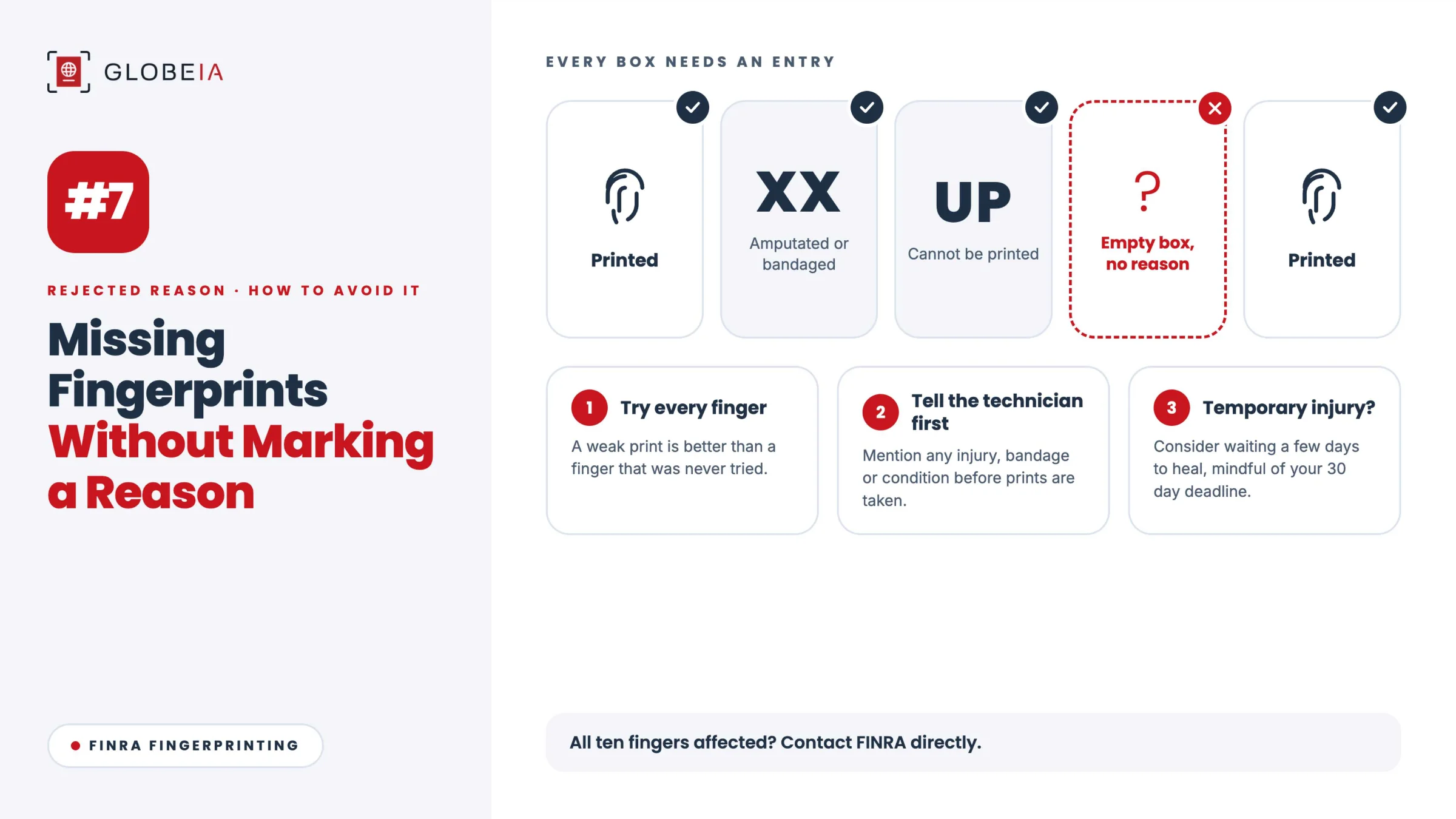
Some people cannot be printed on every finger because of an amputation, an injury, a bandage or a skin condition. That is accepted. The problem is leaving a box empty without saying why. The FBI accepts only two reasons for a missing finger, which are amputation and inability to print.
FINRA tells firms to use “XX” for an amputated or bandaged finger and “UP” for a finger that cannot be printed. An empty box with no mark looks like a mistake, and the card is treated as incomplete. The FBI groups this under the same reject code as fingers out of sequence, which covers missing fingers with no reason given.
The reverse is also a problem. FBI guidance lists “no attempt to print deformed or scarred fingers” as a reason for rejection. A finger that is rough, scarred or hard to print should still be attempted in both the rolled and flat sections. A weak print that comes back illegible is better than a finger that was never tried.
If all ten fingers are amputated, bandaged or unprintable, FINRA has a separate process and asks firms to contact them directly. A firm can also ask the SEC for an exemption when a person cannot be printed because of a physical handicap.
Tell the technician about any injury, bandage or condition at the start, before any prints are taken. They can then mark the right boxes as they go.
Check that every missing finger has a mark in its box. If an injury is temporary, ask whether it is worth waiting a few days for it to heal, keeping your 30 day deadline in mind. A full set of ten prints is always the better and stronger submission.

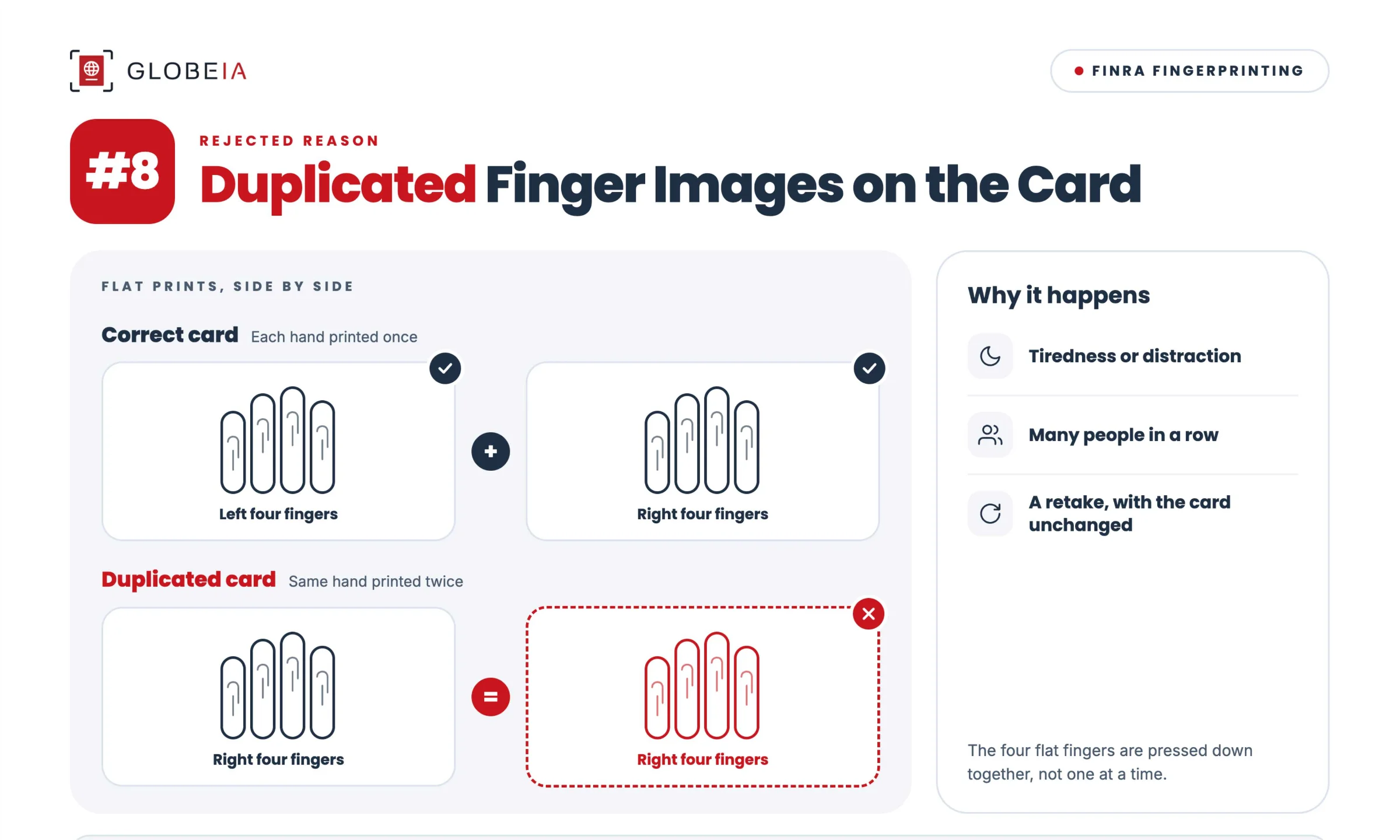
This happens when the same finger, or the same hand, is printed twice on one card. Sometimes the right hand’s flat print appears in both flat boxes. Sometimes one rolled print is repeated in two boxes. To the system, a duplicate means one real finger is missing from the set.
The FBI treats this as an out of sequence problem and lists “printed twice” under the same reject code as wrong order. It also has a separate code for when the same hand is printed twice in the flat section, or when the four flat fingers are not pressed down at the same moment. The four fingers in a flat set are meant to be captured together, not one at a time.
Duplicates tend to come from tiredness, distraction or a technician working through many people in a row. They are also more likely after a retake, when the card is not changed and the person loses track of which hand is next.
A duplicate can be hard to spot because each print on its own looks fine. The error only becomes clear when the whole card is compared.
Work through the card one finger at a time, in order, and tick each one off mentally. Do not move to the next box until the current one is confirmed.
An easy way to catch a duplicate is to compare the two hands. A right hand and a left hand have different patterns, so two matching sets should raise a question. Ask the technician to review the full card before it is sealed. For electronic capture, look at each screen before moving on.

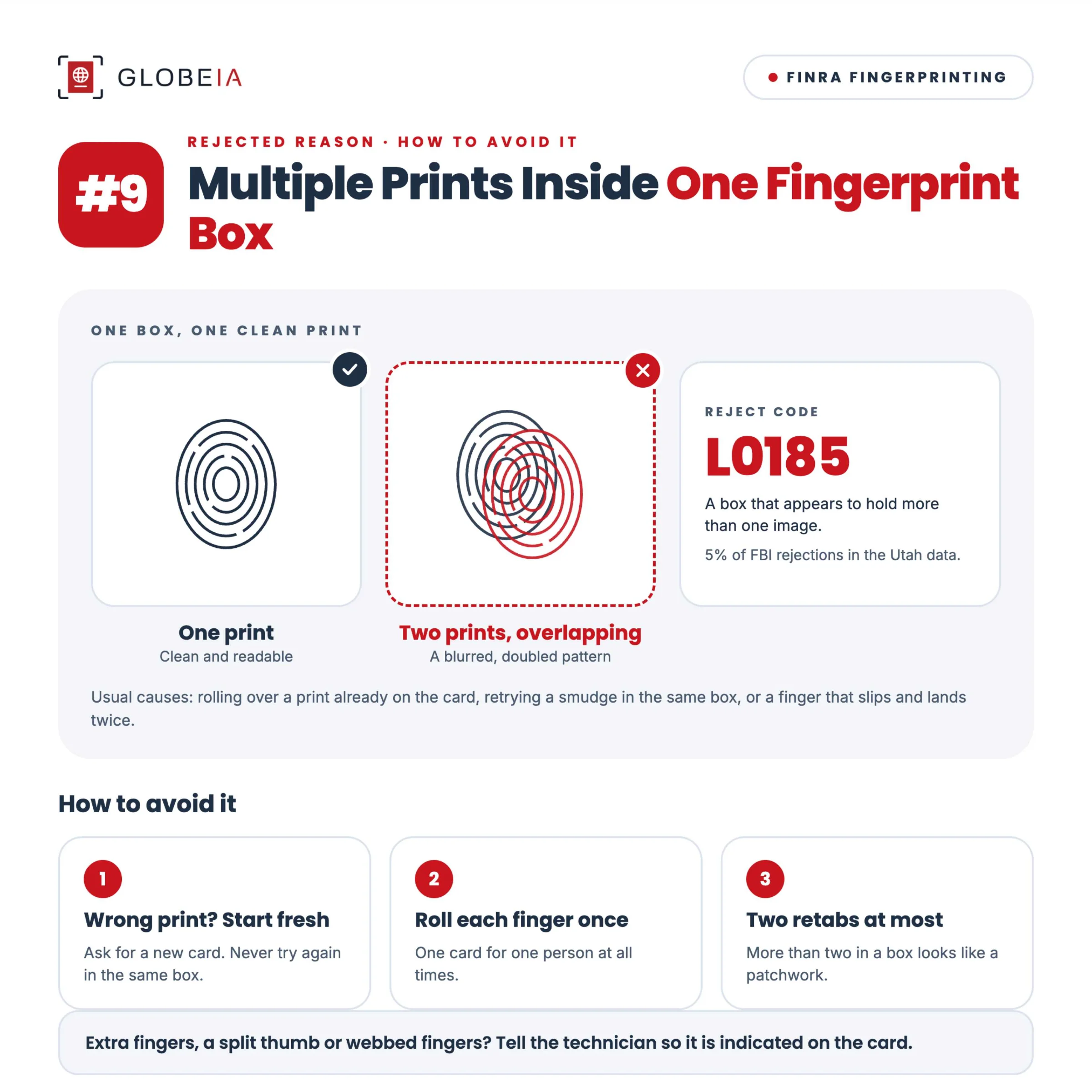
Each box is meant to hold one clean print. When two images overlap in the same box, the FBI sees a blurred, doubled pattern it cannot read. The reject code for this is L0185, which flags a box that appears to hold more than one image. It was one of the top reject reasons in the Utah data, at 5% of FBI rejections.
The usual cause is rolling a finger over a print already on the card. It also happens after a smudge, when the technician tries again in the same box instead of using a new card. A finger that slips and lands a second time can do the same thing.
Retabs add to the risk. These are small FBI approved stickers used to correct a print on a paper card, and the FBI allows no more than two in any one box. A box with a patchwork of corrections is likely to be rejected.
The FBI also has codes for a box or a whole print that appears to come from more than one person. This is a risk when cards get mixed up in a busy session. If someone has extra fingers, a split thumb or webbed fingers, the FBI requires that this be indicated, since two images in one box would otherwise look like an error.
If a print goes wrong, do not try again in the same box. Ask for a fresh card and start that print again cleanly. It might take a minute longer, but it removes the risk of a doubled image.
Only roll each finger once per box. Keep one card for one person at all times, since the FBI also has codes for blocks that look like they came from more than one person. If a retab is needed, make sure no more than two are used in any box.

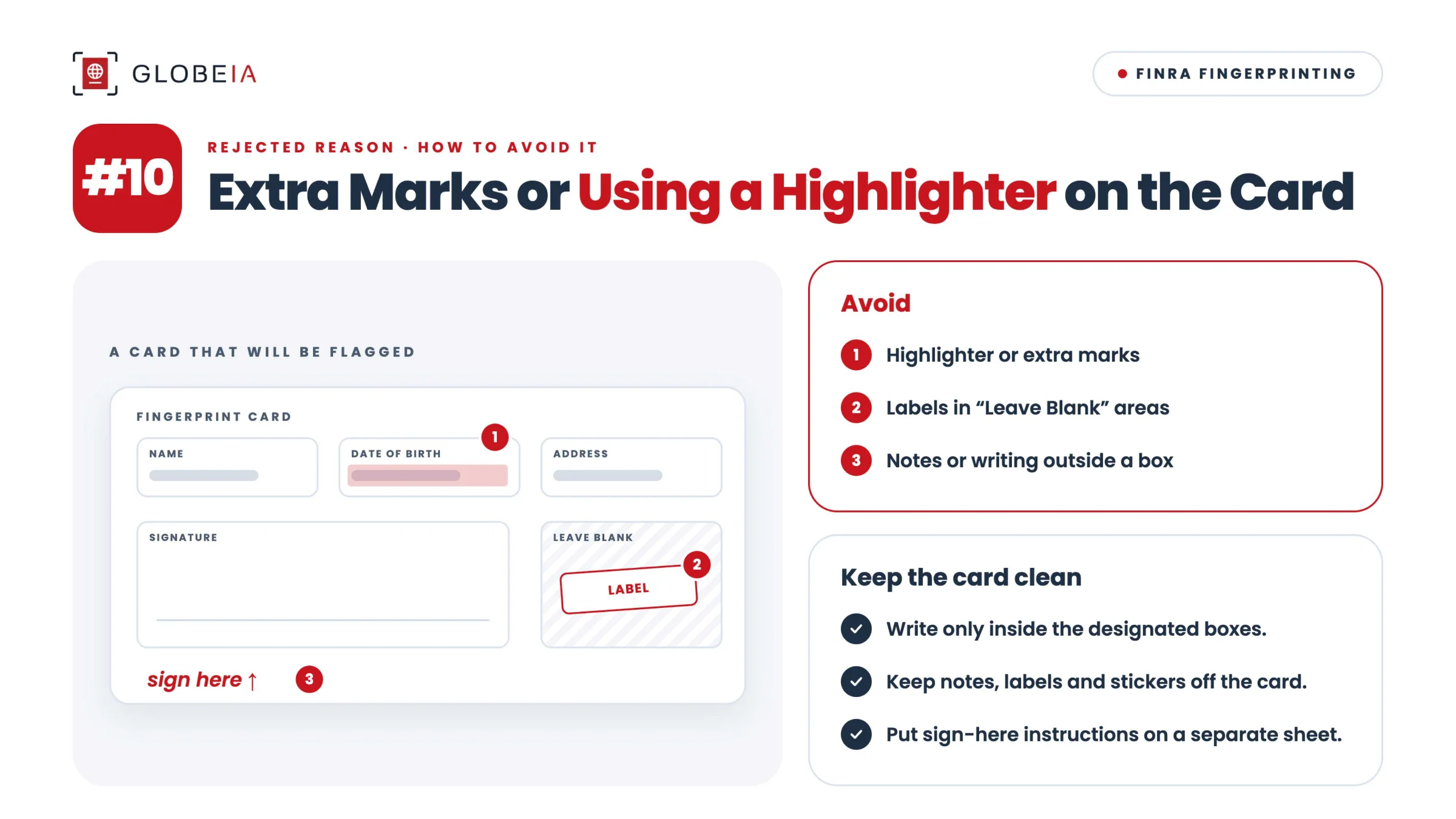
FINRA is clear about this. Using a highlighter or having extra writing on a hardcopy card will cause the fingerprints to be rejected, and a rejected card is not returned. The cards are scanned and read by machines, so a coloured line or a stray note can interfere with the scan. And writing in the wrong place can be mistaken for data.
The FBI lists several related problems. These include entries outside the boundaries of a box, labels placed in areas marked “Leave Blank,” fingerprints on the back of the card, and the use of a non standard card. Any of these can stop a card even when the prints are perfect.
And there’s an irony here. This mistake is more common than you might expect, because it often comes from people trying to be helpful. A compliance officer highlights where to sign, or someone adds a note in the margin.
Keep the card clean. Write only inside the designated boxes, and keep any notes, labels or stickers off it. FBI guidance also flags entries outside the boundaries of a box and labels placed in areas marked “Leave Blank.” If you want to guide someone on where to sign, put those instructions on a separate sheet.
A rejection can come at two points: Sterling may reject the submission during its quality check, before the FBI sees it. Or the FBI may return a result of REJT or ILEG, which is posted to your CRD record.
If Sterling rejects it, the firm or its fingerprint vendor gets a notice with instructions to provide new prints. If the FBI returns REJT or ILEG, the system flags that new prints are required. In every case, the person is usually not the one who tracks this. Their firm sees the fingerprint status in CRD, so ask your compliance team to keep you updated.
Yes, it can. When the FBI result is ILEG or REJT, the registration status goes from Approved Pending Results back to Approved Pending Prints, and a new 30 day clock starts. This is how the statuses move:
Situation | Registration Status | What it Means |
Prints not yet received | Approved Pending Prints | FINRA is waiting for a submission |
Prints sent to the FBI | Approved Pending Results | The FBI is processing them |
FBI returns ILEG or REJT | Approved Pending Prints | New prints due within 30 days |
No new set within 30 days | Inactive Prints | The person must stop business until the status returns to Approved |
Inactive Prints for two years | Terminated No U5 | The registration is terminated |
A Sterling rejection works differently. It uploads no status to the CRD, so the original 30 day deadline after the Form U4 filing keeps running. If a firm cannot meet it for a good reason, such as a person being in another country, FINRA can extend the period when the firm applies within the 30 days.
Check Out My Fingerprints Were Rejected: What Should I Do?
Yes. FINRA says the same set of fingerprints cannot be used again, and new prints must be collected for every submission. Prints taken for another purpose, such as an earlier job check or an immigration application, do not count.
FINRA has also said that, for now, nothing changes under the FBI’s updated reuse policy from January 2026. Only prints collected through the FINRA Fingerprint Program are acceptable, and FINRA is waiting for more guidance from the FBI.
Send one set at a time. If a firm sends several sets for the same person together, only one is processed and the rest are destroyed. A new set should only go in after an ILEG result shows in CRD.
If three sets come back illegible, FINRA asks the FBI to run a Name Check instead. There is no fee for it, but the FBI does it by hand and it can take up to 90 days.
Yes, but it has to be the right card. FINRA accepts only its own approved cards, which are bought from Sterling. The FD-258 card is not accepted because it lacks fields FINRA requires.
From Inside the US or its Territories | Fingerprint cards go to Sterling. |
From Outside the US | Fingerprint cards must be mailed to FINRA, which forwards them to Sterling by express mail. |
FINRA says the FBI’s turnaround is around 48 hours, and results are updated directly in the CRD within 24 to 36 business hours after the FBI receives the prints.
The time before that depends on how the prints are captured. An electronic submission can be on its way the same day. A hardcopy card has to be couriered, so delivery time is added, especially from outside the US.
Whatever the route, the 30 day window after an ILEG or REJT result is the number you need to protect. Book the new appointment as soon as the result appears. If a Name Check is needed, allow up to 90 days for the FBI to finish, and note that it only applies after illegible results.

Almost every rejection reason in this blog comes down to how the prints were captured. Smudges, flat prints, wrong boxes, missing marks and stray writing can all be avoided when an experienced and reliable fingerprinting partner is by your side. Globeia can be that partner.
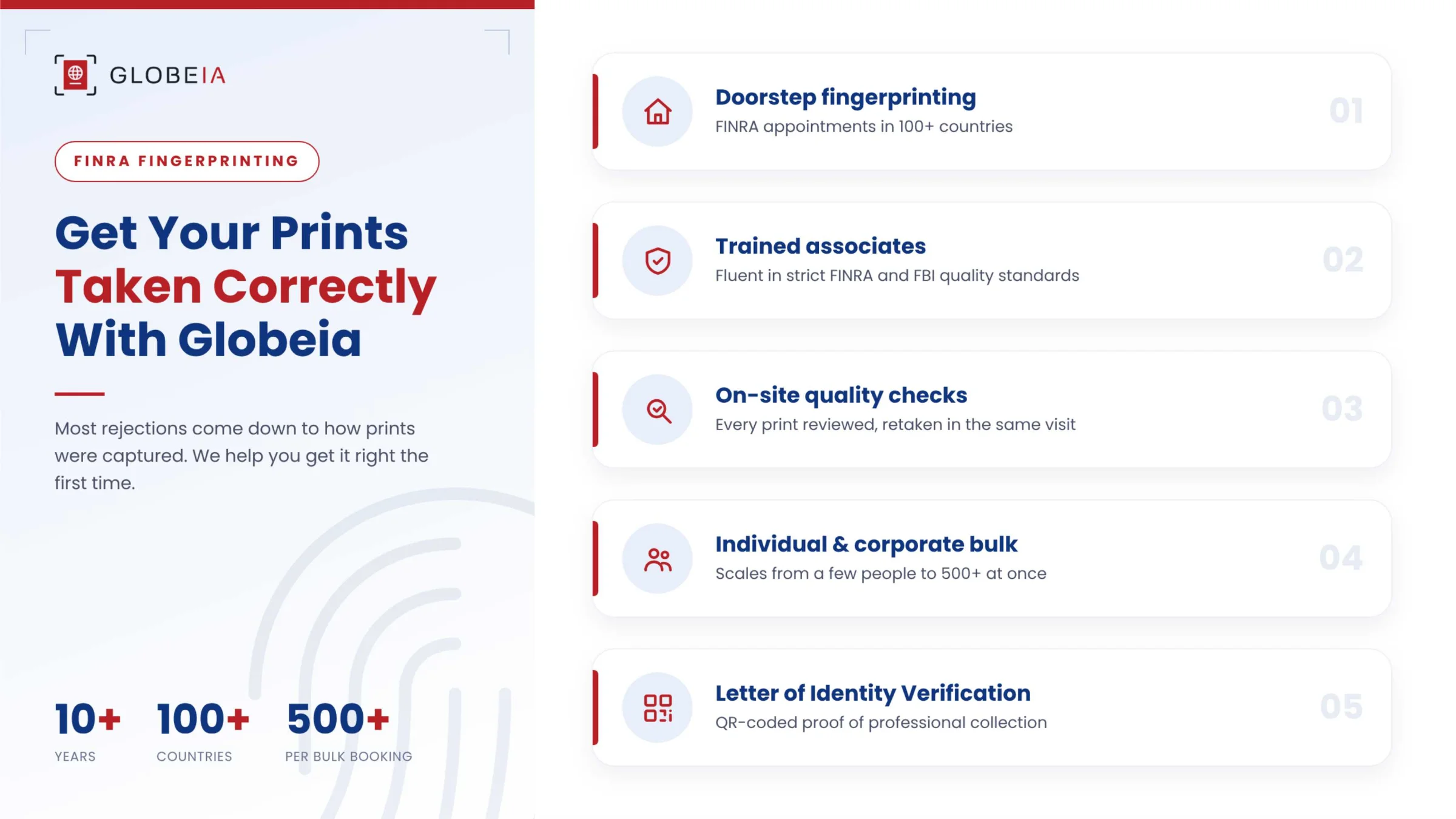
With over 10 years of experience in international fingerprinting and a team of trustworthy fingerprinting associates, we capture prints that give you a much better chance of being accepted the first time. This is what you get with Globeia:
Convenient doorstep FINRA fingerprinting in more than 100 countries around the world.
Highly trained associates familiar with the strict FINRA and FBI quality standards.
On site quality checks and reviews of each print, with prints retaken in the same appointment if needed.
Support for both individual and corporate bulk appointments for finance teams, scalable from a few to 500+ people at once.
A Letter of Identity Verification, a QR coded document that serves as proof of professional fingerprint collection and the strict identity verification protocols followed.
The biggest lesson from these rejection reasons is that fingerprint quality is only one part of a successful FINRA submission. The card also needs to be completed correctly, linked to the right CRD record, and kept free of anything that could interfere with scanning. A good set of prints can still be rejected if these details are overlooked.
This is why the fingerprinting appointment itself deserves attention. Having a trained professional capture and review the prints before you leave gives you a chance to correct visible problems while you are still there, rather than discovering them after the card has been mailed.


Global Services
State Services