By Sejal Jain · Updated July 20, 2026
New Zealand has become an increasingly popular destination for Indians seeking better career opportunities, a higher quality of life, world-class education, and a safe, family-friendly environment. While the immigration process is generally straightforward, success depends on understanding the right visa pathway, meeting eligibility requirements, and planning each step carefully.
This comprehensive guide covers everything you need to know about moving from India to New Zealand in 2026- from visa options and immigration requirements to living costs, healthcare, taxation, job opportunities, and the best cities for Indian migrants. Whether you're relocating for work, study, family, or permanent residency, you'll find practical insights and step-by-step guidance to help make your move smoother and more successful.
Every few years, interest in moving to New Zealand from India spikes sharply. In 2025, Immigration New Zealand processed more than one million visa applications - the highest on record. Visitor visas now average five working days. Accredited Employer Work Visas average twelve. Five new visa categories opened. And in June 2025, New Zealand exempted Indian university degrees from the International Qualification Assessment process - the same exemption previously reserved for countries like Germany, France, and South Korea.
These are not small changes. Combined, they made New Zealand the most accessible major English-speaking destination for skilled Indians in 2025. According to the 2023 New Zealand Census, 292,092 people identified as ethnically Indian - 5.8% of the country's entire population. Between 2018 and 2023, that number grew by 54%. Indians are now the third-largest ethnic group in New Zealand, after Europeans and Māori.
But the numbers alone do not explain why people leave. These are the reasons Indians consistently give.
New Zealand ranked 3rd globally on the 2025 Global Peace Index, published by the Institute for Economics and Peace. There is no military conflict, no terrorism history, and no serious political violence. The police in most towns are unarmed. Violent crime rates are well below India, Australia, the UK, and the United States.
Parents - especially mothers making the decision for their families - mention safety before anything else.
All eight New Zealand universities rank in the global top 3%. State schools are free for resident children from age 5 to 19. The curriculum focuses on thinking and problem-solving rather than rote exam preparation. For Indian families accustomed to JEE coaching and board exam pressure, this is either a relief or an adjustment, depending on how you look at it.
Residents and qualifying work visa holders access New Zealand's publicly funded health system at no cost for hospital care. The Accident Compensation Corporation (ACC) covers injury treatment for everyone in New Zealand - including tourists - regardless of visa status. No insurance claim, no billing department, no surprise invoice after surgery.
New Zealand law requires four weeks of paid annual leave for every full-time employee. The work culture expects you to take it. The 60-hour week that many Indian IT professionals accept as normal in Bengaluru or Pune does not exist as a cultural baseline in New Zealand. This adjustment takes time to believe. But it is real.
300,000 Indians live in New Zealand. One in ten Auckland residents is Indian. There are temples, gurdwaras, Indian grocery stores, Bollywood cinemas, Indian restaurants, and active cricket clubs in every major city. You do not arrive at nothing.
New Zealand is far from India. The direct Air India flight from Delhi to Auckland takes approximately 17 hours. Visiting family is expensive and exhausting. The time zone difference makes real-time calls with family in India difficult.
The cost of living is high, particularly in Auckland. Salaries in New Zealand are lower in absolute terms than equivalent roles in Australia or the Gulf. The job market, in a country of 5 million people, is smaller than what Indian professionals are used to in metro cities.
These are real trade-offs. This guide does not hide them.
Most Indians comparing emigration destinations end up comparing these three. All are English-speaking, safe, and have established Indian communities. The differences matter.
| Factor | New Zealand | Australia | Canada |
| Indian community | ~300,000 (5.8% of population) | ~750,000+ (3%) | ~1.8 million (4.7%) |
| 2025 immigration direction | Expanded, more open | Tightening | Significantly cut |
| Indian degree exemption | Yes (June 2025) | Separate assessment required | Separate assessment required |
| Green List / fast residence | Yes - direct in 12 months (Tier 1) | Longer, no equivalent direct route | No equivalent |
| Average professional salary | NZD 70,000–90,000 | AUD 80,000–120,000 | CAD 75,000–110,000 |
| Cost of living | High (lower than Sydney/Melbourne) | High (Sydney, Melbourne) | Very high (Toronto, Vancouver) |
| Distance from India | ~17 hours direct | ~9–12 hours | ~16–22 hours |
| Winter | Mild (Auckland: 8–14°C in July) | Hot in north, cold in south | Extreme (Toronto: -15°C common) |
| Safety ranking (2025 GPI) | 3rd globally | 22nd | 12th |
Australian salaries are higher for equivalent roles. An IT professional earning NZD 100,000 in Auckland might earn AUD 120,000–130,000 in Sydney. At current exchange rates, that gap is real. The job market in Australia is also bigger - more companies, more senior roles, more sectors active at scale.
Canada reduced its permanent resident intake targets from 500,000 in 2024 to 365,000 by 2027. Processing times have lengthened. Housing in Toronto and Vancouver is among the most expensive in the world. The Indian community is the largest in absolute numbers, but the immigration gateway is narrowing precisely when New Zealand's is widening.
For Indians in healthcare, engineering, construction, and teaching - the Green List provides a pathway to permanent residency in 12 months or less for Tier 1 occupations. Australia has no equivalent direct-to-residence route at that speed. Canada has nothing comparable.
For families prioritising safety, school quality, and quality of daily life over maximum salary, New Zealand consistently comes out ahead. And for anyone who finds the idea of a smaller, quieter country genuinely appealing - five million people, short commutes, mountains and beaches within an hour of every major city - New Zealand offers something neither Australia nor Canada does.
Indian passport holders cannot enter New Zealand without a pre-approved visa. There is no visa on arrival and no NZeTA (Electronic Travel Authority) available to Indian nationals. Every visit - for tourism, study, work, or settlement - needs a visa applied for before you leave India.
New Zealand's visa system is clearly organised. You pick the category that fits your purpose. Here are all the main pathways.
For tourism, family visits, or short courses under three months.
What you need:
Fee: NZD 441 (approximately INR 24,000 at current rates)
Processing time: Now averaging 5 working days in 2025 - down from several weeks in 2024
Approval rate: Around 72% for Indian applicants in 2024. The most common reason for rejection is insufficient proof of ties to India - visa officers need to be confident you will return.
You cannot work in New Zealand on a Visitor Visa. Remote work for a non-New Zealand employer is generally permitted.
Apply through Immigration New Zealand's official portal.
For study programmes lasting more than three months at an approved institution.
What you need:
Work rights (updated November 2025): Students can now work 25 hours per week during term time, increased from 20 hours. Full-time work during scheduled breaks is permitted.
Post-study pathway (2026 update): New Zealand introduced a Short Term Graduate Work Visa - up to six months of open work rights after graduation for students who do not yet have an employer-sponsored visa. Minimum NZD 5,000 in funds required. After that, graduates who complete a bachelor's degree or above over at least two years receive an open work visa for up to three years.
Apply through INZ's student visa page. Find approved providers and licensed education agents at Education New Zealand.
The main work visa for Indian professionals with a job offer from a New Zealand employer. This replaced the old Essential Skills Work Visa in 2022. As of March 2026, more than 185,000 AEWVs have been approved since launch. Over 28,000 employers hold current accreditation. Around 80,000 AEWV holders are working in New Zealand right now.
This visa gets its own full section below.
For skilled workers in specific shortage occupations. Offers either direct residence (Tier 1) or a two-year work-to-residence pathway (Tier 2). Full details in the Green List section.
New Zealand's points-based residence pathway for skilled workers. From August 2026, two new pathways open under this category. Full details in the permanent residency section.
For individuals with NZD 5 million or more to invest in qualifying New Zealand assets. Leads to residency. Details at INZ's investor visa page.
Two-stage pathway for Indians who want to start or buy a business in New Zealand. First stage: Entrepreneur Work Visa with a business plan assessment. Second stage: Entrepreneur Resident Visa after meeting revenue and employment benchmarks.
| Visa | Who It Is For | Leads to Residency | Processing |
| Visitor Visa | Tourism, family, short stays | No | ~5 working days |
| Student Visa | Enrolled in NZ institution | Indirectly (post-study) | ~12 working days |
| AEWV | Job offer from accredited employer | Yes - after 24 months (eligible roles) | ~12 working days |
| Green List Tier 1 | Highest-need roles | Yes - directly | 4–8 weeks |
| Green List Tier 2 | In-demand occupations | Yes - after 2 years | 4–8 weeks |
| Skilled Migrant Category | Points-based skilled workers | Yes - direct residence | 6–18 months |
| Partner Visa | Genuine relationship with NZ citizen/resident | Yes | 6–12 months |
| Parent Resident Visa | Parent of NZ citizen/resident | Yes | 5+ years wait |
| Active Investor Plus | NZD 5M+ investment | Yes | 3–6 months |
Processing times are estimates based on current INZ data and change based on application volumes. Always check INZ's current processing times before planning your timeline.
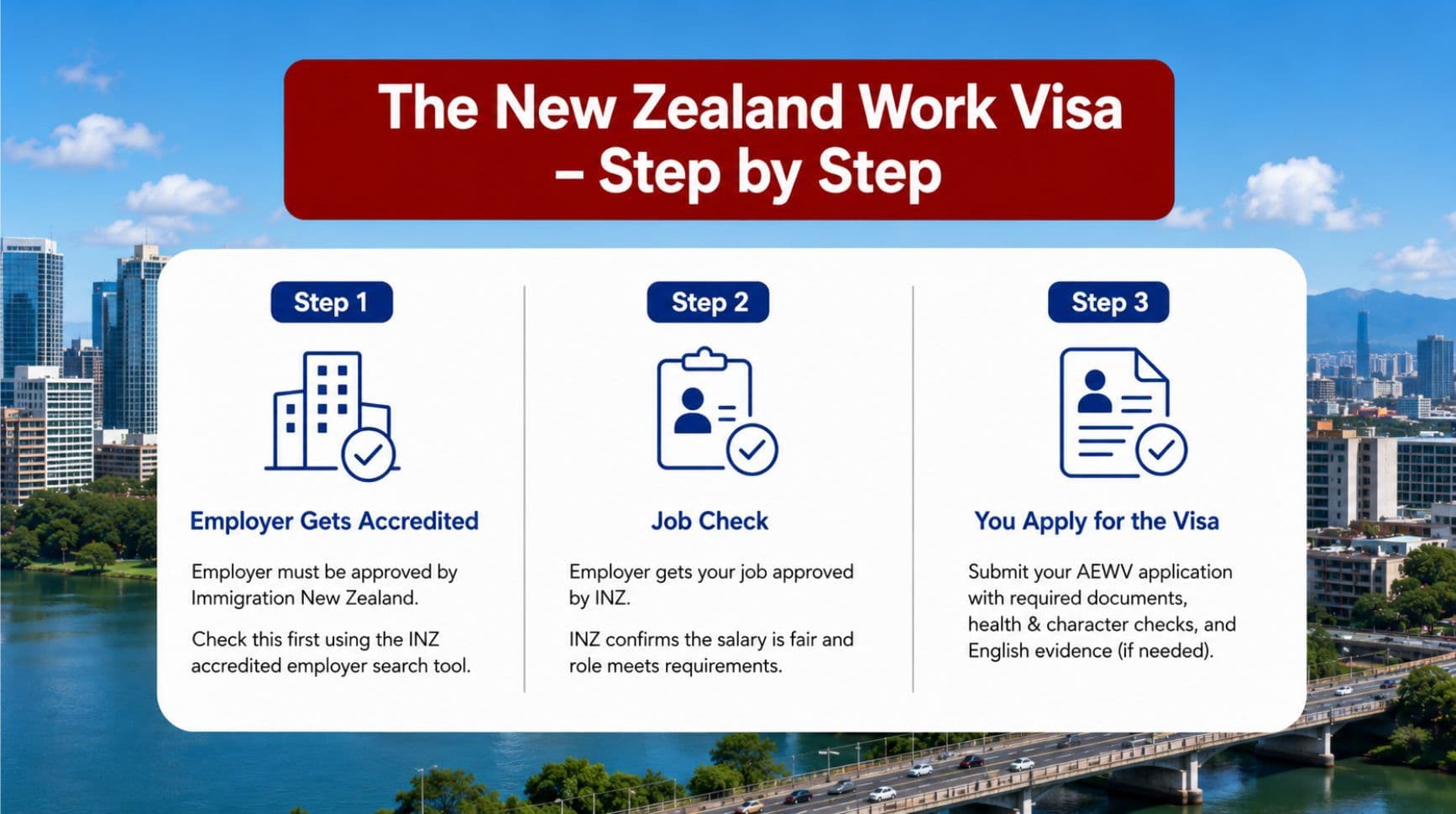
The AEWV is the visa most working Indians will use. It works in three stages that involve both you and your employer.
Before anything else, your employer must be approved (accredited) by Immigration New Zealand. This check confirms the business is legitimate, financially stable, and follows NZ employment law.
Check this first. Use the INZ accredited employer search tool to verify any employer before accepting a job offer. Some Indians receive job offers from non-accredited employers - sometimes genuine companies that simply have not completed the process, but sometimes fraudulent offers. This check takes 30 seconds and could save you months.
Standard accreditation covers businesses employing 5 or fewer migrants at a time. High-volume accreditation covers businesses with larger migrant workforces.
The accredited employer applies to INZ to have your specific job approved. INZ confirms the salary is fair for the role and region, and that the position meets requirements. For lower-skill roles (ANZSCO levels 4 and 5), the employer must demonstrate they attempted to hire a New Zealand worker first.
Once the Job Check is approved, you submit your AEWV application with your qualifications, experience documentation, health clearance, character documents, and where required, English language evidence.
From 23 June 2025, Indian university degrees are on the List of Qualifications Exempt from Assessment (LQEA). You no longer need to pay for or wait for an International Qualification Assessment. India sits alongside Germany, France, South Korea, Singapore, and Switzerland on this list. For Indian applicants, this removed one of the most significant cost and time barriers in the entire visa process.
From March 2025, the old blanket median wage requirement was removed. Employers must now pay:
The key point: employers cannot use this flexibility to underpay migrants. INZ checks that the salary reflects what a New Zealand worker would be paid for the same role.
If you want to bring your spouse on a work visa, you must earn at least NZD 26.85/hour. To include dependent children, you must earn at least NZD 55,844/year.
After you reach the maximum continuous stay, you must leave New Zealand for 12 months before applying again - unless you have secured residency by then.
If you receive a new job offer while on an AEWV, you must apply for a Job Change through INZ and receive approval before starting. Do not give notice to your current employer until the Job Change is approved. Working for a non-accredited employer is a visa breach with serious consequences for all future applications.
The Green List is New Zealand's priority pathway for occupations in critical shortage. If your occupation is on this list, you access a faster and more certain route to residence than through the standard skilled migrant system.
There are two tiers.
You apply for a resident visa directly, without needing to work in New Zealand first. You can even apply from India before you arrive. You need a job offer from an accredited NZ employer, meet the role-specific qualifications and registration requirements, and be 55 years old or younger.
Current Tier 1 roles include:
Tier 1 application fees start from NZD 6,450.
You come to New Zealand on an AEWV, work in your qualifying role for two years, then apply for residence. Tier 2 was expanded in 2025 to include ten additional trades: Metal Fabricators, Welders, Fitters, Panel Beaters, Vehicle Painters, and Paving Plant Operators among them.
Salary requirements: Both tiers carry minimum salary requirements pegged to multiples of the median wage. These are updated when the median wage changes. As of March 2026, the immigration median wage is NZD 35.00/hour (NZD 72,800/year). Always verify current salary thresholds on INZ's Green List page before negotiating any job offer.
The current full Green List is published and regularly updated at that same link. Search your occupation before assuming anything.
New Zealand has eight universities, all globally ranked. There are also polytechnics and private training institutions. For many Indian students, study is the deliberate first step in a longer plan toward working and settling permanently.
The pathway looks like this:
Study (2+ years at bachelor level or above) → Post-Study Work Visa (3 years) → AEWV → Skilled Migrant Residence
| Cost | Domestic (Resident) | International (Student Visa) |
| Annual tuition | NZD 6,500–10,000 | NZD 20,000–45,000 |
| Living costs per year | NZD 15,000–25,000 | NZD 15,000–25,000 |
Students working 25 hours per week at minimum wage earn approximately NZD 580–600 per week gross. Over a year, that is NZD 25,000–28,000 - meaningful against living costs of NZD 15,000–25,000 per year.
Education New Zealand (ENZ) runs the government's international student programme. ENZ-recognised education agents in India are licensed to help with institutional applications. Only institutions approved under the Education (Pastoral Care of International Learners) Code of Practice can legally enrol international students.

Document preparation is where Indian applications most often fall apart - not because the process is complicated, but because certain documents take much longer to obtain than people expect. Start early. Build a checklist before gathering anything.
Must be valid for at least 3 months beyond your planned departure from New Zealand. If yours is approaching renewal, do it before starting the visa process. Changing passport details mid-application creates delays.
This is the single most important compliance update for Indian applicants in 2025–2026.
From 1 December 2025, Immigration New Zealand announced that only Criminal Record Checks issued by a Regional Passport Office of the Indian Ministry of External Affairs are accepted.
Certificates from local police stations, Deputy Commissioner offices, or Superintendent of Police offices are no longer accepted - they come in inconsistent formats that INZ cannot reliably authenticate.
Many Indians using guidance written before December 2025 are still applying with local police certificates and getting rejected for this reason alone.
How to get the correct certificate:
Plan at least 4–6 weeks for this document before your target application date.
Required for most work and residence visa applications. Must be conducted by an INZ-approved panel physician - find approved doctors in India on this site. Results go directly from the doctor to INZ through the eMedical electronic system. You do not handle the paperwork yourself.
The examination checks whether you:
Indian applicants routinely need a chest X-ray as part of TB screening. Between 2019 and 2025, a total of 10,425 visa applications were declined on health grounds - so do not assume this step is a formality.
Book your appointment only with doctors on the current approved list, as the list does change.
Since 23 June 2025, Indian university degrees no longer require a separate IQA for most skilled visa applications. Your degree from a recognised Indian institution is accepted as equivalent to NZ academic standards without additional paperwork. Verify the current LQEA list at INZ's qualifications page.
Required for most work and residence applications. Accepted tests and minimum scores:
| Visa / Purpose | Minimum IELTS Score |
| Most skilled work visas | 6.5 overall (no band below 6.0) |
| Registered nursing | 7.0 overall (no band below 7.0) |
| Teaching (most roles) | 7.5 overall |
| Lower-skill AEWV roles | Required from April 2024 |
PTE Academic and TOEFL iBT are also accepted in most categories.
Fingerprints and photograph collected at a Visa Application Centre (VAC) in India. Find your nearest VAC. Do not attempt to complete biometrics before you receive the request from INZ - they have a validity window.
| Document | Source | Notes |
| Valid passport | Passport Seva | Minimum 3 months validity beyond NZ departure |
| Criminal Record Check | Regional Passport Office (MEA) | Local police certificates rejected from Dec 2025 |
| Medical examination | INZ-approved panel physician | Submitted electronically to INZ |
| Degree certificates + transcripts | Your institution | IQA no longer required for most Indian degrees |
| English test certificate | IELTS / PTE / TOEFL centre | Meets minimum for your visa category |
| Job offer + Job Check number | Your NZ employer | Employer must be INZ-accredited |
| Bank statements | Your Indian bank | Last 3–6 months |
| Biometrics | Approved fingerprinting agency | Only after INZ request |
All visa application fees are non-refundable if your application is declined. Do not pay until your application is complete and correct.
Most Indians who move to New Zealand have one long-term goal: permanent residency and eventually a New Zealand passport. The process is clear - it just takes time and consistency.
A Resident Visa is not the same as a Permanent Resident Visa. Think of it as your first formal foot in the door. Once you have a Resident Visa you can:
Resident Visas are granted through the Green List, Skilled Migrant Category, partnership visas, or family visas.
After holding your Resident Visa for at least two years - and spending at least 184 days in New Zealand in each of those two years - you apply for a Permanent Resident Visa.
The Permanent Resident Visa removes travel restrictions. A regular Resident Visa lets you re-enter as a resident for only two years after issue. A Permanent Resident Visa gives you that right for life.
Apply through INZ's Permanent Resident Visa page.
After five years of New Zealand residence, spending at least 1,350 days in New Zealand in the five years before you apply (with at least 240 days in each of those five years), you can apply for citizenship by grant.
Requirements:
Application fee: NZD 470.70. A citizenship ceremony is mandatory - citizenship is confirmed at the ceremony, not by post.
A New Zealand passport provides visa-free or visa-on-arrival access to more than 180 countries, including the UK, the EU, the USA, Japan, and Australia.
When you become a New Zealand citizen, you must give up your Indian citizenship. India is one of a small number of countries that does not recognise dual citizenship.
The solution is the OCI (Overseas Citizen of India) card. This gives you most economic rights in India - property ownership, banking, long-term visa-free entry - but not voting rights or government employment. Apply for OCI through the Ministry of Home Affairs OCI portal after you naturalise.
The SMC is the main points-based residence pathway. From August 2026, two new pathways are being introduced:
Full details on the INZ SMC announcement page.
New Zealand has licensed and unlicensed immigration advisers. Only Licensed Immigration Advisers registered with the Immigration Advisers Authority can legally give immigration advice for a fee. Unlicensed agents operate illegally and carry no accountability if they give you wrong advice. Check any adviser's licence status at iaa.govt.nz before paying anything.
New Zealand is expensive. Anyone who tells you otherwise has not paid Auckland rent recently. But the costs are manageable on a skilled professional's salary - if you choose the right city and plan your budget before you land, not after.
| Expense | Auckland | Wellington | Christchurch | Hamilton |
| Room in shared flat | NZD 900–1,400 | NZD 800–1,200 | NZD 650–1,000 | NZD 550–900 |
| Groceries | NZD 400–600 | NZD 380–560 | NZD 350–520 | NZD 320–500 |
| Transport (public) | NZD 130–180 | NZD 76–143 | NZD 70–120 | NZD 60–100 |
| Electricity + internet | NZD 120–200 | NZD 110–190 | NZD 100–180 | NZD 90–160 |
| Phone plan | NZD 30–60 | NZD 30–60 | NZD 30–60 | NZD 30–60 |
| Estimated monthly total | NZD 1,580–2,440 | NZD 1,396–2,153 | NZD 1,200–1,880 | NZD 1,050–1,720 |
Exchange rate: 1 NZD ≈ INR 54–57 as of mid-2026. Verify the current rate before financial planning.
| Expense | Auckland | Wellington | Christchurch |
| 3-bedroom house rent | NZD 3,200–3,900 | NZD 2,800–3,600 | NZD 2,100–2,800 |
| Groceries | NZD 900–1,200 | NZD 850–1,100 | NZD 750–1,000 |
| Transport (one car) | NZD 400–600 | NZD 350–550 | NZD 300–500 |
| Utilities | NZD 300–500 | NZD 280–480 | NZD 250–420 |
| Children's activities | NZD 200–500 | NZD 180–450 | NZD 150–400 |
| Estimated monthly total | NZD 5,000–6,700 | NZD 4,460–6,180 | NZD 3,550–5,120 |
Before your first New Zealand pay cheque arrives, you need to cover:
Plan for NZD 10,000–18,000 available before your first working day - above your ongoing monthly budget. This is the most common financial stress point for Indian arrivals.
New Zealand's main supermarkets are Woolworths NZ (previously Countdown), New World, and Pak'nSave. Pak'nSave is consistently the cheapest of the three - warehouse format, no loyalty card gimmicks.
Indian grocery stores in South Auckland (Papatoetoe, Manurewa, Otahuhu) and Wellington's Newtown area stock Indian staples at significantly lower prices than mainstream supermarkets:
Many Indian families split their shopping: Pak'nSave for vegetables, fruit, dairy, and meat; Indian grocer once a week for pantry staples.
New Zealand has no tipping culture. Restaurants, cafes, taxis, and salons do not expect tips. The price shown is the price you pay.
| Profile | Annual cost (NZD) |
| Single professional, shared accommodation | NZD 35,000–45,000 |
| Couple, no children | NZD 60,000–75,000 |
| Family of four, mid-range lifestyle | NZD 80,000–100,000 |
These include housing, food, transport, utilities, and reasonable leisure - but not mortgage repayments, private school fees, or regular trips to India.
Housing is where most Indian migrants' budgets get stretched hardest. The rental market in Auckland and Wellington is competitive. Good properties move in 48 hours. Arriving without complete documentation means losing properties to better-prepared applicants.
The two main platforms:
Properties typically list on Tuesday or Wednesday, with viewings scheduled that same weekend. Popular properties receive 20–40 applications within two days.
Median weekly rents (2025 data):
| City | Median weekly rent | Monthly equivalent |
| Auckland | NZD 675 per week | NZD ~2,925 |
| Wellington | NZD 650 per week | NZD ~2,817 |
| Christchurch | NZD 540 per week | NZD ~2,340 |
| Hamilton | NZD 500 per week | NZD ~2,167 |
For shared accommodation, your per-room cost drops significantly: NZD 180–320 per week per room in Auckland.
When you apply, provide:
Prepare your Indian landlord reference before you leave India. You will need it in the first week.
You pay a bond of up to 4 weeks' rent before moving in. This must be lodged with Tenancy Services - a government agency - not held by the landlord. The landlord must lodge it within 23 working days. You can verify this on the Tenancy Services website. Your bond is legally protected.
You also pay 2 weeks' rent in advance before receiving keys.
Your rights as a tenant:
If your landlord refuses repairs, keeps your bond unfairly, or enters without notice, take the case to the Tenancy Tribunal. Filing costs NZD 20.44. The Tribunal is efficient and does not require a lawyer.
Heating: Is there a working heat pump or fixed heater in the main living area? The Healthy Homes Standards now require this. Ask the property manager to confirm compliance. A New Zealand winter without a heat pump is genuinely cold indoors - not extreme, but uncomfortable in a way that surprises Indians from warm states.
Insulation: Ask whether the property has ceiling and underfloor insulation. Older homes can be cold and damp. This directly affects your electricity bill and health.
Utilities included or excluded: Most rentals are "exclusive" - you pay electricity, water, and internet separately. Confirm before signing to avoid bill surprises.
Lease type: Fixed-term (12 months - you cannot leave early without a penalty) vs periodic (ongoing - either party gives notice). Fixed-term gives stability. Periodic gives flexibility.
Most Indian newcomers book Airbnb or furnished short-term rentals for four to six weeks while they search for a long-term place. This costs more per week but lets you view properties in person, understand which suburbs match your work location, and sign a lease with confidence. South Auckland Airbnbs are notably cheaper than central Auckland.
| City | Average house price (2025) |
| Auckland | NZD 1,245,000 |
| Wellington | NZD 840,000 |
| Christchurch | NZD 770,000 |
| Hamilton | NZD 640,000 |
| West Coast (lowest) | NZD 447,000 |
Permanent residents can buy residential property without restriction. Temporary visa holders generally cannot purchase existing residential property without approval from the Overseas Investment Office.
Banks require a minimum 20% deposit for most buyers. First-home buyers may qualify for a 5% deposit through the First Home Loan scheme.
New Zealand has no capital gains tax on your primary home when you sell. Investment properties sold within two years of purchase are subject to the Brightline Test - profits are taxed as income.
New Zealand's Ministry of Business, Innovation and Employment projects a need for 40,000 new skilled workers every year. The sectors with the highest demand align closely with what Indian universities and colleges produce most.
Stats NZ confirmed a median annual salary of NZD 69,836 (NZD 35.00/hour) for the year to June 2025. The mean is higher at approximately NZD 81,484, pulled up by senior medical, technology, and executive roles.
| Profession | Annual Salary Range (NZD) |
| General Practitioners (GPs) | 160,000 – 300,000+ |
| Surgeons / Medical Specialists | 200,000 – 400,000+ |
| Registered Nurses | 70,000 – 110,000 |
| Software Engineers | 85,000 – 140,000 |
| Data Engineers | 95,000 – 160,000 |
| Cloud Architects | 120,000 – 180,000 |
| Civil Engineers | 85,000 – 140,000 |
| Electrical Engineers | 80,000 – 130,000 |
| Construction Project Managers | 100,000 – 160,000 |
| Accountants | 65,000 – 110,000 |
| Physiotherapists | 75,000 – 120,000 |
| Secondary School Teachers | 60,000 – 90,000 |
The adult minimum wage is NZD 23.50/hour from April 2025, rising to NZD 23.95/hour from April 2026.
The two main job portals:
Set up job alerts for your role title and target city. Apply with a NZ-format CV (2–3 pages, achievement-focused, no photo, no date of birth, no marital status).
Contact recruitment agencies directly. Agencies like Hays, Robert Half, Hudson, and Adecco all operate nationally and have experience with Indian applicants. For healthcare, OneStaff Healthcare and Healthcare New Zealand actively recruit internationally.
Verify employer accreditation before accepting any offer. Check status at INZ's accredited employer search. Do this before any formal negotiation - changing course after accepting an offer from an unaccredited employer wastes months.
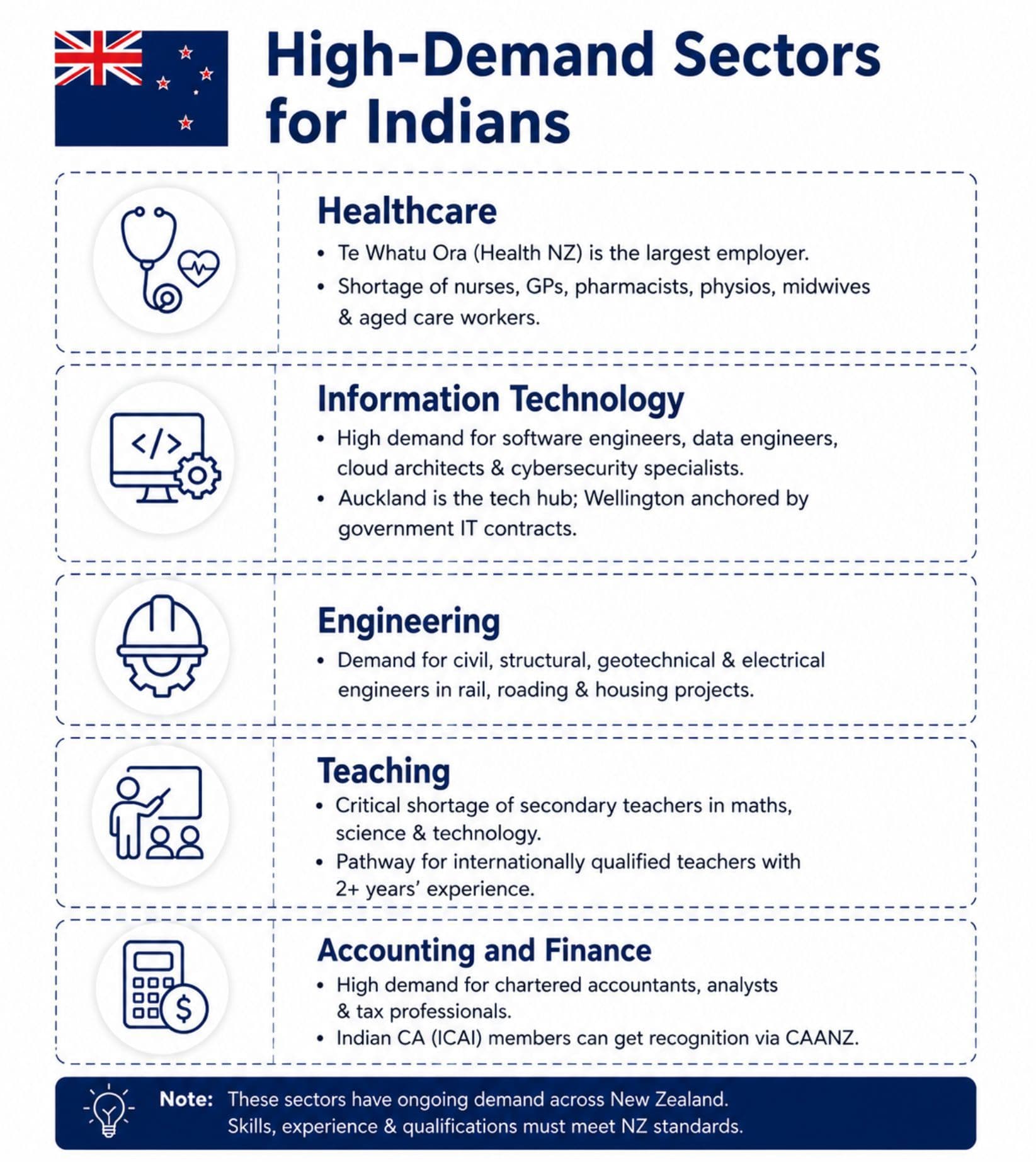
Healthcare. Te Whatu Ora (Health New Zealand) is the country's largest employer. Critical shortages exist for registered nurses, GPs, pharmacists, physiotherapists, midwives, and aged care workers. Several public hospitals run direct recruitment campaigns targeting Indian professionals.
Information Technology. Software engineers, data engineers, cloud architects, and cybersecurity specialists are in consistent demand. Auckland hosts New Zealand's main private tech sector (Xero, Datacom, Fisher & Paykel Healthcare). Wellington's IT sector is anchored by government department contracts - stable, well-resourced.
Engineering. Auckland's City Rail Link, national roading programmes, and housing build pipelines sustain demand for civil, structural, geotechnical, and electrical engineers.
Teaching. Secondary school teachers in mathematics, science, and technology are in critical shortage. The Teaching Council has a structured pathway for internationally qualified teachers with two or more years of post-qualification experience.
Accounting and Finance. Chartered accountants, financial analysts, and tax professionals are consistently sought. Indian CA (ICAI) members can apply for recognition through CAANZ (Chartered Accountants Australia and New Zealand).
Your Indian qualification gives you an educational foundation - not automatic rights to practice in New Zealand's licensed professions.
| Profession | NZ Registration Body |
| Medicine | Medical Council of NZ |
| Nursing | Nursing Council of NZ |
| Teaching | Teaching Council of Aotearoa NZ |
| Engineering (CPEng) | Engineering New Zealand |
| Accounting | CAANZ |
| Electricians | EWRB |
| Plumbers / Gasfitters | PGDB |
Start registration processes at least 6–12 months before you plan to begin work in New Zealand. Medical and nursing registration typically takes 6–18 months. Trades licensing can take 2–4 years. These timelines are the most common reason skilled Indian arrivals have a gap between arriving and working professionally.
New Zealand law gives every worker - regardless of visa status or nationality - the same minimum protections:
If an employer underpays you, threatens your visa status to silence complaints, or provides false information to INZ on your behalf, report it to Employment New Zealand's Labour Inspectorate or to INZ's migrant exploitation reporting line. Your visa status is protected when you report exploitation in good faith.
New Zealand's tax system is significantly simpler than India's. For most salaried employees, you barely interact with it - tax is deducted from your pay automatically, and for many people, that is the end of it.
New Zealand uses progressive income tax. Tax applies from the first dollar - there is no tax-free threshold.
2025–2026 income tax rates (1 April 2025 to 31 March 2026):
| Income Band (NZD/year) | Tax Rate |
| $0 to $15,600 | 10.5% |
| $15,601 to $53,500 | 17.5% |
| $53,501 to $78,100 | 30% |
| $78,101 to $180,000 | 33% |
| Over $180,000 | 39% |
Source: Inland Revenue NZ - confirmed by the Taxation (Annual Rates for 2025–26, Compliance Simplification, and Remedial Measures) Act 2026
These rates are marginal - only the income within each band is taxed at that rate. Someone earning NZD 85,000 does not pay 30% on everything. They pay 10.5% on the first NZD 15,600, then 17.5% on the next slice, then 30% on the portion from NZD 53,501 to NZD 78,100, then 33% on the final NZD 6,900.
For salaried employees, your employer deducts tax from every pay run and sends it to IRD automatically. Most salaried Indians with only employment income will not need to file an annual tax return. IRD sends a tax summary in April or May each year. If it is correct, you do nothing. If you overpaid (common after changing jobs mid-year), a refund processes automatically.
Alongside income tax, employees pay the ACC levy. For 2025–2026, this is 1.67% of liable earnings up to NZD 152,790. This funds New Zealand's no-fault accident compensation scheme - the same scheme that covers everyone in NZ for injury treatment, including visitors.
New Zealand's GST rate is 15%, applied to most goods and services. It is already included in every price you see in shops, restaurants, and online. The price shown is what you pay. No additional tax at checkout.
Your IRD number is New Zealand's equivalent of a PAN card. You need it to receive salary, open a bank account, and manage KiwiSaver.
Apply online through IRD's website after arriving in New Zealand. Bring your passport and visa. The number arrives within 8–10 working days. Until it arrives, your employer withholds tax at 45% - you get this back after filing your return, but it is a cash flow issue. Apply in week one.
KiwiSaver is New Zealand's workplace retirement savings scheme. When you start a job, you are automatically enrolled at 3% of gross salary. Your employer must contribute at least 3% on top. You can change your rate to 4%, 6%, 8%, or 10%.
The government adds NZD 260.72 per year (as of July 2025) as a member tax credit - free money if you contribute at least NZD 1,042.86 of your own money per year.
KiwiSaver is normally locked until age 65. Exceptions: first home purchase (withdraw to help with a deposit after three years of membership) and serious financial hardship.If you leave New Zealand permanently after 12 months, you can withdraw your own contributions and investment returns. Employer contributions and the government credit are generally not returned on emigration. Apply directly to your KiwiSaver provider.
Choose your fund based on your age. Under 50: a growth fund provides better long-term returns. Compare providers using sorted.org.nz.
This is the most financially significant tax provision most Indian migrants never hear about.
When you arrive in New Zealand and become a tax resident, you are normally required to pay NZ tax on your worldwide income - including Indian rental income, Indian bank interest, and Indian dividends.
But for the first 48 months of NZ tax residency, if you have not been an NZ tax resident in the past 10 years, most of your foreign-source income is exempt from NZ tax. This includes:
After 48 months, worldwide income becomes fully taxable in New Zealand. This four-year window is the time to restructure your Indian financial assets with proper advice from both a New Zealand tax accountant and an Indian NRI tax specialist. Not using this window means paying tax you were not required to pay.
Full guidance is available from IRD on foreign income for new migrants.
If you rent, your landlord pays council rates - you do not. If you buy, rates to your local council are your responsibility. Auckland Council rates for a typical residential property run NZD 2,500–4,500 per year. Wellington is similar.
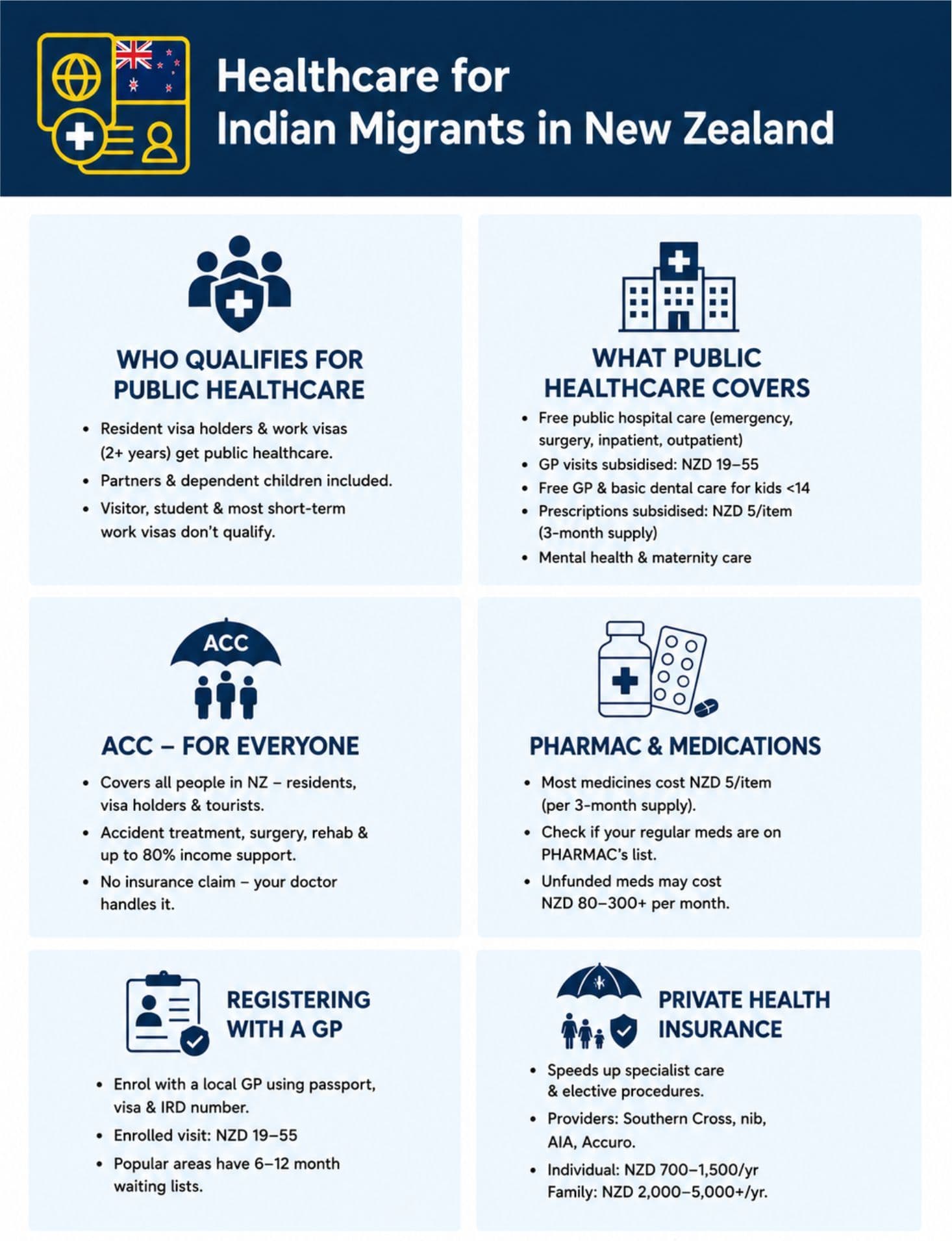
New Zealand's health system is publicly funded, nationally managed by Te Whatu Ora (Health New Zealand), and consistently rated among the better systems in the OECD. For immigrants, access depends on your visa status.
The core rule: Resident visa holders and people on work visas valid for two years or more qualify for publicly funded healthcare from the date their visa is granted. Their partners and dependent children are included.
Visitor visas, student visas, and most short-term work visas do not qualify. If you are on a student visa, you must carry private health insurance - most universities require proof of it before enrolment.
Official eligibility rules are on Health New Zealand's website.
For eligible residents and qualifying work visa holders:
What is not covered even for residents:
The Accident Compensation Corporation (ACC) is one of New Zealand's most notable institutions. It covers all individuals in New Zealand - citizens, residents, visa holders, and tourists - for the costs of medical treatment following an accident.
If you slip on stairs, are injured in a car accident, or tear a ligament playing cricket on the weekend, ACC covers your emergency treatment, surgery, rehabilitation, and up to 80% of your lost income during recovery. You do not need to file an insurance claim. Your doctor does it for you.
The trade-off: New Zealand does not allow personal injury lawsuits for accident-related harm. The country traded legal action for universal accident cover. More information at ACC's website.
PHARMAC manages the list of publicly funded medicines in New Zealand. Most prescriptions cost NZD 5 per item for a three-month supply for eligible patients. Over 65, prescriptions are free.
Not every medication available in India is funded in New Zealand. Before you move, check whether your regular medications appear on PHARMAC's funded schedule. Unfunded medications are available by prescription at full cost - NZD 80–300+ per month for some specialist drugs.
Your first step after arriving is registering with a GP (General Practitioner). Enrolled patients pay NZD 19–55 per visit. Non-enrolled walk-in patients pay NZD 80–150 or more.
To enrol, visit a medical centre near your address with your passport, visa documentation, and IRD number. Find practices accepting new patients near you at HealthPoint.
In Auckland and Wellington, GP practices in popular suburbs have 6–12 month waiting lists for new patients. Indian community networks - temple noticeboards, South Auckland WhatsApp groups - are consistently the fastest source of referrals to practices currently accepting enrolments.
Many residents with full public healthcare access also take out private health insurance. The reason is waiting times. Public hospital care for non-urgent (elective) procedures can involve months or years of waiting. Private insurance provides faster specialist appointments, private hospital access, and choice of surgeon.
Providers: Southern Cross Health Society (largest in NZ), nib, AIA, Accuro.
Individual basic plan: NZD 700–1,500 per year depending on age and excess level chosen. Family plan: NZD 2,000–5,000+ per year.
You can only hold private health insurance in New Zealand if you are also eligible for public healthcare. Private insurance supplements the public system.
Indian skin (higher melanin) produces less Vitamin D at New Zealand's latitudes, especially in winter. Vitamin D deficiency is common among Indians in New Zealand who work indoors. It affects energy levels, immunity, and bone health. A simple blood test through your GP checks your level.
This is the section Indian parents research most carefully - and rightly so. School quality, zone rules, and curriculum differences directly affect which suburb a family chooses to live in.
| Level | Years | Age |
| Early Childhood Education (ECE) | — | 0–5 |
| Primary School | Years 1–6 or 1–8 | 5–12 |
| Intermediate School | Years 7–8 | 11–13 |
| Secondary School / High School | Years 9–13 | 13–18 |
School attendance is compulsory from age 6 to 16. Most children start school on or near their 5th birthday.
State schools are free for resident and citizen children from age 5 to 19. Schools cannot charge for enrolment or tuition. Voluntary school donations (NZD 100–300 per year), uniforms, stationery, and school trips add NZD 500–1,000 per child per year.
Each state school has a geographic zone. Children who live in the zone are guaranteed a place. To enrol:
Children can start school at any time of the year - no need to wait for a new term. Choosing your suburb before signing a lease is important, especially in Auckland, where the school zone often drives the housing decision.
The government funds 20 free hours per week of ECE for children aged 3 to 5. This funding extends to children of qualifying work visa holders, not only residents. Beyond the 20 funded hours, additional care costs NZD 8–15 per hour. Full-time daycare in Auckland for a child under 3 runs NZD 300–600 per week - the biggest childcare cost shock for Indian families accustomed to grandparent support or domestic helpers.
Secondary students are assessed through the NCEA (National Certificate of Educational Achievement), administered by NZQA:
Students accumulate credits across the year through internal assessments and external exams. Achieving NCEA Level 3 qualifies students for university entry in New Zealand and is recognised by universities in Australia and the UK.
The curriculum emphasises critical thinking and inquiry-based learning over rote memorisation. For Indian children used to structured syllabus preparation, this is a genuine adjustment. Most adapt well within one to two terms.
Children of residents pay domestic tuition rates - much lower than international student fees.
| Level | Domestic (NZD/year) | International (NZD/year) |
| Undergraduate degree | 6,500–10,000 | 25,000–45,000 |
The government funds the first year of tertiary study fee-free for eligible first-time domestic students. Residents' children access StudyLink for interest-free student loans covering tuition and some living costs. Repayment is at 12% of income above NZD 24,128 per year - deducted automatically through PAYE once employed. The loan is interest-free while the student lives in New Zealand.
Private (independent) secondary schools charge NZD 10,000–25,000+ per year. Many Indian families in Auckland's higher-income suburbs choose private schools for smaller class sizes and perceived academic rigour. State integrated schools - formerly private schools now partly government-funded - charge attendance dues of NZD 500–1,200 per year and are a middle option.
New Zealand schools provide funded English Language Learning (ELL) support for children arriving with limited English - typically delivered through withdrawal sessions or in-class support. Most children reach conversational fluency within six months and academic language proficiency within two years.
Continuing to speak Hindi, Punjabi, Gujarati, Tamil, or your home language at home does not slow English development. Research consistently shows it supports overall language acquisition.
Getting your financial infrastructure in place in the first week removes a major source of early stress.
The five main banks in New Zealand:
| Bank | Pre-Arrival Option | Notes |
| ANZ New Zealand | Yes (up to 90 days before arrival) | Largest bank, most ATMs nationally |
| ASB Bank | Yes | Popular with new migrants, strong app |
| BNZ | Limited | Strong business banking |
| Westpac NZ | Yes | Good international transfer tools |
| Kiwibank | No | NZ-owned, no pre-arrival option |
To open an account in branch you need: passport, visa documentation, and a New Zealand address (temporary accommodation is acceptable). Add your IRD number once you have it - some banks require it to unlock full features.
ANZ and ASB both market specifically to arriving migrants. ANZ allows pre-arrival account setup up to 90 days before your arrival date. ASB provides online banking access before you land.
The Reserve Bank of India's Liberalised Remittance Scheme (LRS) allows Indian residents to remit up to USD 250,000 per financial year abroad for permitted purposes, including emigration and maintenance of family abroad.
A TCS (Tax Collected at Source) of 20% applies to LRS remittances above INR 7 lakh per financial year (except education and medical purposes). This TCS is refundable when you file your Indian income tax return - it is a cash flow consideration, not a permanent tax.
Comparing transfer services on a NZD 10 lakh transfer:
| Provider | Typical fee | What you save vs bank wire |
| Wise | 0.5–1% (transparent) | NZD 2,000–4,000 vs bank |
| OFX | 0.3–0.8% (larger amounts) | NZD 2,500–4,500 vs bank |
| Indian bank wire | 2–4% + flat fee | Benchmark (expensive) |
For regular salary transfers or a large initial relocation of savings, Wise provides the mid-market exchange rate with transparent fees. Always compare the total amount received in NZD - not just the advertised rate.
When you become a non-resident of India, FEMA regulations require you to convert your Indian savings accounts. Tell your Indian bank before or shortly after your departure date.
Failure to convert is a FEMA violation. Most banks handle this with a form and some documentation. Do it promptly.
Owning property in India as an NRI is permitted under RBI guidelines. Rental income from Indian property is taxable in India and, once your New Zealand 48-month transitional residency window ends, also taxable in New Zealand. Maintain Indian ITR filings even as an NRI if you have rental income or investment returns.
TDS applies to rental income received by NRIs - tenants must deduct 30% from rent payments to NRI landlords. This TDS is creditable against your Indian tax liability.
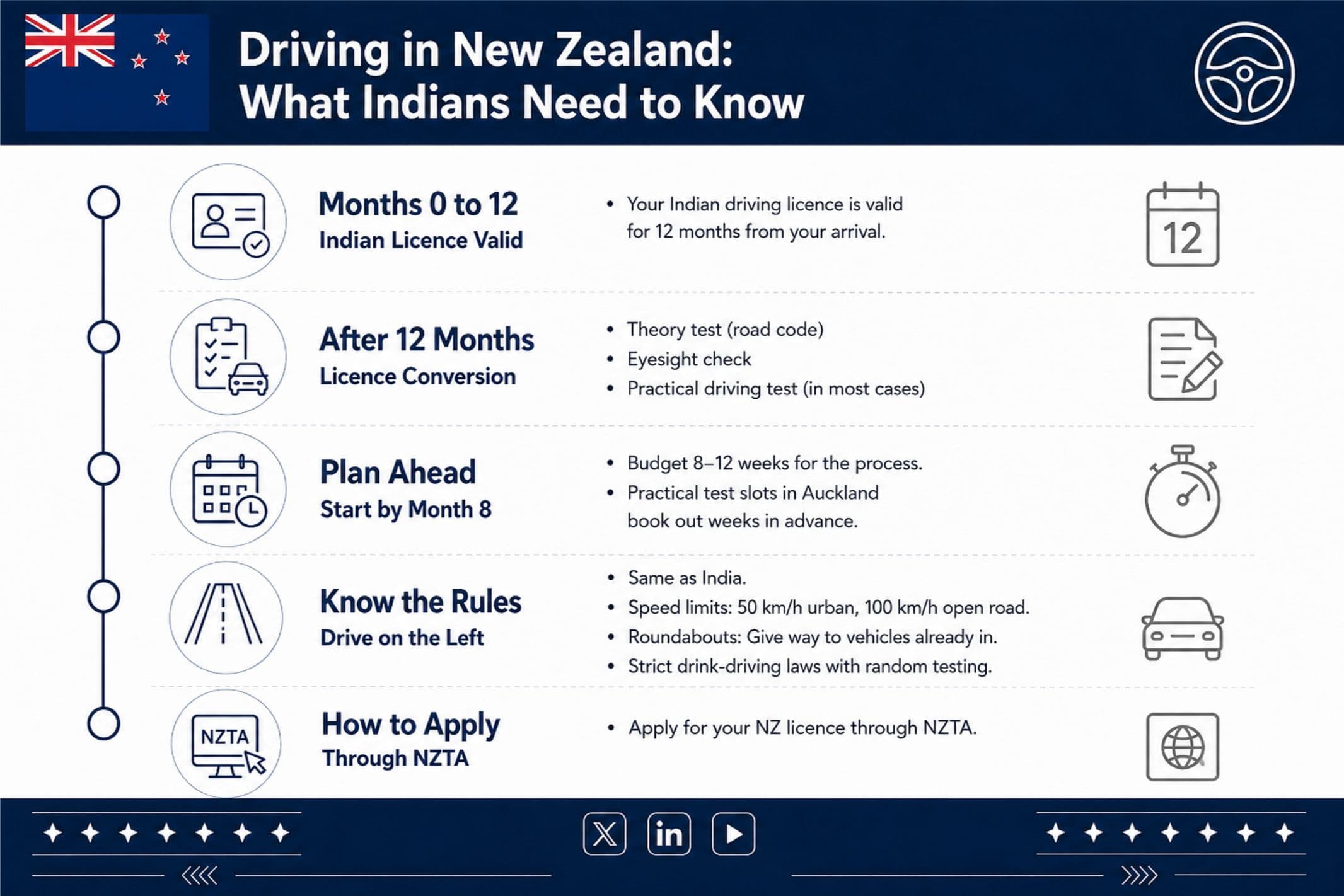
Your Indian driving licence is valid in New Zealand for 12 months from your date of arrival. After 12 months, you must convert to a New Zealand licence.
Unlike UK or Australian licence holders, Indians cannot simply swap their licence. The conversion requires:
Budget 8–12 weeks from when you start the process. Practical test appointments in Auckland book out several weeks in advance. Start by month 8, not month 11.
New Zealand drives on the left - same as India. Speed limits: 50 km/h urban, 100 km/h open road. Roundabouts give way to vehicles already in the roundabout. Drink-driving enforcement is strict with random breath testing.
Apply for your NZ licence through NZTA.
Your Indian CIBIL score does not transfer to New Zealand. You start with no NZ credit history. New Zealand uses Equifax NZ, Illion, and Centrix.
Build credit by using a NZ credit card responsibly - pay the full balance each month. Pay all bills on time. Avoid multiple credit applications in a short period. A clean NZ credit history over 12–24 months is needed for larger financial decisions, particularly mortgage applications.
Understanding daily life in New Zealand helps set realistic expectations. The adjustment is real for every Indian who moves there. Knowing what to expect reduces the culture shock considerably.
New Zealand ranked 3rd in the world on the 2025 Global Peace Index. There is no significant terrorism, no political violence, and violent crime rates far below India, Australia, the UK, and the United States. In practical terms: children walk to school by themselves in most suburbs. Public transport at night is generally safe. This is the daily quality-of-life difference Indians most consistently describe as the biggest surprise.
The New Zealand working week is 40 hours. Most professional roles run Monday–Friday, 8 or 9am to 5 or 6pm. The culture does not reward being seen to work long hours. Taking your four weeks of annual leave is normal - not a sign of disengagement or lack of ambition.
Workplaces are flat. You call your manager by their first name from day one. Hierarchy exists but is not performed through titles or deference. Meetings expect contribution from everyone regardless of seniority. Direct, polite disagreement is respected. "I think there is a better approach" is a professional statement, not an act of insubordination.
Kiwis use understatement as a default. "Not too bad" means good. "A bit tricky" signals a serious problem. "She'll be right" is a genuine cultural response to difficulty - a preference for calm over drama. Getting used to this register takes a few months. Learning it avoids the misreading that catches Indian professionals off guard in early workplace conversations.
New Zealand is officially bicultural under Te Tiriti o Waitangi (the Treaty of Waitangi, signed in 1840). This shapes public life visibly:
You are not required to speak Māori. But showing basic familiarity with Māori place names and respectful understanding of the Treaty opens social connections that formal networking does not. The Ministry for Culture and Heritage provides accessible background on New Zealand history.
| Phrase | Meaning |
| Kia ora | Hello / thank you |
| She'll be right | It will be fine |
| Good as gold | Excellent / no problem |
| Dairy | Corner convenience store |
| Jandals | Flip-flops |
| BYO | Bring your own alcohol (to an unlicensed restaurant) |
| Tramping | Hiking |
| Fortnight | Two weeks |
| Bach (pronounced "batch") | Holiday house / vacation cabin |
Finding Indian food is not difficult in Auckland, Wellington, and Hamilton. South Auckland (Papatoetoe, Manurewa, Otahuhu) has multiple Indian grocery stores, sweet shops, South Indian restaurants, Punjabi dhabas, and Indian bakeries. Brands like MDH, Aashirvaad, Everest, Haldiram's, Patanjali, MTR, and Lijjat are stocked. Fresh curry leaves, methi, raw mango, and Indian lentil varieties are available from specialist grocers.
Bollywood films screen in South Auckland cinemas, often within days of their India release date.
In Christchurch and smaller cities, the selection is smaller but growing. Mainstream supermarkets stock basic Indian pantry items but at limited selection and higher prices than Indian grocers.
| Months | Season |
| December – February | Summer (warmest; Christmas is a beach holiday) |
| March – May | Autumn |
| June – August | Winter (coldest) |
| September – November | Spring (best time to arrive) |
Auckland is subtropical - warm, humid, rarely below 10°C in winter. Wellington is noticeably cooler and consistently windy. Christchurch has cold winters with occasional frost.
New Zealand homes - especially older rentals - are poorly insulated by Indian standards. A good heat pump makes winter comfortable. Without one, a New Zealand winter in Wellington or Christchurch is genuinely cold indoors, which surprises migrants from warmer Indian states.
Arrive in spring (September–November) if you can. Weather is improving, school terms allow children to settle in naturally, and the rental market is less competitive than the January peak.
New Zealand's UV index reaches 12–14 on summer days in most cities - significantly higher than equivalent latitudes in the Northern Hemisphere due to the thinner ozone layer over the Southern Hemisphere. Sunscreen (SPF 50+) applied before going outdoors and reapplied every two hours is a daily necessity, not a beach-day extra. This applies to all skin types, including darker Indian skin tones which can still burn.
More than a third of New Zealand's land area is protected conservation estate managed by the Department of Conservation (DOC). Walking tracks, beaches, lakes, and forests are within 30–90 minutes of every major city, year-round.
Weekend culture is less about shopping malls and more about beaches, hiking, and outdoor activities. Indian families who embrace this shift - even starting with Sunday drives to a beach - integrate faster and consistently report it as one of the unexpected improvements in their quality of life.
The first six months are genuinely hard for most Indian migrants - not because New Zealand is unwelcoming, but because you have removed yourself from every established support network. Extended family, spontaneous family visits, the familiar density of Indian social life - none of it exists at 10,500 km.
Most Indian migrants describe months 12–24 as when New Zealand finally starts to feel like home rather than a temporary posting. The first year is not representative of what your life there will eventually be.
What consistently helps:
This decision affects housing cost, commute, community size, school zones, and your daily quality of life more than any other single choice after your visa.
New Zealand's largest city. 1.7 million people. Home to approximately 155,000 Indian New Zealanders, 64% of all Indians in the country.
Auckland has everything: the widest job market, the most complete Indian community infrastructure (temples, gurdwaras, Indian grocery stores, Bollywood cinemas, cricket leagues), the most competitive school zones, and the only direct flights from India.
It also has the highest rents, the most expensive housing, the worst traffic, and the most competitive rental market. Auckland was built for cars and has not adapted to its current size. Rush hour on the Southern Motorway is genuinely painful.
Best for: Healthcare workers, IT professionals, finance, corporate professionals, families who need a large Indian community and the widest range of schooling options.
Key Indian suburbs: Papatoetoe, Manurewa, Otahuhu (South Auckland - highest Indian density, most affordable, strongest community). Flat Bush, Botany, Howick (East Auckland - higher income area, strong school zones, larger homes, higher rents).
Median weekly rent (3-bedroom): NZD 750–1,000 per week
New Zealand's capital. 215,000 urban residents. Compact and walkable - you can cross central Wellington in 20 minutes. Wellington is the seat of government and the cultural capital: Te Papa Museum, the main national theatre, New Zealand's best restaurant scene per capita.
The public sector dominates employment - government departments, regulatory bodies, public service. The technology sector is anchored by government IT contracts and includes companies like Xero's NZ headquarters, Vista Group, and various government IT suppliers.
Wellington is famously windy. Locals acknowledge it without apology. But the walkability, cultural density, and shorter commutes make it the city Indian migrants in government, policy, law, and creative sectors consistently prefer after Auckland.
Best for: Public sector professionals, policy workers, lawyers, IT professionals on government contracts, academics, couples prioritising walkability and culture.
Median weekly rent (3-bedroom): NZD 650–900 per week
New Zealand's third-largest city. About 400,000 residents on the South Island's east coast. The city rebuilt extensively after the 2010–2011 earthquakes and now has some of the newest central city infrastructure in the Southern Hemisphere.
Christchurch is consistently the most affordable major New Zealand city for housing. A 3-bedroom house rents for NZD 550–750 per week - significantly less than Auckland or Wellington. The job market is strong in engineering, construction, agriculture, healthcare, and food manufacturing. The Indian community is smaller than in Auckland but growing.
Best for: Engineers, construction professionals, healthcare workers, families prioritising housing affordability over community scale.
Median weekly rent (3-bedroom): NZD 550–750 per week
130 km south of Auckland. About 180,000 people. New Zealand's fourth-largest city and the fastest-growing Indian community centre outside Auckland. Lower housing costs than Auckland, a major university (University of Waikato), and strong employment in agriculture, food manufacturing, healthcare, and education.
Hamilton is connected to Auckland by road (1.5 hours) and growing rail services, making it viable for professionals with Auckland connections who want lower living costs. Many Indian families choose Hamilton as the practical compromise between Auckland's community size and a manageable rent.
Best for: University-linked professionals, agricultural sector workers, families prioritising housing affordability.
Median weekly rent (3-bedroom): NZD 500–680 per week
| Factor | Auckland | Wellington | Christchurch | Hamilton |
| Indian community | Largest | Medium | Smaller, growing | Growing fast |
| Housing cost | Highest | High | Moderate | Lower |
| Job market breadth | Widest | Good (govt/tech) | Good (eng/health) | More limited |
| Winter indoors | Mild | Cold, windy | Cold, frost | Cold |
| Traffic | Significant | Manageable | Light | Light |
| Commute (typical) | 30–60 min | 15–30 min | 15–30 min | 15–25 min |
The 2023 New Zealand Census counted 292,092 people of Indian ethnicity - 5.8% of the country's total population, up 54% from 2018. Indians are the third-largest ethnic group in New Zealand, after Europeans and Māori.
| Region | Indian Population |
| Auckland | ~155,000 |
| Wellington | ~22,000 |
| Hamilton (Waikato) | ~17,000 |
| Christchurch (Canterbury) | ~15,000 |
| Bay of Plenty | ~10,000 |
Source: Stats NZ 2023 Census
Religious institutions. The Sri Venkateswara Swami Temple in Manukau is one of the largest Hindu temples in the Southern Hemisphere. Multiple ISKCON centres serve the broader Hindu community. Sikh gurdwaras across South Auckland provide langar (community meals open to everyone) daily. Islamic centres in Auckland and Wellington serve Indian Muslim families. Jain associations operate in Auckland.
Cultural events. Auckland's Diwali Festival is one of the city's largest annual public events - attended by people of all backgrounds. Holi, Navratri, Vaisakhi, and Janmashtami are properly organised public community events, not informal gatherings.
Indian business community. Indian-owned businesses span grocery retail, restaurants, IT consulting, medical clinics, and real estate. Indian Chambers of Commerce operate in Auckland and Wellington.
Political representation. Indians are represented in New Zealand's Parliament and across Auckland's local councils. This affects community services, resource allocation, and civic recognition in measurable ways.
Second generation. The children of the first major migration wave are now in their 20s and 30s - professionals across medicine, law, engineering, and technology who grew up in New Zealand. They bridge both cultures and are an invaluable resource for new arrivals trying to understand how New Zealand actually works versus how it is described from the outside.
Temple and gurdwara community noticeboards carry housing leads, job referrals, and GP recommendations that are often more current and accurate than anything publicly listed. WhatsApp groups for Indian New Zealanders share information faster than any formal system.
For a new arrival, engaging with these networks in the first two weeks - before you feel settled, before you think you need it - is one of the highest-value actions you can take.
These are the most frequent and costly errors Indian migrants make. Learning from them costs nothing.
Applying for the wrong visa. Many Indians apply for a Visitor Visa with an undisclosed intention to convert to a work visa after arriving. Converting status while in New Zealand is sometimes possible but not straightforward and not guaranteed. Apply for the correct visa from the start.
Not verifying employer accreditation. Some job offers come from non-accredited employers - sometimes genuine companies that have not completed the process, sometimes fraudulent offers. Check INZ's accredited employer search before accepting any offer.
Submitting the wrong Criminal Record Check. Since December 2025, only certificates from the Regional Passport Office of the Ministry of External Affairs are accepted. Local police station certificates are rejected outright. Many applicants using outdated guidance continue to make this mistake.
Not starting professional registration early enough. Medical, nursing, engineering, teaching, and trades registrations take 6–18 months. Arriving in New Zealand and then beginning the registration process means months without professional income. Start registration before your visa application if possible.
Underestimating first-month costs. The bond, advance rent, furniture, SIM card, and groceries before your first pay cheque require NZD 10,000–18,000 above your ongoing monthly budget. Many people arrive without enough and start their New Zealand life under financial stress.
Signing a lease without checking heating. New Zealand winters are not extreme, but old rental homes without insulation or a heat pump are genuinely cold. Always verify what heating exists in a property before signing. A heat pump is non-negotiable in Wellington or Christchurch.
Choosing a suburb only for Indian community density, without checking school zones. South Auckland has the largest Indian community and the most affordable rents. But school zone performance varies significantly within South Auckland. Research individual schools using ERO (Education Review Office) school reviews before committing to a suburb.
Not using the 48-month transitional tax exemption. This four-year window allows most foreign income (Indian rental income, investment returns) to be exempt from NZ tax. Not structuring Indian assets appropriately during this window means paying tax you were not required to pay. See a NZ tax accountant who understands the rules before your first NZ tax year filing.
Waiting to convert your driving licence. Your Indian licence works for 12 months. After that, you need a NZ licence requiring theory and practical tests. Start the process at month 8, not month 11.
Not engaging with the community early. Many Indian newcomers stay home and wait until they feel settled before reaching out. This is exactly backward. Join a temple, gurdwara, or community group in the first two weeks. Build the network before you need it.
Using an unlicensed immigration agent. Many Indian migrants pay substantial fees to unlicensed "immigration consultants" who operate illegally, give wrong advice, and have no accountability. Always verify licence status at iaa.govt.nz before paying anyone.

Everything you need for a UK apostille in 2026 - FCDO process, fees, timelines, document types, non-Hague countries, and common rejection fixes.
Your complete guide to fingerprinting in India, covering Aadhaar, passports, background checks, immigration, property registration, and your legal rights.
Learn how Canada apostille services work after the Hague Convention. Understand provincial authorities, Global Affairs Canada process, fees, timelines, document requirements, and how to apostille Canadian documents for international use.
Need help with your application or background check?
Contact us now and speak with a dedicated Globeia expert today.