State Apostille Services from USA
Apostille Services in California
Apostille Services in Texas
Apostille Services in Florida
Apostille Services in Washington
Services from Canada
Services from United Kingdom
Services from New Zealand

Portugal, Spain, and Mexico are among the countries Americans can consider for a move abroad in 2026, but the right choice depends on your priorities. From retiring in Panama or Costa Rica to working remotely from Spain or Portugal, this blog explores the options, visa pathways, living costs, and other factors to consider before relocating.
Moving abroad can mean different things to different people. Some Americans want a lower cost of living, others are looking for better healthcare or a safer environment. With more countries offering retirement and remote work visa options, relocating from the USA has become a realistic possibility for people with different goals.
But choosing a destination takes more than looking at popular expat lists. Living costs, safety, healthcare, language, and immigration requirements can vary considerably from one country to another. This blog compares the best countries for Americans to move to in 2026 and what each destination offers.
We combined five 2026-era rankings with current visa rules for US passport holders:
Global Peace Index
Cost of Living Index
Internations Expat Insider 2026
International Living Rankings 2026
EF's English Proficiency Index

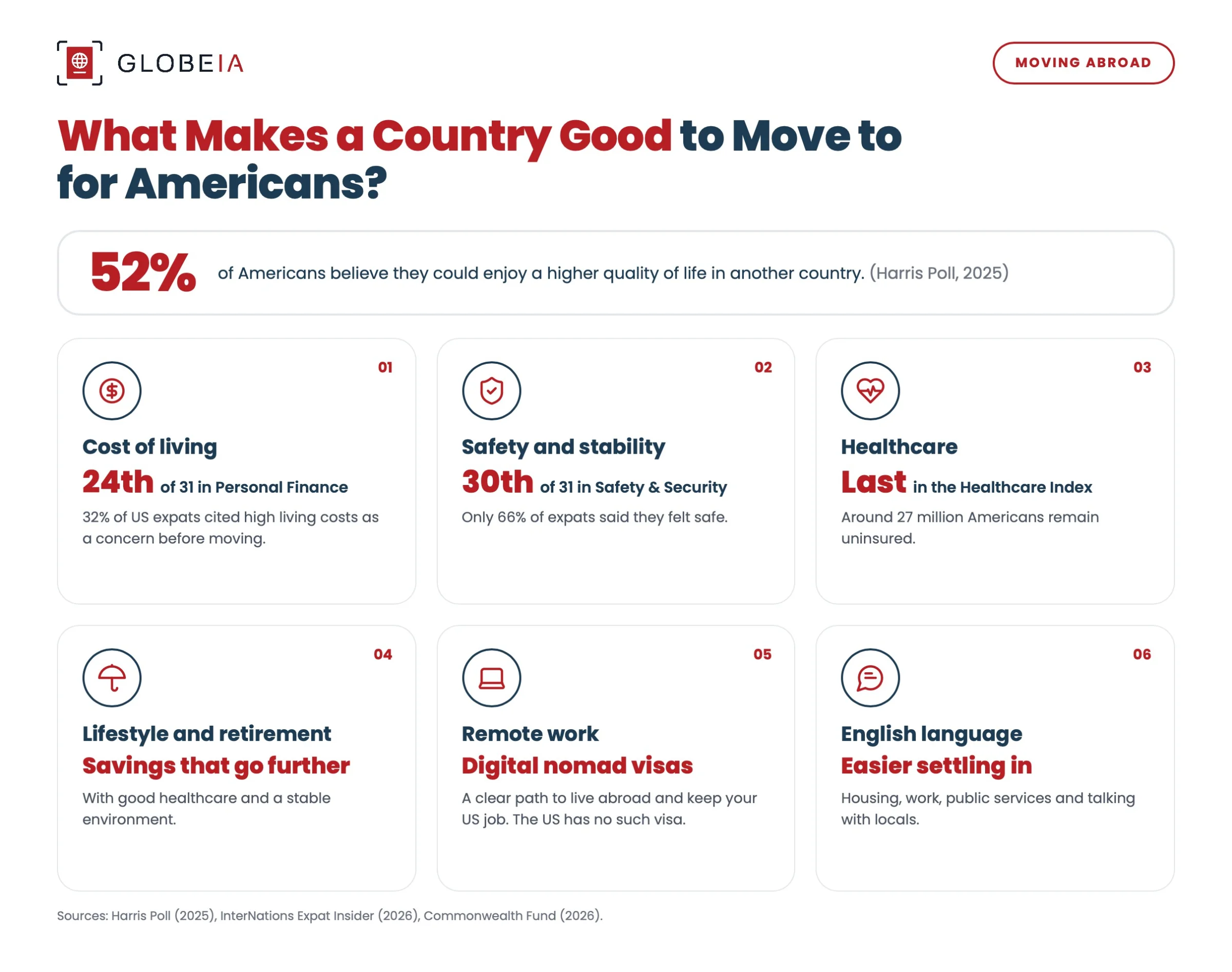
In 2026, more Americans are considering life abroad in search of lower living costs, better healthcare, safer surroundings, and a better quality of life. A 2025 Harris Poll found that 52% of Americans believe they could enjoy a higher quality of life in another country. Below are some of the factors worth considering when choosing a country to move to.
The US remains an expensive place to live, with housing, healthcare, groceries, and everyday expenses taking up a significant share of household budgets. In the 2026 InterNations survey, 32% of expats in the US said the high cost of living was a concern before moving, and the country ranked 24th out of 31 in the Personal Finance Index.
Safety is another major consideration, particularly for people concerned about gun violence and political uncertainty. The US ranked 30th out of 31 countries in the 2026 Expat Insider Safety & Security Index, with only 66% of expats saying they felt safe.
Healthcare is one of the biggest reasons people consider moving away from the US. The country ranked last in the 2026 Expat Insider Healthcare Index, with 66% of expats rating healthcare affordability negatively. A 2026 Commonwealth Fund report also found that around 27 million Americans remain uninsured, making countries with accessible public healthcare and lower medical costs worth considering.
Many Americans who have built substantial savings over their careers, including tech professionals nearing retirement, are exploring countries where they can enjoy a safe and comfortable life after leaving the workforce. They usually look for places where their retirement savings can go further while still offering good healthcare and a stable environment.
With remote work becoming more common, many Americans are looking at countries that have digital nomad visas and a clear pathway to living abroad while keeping their US-based jobs. Since the US does not offer a specific digital nomad visa, Americans exploring relocation seek a new environment where they can work remotely and enjoy a change of surroundings.
Moving to a country where English is widely spoken can make settling in easier, particularly when finding accommodation, working, accessing public services, and communicating with locals.
To legally move out of the United States, you must obtain a visa or residence permit issued by your target country. A US passport does allow visa-free tourist visits (usually up to 90 days) in many parts of the world. But long-term living, working, or retiring abroad requires a specific legal pathway. These are some of the options you have:
Considering all the factors above, we have created a list of the top 10 countries that Americans can consider moving to in 2026:
Rank | Country | Best For |
1 | Portugal | All-rounder: safe, mild climate, good healthcare. |
2 | Spain | Lifestyle and healthcare, with EU access. |
3 | Mexico | A fast, close-to-home start and a large expat community. |
4 | Panama | Expat-friendliness, US-dollar living and tax. |
5 | Costa Rica | Nature, wellness, and retirement. |
6 | Greece | Retirees; 7% flat tax on foreign income and Mediterranean life. |
7 | Ireland | English-speaking Europe and Irish-ancestry citizenship. |
8 | Canada | Familiarity and careers, if you can qualify. |
9 | Italy | Food, culture, and southern-Italy value. |
10 | Thailand | Low costs and the world's happiest expats. |

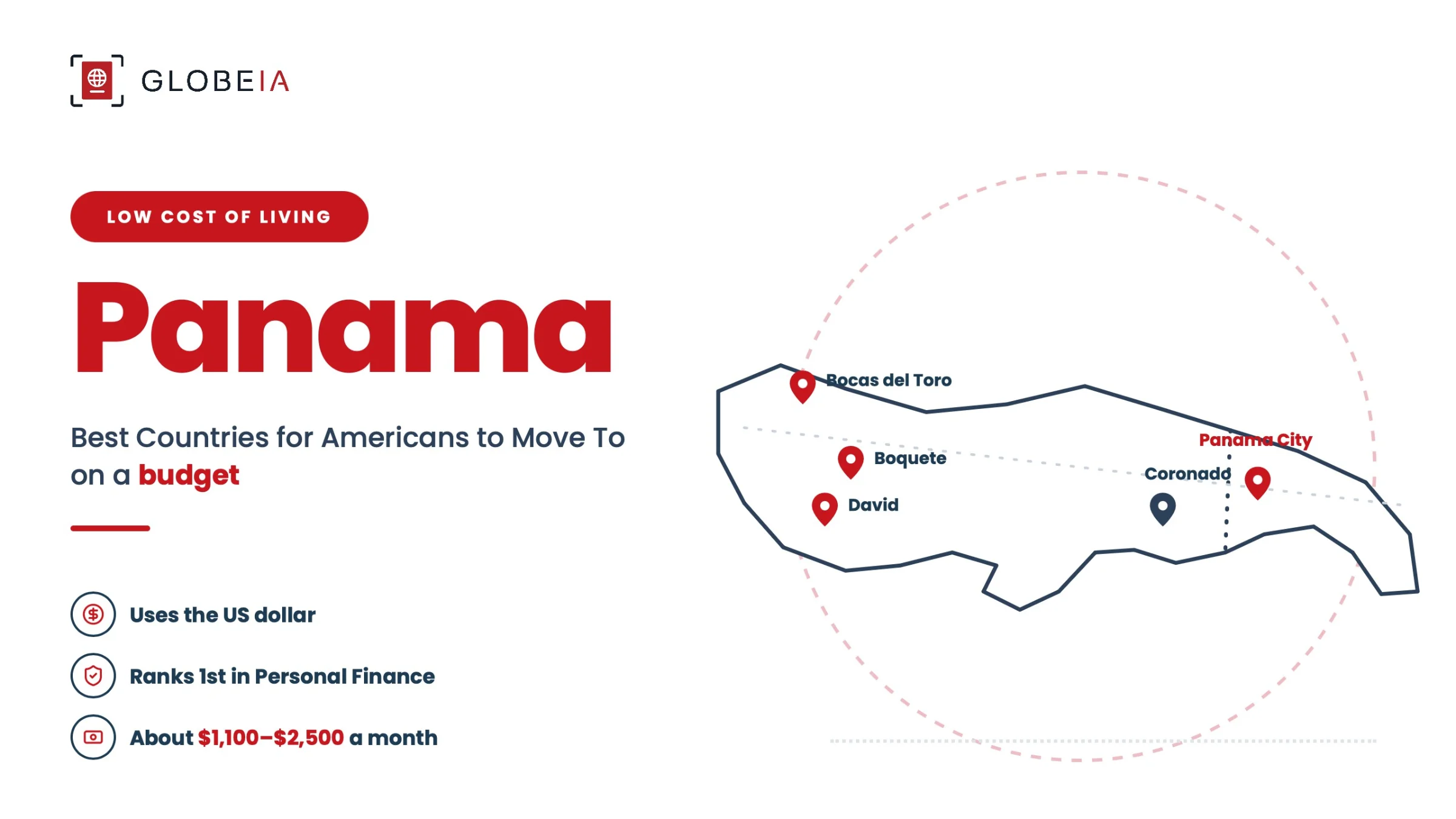
Panama ranks 1st in the 2026 Personal Finance Index, with 90% of expats saying their household income is enough to live comfortably. It also uses the US dollar as its official currency, so Americans do not have to deal with currency conversion for everyday expenses.
Top Cities: Panama City, David, Boquete, Bocas del Toro, Coronado.
Average Monthly Income Required: Around $1,100-$2,500 for one person, depending on the city and accommodation. David is among the more affordable choices, while Panama City and Coronado require a higher budget.

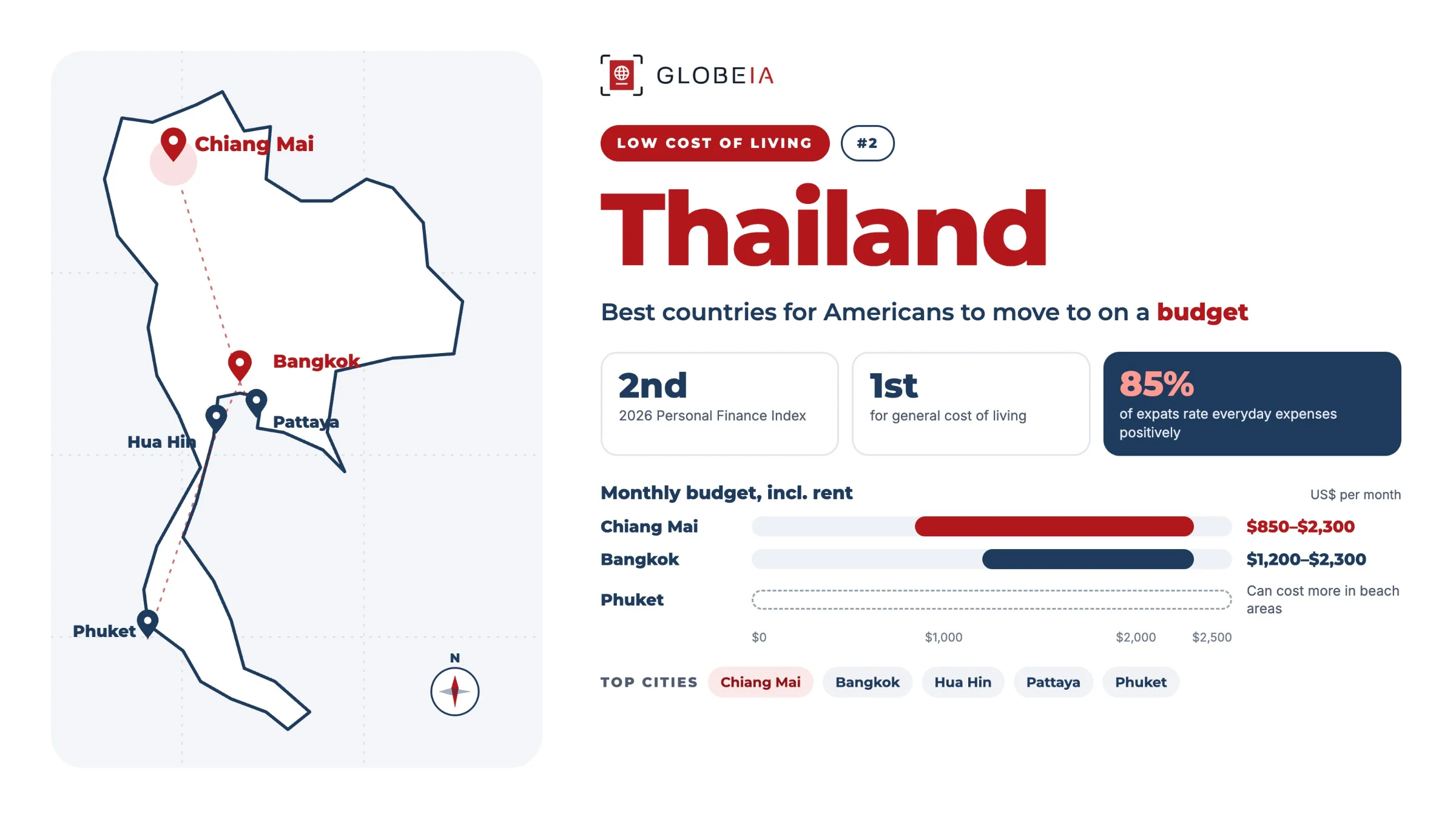
Thailand ranks 2nd in the 2026 Personal Finance Index and 1st for general cost of living, with 85% of expats rating everyday expenses positively. From affordable local meals and public transport to reasonably priced apartments, cities like Chiang Mai make it possible to enjoy a comfortable lifestyle on a smaller budget.
Top Cities: Chiang Mai, Bangkok, Hua Hin, Pattaya, Phuket.
Average Monthly Income Required: Around $850-$2,300 in Chiang Mai and $1,200-$2,300 in Bangkok, including rent and regular living expenses. Phuket can cost more, particularly in popular beach areas.
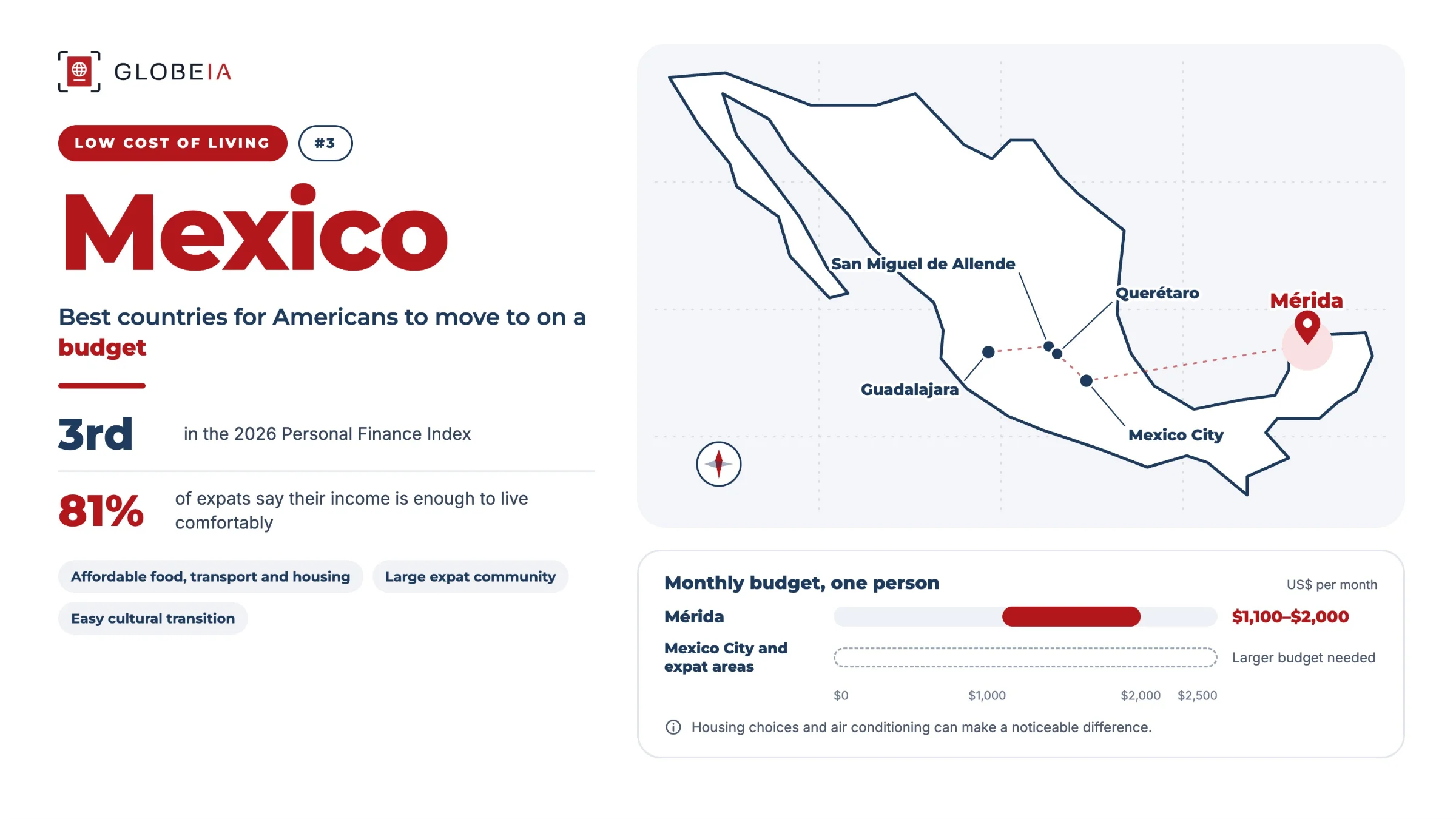
Mexico ranks 3rd in the 2026 Personal Finance Index, with 81% of expats saying their income is enough to live comfortably. It also offers affordable local food, public transport, and housing in several cities, along with a large expat community and a relatively easy cultural transition for Americans.
Top Cities: Mérida, Guadalajara, Querétaro, Mexico City, San Miguel de Allende.
Average Monthly Income Required: Around $1,100-$2,000 for one person in Mérida, with larger budgets needed for Mexico City and popular expat neighbourhoods. Housing choices and the use of air conditioning can make a noticeable difference to monthly expenses.
Portugal ranks 4th in the 2026 Personal Finance Index, with 61% of expats rating its general cost of living positively. While Lisbon has become considerably more expensive, in smaller cities such as Braga and Coimbra, you can get lower rents and easier access to everyday services.
Top Cities: Braga, Coimbra, Porto, Aveiro, Lisbon.
Average Monthly Income Required: Around €1,200-€1,800 for one person in smaller cities such as Braga and Coimbra. Porto may require approximately €1,400-€2,000, while Lisbon generally needs a higher budget, particularly for private accommodation.
Also Read:

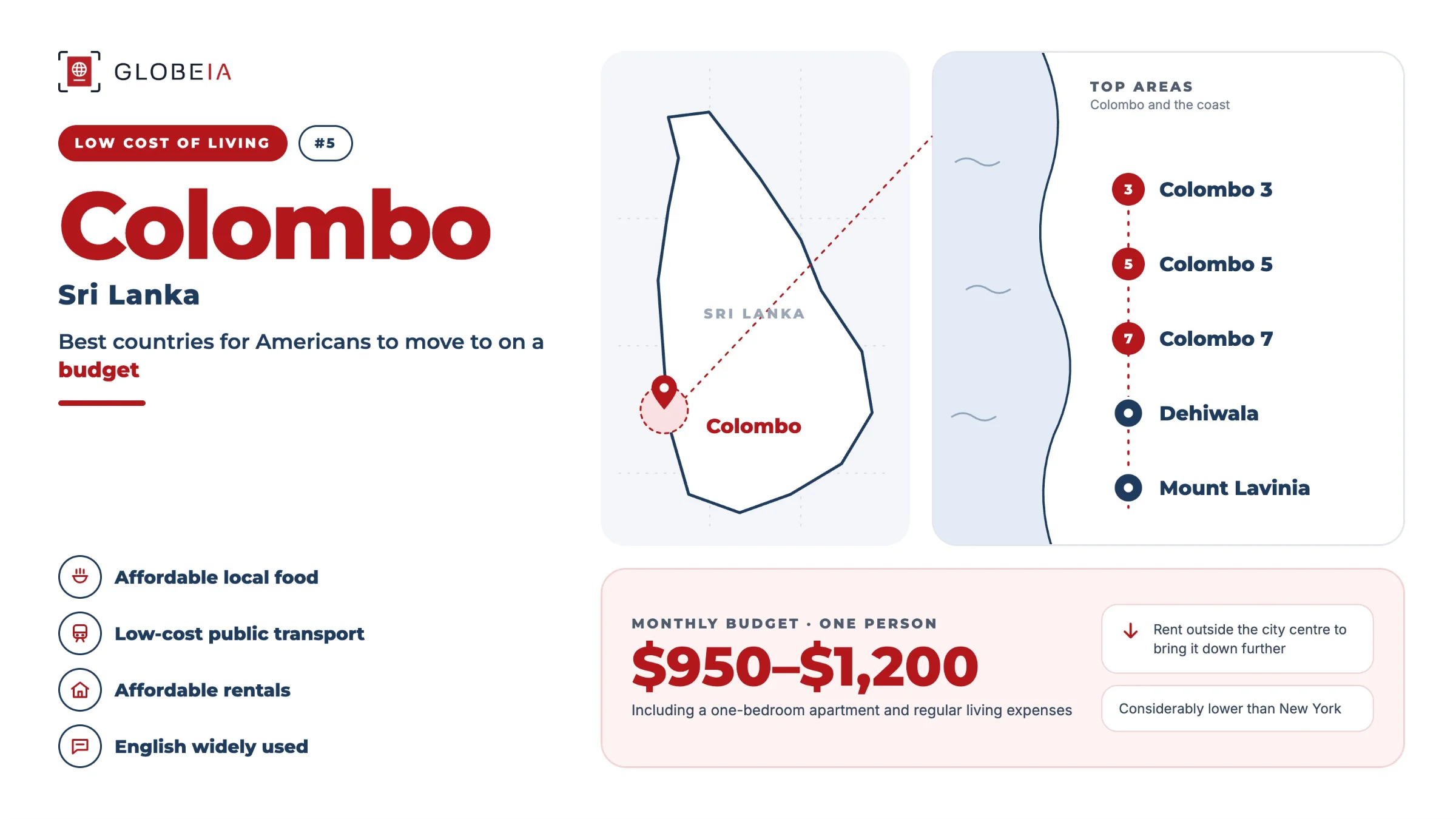
Colombo is another affordable option for Americans looking to live in South Asia. Its cost of living is considerably lower than that of major US cities like New York, with affordable local food, public transport, and rental accommodation. English is also widely used in business and everyday interactions, making it easier for English-speaking newcomers to communicate.
Top Areas: Colombo 3, Colombo 5, Colombo 7, Dehiwala, Mount Lavinia.
Average Monthly Income Required: Around $950-1,200 for one person, including a one-bedroom apartment and regular living expenses. Renting outside the city centre can bring the monthly budget down further.

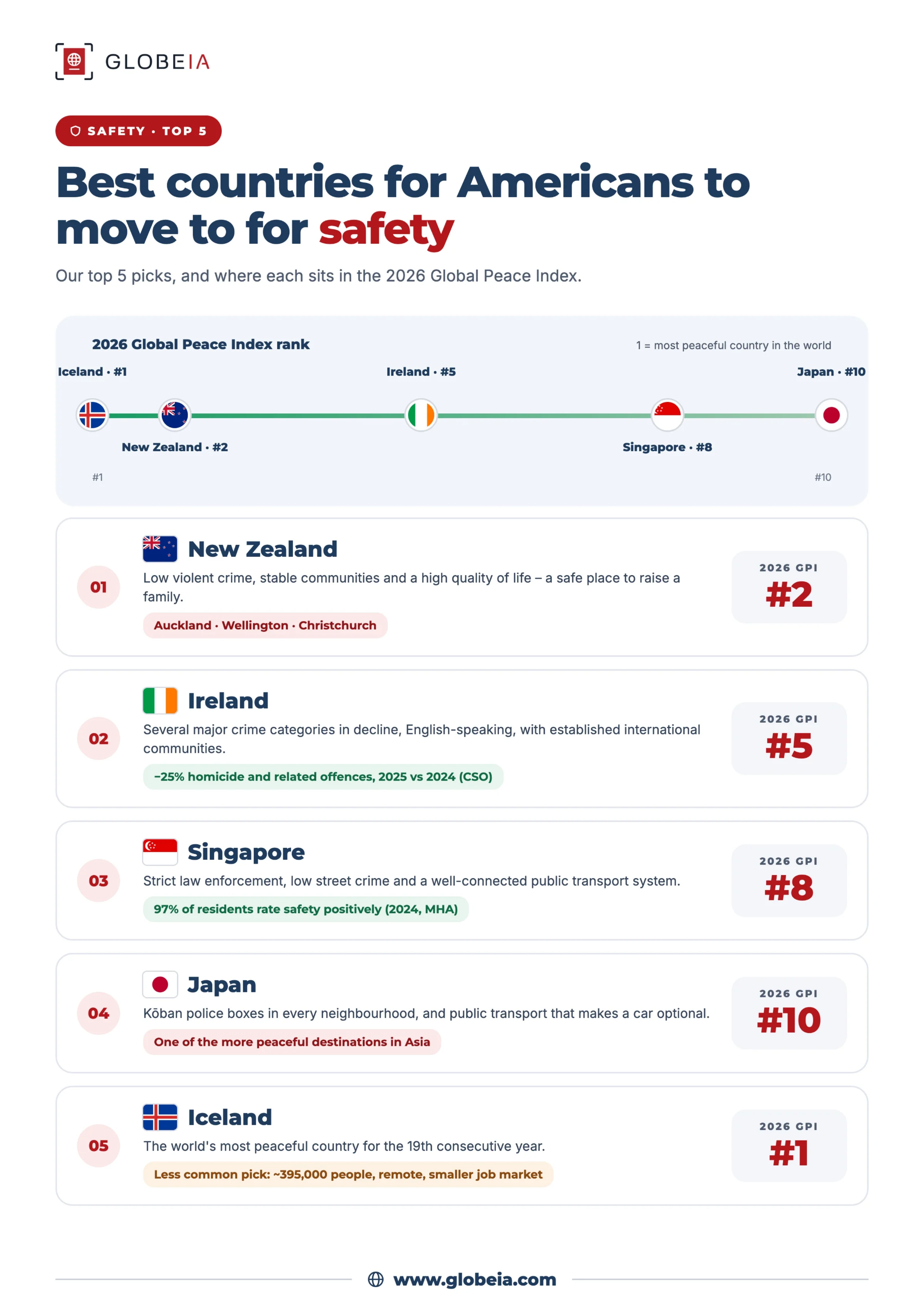
Ranked 2nd in the 2026 Global Peace Index, New Zealand is a great choice for Americans looking for a peaceful environment and a safe place to raise a family. Its relatively low levels of violent crime, stable communities, and high quality of life make cities such as Auckland, Wellington, and Christchurch attractive relocation options.
Also Read Our Complete Guide for Americans Moving to New Zealand 2026
Ireland ranks 5th globally in the 2026 Global Peace Index and has seen a decline in several major crime categories. According to Ireland's Central Statistics Office, recorded homicide and related offences fell by 25% in 2025 compared with 2024. Its English-speaking environment and established international communities also make it a favourable option for Americans moving abroad.
Singapore ranks 8th in the 2026 Global Peace Index and is known for its strict law enforcement and high levels of public safety. In 2024, 97% of surveyed residents gave positive ratings to the country's general safety and security, according to Singapore's Ministry of Home Affairs. Its well-connected public transport system and low levels of street crime add to its appeal for Americans.
Japan ranks 10th in the 2026 Global Peace Index, making it one of the more peaceful destinations in Asia for Americans considering a move abroad. Its extensive network of police boxes, known as kōban, allows residents to access local police assistance within their neighbourhoods. Japan also has a well-developed public transport system, so residents can travel between cities and commute without depending on a personal vehicle.
Iceland holds the 1st position in the 2026 Global Peace Index, making it the world's most peaceful country for the 19th consecutive year. But despite its excellent safety record, it is a less common relocation choice for Americans than destinations such as Ireland or New Zealand, partly because its population is only around 395,000, its location is relatively remote, and its job market is smaller than those of larger destinations.

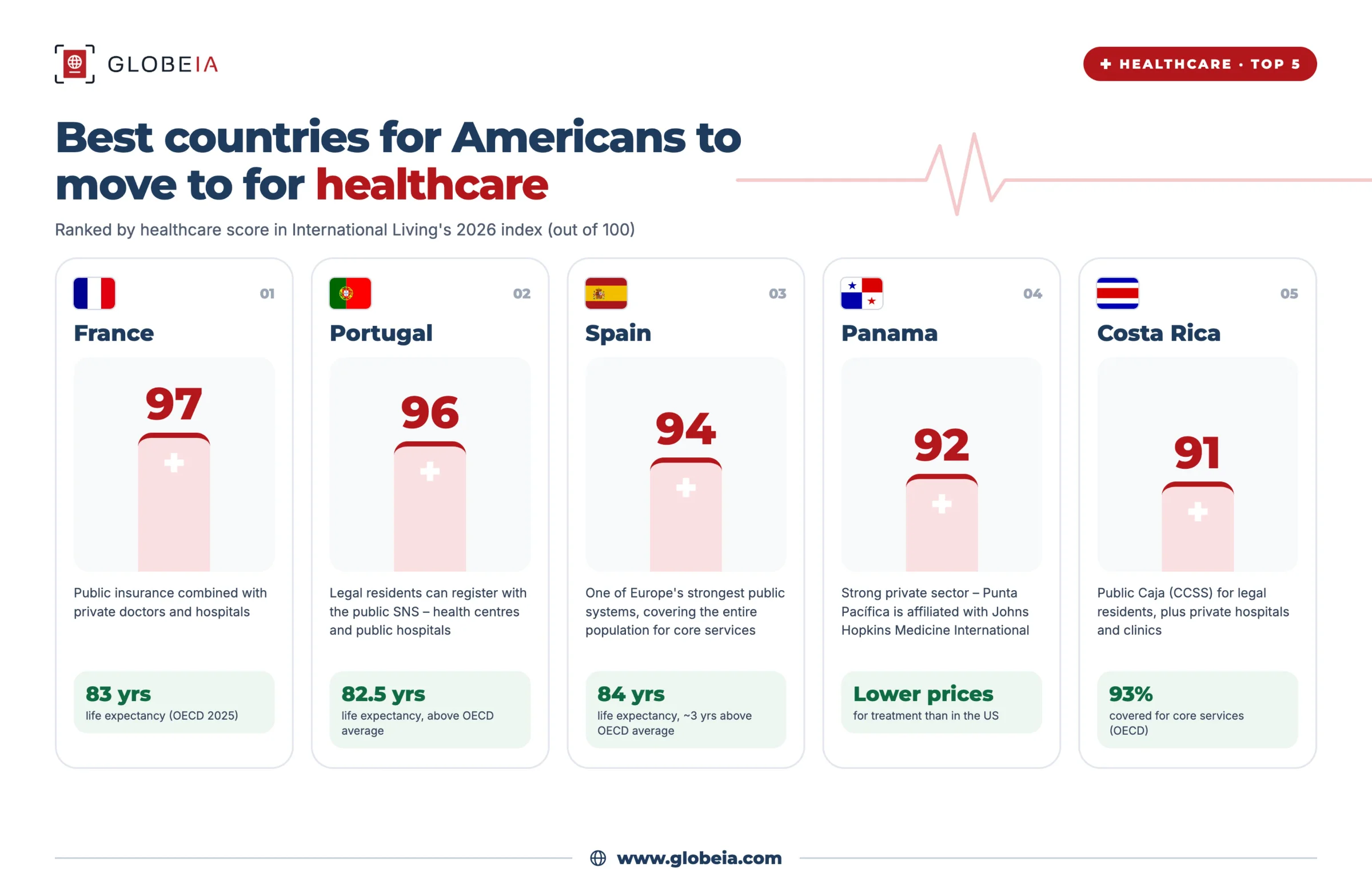
France ranks highest among these five countries, with a healthcare score of 97 in International Living's 2026 index. Its healthcare system combines public insurance with private doctors and hospitals, giving residents access to a wide network of medical services. France also recorded a life expectancy of 83 years in the OECD's 2025 data.
Portugal scores 96 in International Living's 2026 healthcare index. Its National Health Service (SNS) allows legally resident Americans to register for public healthcare, including consultations at local health centres and treatment at public hospitals. Life expectancy in the country reached 82.5 years, above the OECD average.
Spain scores 94 in the 2026 ranking and has one of Europe's strongest public healthcare systems. The OECD reports that the entire population is covered for a core set of healthcare services, and life expectancy stands at 84 years, nearly three years above the OECD average.
Also Learn About Retiring in Spain as an American: The Complete Visa Types, Document Apostille Checklist
Panama scores 92 in International Living's healthcare ranking. Its private healthcare sector is a major draw for American expats, with hospitals such as Punta Pacífica affiliated with Johns Hopkins Medicine International and offering medical treatment at lower prices than in the US.
Costa Rica scores 91 in the 2026 ranking. Legal residents can join the public Caja (CCSS) healthcare system, which covers hospital treatment, doctor visits, and preventive care. The OECD also reports that 93% of the population has coverage for a core set of healthcare services, while private hospitals and clinics provide another option for residents.
Read About Immigrating to Costa Rica: Essential Tips for a Successful Move in 2026
Greece offers a Mediterranean lifestyle with warm weather, island communities, historic towns, and a strong café and outdoor dining culture. Retirees can enjoy coastal living in places such as Crete and the Peloponnese, while still having access to larger cities and European healthcare facilities.
Greece has options for self-funded retirees and high-net-worth individuals:
Visa Route | What It Is | Requirements |
Financially Independent Persons (FIP) Visa | A residence permit specifically designed for non-EU retirees or individuals with stable passive income from abroad, allowing renewable stay without working locally. |
|
Greece Golden Visa | A residency-by-investment route suitable for wealthy retirees looking to buy real estate without minimum physical stay requirements. |
|
Panama is a popular choice for American retirees because it uses the US dollar and has direct flight connections to major US cities. Its Pensionado program also offers discounts on healthcare, entertainment, transport, and everyday services for eligible retirees.
Panama has one of the most famous and beneficial retiree visa programs in the world:
Visa Route | What It Is | Requirements |
Pensionado Visa (Retiree & Pensioner) | A permanent residency path for adults receiving a lifetime guaranteed pension, featuring extensive government-mandated discounts. |
|
Costa Rica appeals to retirees who enjoy spending time outdoors, with tropical beaches, rainforest-covered mountains, and pleasant temperatures in its Central Valley. The country also has an established public and private healthcare system, along with a strong focus on environmental protection.
Costa Rica provides two primary retirement pathways based on whether income is a lifetime pension or general passive capital.
Visa Route | What It Is | Requirements |
Pensionado Visa | Temporary residency status for individuals receiving a fixed lifetime retirement pension. |
|
Rentista Visa | Temporary residency for non-pensioner retirees or early retirees who have reliable passive income. |
|
Portugal combines a relaxed coastal lifestyle with historic towns, walkable cities, and good public transport. Places such as Porto and the Algarve attract retirees looking for mild weather, access to beaches, and a well-developed healthcare system.
There is one visa route available for retirees in Portugal:
Visa Route | What It Is | Requirements |
A residence visa tailored for retirees and individuals living off stable, regular passive foreign income. |
|

Mexico gives American retirees the freedom to choose between beach communities, mountain towns, and lively cities. Areas such as Lake Chapala and San Miguel de Allende have established expat communities, while its proximity to the US makes visiting family and friends easier.
Visa Route | What It Is | Requirements |
Residencia Temporal (Temporary Resident) | A temporary residence permit (1 to 4 years total) allowing retirees to live in Mexico and transition to permanent status later. |
|
Residencia Permanente (Direct Permanent Resident) | Immediate permanent residency status available directly from abroad for retirees meeting higher financial thresholds. |
|

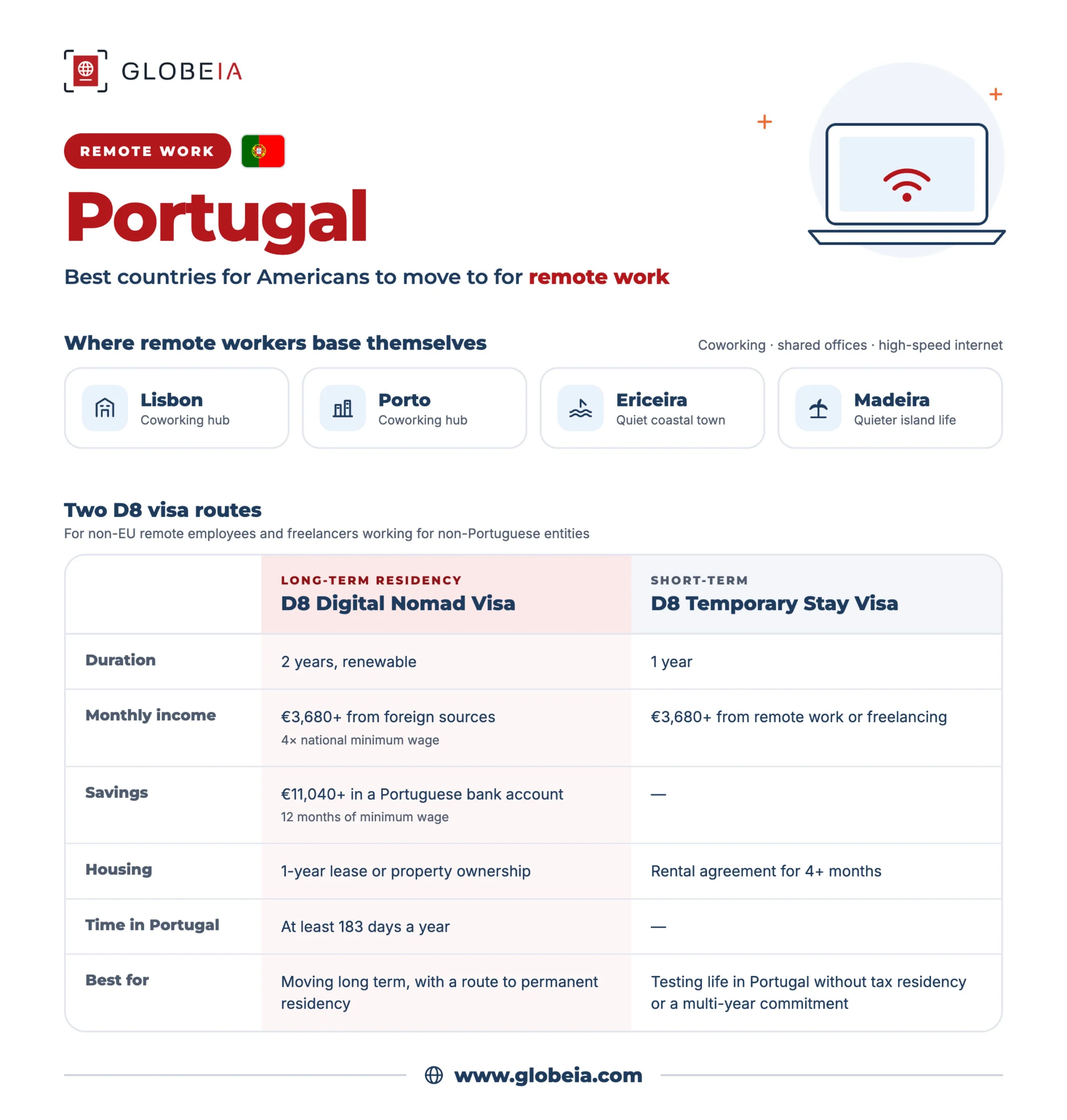
Portugal has a well-established remote work scene. Particularly in Lisbon and Porto, where coworking spaces, shared offices, and reliable high-speed internet make it easier to work away from home. Smaller coastal towns such as Ericeira and Madeira also attract remote workers looking for quieter surroundings without giving up access to workspaces and digital services.
To move to Portugal, you have a direct D8 Digital Nomad Visa, with options for short-term stays or long-term residence leading to permanent residency.
Visa Route | What It Is | Requirements |
D8 Digital Nomad Visa (Long-Term Residency) | A residence visa allowing non-EU remote employees and freelancers to live in Portugal for 2 years (renewable) while working for non-Portuguese entities. |
|
D8 Temporary Stay Visa (Short-Term) | A non-immigrant, 1-year visa aimed at remote workers who want to test living in Portugal without committing to tax residency or multi-year immigration. |
|
Spain offers a mix of modern work facilities and city life, with Madrid, Barcelona, and Valencia providing plenty of coworking spaces, fast internet, and cafés suited to working remotely. Its extensive public transport also makes it easier to live outside busy city centres while staying connected to business districts and shared workspaces.
Spain’s Digital Nomad Visa (DNV) was established under the Startup Act to attract international remote professionals and freelancers.
Visa Route | What It Is | Requirements |
Spain Digital Nomad Visa (Teletrabajador Internacional) | A residency path for non-EU remote employees or freelancers, permitting a 1-year visa (applied from home) or a 3-year residence permit (applied directly in Spain). |
|
Read More in Our Guide for Americans Moving to Spain
Mexico has a growing remote work community, with Mexico City offering established coworking spaces, business centres, and cafés with internet access. Another major advantage is its time zone overlap with the US, which allows Americans working remotely to attend meetings and coordinate with US-based teams during normal daytime hours without adjusting to late-night schedules.
Mexico does not have a visa explicitly named "Digital Nomad Visa," but relies on its Temporary Resident Visa path for self-sufficient remote workers.
Visa Route | What It Is | Requirements |
Residencia Temporal (Remote Work Path) | A 1-year initial resident permit (renewable up to 4 total years) that grants foreign remote workers the legal right to live in Mexico while working for foreign clients. |
|

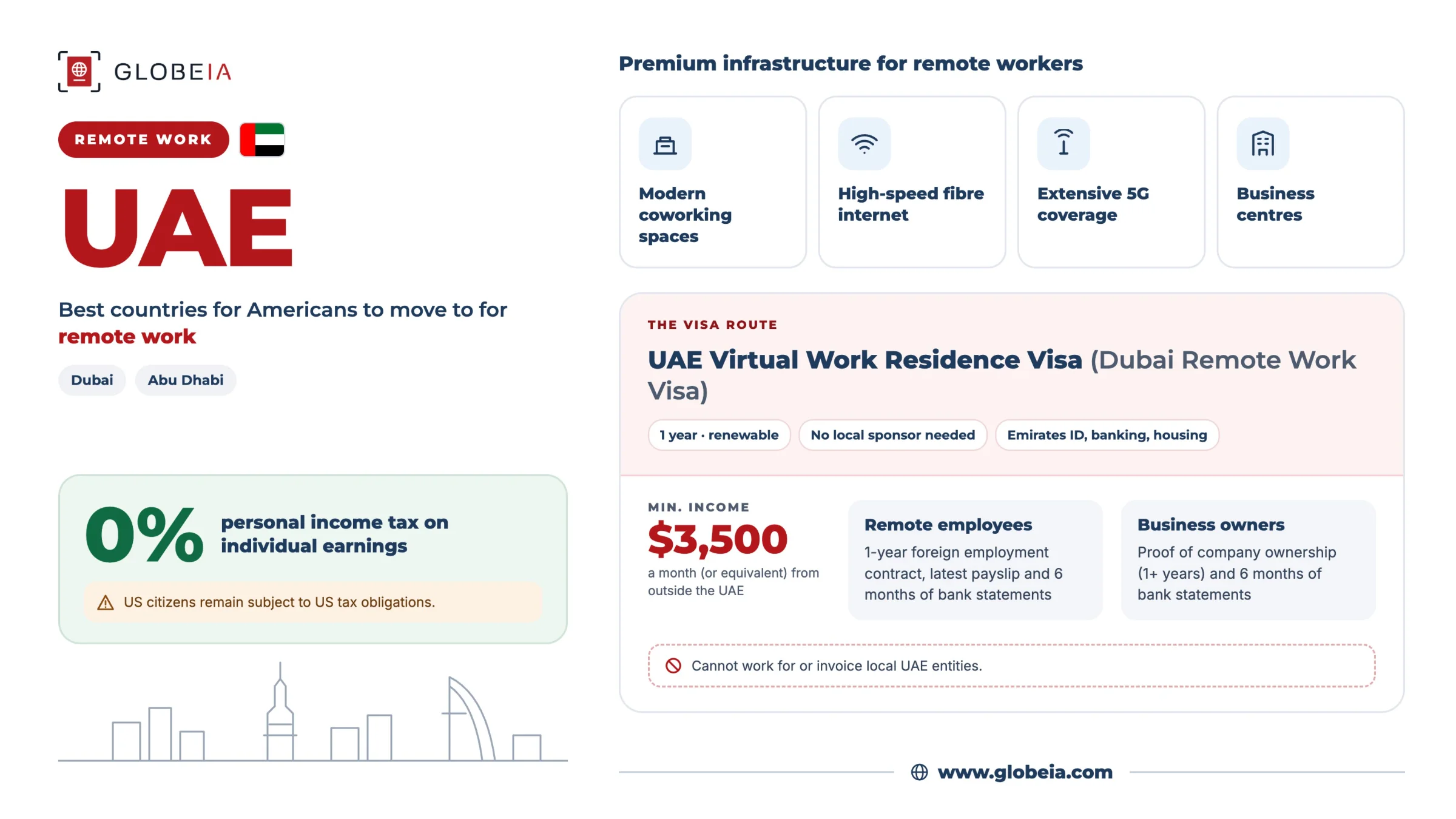
The UAE, particularly Dubai and Abu Dhabi, has premium infrastructure for remote workers, with modern coworking spaces, high-speed fibre internet, extensive 5G coverage, and well-equipped business centres. It also has 0% personal income tax on individual earnings, making it financially attractive for Americans working remotely. But US citizens remain subject to US tax obligations.
The UAE offers federal and Dubai-specific 1-year virtual work residency options allowing foreigners to reside in the Emirates without a local sponsor:
Visa Route | What It Is | Requirements |
UAE Virtual Work Residence Visa (Dubai Remote Work Visa) | A 1-year renewable residence permit that allows remote employees and business owners to live in the UAE with local resident benefits (Emirates ID, banking, housing). |
|

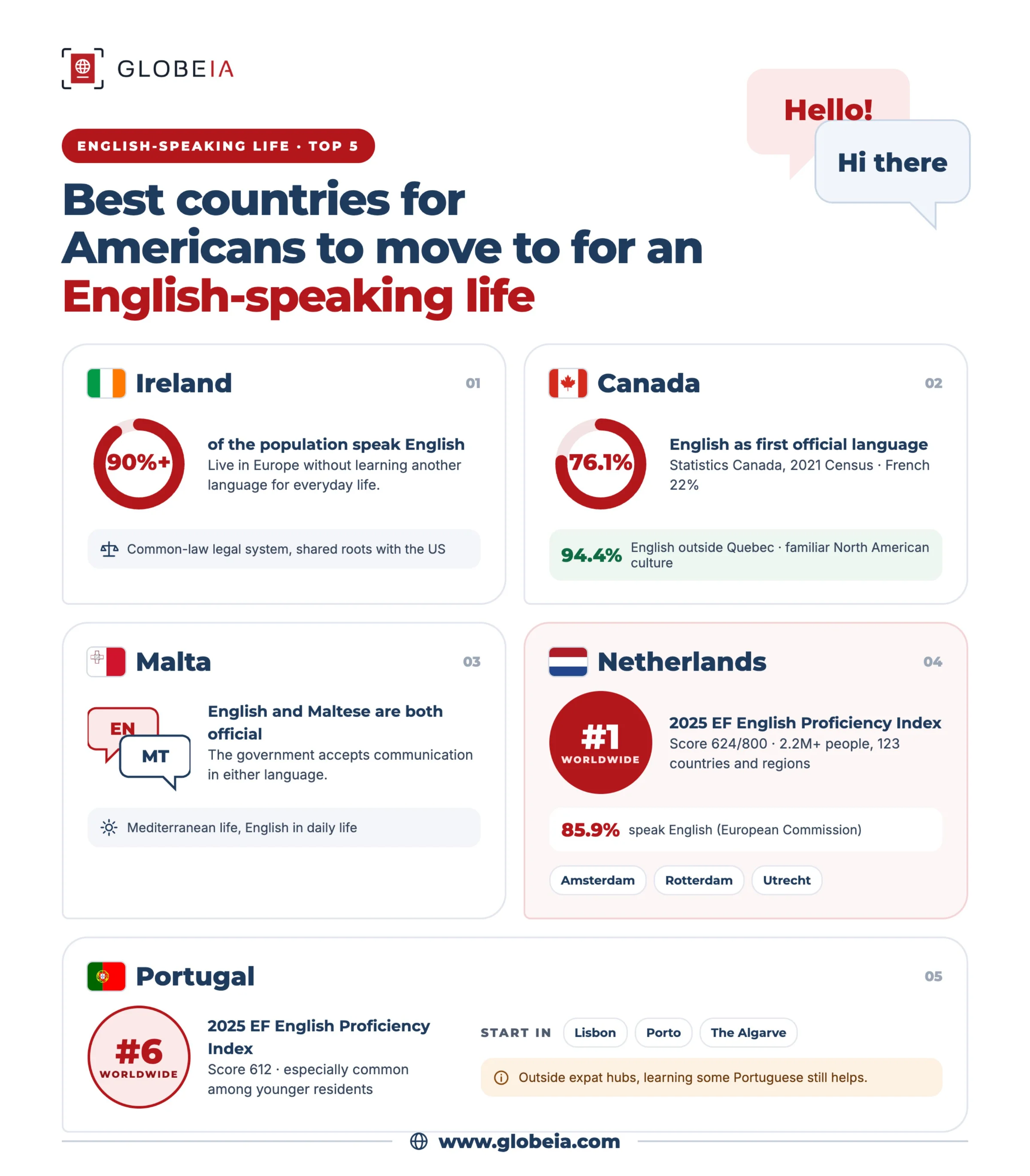
Ireland is a natural choice for Americans who want to live in Europe without learning another language for everyday communication. English is widely spoken, with more than 90% of the population able to speak it. Ireland also follows a common-law legal system, which shares its legal roots with the US and may feel more familiar to American residents.
Canada offers an English-speaking environment with familiar North American culture, making the move from the US easier to adjust to. According to Statistics Canada's 2021 Census, English is the first official language spoken by 76.1% of the population, while French accounts for 22%. Outside Quebec, the figure for English rises to 94.4%, giving Americans plenty of options for English-speaking communities.
Malta is a good option for Americans who want to live in a Mediterranean country without giving up English in their daily lives. Both English and Maltese are official languages, and the government accepts communication in either language.
The Netherlands ranks first in the world in the 2025 EF English Proficiency Index, with a score of 624 out of 800, based on test results from more than 2.2 million people across 123 countries and regions. European Commission data also shows that 85.9% of its population speaks English. This makes cities such as Amsterdam, Rotterdam, Utrecht, and more practical choices for Americans who want to work and manage daily activities in English while living in mainland Europe.
Portugal ranks sixth globally in the 2025 EF English Proficiency Index, with a score of 612. English is particularly common among younger residents. Lisbon, Porto and the Algarve are popular starting points for English-speaking expats, and residents in these international communities can usually find opportunities to communicate in English. For daily interactions outside these areas, learning some Portuguese will still help.
The countries below draw plenty of American interest:
Yes, several countries (and regions within them) offer financial incentives, property grants, or startup capital to attract foreign residents, including US citizens.
Country | Scheme | The Catch |
Ireland | Our Living Islands Scheme: Property renovation grants of up to €84,000 (approx. $90,000+) to individuals who purchase and restore vacant or derelict homes on one of 23 offshore islands. | The funds must go directly toward renovating an eligible property, and you must secure a legal visa/residency to live in Ireland independently. |
Italy | Rural Regional Initiatives: Regions such as Tuscany, Sardinia, and Calabria have run initiatives offering €10,000 to €30,000+ to buyers purchasing homes in rural, declining villages. Additionally, famous €1 (or €3) house schemes exist across Sicily and rural Italy. | You are required to invest significant money (usually $30,000-$100,000+) into property renovations within a set timeframe and commit to living there long-term. |
Greece | Island Repopulation: Programs targeting sparse Aegean islands like Antikythera have offered monthly stipends (around €500/month for up to three years) alongside housing support, mainly targeting families willing to move long-term. | - |
Albinen, Switzerland | The small mountain village of Albinen approved an initiative offering CHF 25,000 (around $28,000+) per adult and additional funds for children to families moving to the town. | Applicants must be under age 45, build or purchase a home worth at least CHF 200,000, become Swiss residents, and commit to staying for at least 10 years. |
Chile | Start-Up Chile: Provides equity-free seed funding and grants ranging from $10,000 to over $100,000 depending on the program tier, a 1-year visa, and workspace in Santiago | You must build and launch a scalable, innovative startup locally. |
These programs are rarely "free money without strings attached". They fall into specific categories, usually aimed at repopulating rural areas, restoring old homes, or growing local economies.
There is no blanket rule stopping Americans from moving to or traveling in nearly all cases, but you should avoid moving to or traveling in countries currently listed under the US State Department’s Level 4: Do Not Travel advisory.
These countries are on the list because of risks such as armed conflict, political unrest, terrorism, kidnapping, wrongful detention, serious crime, and public health threats. In many of them the US government can offer little or no help if something goes wrong, because embassy services are limited or nonexistent.
Afghanistan
Belarus
Burkina Faso
Burma (Myanmar)
Central African Republic
Chad
Democratic Republic of the Congo
Gaza
Haiti
Iran
Iraq
Lebanon
Libya
Mali
Niger
North Korea
Russia
Somalia
South Sudan
Sudan
Syria
Uganda
Ukraine
Yemen
Rankings and indexes are useful starting points, but they should not be the only things guiding your decision. The right country depends on what you want from your move out of the USA.
Some Americans want to enjoy a better lifestyle while continuing to work, others want to retire somewhere affordable, and some simply want to live closer to family or reconnect with their roots.
Your priorities can help you narrow down the options.
Retirees with a pension can start by exploring Panama, Costa Rica, Greece, Spain, and Portugal, particularly if they want a comfortable retirement with a different cost of living and lifestyle.
Remote workers can look at Spain, Portugal, Greece, Croatia, Costa Rica, and Thailand for their remote-work and digital nomad visa options.
Americans with Irish ancestry may want to consider Ireland first, especially if they have a parent or grandparent who was born there and may qualify for Irish citizenship through descent.
Once you have a shortlist, there are a few important things to check before making your plans.
Moving abroad does not automatically end your US tax obligations. American citizens generally have to report their worldwide income to the IRS, even when they live and work in another country.
You may qualify for benefits such as the Foreign Earned Income Exclusion or a foreign tax credit, depending on your circumstances. You may also have to report certain foreign bank accounts and financial assets.
Visa requirements can change from year to year, including minimum income, savings, health insurance, and residency requirements. Governments can also increase application fees or change how long you must live in a country before applying for citizenship.
For example, Portugal increased its citizenship residency requirement from 5 to 10 years for most non-EU and non-Portuguese-speaking nationals from May 19, 2026. Mexico also increased several immigration fees from January 1, 2026. Always check the latest rules with the country's immigration authorities or consulate before making your plans.
A country can have safe cities and regions alongside areas with higher crime or security risks. Even the US Department of State gives different safety advice for different parts of the same country.
Before choosing where to settle, look beyond the country's overall safety ranking and research the particular city, neighbourhood, and region you are considering. Check local crime levels, healthcare access, political stability, and current travel advisories as well.

Choosing a destination is only one part of an international move. Once you have made that decision, you may also need to arrange police certificates, background checks, document authentication, and other paperwork for your visa or residency application. Some of these requirements involve authorities in the USA, even after you have moved abroad.
Globeia helps individuals manage cross-border documentation, including fingerprinting and background check requirements. So, as you plan your move, you can also account for the documents you may need to complete the process.
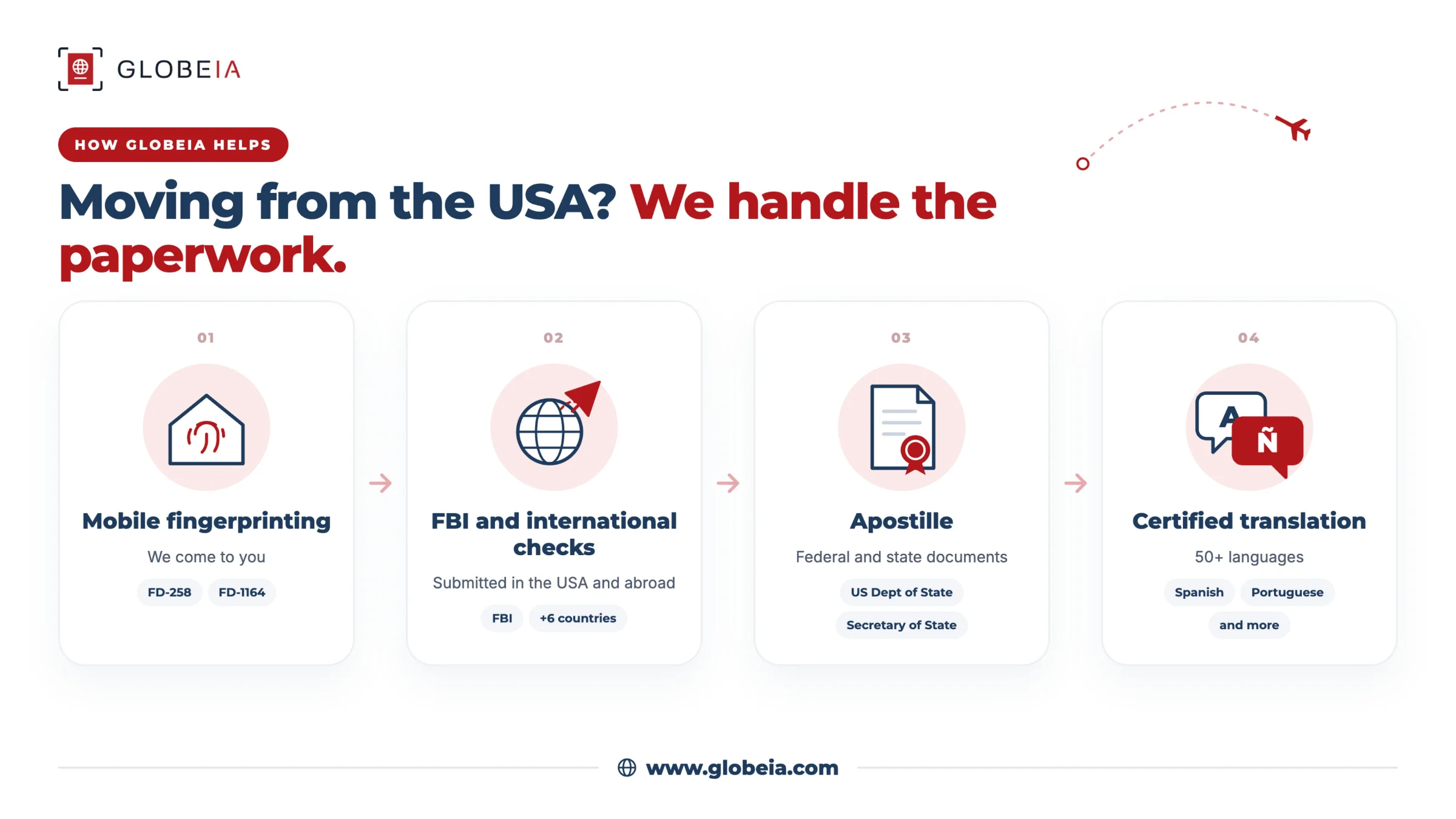
This is what Americans can get with Globeia:
If you need an FBI background check for your visa or residency application, Globeia's trained associates can visit your home, office, or another convenient location to take your fingerprints on FBI-compliant FD-258 or FD-1164 cards. You do not need to visit a fingerprinting office yourself.
Globeia also supports fingerprinting for other countries' background checks, including Canada, the UK, Hong Kong, Singapore, the Philippines, and the UAE. This can be useful if you need police clearance certificates from countries where you previously lived or worked.
Globeia Inc. in the USA coordinates the submission of fingerprint cards to the FBI for Identity History Summary checks.
For international background checks, Globeia also works through its teams and offices in different countries to coordinate fingerprint submissions to the relevant authorities. This helps you arrange the required checks even when you are applying from outside the country that needs to issue them.
Some countries require an apostille on your US documents before accepting them for immigration, residency, or other official purposes. For example, you may need an apostille for your FBI background check, birth certificate, marriage certificate, or educational documents.
The process depends on who issued the document. FBI background checks and other eligible federal documents go through the US Department of State. State-issued documents, such as birth certificates, generally need certification from the relevant state's Secretary of State. Private documents, such as diplomas, may need notarization or other preparation before they can be submitted for an apostille.
Globeia can coordinate the submission of your eligible documents to the relevant federal or state authorities and arrange the required apostille on your behalf.
If you are moving to a country where English is not the official language, you may also need translations of your US documents. For example, documents submitted for residency in Mexico or Portugal may need to be translated into Spanish or Portuguese, depending on the requirements of the receiving authority.
Globeia can arrange certified translations in 50+ languages for documents such as background checks, birth certificates, educational records, and other paperwork. We can also help you understand the required order of translation and authentication, as some authorities have specific rules about how these documents must be prepared.
Check out all our services here!
Where should you move if you want to build a life outside the United States? The answer depends on what matters most to you. A country with affordable housing may not have the healthcare access you need, while a highly ranked destination may have visa requirements that make relocation difficult. Take the time to compare not just the country, but also the city and the residency conditions that apply to you. A little preparation before leaving the US can help you avoid unexpected paperwork and complications during the relocation process.


Global Services
State Services