State Apostille Services from USA
Apostille Services in California
Apostille Services in Texas
Apostille Services in Florida
Apostille Services in Washington
Services from Canada
Services from United Kingdom
Services from New Zealand

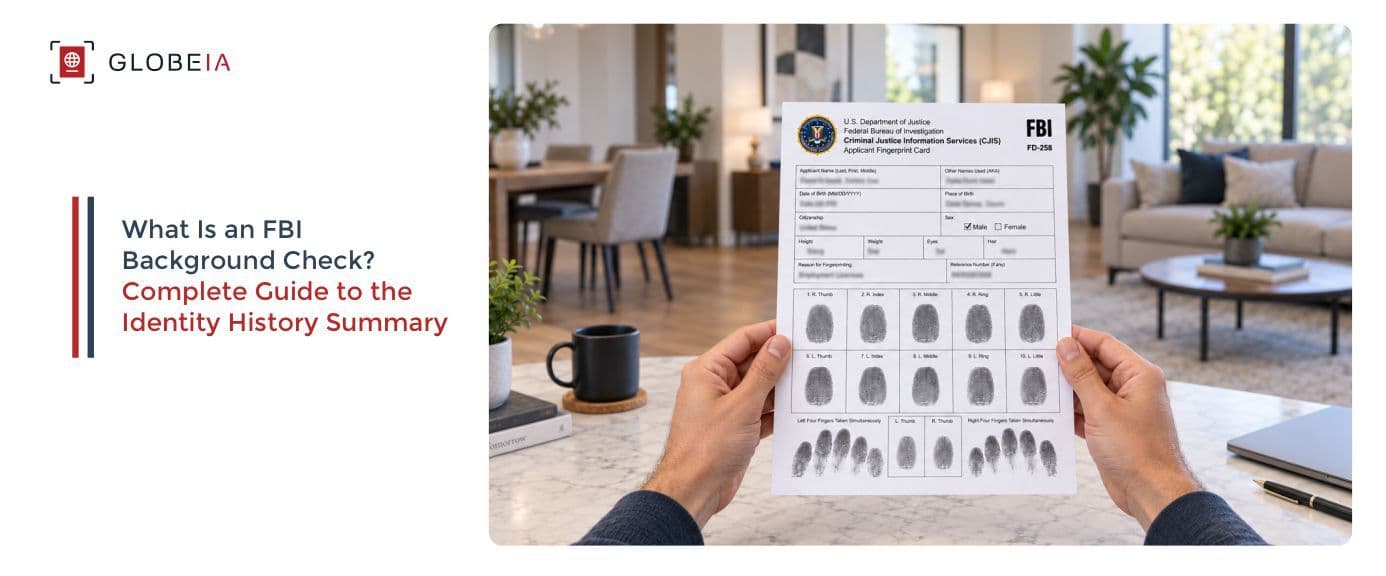
An FBI background check, officially called an FBI Identity History Summary, is a fingerprint-based search of FBI records to identify criminal history information associated with an individual. It may contain details, like arrest information and other records maintained by the FBI, depending on what has been reported to and retained by the Bureau. The FBI charges $18 for an Identity History Summary. For applicants outside the United States, ink fingerprints on the FD-258 or FD-1164 card must be submitted either directly to the FBI by mail or through an FBI-approved coordination service. Globeia coordinates FBI Identity History Summary submissions for international applicants across Dubai, Kuala Lumpur, Australia, Spain, Portugal, the UK, and other locations.
If a foreign government, employer, or immigration authority has asked you for an "FBI background check," what they are actually asking for is your FBI Identity History Summary - a federal record of criminal history information maintained by the FBI, or a response indicating that no such information was found.
For most people living or working outside the US, this is not a process they have navigated before. It includes multiple steps and stages that must be carefully completed, like submitting the officially accepted forms, following valid submission routes, fingerprinting requirements, processing times, and apostille steps that are not immediately obvious. Getting any one of them wrong means starting over.
This guide answers the key questions that most applicants have about an FBI Background Check: what the check contains, what it does not show, how to get one from outside the U.S., how long it takes, when you need an apostille, and which submission options may be available. For applicants who want help coordinating the process, Globeia’s FBI Identity History Summary service coordinates fingerprinting, submission, and apostille support for international applicants.
| Question | Answer |
| What is an FBI background check officially called? | FBI Identity History Summary Check (IdHS) - commonly referred to as an FBI background check or, informally, a “rap sheet.” |
| Who issues an FBI Identity History Summary? | The FBI’s Criminal Justice Information Services (CJIS) Division processes Identity History Summary requests. |
| Is an FBI background check based on fingerprints? | Yes. An Identity History Summary is fingerprint-based, allowing the FBI to search records associated with the submitted fingerprints. |
| How much does an FBI background check cost? | The FBI fee for an Identity History Summary is $18 USD. Fingerprinting, mailing, apostille, translation, and third-party coordination fees, if applicable, are separate. |
| How long does an FBI background check take? | Processing time depends on the submission method and circumstances. FBI-approved Channelers may provide faster processing, while direct submissions to the FBI can take longer. |
| Can I get an FBI background check from outside the U.S.? | Yes. Applicants outside the U.S. can submit fingerprints to the FBI using an accepted submission method, including mailing a fingerprint card directly to the FBI. |
| Can someone else request an FBI Identity History Summary for me? | An Identity History Summary is requested by or on behalf of the individual, subject to FBI requirements. A third party may assist with the process where permitted, but the applicant must provide the required information and authorization. |
| Does an FBI background check expire? | The FBI does not assign an expiration date to an Identity History Summary. However, the receiving authority may require a recently issued report, such as one issued within a specified number of days or months. |
| Do I need an apostille for an FBI background check? | It depends on the country and receiving authority. When required for use abroad, an FBI document may need authentication through the U.S. Department of State, followed by any additional legalization required by the destination country. |
| What happens if I have no U.S. criminal history? | The FBI may issue a response indicating that no Identity History Summary exists based on the submitted fingerprints. |
| Does an FBI background check show traffic violations? | Not necessarily. Whether a traffic-related offense appears depends on whether the relevant information was reported to and retained in FBI records. |
| Does an FBI background check show expunged or sealed records? | The appearance of sealed or expunged information depends on the underlying records, jurisdiction, and whether updates were reported to the FBI. Applicants should also follow the disclosure requirements of the authority requesting the check. |
| Does an FBI background check show juvenile records? | Juvenile records may be subject to different reporting and sealing rules. Whether information appears depends on the record, jurisdiction, and information reported to the FBI. |
An FBI Background Check is a fingerprint-based record maintained by the FBI’s Criminal Justice Information Services (CJIS) Division. It contains certain information retained by the FBI from fingerprint submissions, including records associated with arrests and, in some cases, federal employment, naturalization, or military service.
When a person is arrested in the United States and fingerprinted, those prints, along with the associated charge and disposition data, are transmitted to the FBI and stored in the Next Generation Identification (NGI) system. The Identity History Summary is the compiled output of everything linked to a person's fingerprints within that system.
An Identity History Summary is not the same as a standard employment background check or a complete nationwide criminal-record search. The FBI itself notes that an Identity History Summary may not include information held in state repositories that could appear in an employment background check.
For applicants using the document for international employment, immigration, residency, licensing, and other overseas requirements, the Identity History Summary can serve as the U.S. federal criminal-history document requested by the receiving authority. The FBI also confirms that Identity History Summaries may be used for purposes such as living, working, or traveling in a foreign country.
Note: For the FBI’s official requirements, request options, and current instructions, refer to the FBI’s Identity History Summary information.
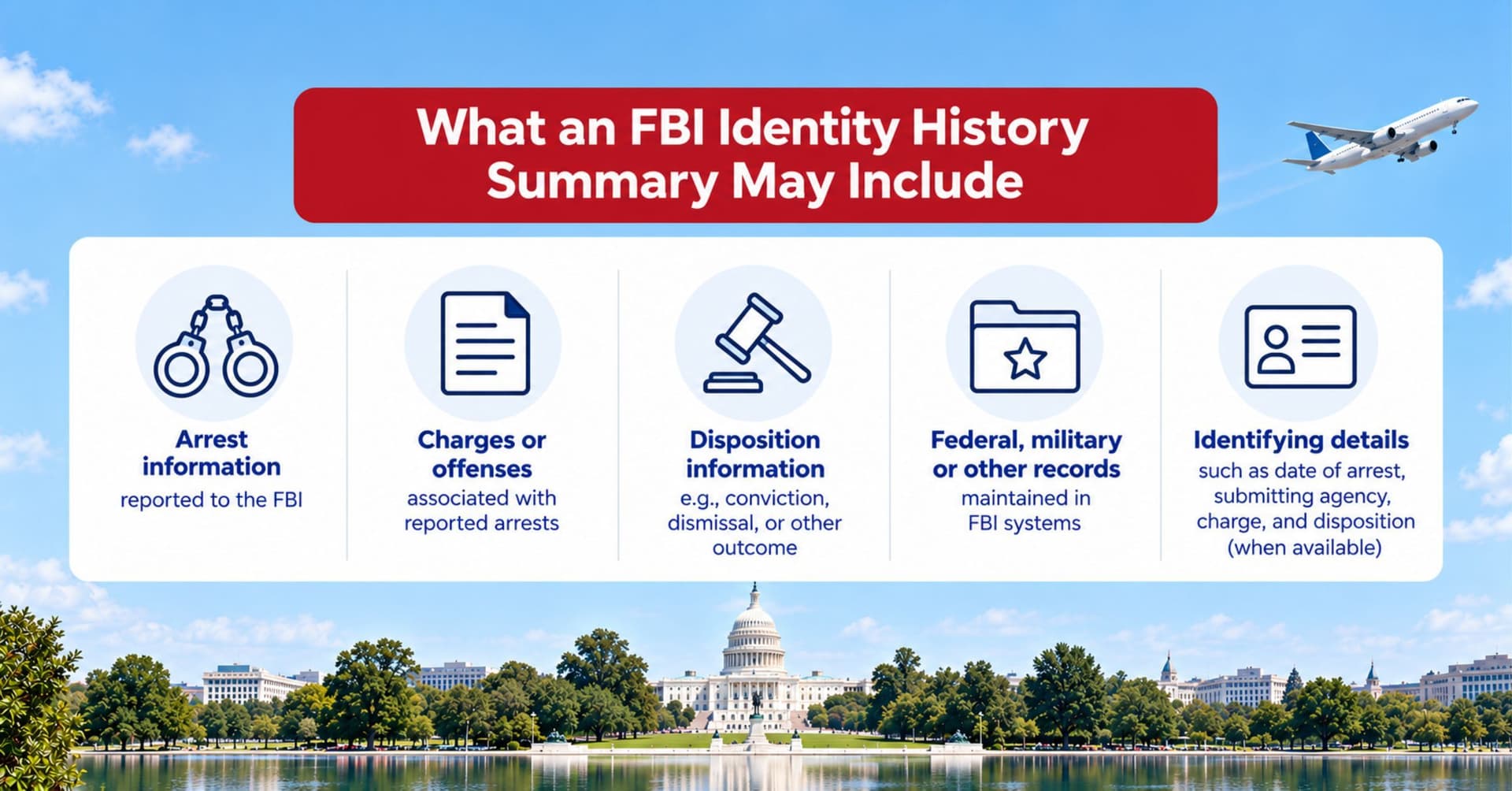
An FBI Identity History Summary shows certain criminal-history information associated with fingerprints retained by the FBI. The information available in the report depends on what participating agencies have submitted to the FBI and whether corresponding disposition information has been reported.
What an FBI Identity History Summary May Include

What an FBI Identity History Summary Does Not Show
An FBI Identity History Summary is not a complete record of every criminal, court, or civil matter in the United States. It generally does not provide:
Note: The FBI officially cautions that an Identity History Summary may not reflect all records held in state repositories and should not be confused with a multi-jurisdictional name search.
What Does an FBI Background Check Say If You Have No Record?
If no matching biometric records are identified, CJIS issues an official response confirming that no Identity History Summary exists for the submitted fingerprints.
For international applicants, this distinction is critical: a "No Record" response certifies that no record was matched within the FBI's central repository, satisfying the criminal clearance requirements for most foreign embassies, immigration bodies, and overseas employers.
An FBI Background Check and a state background check are different records issued through different systems. The appropriate document depends on what the requesting authority requires.
| Factor | FBI Identity History Summary | State Background Check |
| Scope | Information retained by the FBI from fingerprint submissions and participating agencies | Records maintained by a particular state |
| Identification method | Fingerprint-based | Depends on the state and type of search; may be name-based or fingerprint-based |
| Issuing authority | FBI, through its Criminal Justice Information Services (CJIS) Division | State police, bureau of investigation, department of public safety, or another designated state authority |
| Geographic coverage | FBI records associated with submissions from across the United States and certain federal sources | Primarily records within the issuing state |
| Records outside the jurisdiction | May not include information that was never submitted to or retained by the FBI | Generally does not provide a comprehensive search of other states |
| Use for international purposes | May be required when a foreign authority specifically requests an FBI Identity History Summary | Generally cannot be assumed to be an acceptable substitute for an FBI check |
| How it is obtained | Through an FBI-approved submission method, including direct submission or an FBI-approved Channeler | Process varies by state |
How to Know Which One Do You Need?
If an embassy, immigration authority, foreign employer, licensing body, or other organization specifically asks for an FBI background check or FBI Identity History Summary, a state-level criminal record check is generally not a substitute.
For example, a background check issued by California, New York, or Texas does not automatically satisfy a requirement specifically requesting an FBI Identity History Summary. Always follow the document requirements provided by the authority requesting your background check.
The FBI Identity History Summary is commonly required in the following situations:
International Immigration and Residency
Immigration authorities may ask applicants to provide a police or criminal-history certificate from countries where they previously lived. Therefore, if you have lived in the United States for any purposes, this may include an FBI Identity History Summary. It completely depends on the destination country's requirements and your period of residence.
Overseas Employment
An employer or regulatory authority may request an FBI Identity History Summary when a position requires criminal-history screening and the applicant has a history of residence or employment in the United States. This can apply to roles in healthcare, education, finance, engineering, security, and other regulated fields.
Visa Applications
Some long-term, work, residency, and other visa applications require applicants to provide police clearance certificates from countries where they have previously lived. If you have lived in the United States, an FBI Identity History Summary may be one of the documents you need to provide, depending on the visa and the destination country's requirements.
Professional Licensing
Getting licensed or registered to work in another country can also involve a criminal-history check. Healthcare, legal, financial, and other regulated professionals may be asked to provide an FBI Identity History Summary, depending on the requirements of the relevant licensing authority.
International Adoption
If you are pursuing an international adoption, you may need to provide U.S. criminal-history documentation as part of the screening process. The exact requirements vary based on the destination country, adoption authority, and applicable regulations.
Personal Review or Correction
You do not need to be applying for a visa or moving abroad to request your FBI Identity History Summary. You can also request a copy to review the information the FBI has on record about you. If you find information that is inaccurate or incomplete, the FBI provides a process for requesting a correction or update.
There is more than one way to request an FBI Identity History Summary. The right option depends on individual factors, like where you are located, how you plan to submit your fingerprints, and whether you need additional services such as international document handling or apostille support.
For applicants outside the United States, the most important step is often getting a clear and correctly completed fingerprint submission before the request is sent to the FBI.
Route 1: FBI eDO Portal - Online Request + Fingerprint Submission
The FBI's Electronic Departmental Order (eDO) system enables you to start your Identity History Summary request online.
How it works:
Best suited for: Applicants who are comfortable managing the FBI application, fingerprinting, mailing, and follow-up steps themselves.
Route 2: Direct Paper Submission to the FBI
Applicants can also submit their Identity History Summary request by mail without starting the request electronically.
How it works:
FBI CJIS Division – Summary Request
1000 Custer Hollow RoadClarksburg, WV 26306United StatesThe fingerprint cards can be obtained and completed through appropriate fingerprinting providers. FD-1164 is an accepted fingerprint card for Identity History Summary requests.
Best suited for: Applicants who prefer to manage the entire request directly with the FBI and are comfortable handling fingerprinting, documentation, payment, and international mailing themselves.
Route 3: FBI-Approved Channelers
An FBI-approved Channeler is a private entity authorized to receive fingerprint submissions and related information, electronically forward them to the FBI's CJIS Division, and receive the electronic result for dissemination to the individual.
Channelers can provide a faster alternative to submitting a request directly to the FBI. However, availability, fingerprinting options, eligibility, fees, and delivery methods vary by Channeler.
Important: FBI-approved Channelers are separate from general fingerprinting or document-coordination companies. The FBI maintains an official list of approved Channelers.
Best suited for: Applicants who are eligible to use an FBI-approved Channeler and want a streamlined submission option.
Route 4: International Fingerprinting and Coordination Services
For applicants living outside the United States, the FBI request is only one part of the process. You may also need to arrange professional fingerprinting, complete the correct fingerprint card, check the quality of the impressions, coordinate international mailing, and handle any post-FBI authentication or translation requirements.
This is where an international service provider such as Globeia can coordinate the process.
How Globeia helps:
The key advantage for an international applicant applying with Globeia’s assistance is that fingerprinting and FBI submission are handled as one coordinated process rather than as separate tasks.

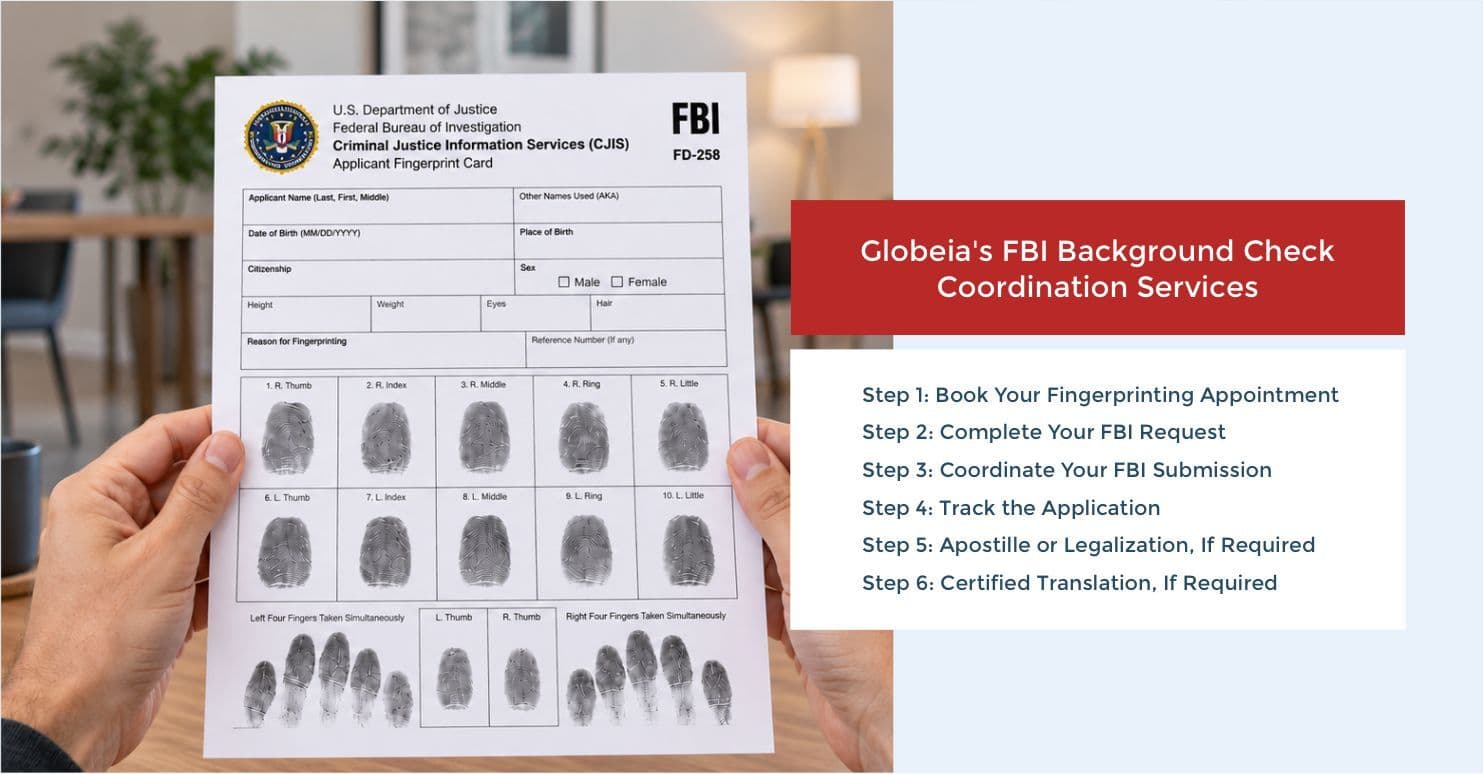
For international applicants, getting an FBI Identity History Summary can involve several separate steps- arranging fingerprints locally, preparing the FBI submission, coordinating documents in the United States, and obtaining an apostille or translation if required.
Globeia brings these steps together into one coordinated process for FBI Background Check Application, so you do not have to manage each stage separately.
Step 1: Book Your Fingerprinting Appointment
Start by booking a professional ink fingerprinting appointment at a Globeia location. Depending on the location, mobile fingerprinting can also be arranged at your home, office, or another preferred address.
A trained fingerprinting professional captures your impressions on the required fingerprint card, such as FD-258, and checks the card for completeness before you leave.
You can communicate with the associate and they will help you capture your impressions with the right technique on your fingerprint card.
If you have already completed the card with the right technique and required clarity, Globeia can help you with the further steps after carefully reviewing the card.
Step 2: Complete Your FBI Request
Once your fingerprints are captured, Globeia helps you prepare the information required for your FBI Identity History Summary request.
This includes checking the fingerprint card and supporting details so that the submission is ready for the next stage.
Step 3: Coordinate Your FBI Submission
Your completed fingerprint card and required information are coordinated for submission to the FBI through Globeia Inc. in the United States.
This gives international applicants a coordinated U.S.-based submission process without requiring them to manage the U.S. document-handling steps themselves.
Step 4: Track the Application
After submission, you can follow the progress of your application through Globeia's SmartPortal.
The portal provides a centralized way to keep track of your application and related document updates.
Step 5: Apostille or Legalization, If Required
If your destination authority requires authentication of the FBI document, Globeia can coordinate the U.S. Department of State apostille for the federal document.
If the destination country follows a different authentication process, additional legalization may be required.
Step 6: Certified Translation, If Required
If the receiving authority requires the FBI document in a language other than English, Globeia can also coordinate certified translation based on the destination country's requirements.
One Coordinated Process for International Applicants
With Globeia, the process can bring together:
The exact services required depend on where you are applying, the authority requesting the FBI check, and the destination country's document requirements.
Important: The FBI makes all decisions regarding Identity History Summary processing and the information included in the final report. Globeia coordinates the fingerprinting, submission, and related document services but cannot guarantee FBI acceptance, processing times, or the outcome of the request.
The time required to obtain an FBI Identity History Summary depends on how you submit the request, how quickly your fingerprints reach the FBI, and whether you need additional services such as an apostille or certified translation.
| Submission Method | What Affects the Timeline |
| FBI electronic request + fingerprint card | FBI processing begins after the required fingerprint submission is received |
| Direct paper submission to the FBI | FBI processing time + postal delivery |
| FBI-approved Channeler | Channeler processing + FBI processing + result delivery |
| International coordination | Fingerprinting + document preparation + submission + FBI processing + apostille or translation, if required |
The FBI does not guarantee a specific processing time for Identity History Summary requests. It states that electronic requests are usually processed faster than requests submitted entirely by mail, but actual timing can vary depending on the request and processing volume.
For international applicants, the FBI's processing time is only one part of the overall timeline. Fingerprinting, international document delivery, apostille, embassy legalization, and certified translation can each add additional time when required.
If you have a visa appointment, immigration deadline, employment start date, or licensing deadline, it is best to begin the process early and confirm the required document's validity period with the authority requesting it.
The FBI does not assign an expiration date to an Identity History Summary. How recently the document must have been issued depends on the organization or government authority requesting it.
For example, an immigration authority may require a recently issued criminal-history document, while an employer, licensing body, or other organization may follow a different timeframe. The requirement can also vary depending on the type of application and destination country.
Before requesting your FBI Identity History Summary, check the document-validity requirements of the authority receiving it. If the report is too old when you submit your application, you may need to obtain a new one.
The key point is simple: the FBI report itself does not expire, but the authority requesting it may impose a freshness requirement.
Whether your FBI Identity History Summary needs an apostille depends on where you plan to use it and what the receiving authority asks for. An apostille is not required for every FBI background check used outside the United States.
If an apostille is required, it must come from the U.S. Department of State because an FBI Identity History Summary is a federal document. A state Secretary of State cannot issue the apostille for an FBI document. The Department of State lists FBI background checks issued by the U.S. Department of Justice among the federal documents that may be submitted for authentication or apostille.
Before the document is sent for apostille, the FBI authenticates the background check with an FBI watermark and the signature of a division official. The authenticated document can then be submitted to the U.S. Department of State when an apostille is required.
If you are submitting the document to a country that is not part of the Hague Apostille Convention, the process is different. Instead of an apostille, you may need additional authentication followed by embassy or consular legalization, depending on the destination country's requirements.
Because authentication requirements vary, it is best to check with the authority receiving your FBI background check before arranging an apostille.
If you need help with this step, Globeia coordinates U.S. Department of State apostille services for FBI Identity History Summaries, along with the other document services required for international applications.
Obtaining an FBI Identity History Summary from outside the U.S. can involve more than requesting the report. Finding reliable fingerprinting, preparing the correct documents, coordinating submission to the U.S., meeting authentication requirements, and working within an overseas application deadline can make the process difficult to manage independently.
Globeia coordinates the process from fingerprinting and FBI submission to U.S. Department of State apostille and certified translation, where required. Get your FBI background check process started with Globeia and have the key steps coordinated through one service.


Global Services
State Services