State Apostille Services from USA
Apostille Services in California
Apostille Services in Texas
Apostille Services in Florida
Apostille Services in Washington
Services from Canada
Services from United Kingdom
Services from New Zealand

A fingerprint-based RCMP criminal record check may be required for employment, volunteering, adoption, immigration, foreign travel, name changes, record suspensions, and certain government or high-security positions. You can read more about these requirements in this guide.
An RCMP criminal record check confirms an individual's criminal record history in Canada, in many cases through a fingerprint-based verification process. It may be requested by employers, government authorities, immigration departments, or other organizations before approving an application. Knowing when you may need one can help you prepare the right documents and avoid delays.
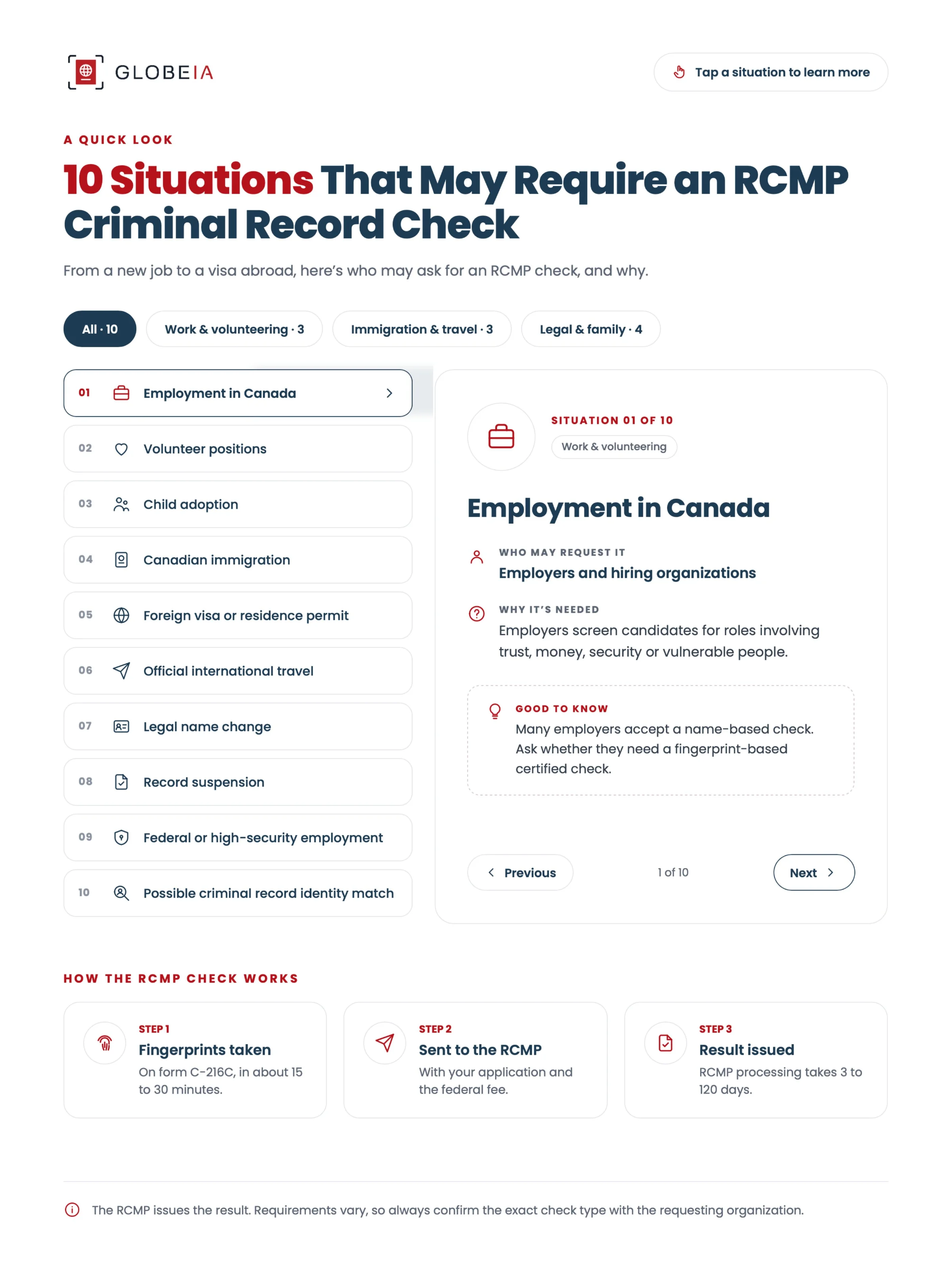
Here are 10 common situations in which you may be asked to provide an RCMP Criminal Record Check in 2026.
New to RCMP criminal record check? Check our complete 2026 guide.

Situation | Who may request the check? |
|---|---|
Employment in Canada | Employers and hiring organizations |
Volunteer positions | Volunteer organizations |
Child adoption | Adoption agencies and relevant authorities |
Canadian immigration | Immigration, Refugees and Citizenship Canada (IRCC) |
Foreign visa or residence permit | Foreign immigration departments |
International travel for official purposes | Foreign government authorities |
Legal name change | Provincial or territorial authorities |
Record suspension | Parole Board of Canada |
Federal government or high-security employment | Federal departments and security authorities |
Possible criminal record identity match | Police services or the RCMP |
Note: These are potential reasons for a criminal record check, not automatic requirements. The requesting organization determines which type of screening is necessary.
Read RCMP's explanation of when a criminal record check may be required

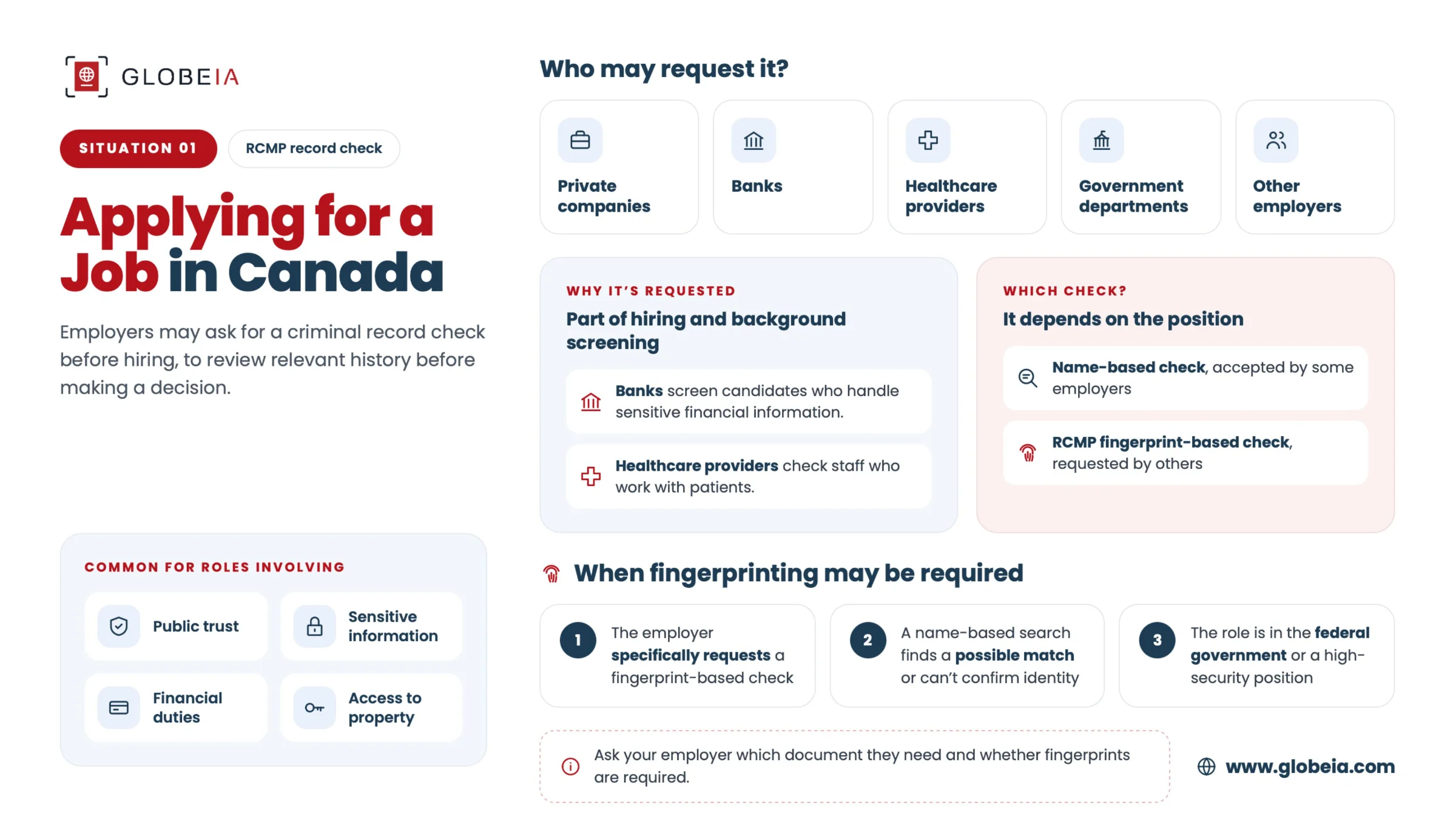
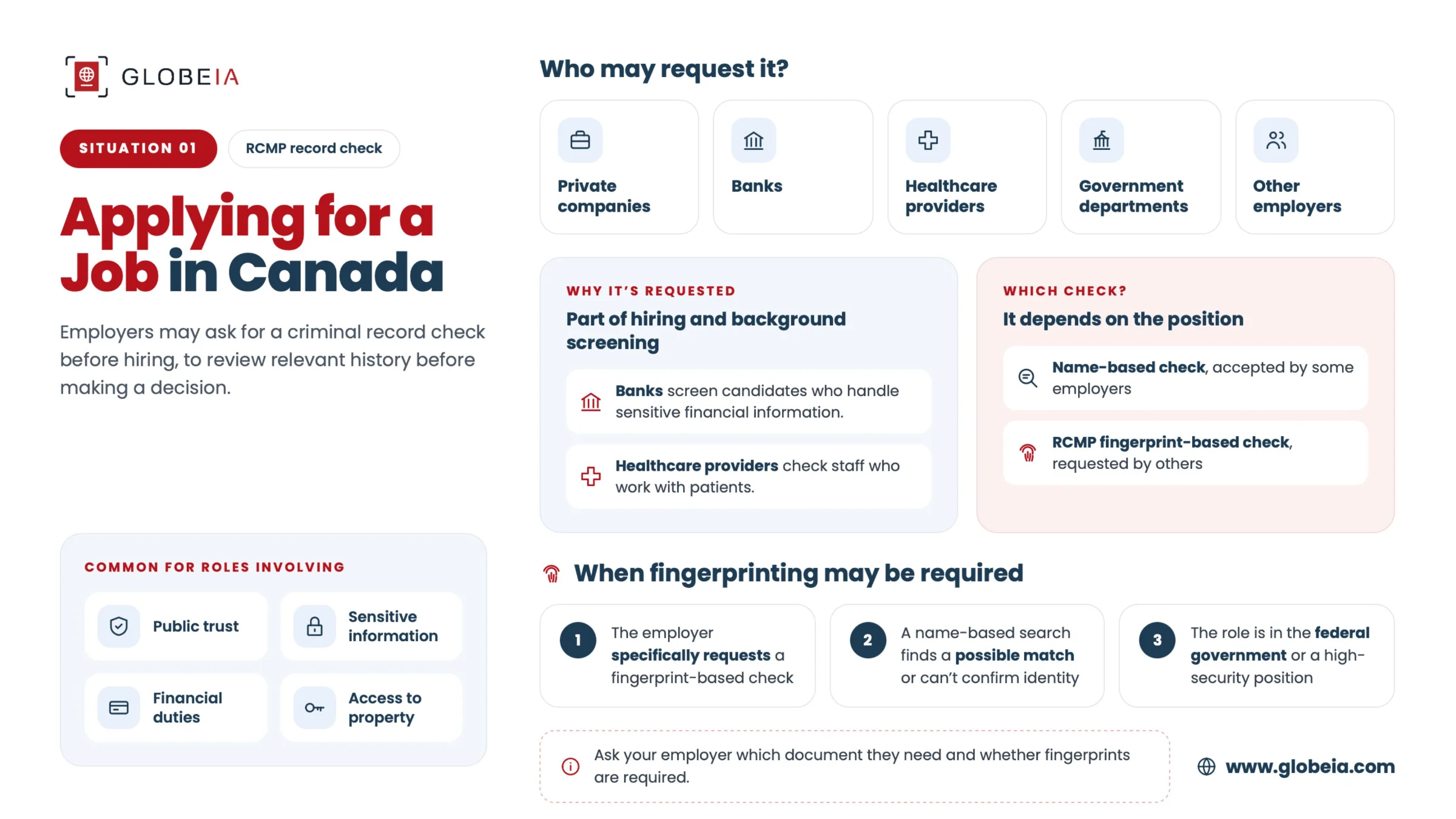
Employers in Canada may request a criminal record check before hiring someone. This is common for positions that involve public trust, sensitive information, financial responsibilities, or access to other people's property. The purpose is to review relevant criminal history before making an employment decision.
Why is the check requested?
Employers use criminal record checks as part of their hiring and background screening procedures. For example, a financial institution may want to screen candidates applying for positions involving sensitive financial information.
Similarly, healthcare providers may conduct background checks before hiring staff who work with patients.
The type of screening depends on the position. Not every employer requires an RCMP fingerprint-based check. Some may accept a name-based police record check, while others may request a Criminal Record Check.
Who may request it?
Private companies, banks, healthcare providers, government departments, and other employers may request criminal record checks. The employer should explain which document is required and whether the applicant needs to submit fingerprints.
When might fingerprinting be required?
Fingerprinting may be necessary when the employer specifically requests a fingerprint-based Criminal Record Check. It may also be required when a name-based search produces a possible match or cannot confirm the applicant's identity.
For certain federal government and high-security positions, fingerprint-based verification may be a specific requirement.
Detail | What to know |
|---|---|
Who may request it? | Private employers, banks, healthcare providers, government departments, and other hiring organizations |
Possible check type | Name-based police record check or fingerprint-based Criminal Record Check, depending on the position |
When are fingerprints needed? | When the employer specifically requires a fingerprint-based check or a name-based search produces a possible identity match |
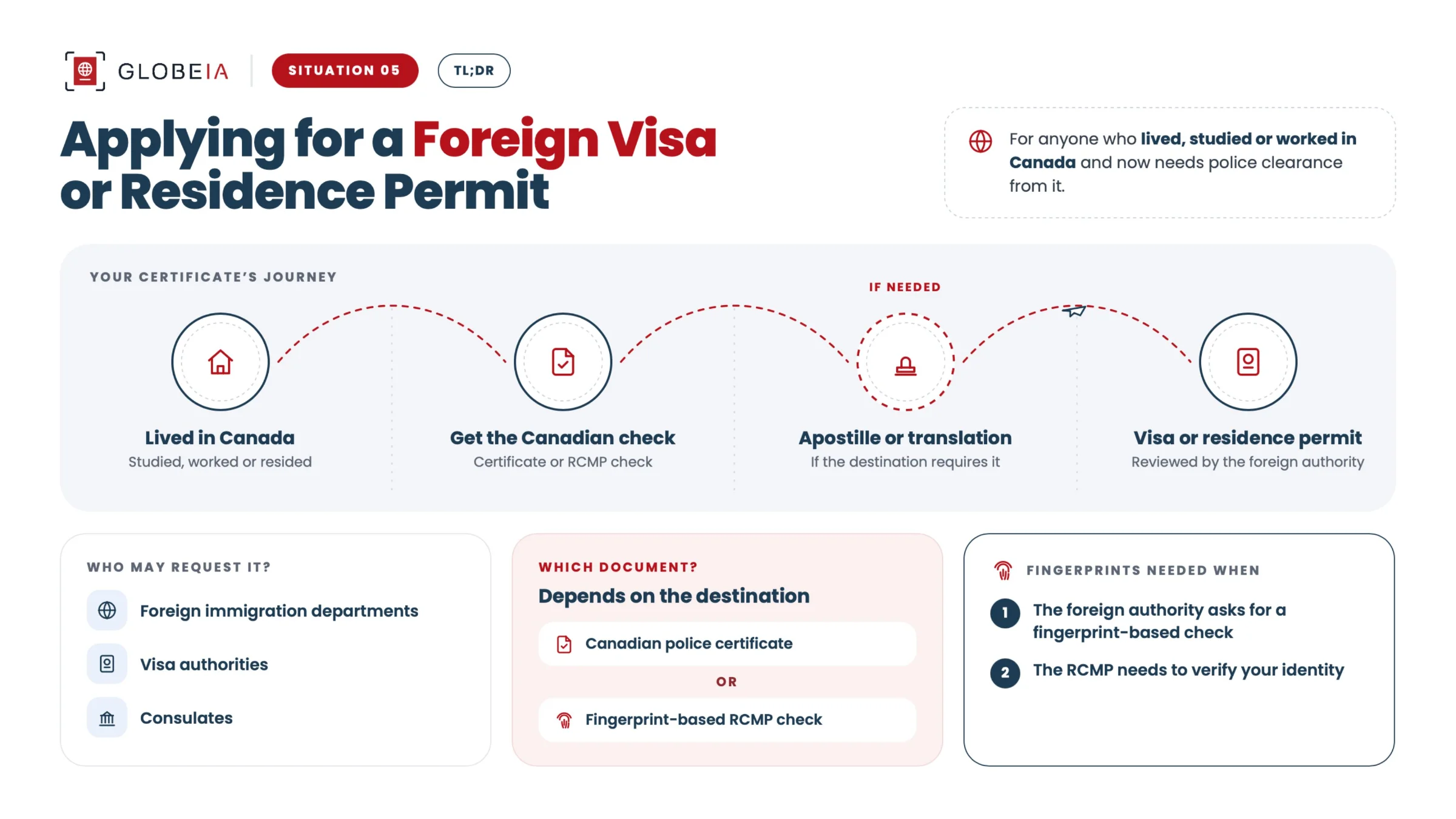
A Canadian criminal record check may be required when applying for a visa, residence permit, or other immigration status in another country. This is particularly relevant to people who previously lived, studied, or worked in Canada and now need to provide police clearance from their former country of residence.
Why is the check requested?
Foreign immigration authorities may ask applicants to provide police certificates from countries where they have lived. The purpose is to review their criminal history before granting a visa, residence permit, or other immigration status.
For example, someone who previously lived in Canada for several years may be asked to provide Canadian Criminal Record Check when applying for long-term residence in another country.
The required document depends on the destination country's rules. Some authorities may request an RCMP Criminal Record Check, while others may accept a different police certificate.
Who may request it?
Foreign immigration departments, visa processing authorities, consulates, and other government agencies may request Canadian criminal record documentation.
The applicant should confirm whether the authority requires an RCMP-issued certificate, a fingerprint-based check, or an additional form of document verification.
When might fingerprinting be required?
Fingerprinting may be necessary when the foreign authority specifically asks for a fingerprint-based Canadian criminal record check.
Applicants may also need to arrange an apostille, authentication, or translation after receiving the RCMP document. These requirements depend on the destination country and the authority receiving the certificate.
Detail | What to know |
|---|---|
Who may request it? | Foreign immigration departments, visa authorities, and consulates |
Possible check type | Canadian police certificate or fingerprint-based RCMP Criminal Record Check, depending on the destination country's requirements |
When are fingerprints needed? | When the foreign authority specifically requires a fingerprint-based Canadian check or the RCMP process requires identity verification |

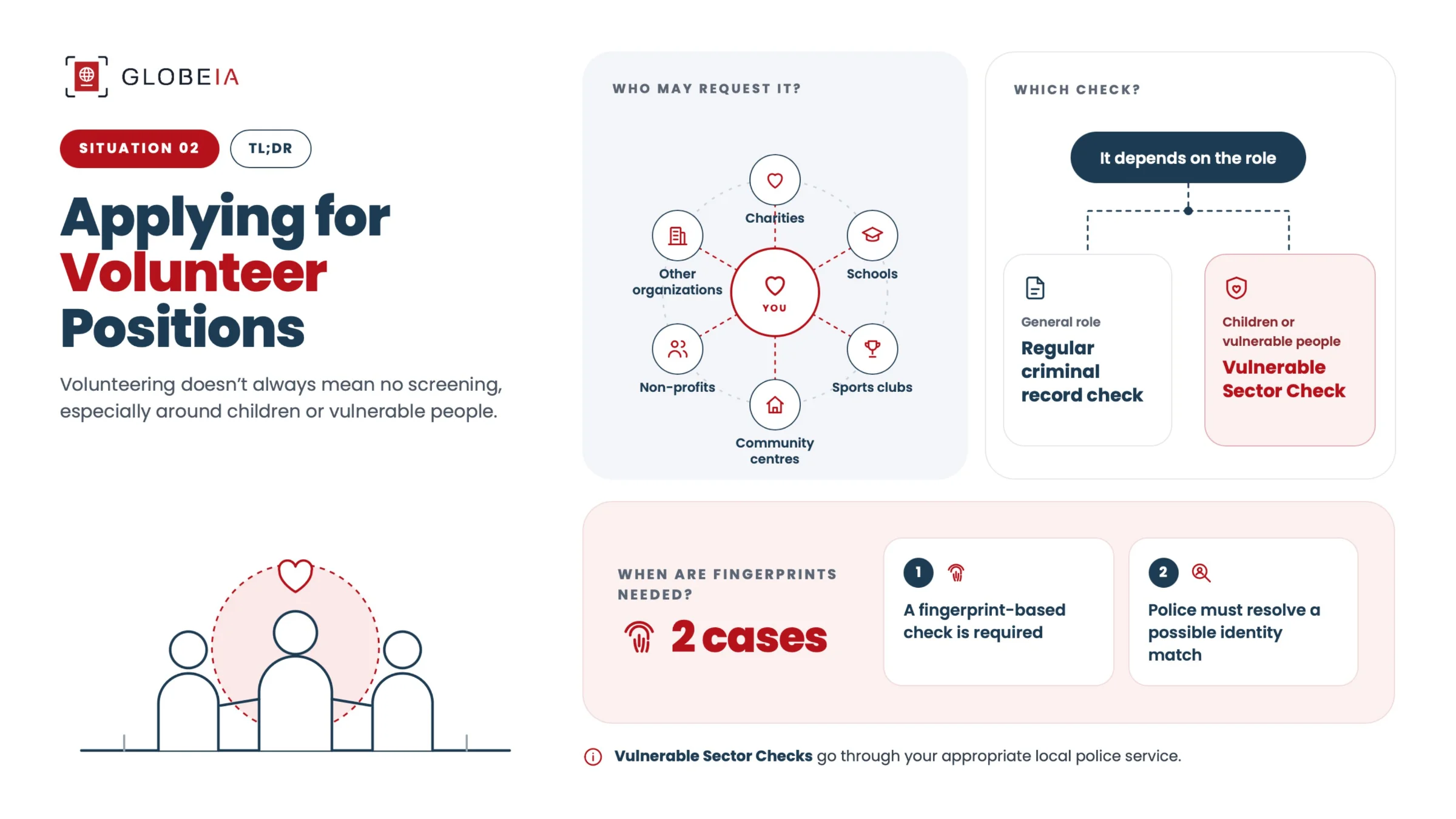
Volunteering does not always mean working without screening. Organizations may ask volunteers to provide criminal record checks before allowing them to take part in activities, especially when their roles involve children or vulnerable individuals.
Why is the check requested?
Volunteer organizations have a responsibility to consider safety when selecting people for positions involving public interaction or access to vulnerable groups. A background check can help the organization review relevant criminal history before approving a volunteer.
For example, a person volunteering at a community centre, youth programme, care facility, or educational organization may be asked to complete background screening.
Some positions may require a Vulnerable Sector Check rather than a regular criminal record check. These are different types of screening and should not be treated as interchangeable.
Who may request it?
Non-profit organizations, schools, community centres, charities, sports organizations, and other volunteer groups may request criminal record checks. The organization determines the screening required for the specific role.
When might fingerprinting be required?
A fingerprint-based check may be requested when the organization requires a Criminal Record Check or when the police need fingerprints to confirm an applicant's identity.
For a Vulnerable Sector Check, the local Canadian police service handles the process. Fingerprints may be requested if a name-based search produces a possible match. An RCMP-accredited private fingerprinting company cannot independently issue a Vulnerable Sector Check.
Detail | What to know |
|---|---|
Who may request it? | Charities, schools, non-profit organizations, sports clubs, community centres, and other volunteer organizations |
Possible check type | Regular criminal record check or Vulnerable Sector Check, depending on the volunteer role |
When are fingerprints needed? | When a fingerprint-based check is required or police need to resolve a possible identity match. Vulnerable Sector Checks must be handled through the appropriate local police service |

People applying to adopt a child may need to provide criminal background documentation as part of the adoption assessment. Adoption authorities use these checks to review the applicant's background and consider the safety and well-being of the child.
Why is the check requested?
Adoption involves a detailed assessment of prospective parents. Criminal record information may form part of the process used to evaluate an applicant's suitability.
The requirements can differ between domestic and international adoption. Applicants adopting through a provincial authority, licensed adoption agency, or international adoption programme may receive different instructions about the documents they need to provide.
Who may request it?
Provincial and territorial adoption authorities, licensed adoption agencies, and relevant government departments may request criminal record documentation.
Applicants should check the instructions provided by their adoption authority before arranging a check. A regular criminal record check and a Vulnerable Sector Check are not the same, and a Vulnerable Sector Check is not legally available for adoption purposes.
When might fingerprinting be required?
An adoption authority or local police service may request fingerprints to confirm identity or check for specific criminal record information, including relevant record suspensions for sexual offences.
The RCMP recommends that a check of local police records accompany an adoption-related request submitted to CCRTIS. Applicants should follow the exact instructions issued for their adoption application.
Detail | What to know |
|---|---|
Who may request it? | Provincial or territorial adoption authorities, licensed adoption agencies, and relevant government departments |
Possible check type | Adoption-related Criminal Record Check |
When are fingerprints needed? | When the adoption process requires a fingerprint-based check. Applicants should follow the authority's instructions on the required check and local police records |

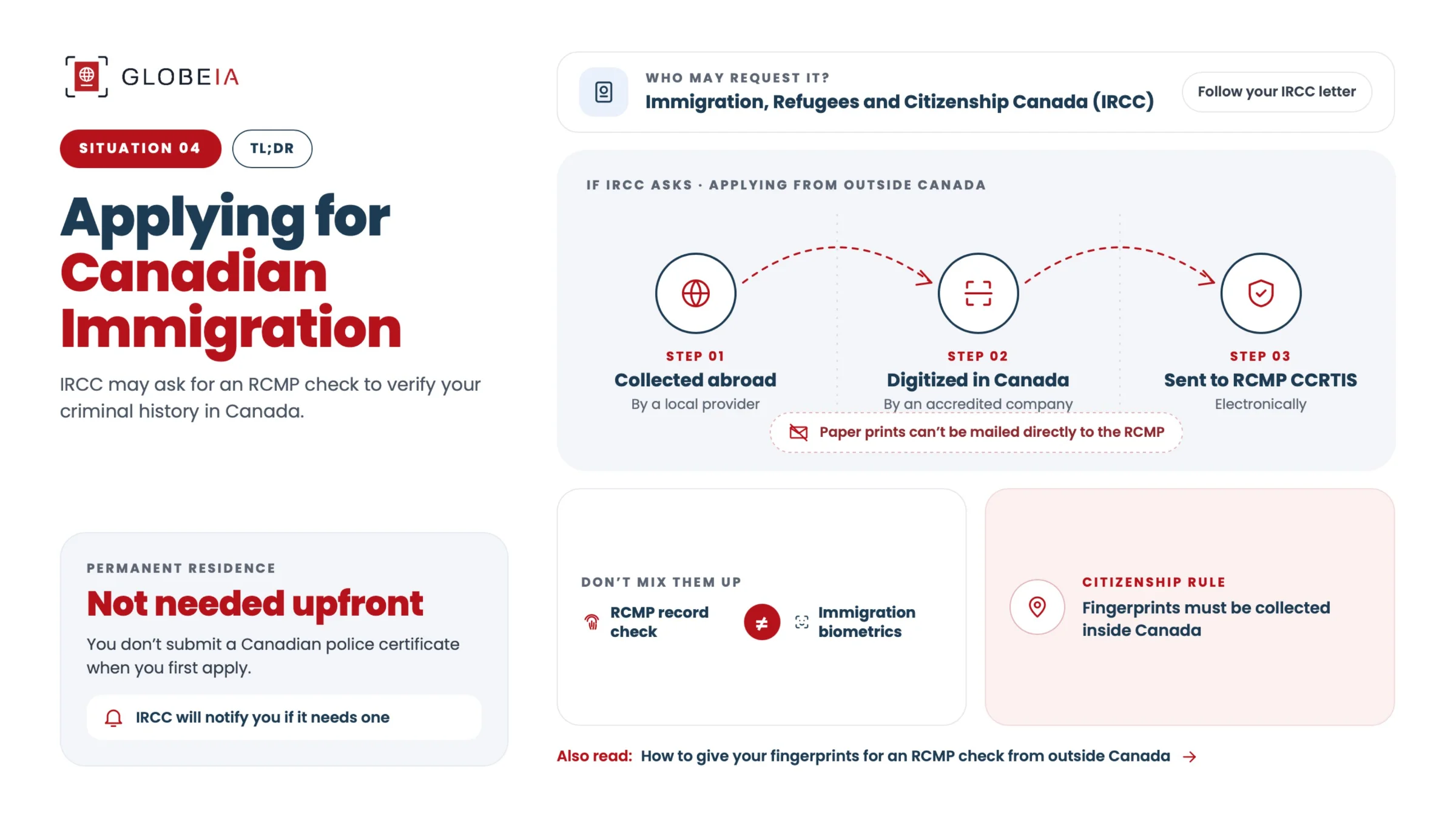
A Canadian immigration application may involve several background and security checks. In some cases, Immigration, Refugees and Citizenship Canada (IRCC) may ask an applicant to provide an RCMP criminal record check during the application process.
Why is the check requested?
IRCC may request a Canadian criminal record check to verify an applicant's criminal history in Canada. This can be relevant when the applicant has previously lived in Canada or when additional criminal record information is needed to assess an application.
It is important to understand that an RCMP criminal record check is not automatically required with every permanent residence application. IRCC states that applicants do not need to submit a Canadian police certificate when initially applying for permanent residence. The department will notify applicants if it needs a Canadian criminal record check while processing their application.
A Canadian criminal record check is also different from the fingerprints and photograph collected as immigration biometrics.
Who may request it?
Immigration, Refugees and Citizenship Canada is the main authority that may request a Canadian criminal record check during an immigration or citizenship application.
Applicants should follow the specific instructions in their IRCC correspondence, including the required document and fingerprint submission method.
When might fingerprinting be required?
If IRCC requests a Canadian criminal record check, fingerprints must be submitted electronically to the RCMP's Canadian Criminal Real Time Identification Services (CCRTIS).
Applicants outside Canada cannot send paper fingerprints directly to the RCMP. They must arrange fingerprint collection abroad and contact an accredited company in Canada to digitize and submit the fingerprints electronically.
There is also a special rule for citizenship applications: if fingerprints are required for a citizenship application, they must be collected inside Canada.
Also read: How to Give Your Fingerprints for an RCMP Criminal Record Check from Outside Canada
Detail | What to know |
|---|---|
Who may request it? | Immigration, Refugees and Citizenship Canada (IRCC) |
Possible check type | RCMP criminal record check for immigration or citizenship purposes |
When are fingerprints needed? | When IRCC specifically requests a Canadian criminal record check. For citizenship applications, required fingerprints must be collected inside Canada |

A Canadian criminal record check may be required when applying for a visa, residence permit, or other immigration status in another country. This is particularly relevant to people who previously lived, studied, or worked in Canada and now need to provide police clearance from their former country of residence.
Why is the check requested?
Foreign immigration authorities may ask applicants to provide police certificates from countries where they have lived. The purpose is to review their criminal history before granting a visa, residence permit, or other immigration status.
For example, someone who previously lived in Canada for several years may be asked to provide Canadian Criminal Record Check when applying for long-term residence in another country.
The required document depends on the destination country's rules. Some authorities may request an RCMP Criminal Record Check, while others may accept a different police certificate.
Who may request it?
Foreign immigration departments, visa processing authorities, consulates, and other government agencies may request Canadian criminal record documentation.
The applicant should confirm whether the authority requires an RCMP-issued certificate, a fingerprint-based check, or an additional form of document verification.
When might fingerprinting be required?
Fingerprinting may be necessary when the foreign authority specifically asks for a fingerprint-based Canadian criminal record check.
Applicants may also need to arrange an apostille, authentication, or translation after receiving the RCMP document. These requirements depend on the destination country and the authority receiving the certificate.
Detail | What to know |
|---|---|
Who may request it? | Foreign immigration departments, visa authorities, and consulates |
Possible check type | Canadian police certificate or fingerprint-based RCMP Criminal Record Check, depending on the destination country's requirements |
When are fingerprints needed? | When the foreign authority specifically requires a fingerprint-based Canadian check or the RCMP process requires identity verification |

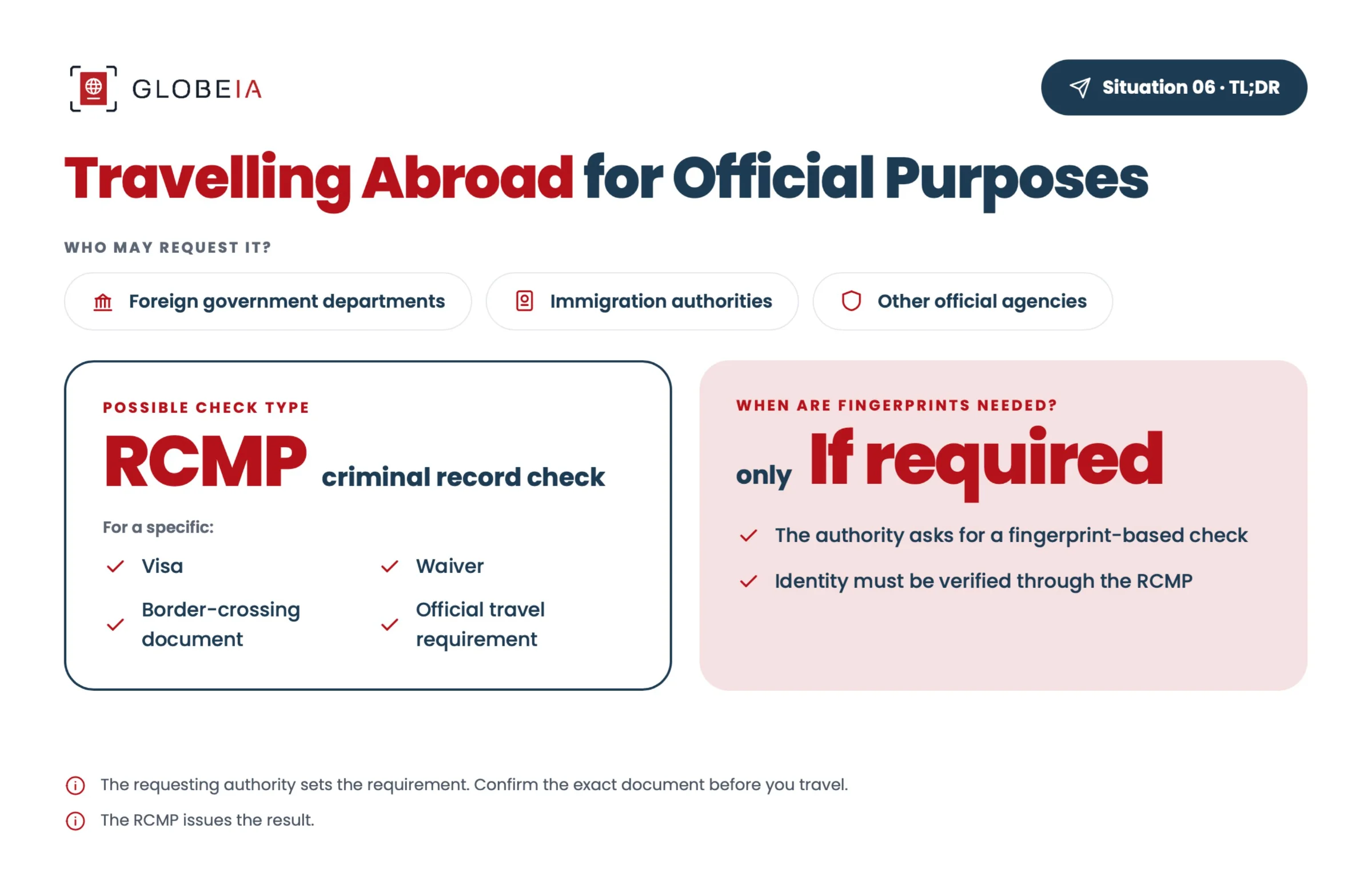
Not every international trip requires a criminal record check. But some travel-related applications involve additional background documentation, particularly when the applicant needs permission for an extended stay or a specific official purpose.
Why is the check requested?
Foreign authorities may request proof of criminal history when reviewing certain long-term travel, residency, or official applications. A person who has previously lived in Canada may need to provide a Canadian criminal record check as part of that process.
For example, an individual applying for a long-term stay abroad may be asked to provide police clearance from Canada if they previously resided there.
This requirement is different from ordinary tourist travel. A short holiday does not automatically create a need for an RCMP criminal record check.
Who may request it?
Foreign government departments, immigration authorities, consulates, and other official agencies may request criminal record documentation.
The applicant should check the destination country's requirements and confirm whether a Canadian police certificate is necessary.
When might fingerprinting be required?
Fingerprinting may be required when the requesting authority specifically asks for a fingerprint-based RCMP criminal record check or when the Canadian Criminal Record Check process requires identity verification.
Applicants should also check whether the final document needs an apostille, authentication, or translation before it can be accepted abroad.
Detail | What to know |
|---|---|
Who may request it? | Foreign government departments, immigration authorities, and other official agencies |
Possible check type | RCMP criminal record check for a specific visa, border-crossing document, waiver, or official travel requirement |
When are fingerprints needed? | When the requesting authority requires a fingerprint-based check or identity verification through the RCMP |

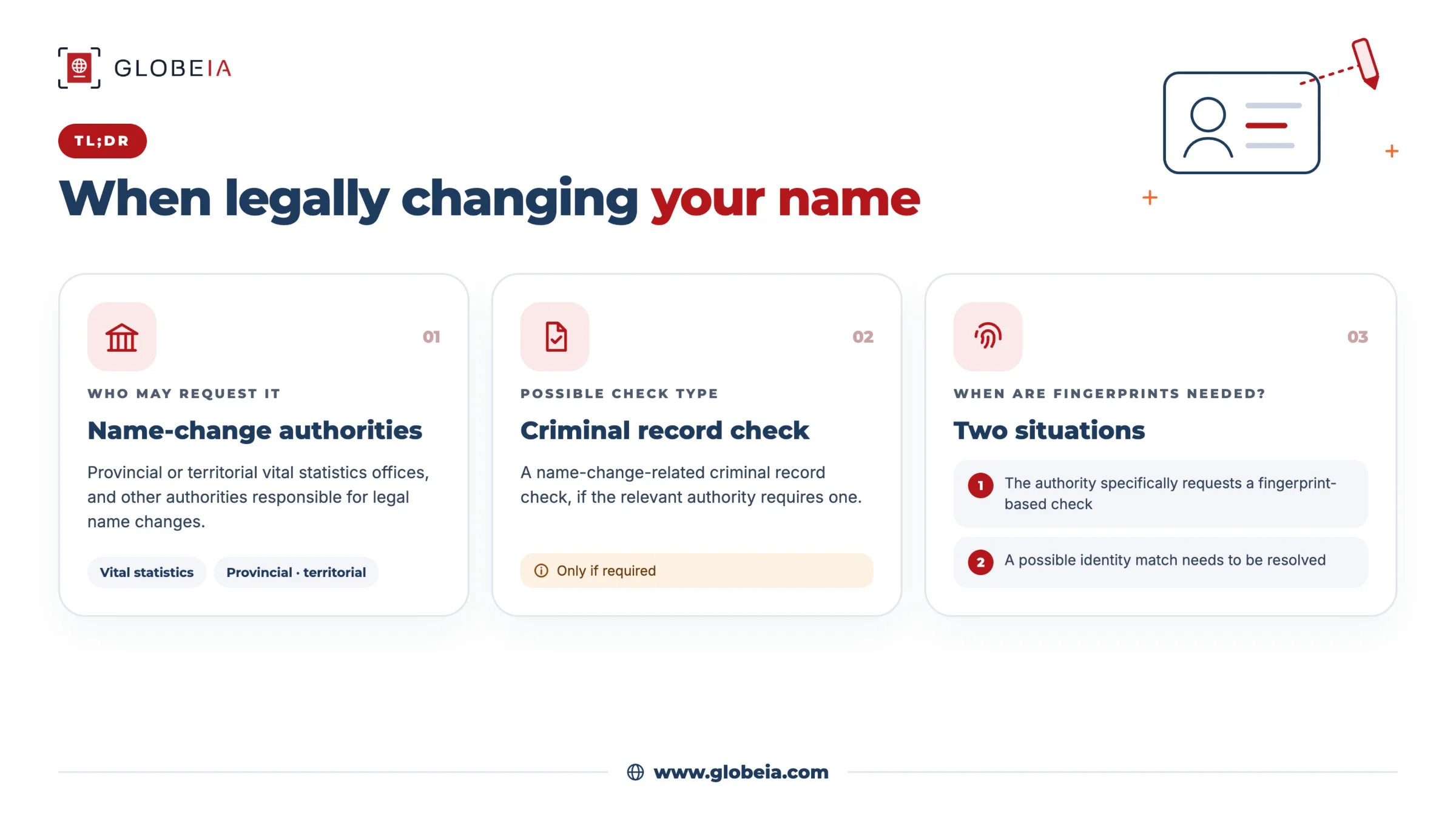
A legal name change may involve more than submitting a form and proof of identity. Depending on the province or territory and the applicant's circumstances, authorities may request additional background documentation, including a criminal record check.
Why is the check requested?
Some name-change procedures include checks intended to confirm the applicant's identity and review relevant criminal history. These requirements may also help authorities identify cases where a name change could affect an existing legal record or obligation.
But a criminal record check is not a universal requirement for every name change in Canada. The rules depend on the relevant provincial or territorial authority.
Who may request it?
Provincial and territorial vital statistics offices, government departments responsible for legal name changes, or other authorized agencies may request supporting criminal record documentation.
Applicants should review the official name-change instructions for their province or territory before arranging fingerprinting.
When might fingerprinting be required?
Fingerprinting may be requested if the authority specifically requires an RCMP Criminal Record Check or if a name-based search cannot confirm the applicant's identity.
If fingerprints are required, applicants should confirm the correct application category and submission method before visiting a fingerprinting provider.
Detail | What to know |
|---|---|
Who may request it? | Provincial or territorial vital statistics offices and other authorities responsible for legal name changes |
Possible check type | Name-change-related criminal record check, if required by the relevant authority |
When are fingerprints needed? | When the authority specifically requests a fingerprint-based check or a possible identity match needs to be resolved |

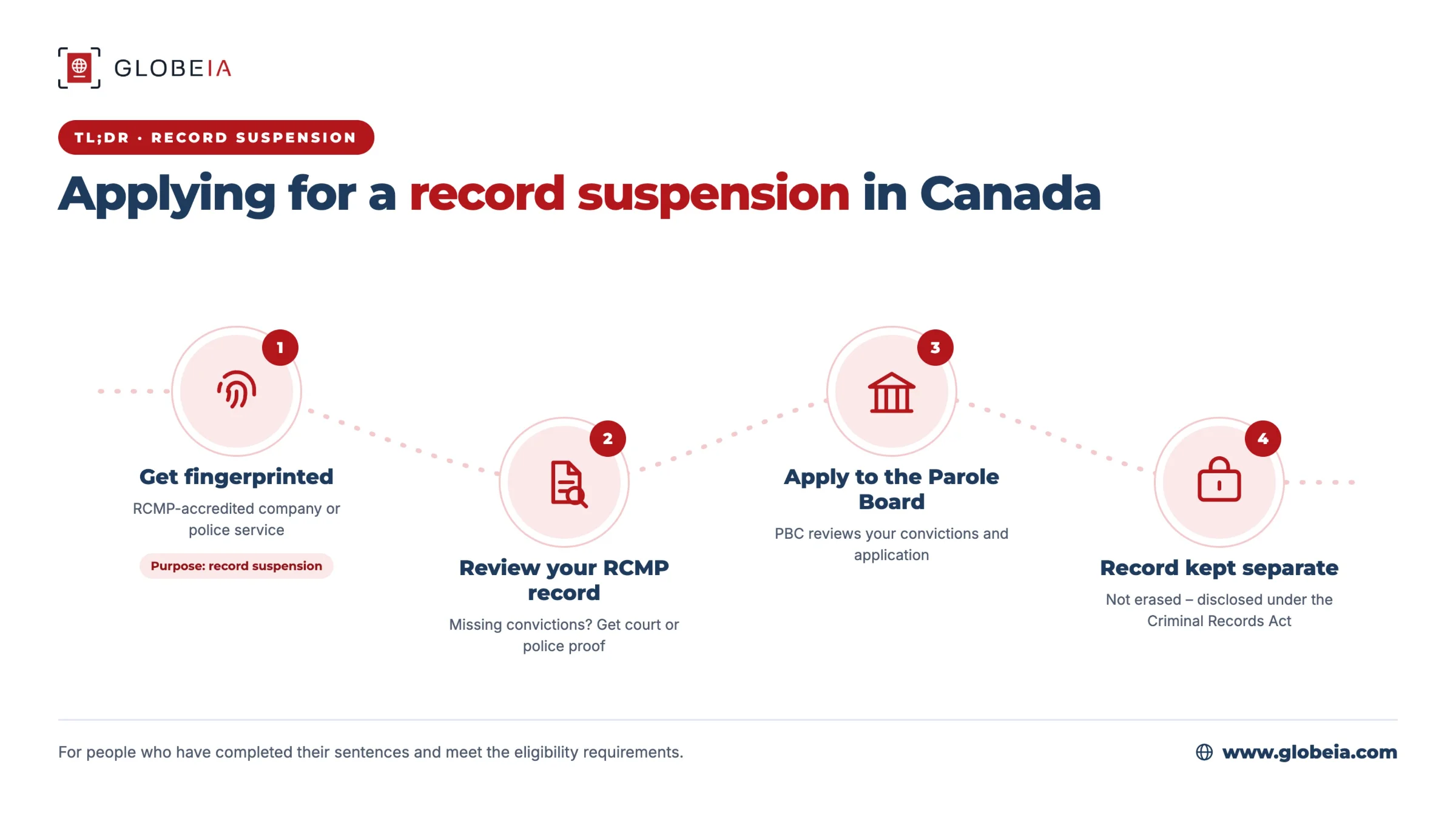
People who have completed their sentences and meet the eligibility requirements may apply for a record suspension in Canada. The process includes obtaining criminal record information from the RCMP.
Why is the check requested?
A record suspension helps keep a person's criminal record separate from other criminal records in the federal repository, subject to the rules of the Criminal Records Act.
The Parole Board of Canada (PBC) requires applicants to obtain their criminal record as part of the application process. This allows the Board to review the relevant convictions and other required information.
A record suspension does not erase a criminal record. It changes how the record is maintained and disclosed under the applicable rules.
Who may request it?
The Parole Board of Canada is responsible for reviewing record suspension applications. Applicants must obtain the required criminal record documents from the RCMP and provide them as part of their application.
When might fingerprinting be required?
Fingerprinting is a required part of obtaining the criminal record for a record suspension application.
According to the Parole Board of Canada's instructions, applicants must visit an RCMP-accredited fingerprinting company or a police service that can submit fingerprints electronically. The electronic submission must clearly state that the purpose is a record suspension application.
Applicants should also obtain and review their RCMP criminal record before completing the remaining application requirements. If any convictions are missing, additional proof may be needed from the relevant courts or police services.
Detail | What to know |
|---|---|
Who may request it? | Parole Board of Canada (PBC), as part of the record suspension application process |
Possible check type | RCMP Criminal Record Check for record suspension purposes |
When are fingerprints needed? | Fingerprinting is required to obtain the criminal record for this application. The electronic submission must identify record suspension as its purpose |

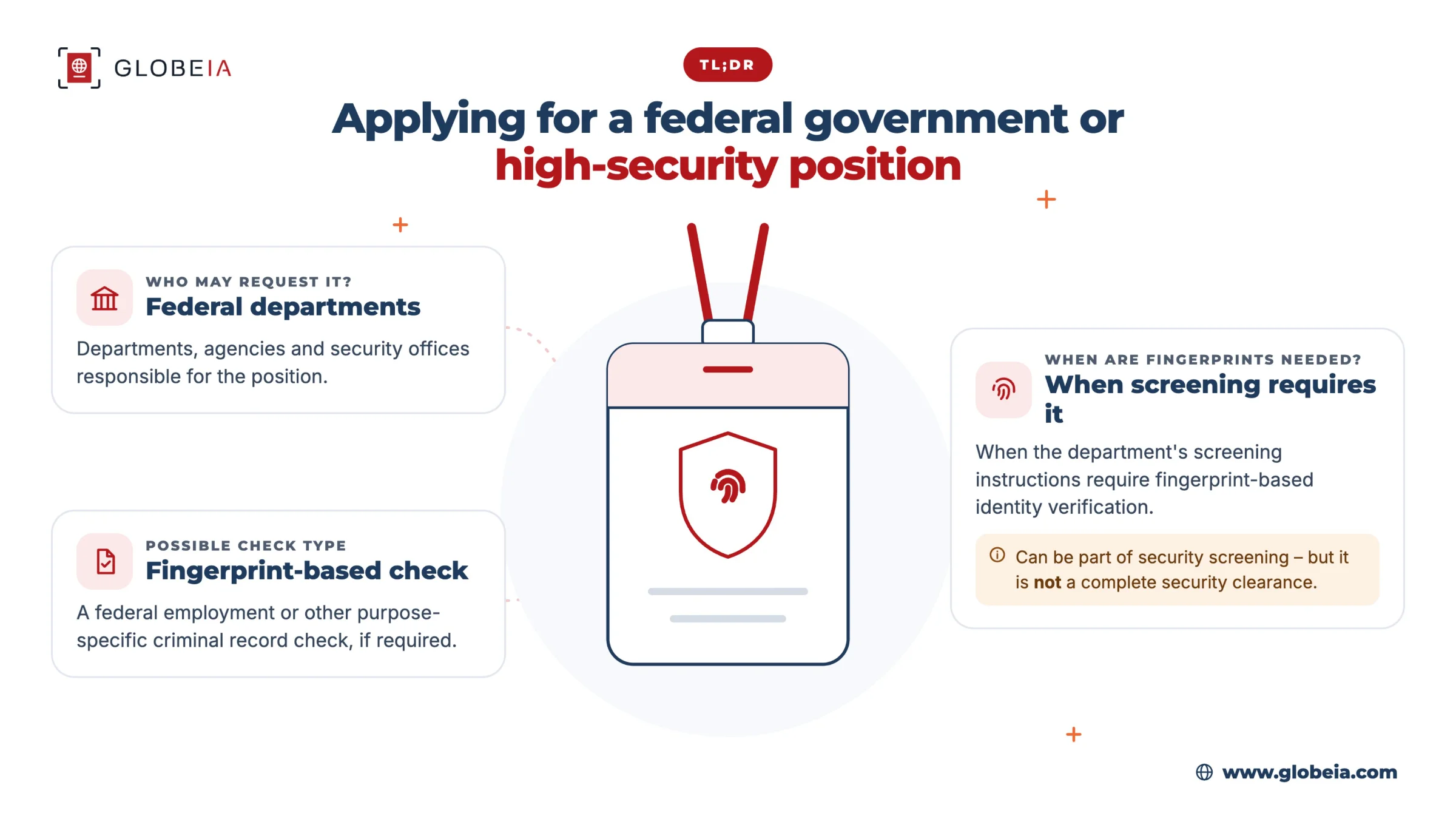
Some federal government and security-sensitive positions require more detailed background screening than ordinary employment. Depending on the role, applicants may need to provide an RCMP fingerprint-based criminal record check.
Why is the check requested?
Government departments and organizations responsible for sensitive work may need to verify an applicant's identity and criminal history before granting access to certain positions, information, or facilities.
For example, a position involving sensitive government information may require a higher level of screening than a standard office role.
A criminal record check may form part of this process, but it is not the same as a complete security clearance. Security screening can involve additional checks and assessments.
Who may request it?
Federal government departments, agencies, and organizations responsible for security-sensitive positions may request criminal record documentation.
The hiring department or security office should explain the required screening level and whether the applicant needs to submit fingerprints.
When might fingerprinting be required?
The RCMP identifies federal government employment and high-security jobs as situations where fingerprint-based criminal record checks may be needed.
The requesting department may provide specific instructions about fingerprint collection, the application purpose, and where the results must be sent. Applicants should use those instructions when arranging their appointments.
Detail | What to know |
|---|---|
Who may request it? | Federal government departments, agencies, and security offices responsible for the position |
Possible check type | Federal employment or other purpose-specific fingerprint-based criminal record check, if required |
When are fingerprints needed? | When the department's screening instructions require fingerprint-based identity verification. This may form part of security screening but is not the same as a complete security clearance |

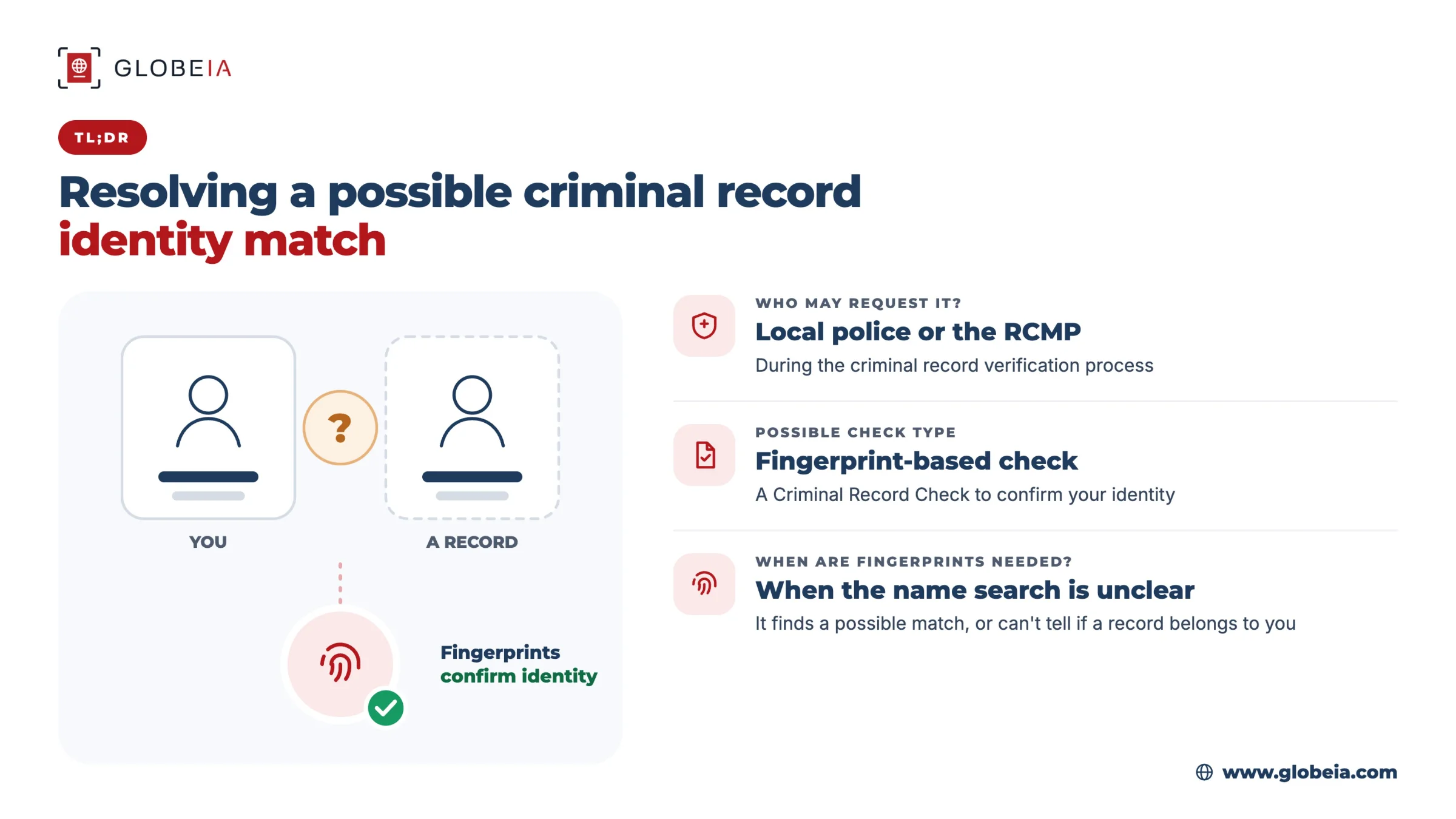
A person may be asked to submit fingerprints even if they have never been arrested or convicted of a crime. This can happen when a name-based search identifies a possible match with another person's criminal record.
Why is the check requested?
Name-based searches use personal details such as a person's name and date of birth. If these details are similar to those of another individual in the criminal record system, the search may not be able to confirm whose record it has found.
For example, two people may have similar names and dates of birth. A name-based search may identify a possible match but cannot always establish whether the record belongs to the applicant.
Fingerprint verification helps resolve this uncertainty.
Who may request it?
A local police service, an authorized fingerprinting company, or the RCMP may require fingerprints as part of the criminal record verification process.
The applicant may receive instructions to complete fingerprinting after an initial name-based search.
When might fingerprinting be required?
Fingerprinting may be required when a name-based search produces a possible match or when the available biographical information cannot confirm identity.
The RCMP uses fingerprints to compare the applicant's identity with the relevant criminal record information. Being asked to provide fingerprints does not mean that the applicant is suspected of a crime. It helps prevent someone from being incorrectly linked to another person's record.
Detail | What to know |
|---|---|
Who may request it? | Local police services or the RCMP during the criminal record verification process |
Possible check type | Fingerprint-based Criminal Record Check to confirm identity |
When are fingerprints needed? | When a name-based search identifies a possible match or cannot establish whether a record belongs to the applicant |
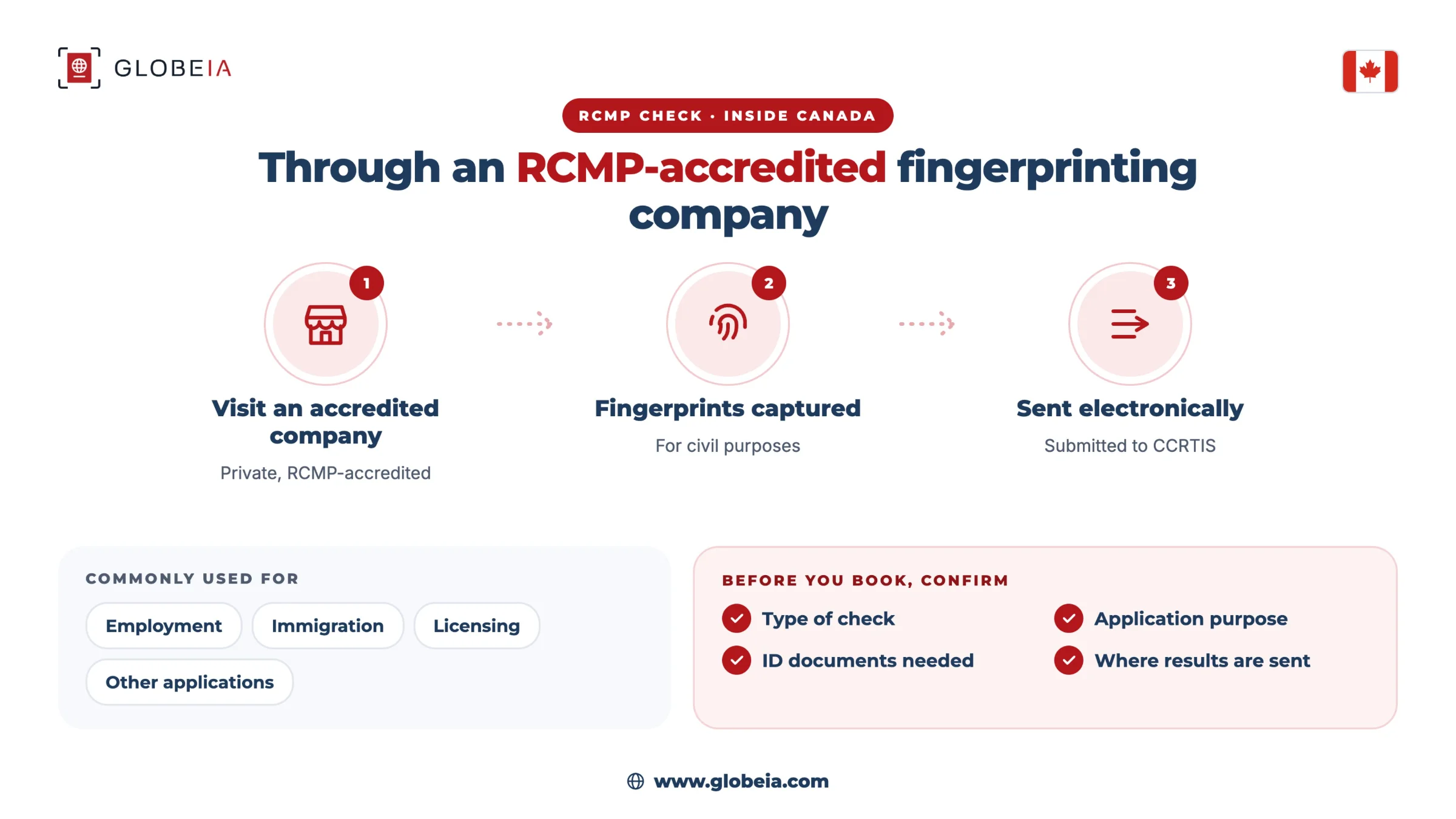
The process for obtaining a fingerprint-based RCMP Criminal Record Check depends partly on where you live. Applicants inside Canada can visit a local police service or an RCMP-accredited fingerprinting company. Applicants outside Canada must first arrange paper fingerprint collection and then send their original fingerprint form to an accredited company in Canada.
Here is how the two routes compare:
Factor | Applicants inside Canada | Applicants outside Canada |
|---|---|---|
Fingerprint collection | Local police service or RCMP-accredited fingerprinting company | Authorized local agency in the country of residence |
Fingerprint format | Electronic or paper, depending on the provider and process | Paper fingerprints, usually taken in black ink |
Submission | Police service or accredited company submits the application | Original fingerprint form is sent to an accredited company in Canada |
Digitization | Electronic capture may be available | Canadian accredited company converts the paper fingerprints into digital format |
RCMP submission | Electronic submission to CCRTIS | Electronic submission to CCRTIS through the Canadian accredited company |
Additional services | Depends on the provider and purpose | International courier, apostille, authentication, and translation may be needed |

Applicants living in Canada generally have two options for fingerprint-based criminal record checks.
1. Through a local police service
Applicants can contact their local police service to ask whether it provides fingerprint collection and criminal record check services.
Some police services capture fingerprints electronically and submit them to the RCMP. Others may direct applicants to an accredited fingerprinting company.
If the applicant needs a Vulnerable Sector Check, they must contact the appropriate local police service. Private RCMP-accredited fingerprinting companies do not independently provide this service.
2. Through an RCMP-accredited fingerprinting company
Applicants can also visit a private fingerprinting company accredited by the RCMP. These companies are authorized to capture fingerprints for civil purposes and submit electronic transactions to CCRTIS.
This route is commonly used for employment, immigration, licensing, and other applications requiring a Criminal Record Check.
Before booking an appointment, confirm the type of check required, the application purpose, the identification documents needed, and where the results must be sent.
Here are RCMP’s instructions for applicants inside and outside Canada.
Getting an RCMP Criminal Record Check from Outside Canada
Living outside Canada does not automatically prevent someone from obtaining an RCMP Criminal Record Check. The RCMP provides a process for applicants abroad, but the fingerprint collection and submission steps are different.
1. Arrange fingerprint collection locally
The first step is to contact an authorized agency in your country of residence. This may include a local police service, an eligible government department, a foreign government's embassy or consulate, a notary public, or a private fingerprinting provider that meets the RCMP's stated arrangements.
Request a paper copy of your fingerprints. The RCMP specifies that the form must include all 10 fingers in black ink, along with the agency's name and address and the name and signature of the official who took the prints.
2. Contact an RCMP-accredited company in Canada
The original fingerprint form must be sent to an RCMP-accredited fingerprinting company in Canada.
The company converts the paper fingerprints into a digital format and submits the application electronically to CCRTIS.
It is important to understand that there are no private fingerprinting companies accredited by the RCMP outside Canada. The overseas agency collects the fingerprints, while the accredited Canadian company handles the electronic submission.
3. Receive your RCMP criminal record check
Once the RCMP completes its verification, the result is issued according to the application and delivery arrangements.
Applicants should account for both RCMP processing time and international mailing time. If the document is needed for immigration, employment, or another foreign application, they should also confirm whether additional authentication, apostille, or translation is required.
Do not mail your fingerprints directly to CCRTIS. The RCMP requires applications from overseas applicants to go through an accredited company in Canada.

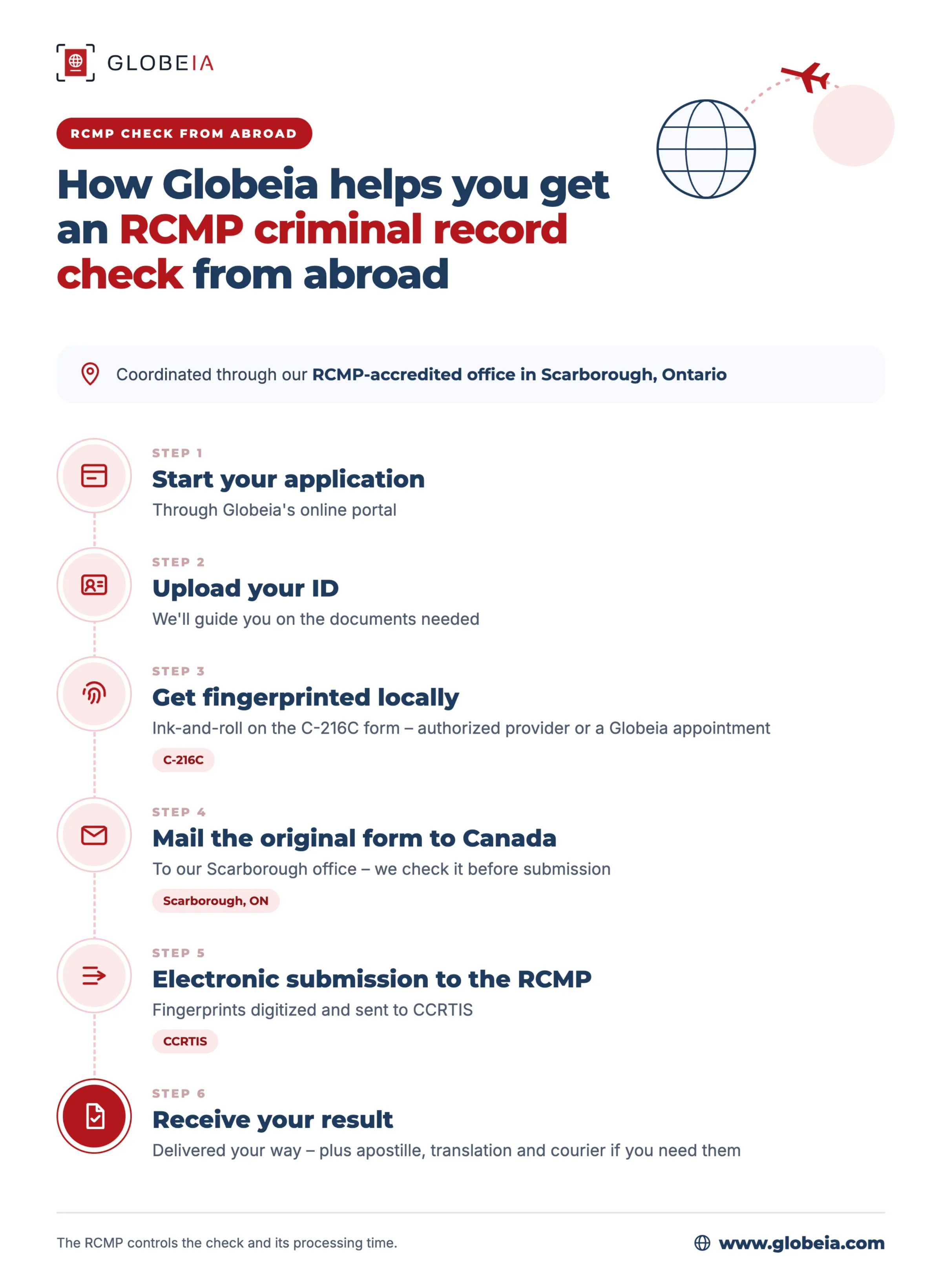
Applicants living outside Canada may find it difficult to arrange the correct fingerprint form, identify an authorized local provider, and send original documents to Canada. Globeia helps coordinate these steps through its RCMP-accredited office in Scarborough, Ontario.
Globeia's RCMP accreditation is held by its Canadian office. Applicants abroad can arrange local ink-and-roll fingerprint collection through an authorized provider or a Globeia-supported appointment where available. The original fingerprint form is then sent to the Canadian office for processing.
Here is how the process works:
1. Start your application
Complete the application through Globeia's online portal and provide the information needed for your RCMP criminal record check.
2. Upload your identification documents
Submit the required identity documents and application details. The team can guide you on the documents needed for your application.
3. Arrange fingerprint collection
Complete ink-and-roll fingerprinting on the required C-216C form through an authorized local provider or an available Globeia fingerprinting appointment.
4. Send the original fingerprint form to Canada
Mail the completed original fingerprint form to Globeia's Scarborough office. The team checks the form before preparing it for electronic submission.
5. Electronic submission to the RCMP
Globeia's accredited Canadian office digitizes the fingerprints and submits the application electronically to CCRTIS.
6. Receive your result
Once the RCMP completes the check, the result is delivered through the selected delivery arrangement. Applicants who need the document for use abroad can also request additional support with apostille, authentication, certified translation, and international courier services.
The RCMP controls the actual criminal record check and its processing time. Globeia assists with fingerprint collection, application preparation, submission, and related document services.
Also read: How Long Does a Canadian Criminal Record Check Take | A 2026 Guide
An RCMP Criminal Record Check may be required at different stages of your professional, personal, and international life. The important thing is to confirm which type of check the requesting authority needs before arranging fingerprint collection.
For applicants living outside Canada, the process can be completed without travelling back to Canada. With the correct fingerprint form and support from an RCMP-accredited company in Canada, you can submit your application from abroad and receive the required criminal record documentation.


Global Services
State Services