State Apostille Services from USA
Apostille Services in California
Apostille Services in Texas
Apostille Services in Florida
Apostille Services in Washington
Services from Canada
Services from United Kingdom
Services from New Zealand

You can get a second citizenship in 2026 through four main routes: citizenship by investment (CBI), fast naturalization (short residency periods), citizenship by descent (ancestry), or marriage. In this blog, we’ll explore the 15 easiest and most popular countries making citizenship more accessible in 2026.
Ireland, Argentina, Portugal, Dominica and several other countries offer some of the easiest routes to citizenship in 2026. Depending on the country, you may qualify through your descent, marriage, naturalisation, or a qualifying investment. The time and cost involved vary considerably, so the easiest option depends on your eligibility and circumstances.
Below, we compare 15 easiest countries to get citizenship, including their requirements, estimated costs and application timelines.
To become a national of a country, you can explore these ways:
Citizenship by descent
Citizenship by marriage
Citizenship by residency (naturalisation)
Citizenship by investment (CBI)
You can also get citizenship by birth, but we have not included it in this list since we’re focusing on the easy ways to become a citizen for foreigners.
Best for: People with a parent, grandparent or, in some countries, great-grandparent born in the country.
You claim a nationality you already have a right to through your family. There is no need to move.
Time: 12 months to 3 years
Cost: Application, translation, authentication and document-recovery costs vary.
Verdict: The cheapest and fastest route, if you qualify.
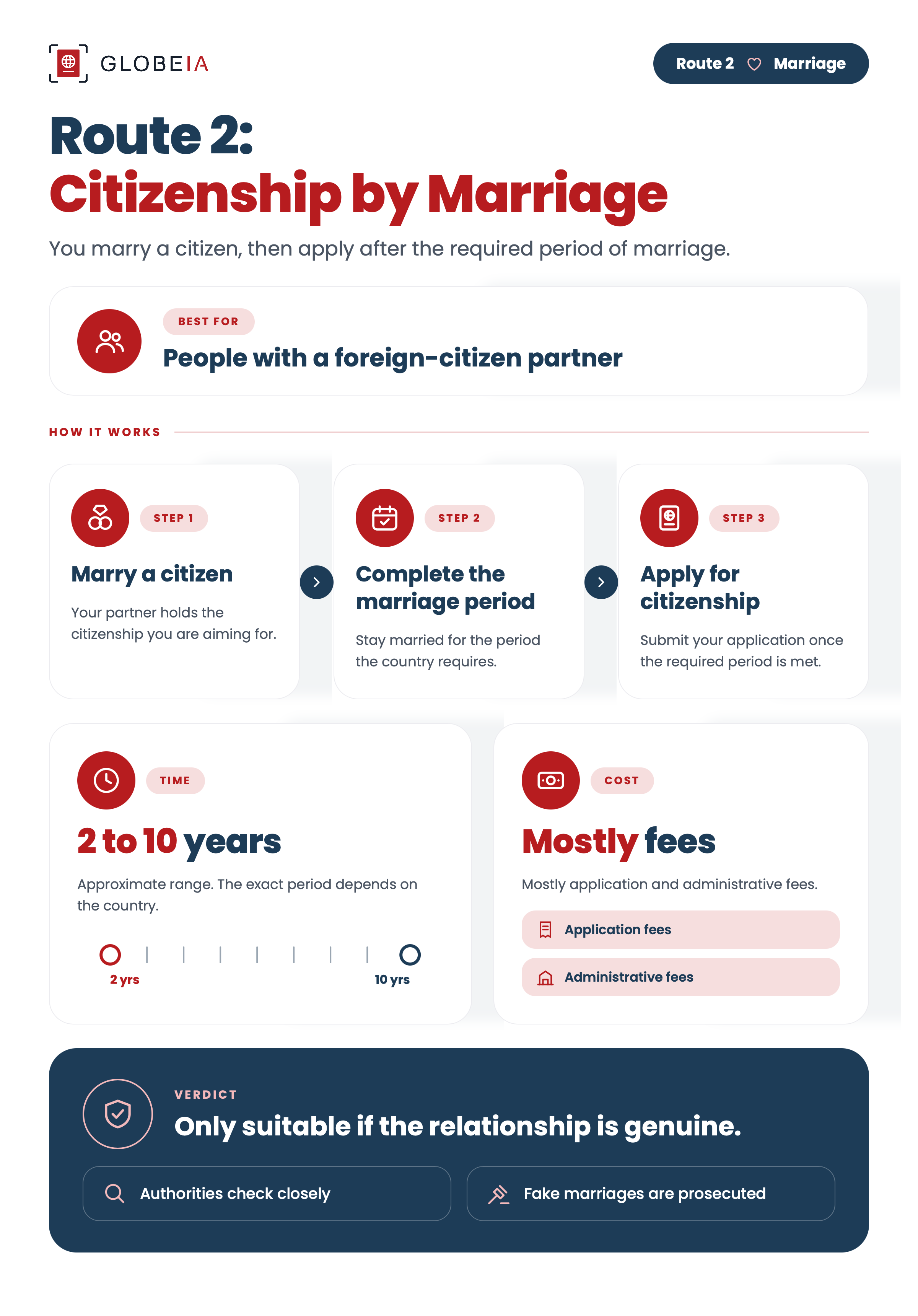
Best for: People with a foreign-citizen partner.
You marry a citizen, then apply after the required period of marriage.
Time: Approximately 2 to 10 years
Cost: Mostly application and administrative fees
Verdict: Only suitable if the relationship is genuine. Authorities check closely, and fake marriages are prosecuted.

Best for: People who can move abroad and live there legally.
You live in the country for a set period, then apply. The required period is usually 2 to 10 years. Argentina (2 years) is among the fastest.
Time: Several years
Cost: Your living costs in that country during the period
Verdict: Affordable if you are willing to relocate, but it is the slowest route and needs your time.
Best for: People with the budget who want quick results and no relocation.
You make a government-approved contribution, like a donation to a national fund or a real estate purchase, and receive citizenship. Caribbean programmes are best known for this.
Time: Normally a few months
Cost: The highest of the four routes, starting from around US$200,000 plus due diligence and processing fees
Verdict: The fastest route that doesn’t depend on your family or your partner, but you pay for the speed.
Citizenship applications can also involve supporting documents from countries where you previously lived, including criminal-record certificates and authenticated records. For a practical example, read our guide to getting an FBI background check for a citizenship application in Singapore.
Country | Route | Eligibility period / processing estimate |
Ireland | Descent | FBR: approximately 12 months; Irish-association cases: 30+ months |
Poland | Descent | Usually at least 6 months for a confirmation decision; may be extended |
Hungary | Descent / marriage | Processing time varies |
Italy | Descent / marriage | Marriage eligibility: 2 years in Italy or 3 years abroad; descent processing varies |
Greece | Marriage-linked naturalisation | 3 years of legal residence in qualifying cases; processing varies |
France | Marriage | 4 years of marriage, or 5 in certain circumstances; processing varies |
Argentina | Naturalisation | 2 years of continuous legal residence immediately before applying |
Brazil | Naturalisation | 4 years standard; 1 or 2 years for qualifying applicants |
Portugal | Naturalisation / marriage | 7 years for EU and Portuguese-speaking nationals; 10 years for other nationalities; marriage route after 3 years |
Dominica | Investment | Approximately 3–6 months |
Antigua and Barbuda | Investment | Approximately 3 months |
Grenada | Investment | Approximately 60 business days after submission, subject to checks |
Saint Lucia | Investment | Approximately 3 months after acceptance for processing |
St. Kitts and Nevis | Investment | Approximately 120-180 days |
Türkiye | Investment | Processing varies; do not promise 3–6 months |
Choosing a citizenship route is only one part of the process. Applicants planning to relocate may also need to complete immigration biometrics or obtain separate criminal-record checks. Our guide to fingerprinting for immigration applications explains how these requirements differ.

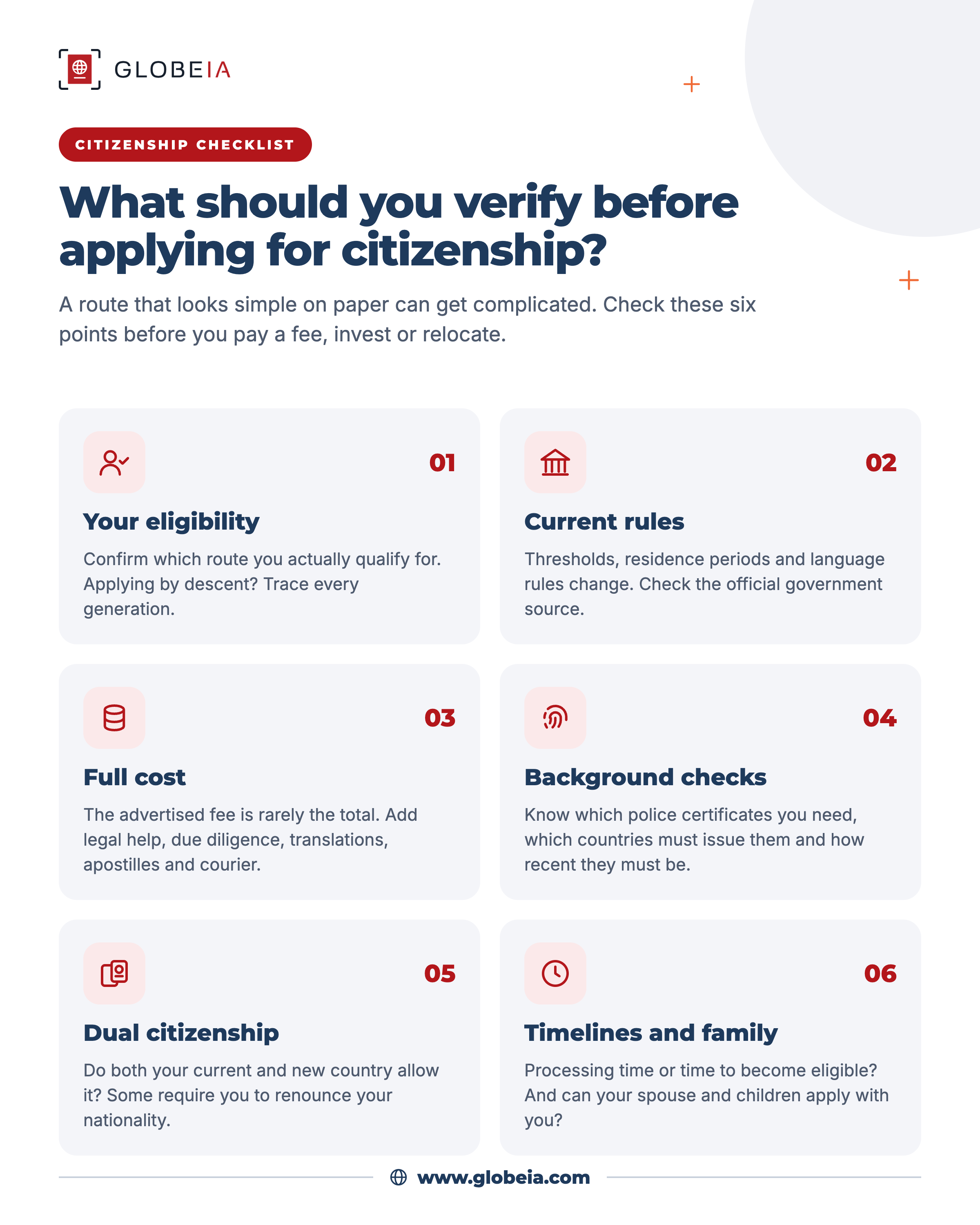
A route that looks simple on paper can get complicated once your own circumstances come into play. Before you pay a fee, invest, or relocate, check these six points:
Your eligibility: Confirm which route you actually qualify for. For descent, trace the citizenship status of every generation.
Current rules: Thresholds, residence periods, and language requirements change regularly. Confirm them with the official government source, not a third-party site.
Full cost: The advertised fee is rarely the total. Add government charges, due diligence, legal help, translations, apostilles, and courier costs.
Background checks: Find out which police certificates you need, which countries must issue them, and how recent they must be.
Dual citizenship: Check whether both your current country and the new one allow it. Some require you to renounce your existing nationality.
Timelines and family: Check whether a timeline means processing time or time to become eligible, and whether your spouse and children can apply with you.
Before you commit: Get the key requirements and costs in writing. It is far easier to check the rules at the start than to find a problem halfway through.
Many foreign police checks require fingerprinting. Read our guide to Fingerprinting Requirements for Police Clearance in 2026 for more information.
We compared citizenship pathways across 15 countries, looking beyond the advertised processing times or minimum investment amounts. Our assessment considered:
how applicants qualify, whether they need to relocate,
the financial commitment involved,
processing periods,
language requirements,
dual citizenship rules and
the possibility of including family members.
We also considered the differences between investment, descent and naturalisation, since each route serves a different type of applicant.
So the ranking below reflects how accessible each country's citizenship pathway really is, not just which one has the shortest wait.
Some countries let you claim citizenship through your family line. No investment or long residency required. If you have a parent or grandparent born in the place, you may already qualify for a second passport without ever having lived there. The countries below offer some of the more accessible descent-based routes in 2026.

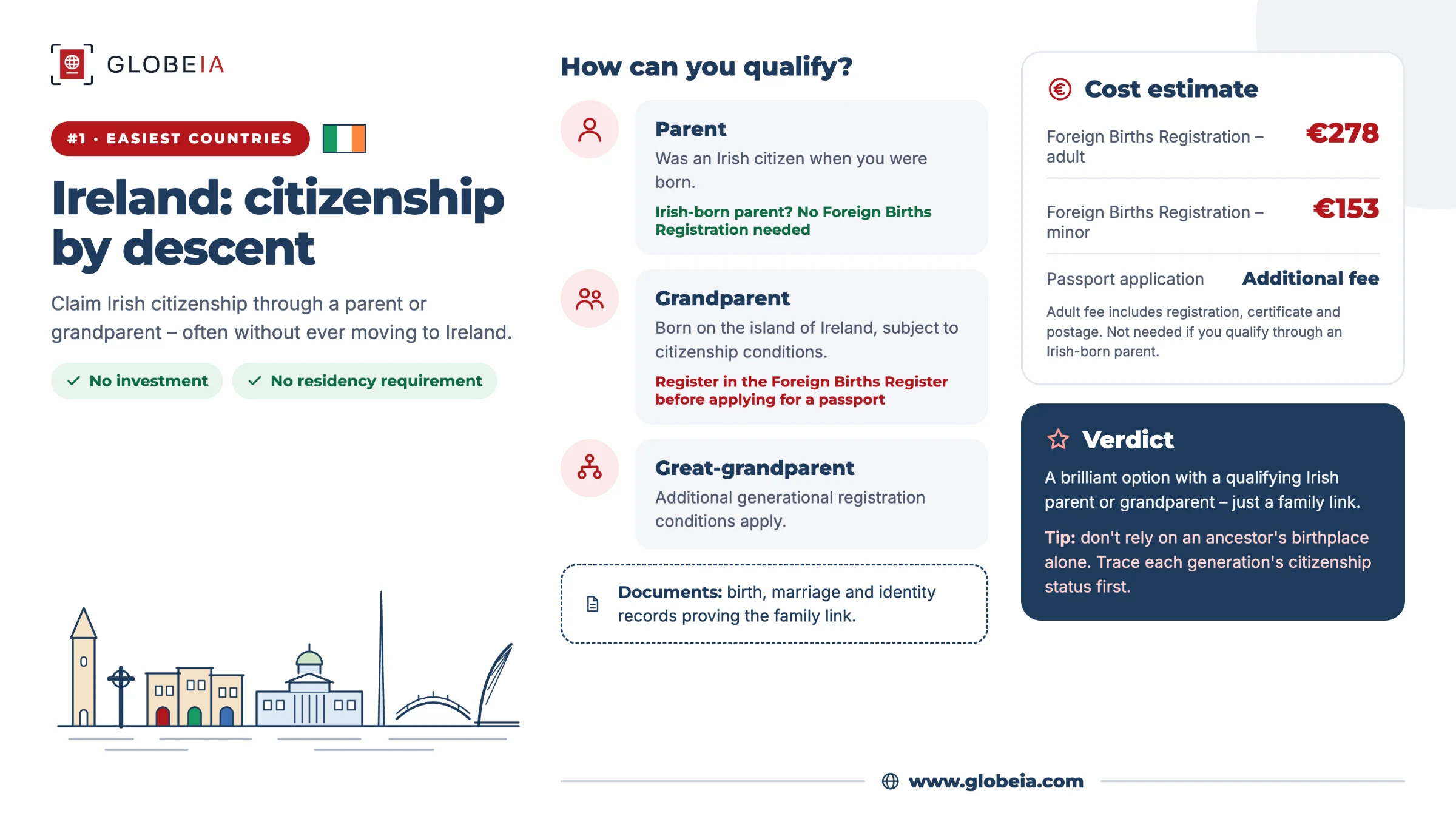
Ireland can be one of the easiest countries to get citizenship in if you have the right family connection. Its nationality laws allow eligible people born abroad to claim Irish citizenship through a parent or grandparent. For many applicants, this means becoming an Irish citizen without ever moving to Ireland - a very different route from investment or naturalisation programmes.
How can you qualify?
You may qualify if:
One of your parents was an Irish citizen when you were born.
One of your grandparents was born on the island of Ireland, subject to the relevant citizenship conditions.
Applicants claiming through an Irish-born grandparent need to register through Ireland's Foreign Births Register before applying for an Irish passport. If the connection is through a great-grandparent, additional generational registration conditions apply.
You will need documents establishing the family relationship, including relevant birth, marriage and identity records.
Cost Estimate
Cost component | Estimated amount |
Foreign Births Registration – adult applicant | €278 |
Foreign Births Registration – minor applicant | €153 |
Passport application | Additional fee |
The adult fee includes registration, the certificate and postage. Applicants who qualify automatically through an Irish-born parent do not need Foreign Births Registration.
Verdict
Ireland is a brilliant option if you have a qualifying Irish parent or grandparent. No investment, no residency requirement, just a family link. That said, don't rely on an ancestor's birthplace alone. Trace the citizenship status of each generation first, or you could hit a wall late in the process.

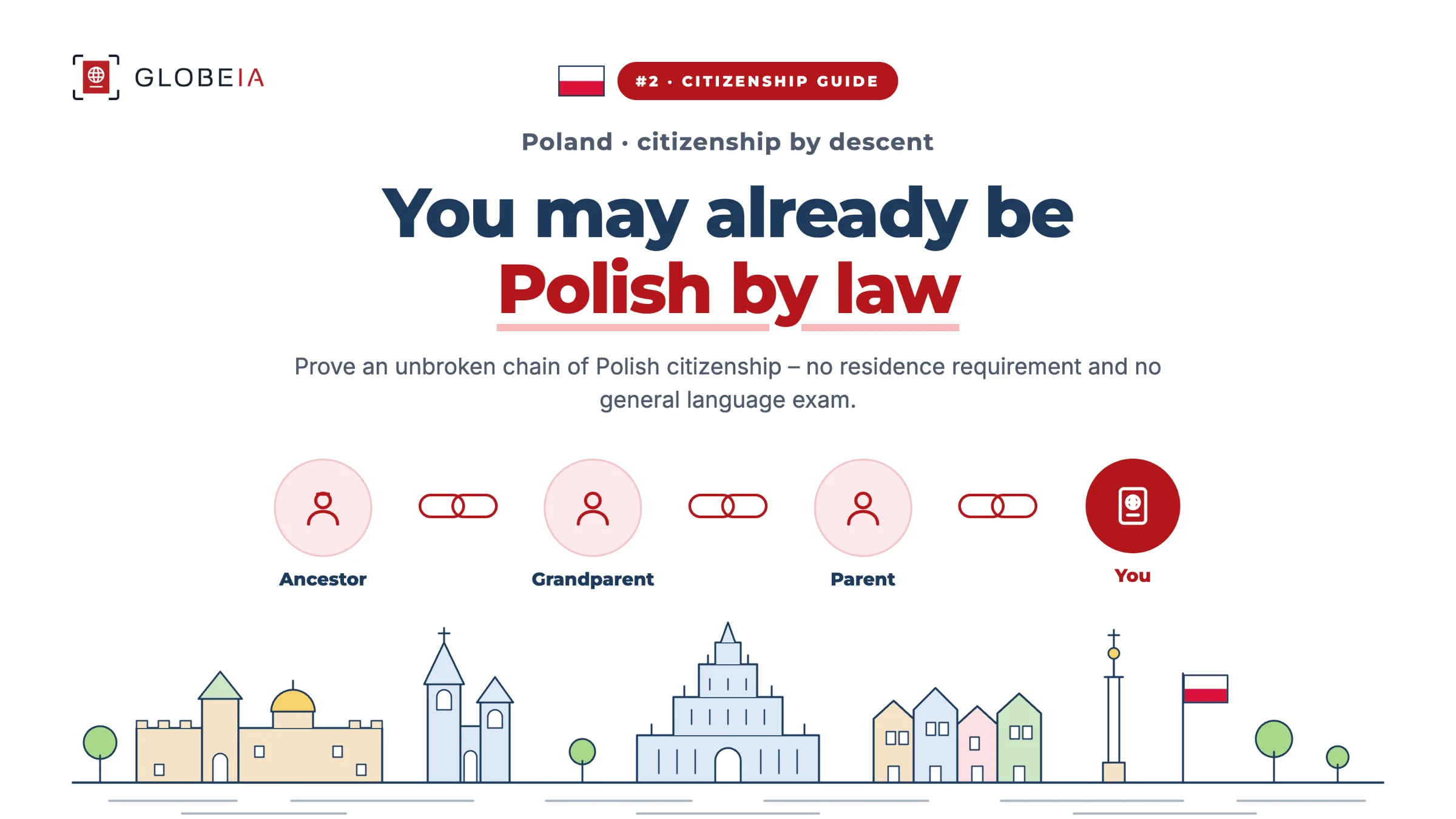
Polish citizenship by descent doesn't work like an investment or naturalisation application. If you have Polish ancestry and your family kept their Polish citizenship through the generations, you may already be Polish by law.
The process, then, is usually about confirming what you already have rather than applying for something new. That makes Poland a genuinely attractive option for anyone whose parents, grandparents, or earlier ancestors came from there.
How can you qualify?
Applicants must establish an unbroken chain of Polish citizenship. This usually involves tracing the family through birth and marriage certificates, historical Polish records and evidence of the ancestor's citizenship status.
Historical events matter. An ancestor's emigration or subsequent acquisition of another nationality may affect whether citizenship passed to the next generation. The relevant Polish nationality law at the time must be examined.
There is no general Polish-language examination or residence requirement for confirmation of existing citizenship.
Poland
Cost component | Estimated amount |
Confirmation of Polish citizenship through a Polish consulate in the US | US$118 |
Polish passport application (after citizenship confirmation) | US$165 |
Document translations, apostilles and record retrieval | Additional; varies |
Note: The US$118 consular fee covers administering the confirmation application and delivering the decision. It does not include the subsequent passport application or variable document-preparation expenses.
Verdict
Polish citizenship may be an option for you if your family has a documented Polish background. It can be a relatively accessible route for eligible descendants, but the most important step is proving that Polish citizenship was never lost before it passed to the next generation.
International applicants may need fingerprints collected locally and submitted to the relevant overseas authority. Learn how Globeia handles international FBI, RCMP and fingerprinting requirements for applicants outside the issuing country. |

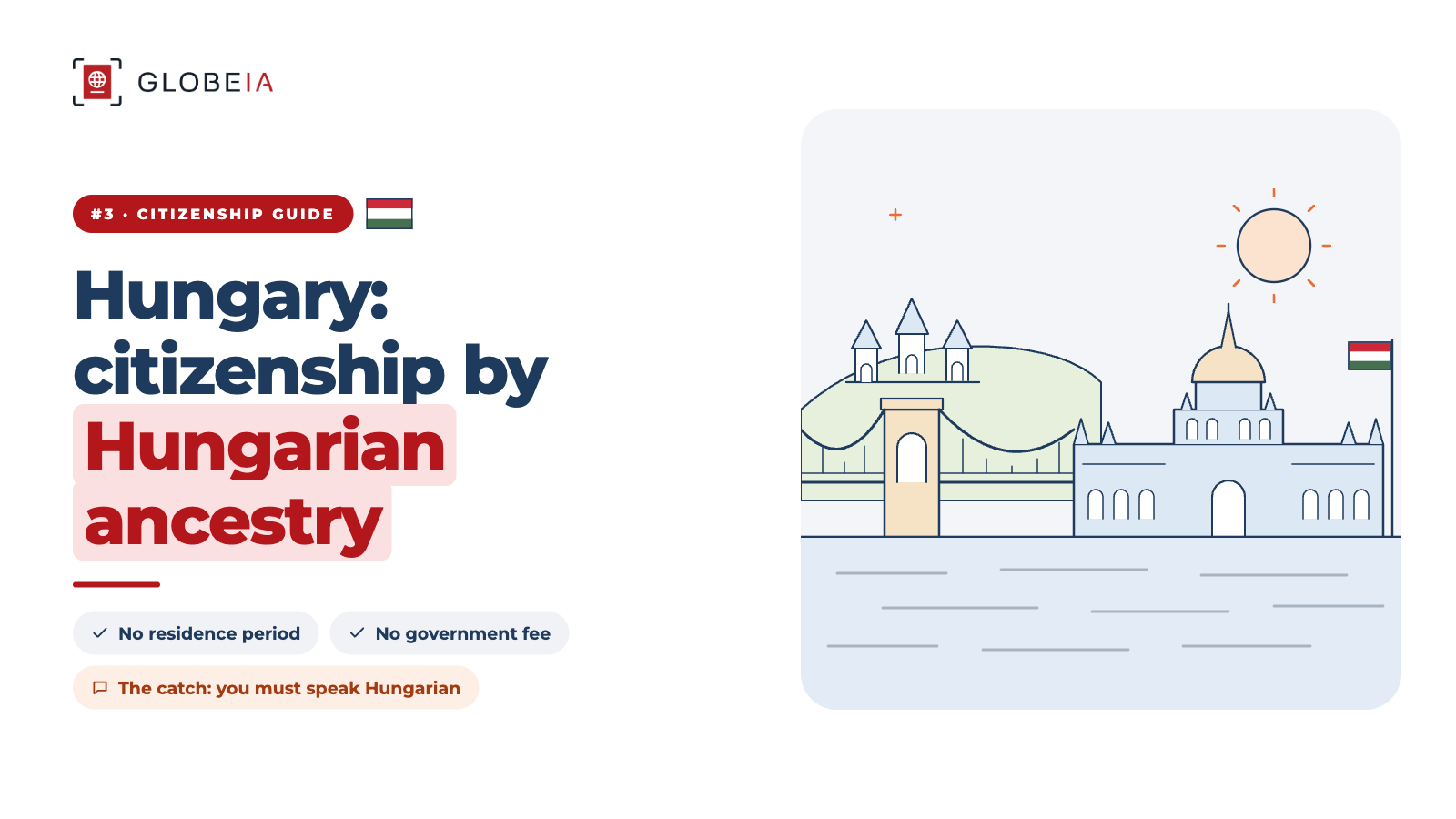
Hungary offers a simplified naturalisation process for people who can show Hungarian ancestry or origin. Unlike the standard route, eligible applicants don't need to live in Hungary for years before applying. But there's a catch that sets Hungary apart from some other ancestry-based options: you'll need to speak Hungarian.
How can you qualify?
Applicants need to establish a Hungarian family connection through official records and demonstrate sufficient Hungarian-language knowledge during the application process.
The route may be available through qualifying ancestors beyond grandparents, provided the applicant can establish Hungarian origin.
Applicants must also meet the relevant criminal record and national security conditions. The application can be submitted through the appropriate Hungarian authorities or diplomatic missions abroad.
A note on citizenship by marriage: A separate simplified naturalisation route is available to foreign spouses of Hungarian citizens after 10 years of marriage, or five years if the couple has a child together. Hungarian language proficiency is required.
Cost Estimate
Cost component | Estimated amount |
Simplified naturalisation application | No government application fee |
Certified translations, authentication and document preparation | Variable |
Hungary's simplified naturalisation procedure is free, but applicants may still need to pay for translations, apostilles and other supporting documents.
Verdict
Hungary is a strong pick if you've got Hungarian roots and don't mind putting in the language work. It lets you chase citizenship without moving there first, but that language requirement makes it tougher going than some other descent routes.

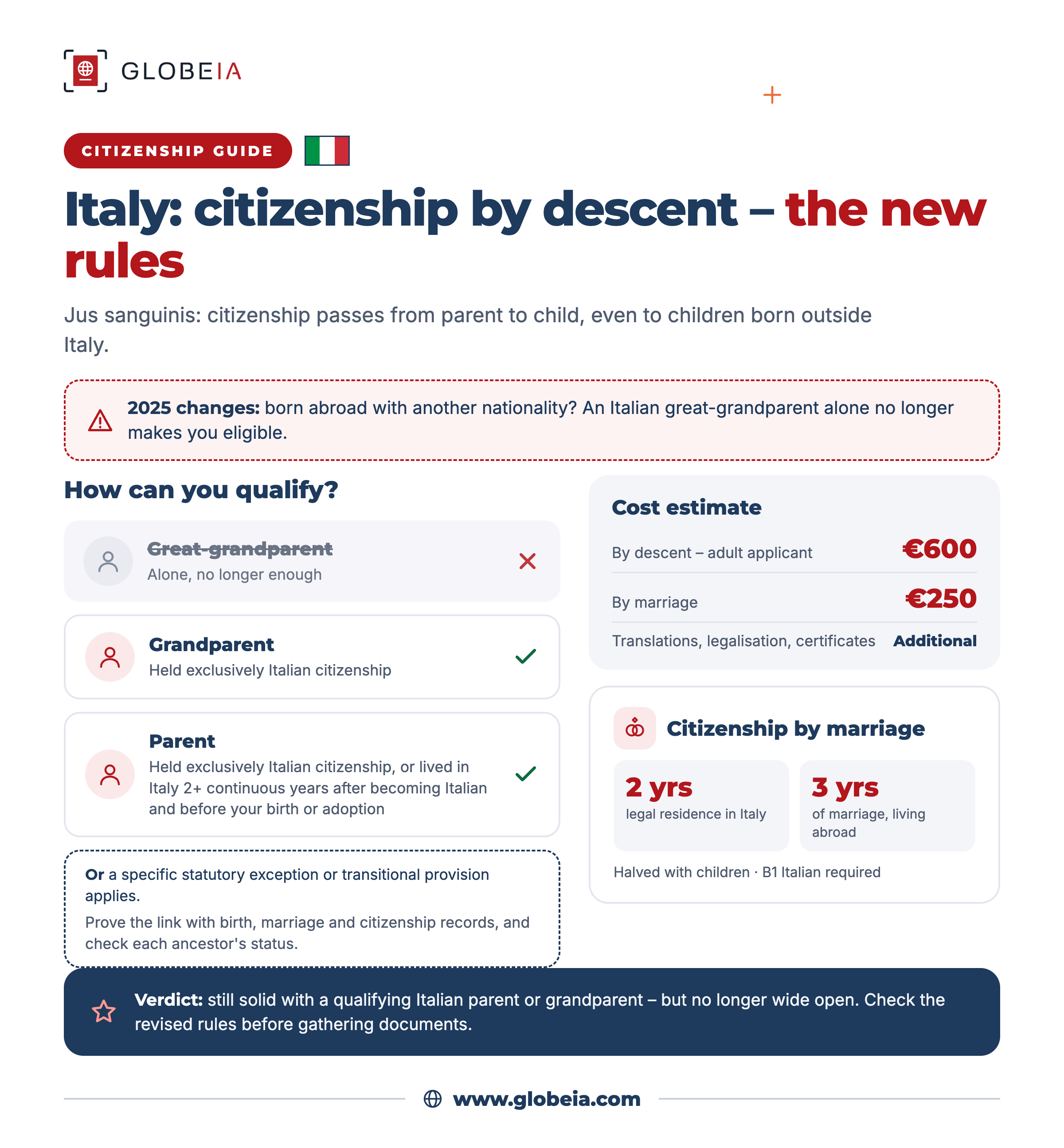
Italy has long been a magnet for people seeking citizenship through their family tree. Under the principle of jus sanguinis, Italian citizenship passes from parent to child, even to children born outside Italy.
But 2025 brought major changes. If you were born abroad and hold another nationality, the rules are now much tighter: an Italian great-grandparent alone no longer makes you eligible for Italian citizenship.
How can you qualify?
Under the revised rules, applicants need to meet one of the following conditions:
A parent or grandparent held exclusively Italian citizenship.
A parent who was an Italian citizen lived in Italy for at least two continuous years after acquiring Italian citizenship and before the applicant's birth or adoption.
Another specific statutory exception or transitional provision applies.
Applicants must establish their family connection using official birth, marriage and citizenship records. The rules also require careful examination of the citizenship status of each ancestor.
A note on citizenship by marriage: Separately, a foreign spouse of an Italian citizen can apply after two years of legal residence in Italy or three years of marriage while living abroad. These periods are halved if the couple has children, and B1 Italian proficiency is required.
Cost Estimate
Cost component | Estimated amount |
Citizenship by descent – adult applicant | €600 |
Citizenship by marriage | €250 |
Translations, legalisation and certificates | Additional |
Verdict
Italy is still a solid option if you have a qualifying Italian parent or grandparent, but it's no longer the wide-open route for people with Italian ancestors it once was. If you're thinking of applying, check the revised eligibility rules first before sinking time and money into gathering documents.
Marriage may shorten the path to a second passport, but there’s more to it. You still apply through a naturalisation process, normally with a shorter waiting period than the standard residency route.

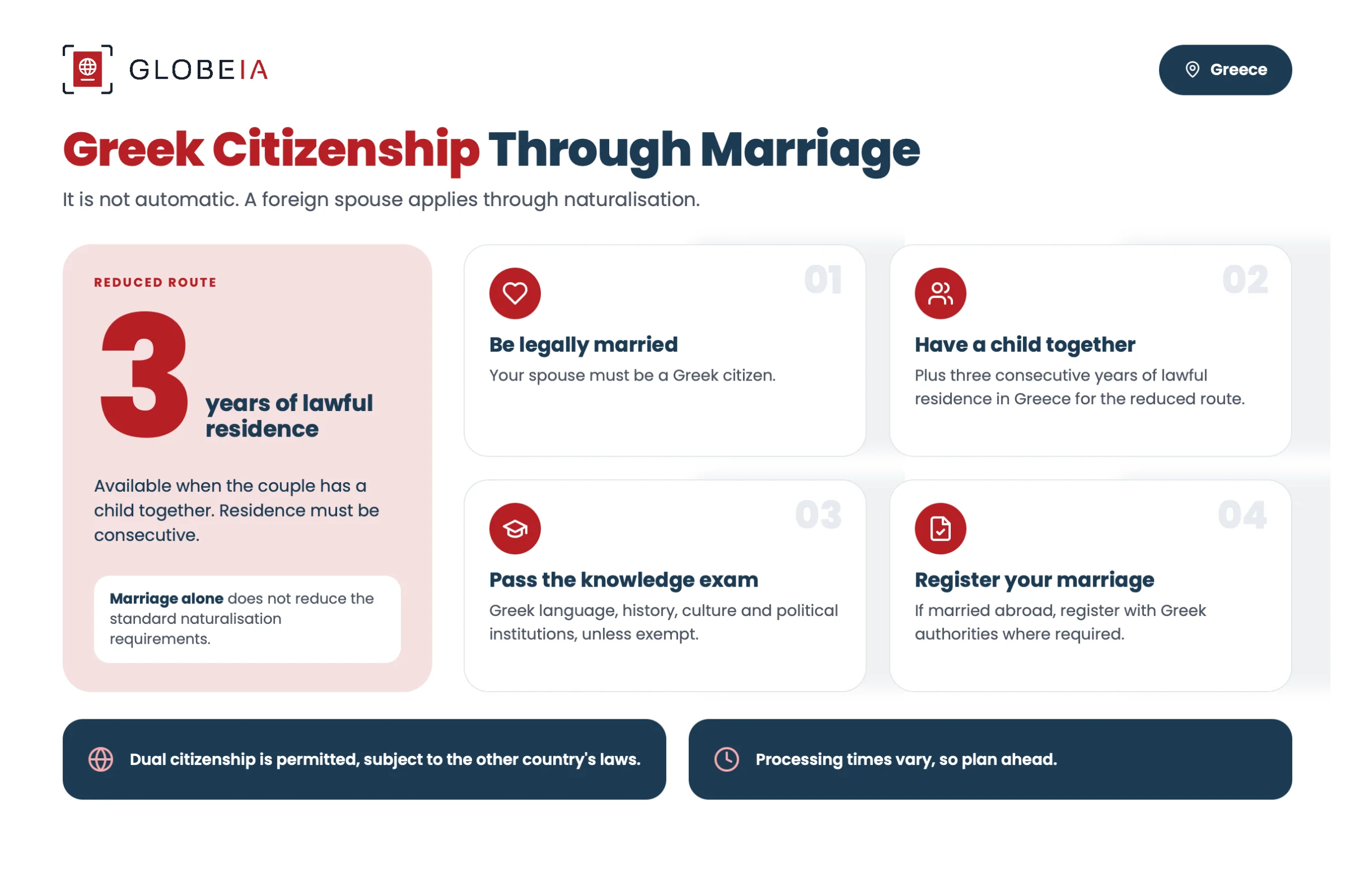
Greece does not grant citizenship automatically through marriage. A foreign spouse can apply through naturalisation, with a reduced three-year residence requirement if the couple has a child together. Greece permits dual citizenship, subject to the other country's laws.
How can you qualify?
Be legally married to a Greek citizen.
Have a child together and complete three consecutive years of lawful residence in Greece to qualify for the reduced route.
Demonstrate knowledge of Greek language, history, culture and political institutions through the required examination, unless exempt.
Provide properly registered marriage documents, including registration with Greek authorities where required if married abroad.
Processing times vary, and marriage alone does not reduce the standard naturalisation requirements.
Cost Estimate
Cost component | Estimated amount |
Naturalisation application for most non-EU applicants | €550 |
Application for certain eligible categories, including members of the Greek diaspora and refugees | €100 |
Document translation, certification and supporting records | Additional |
Verdict
Greece is worth considering for couples who plan to settle there and have a child together. The three-year route is attractive, but it still requires residence, language proficiency and integration.

France allows foreign spouses of French citizens to acquire nationality through a declaration of nationality by marriage. Applicants can generally apply after four years of marriage, although this increases to five years in certain circumstances. B2-level French is required from 2026.
How can you qualify?
Be married to a French citizen who has retained French nationality.
Complete four years of marriage, or five years if the additional residence or consular-registration conditions are not met.
Maintain a genuine and continuous shared marital life.
Be at least 18 years old.
Demonstrate French proficiency at B2 level and provide the required supporting documents.
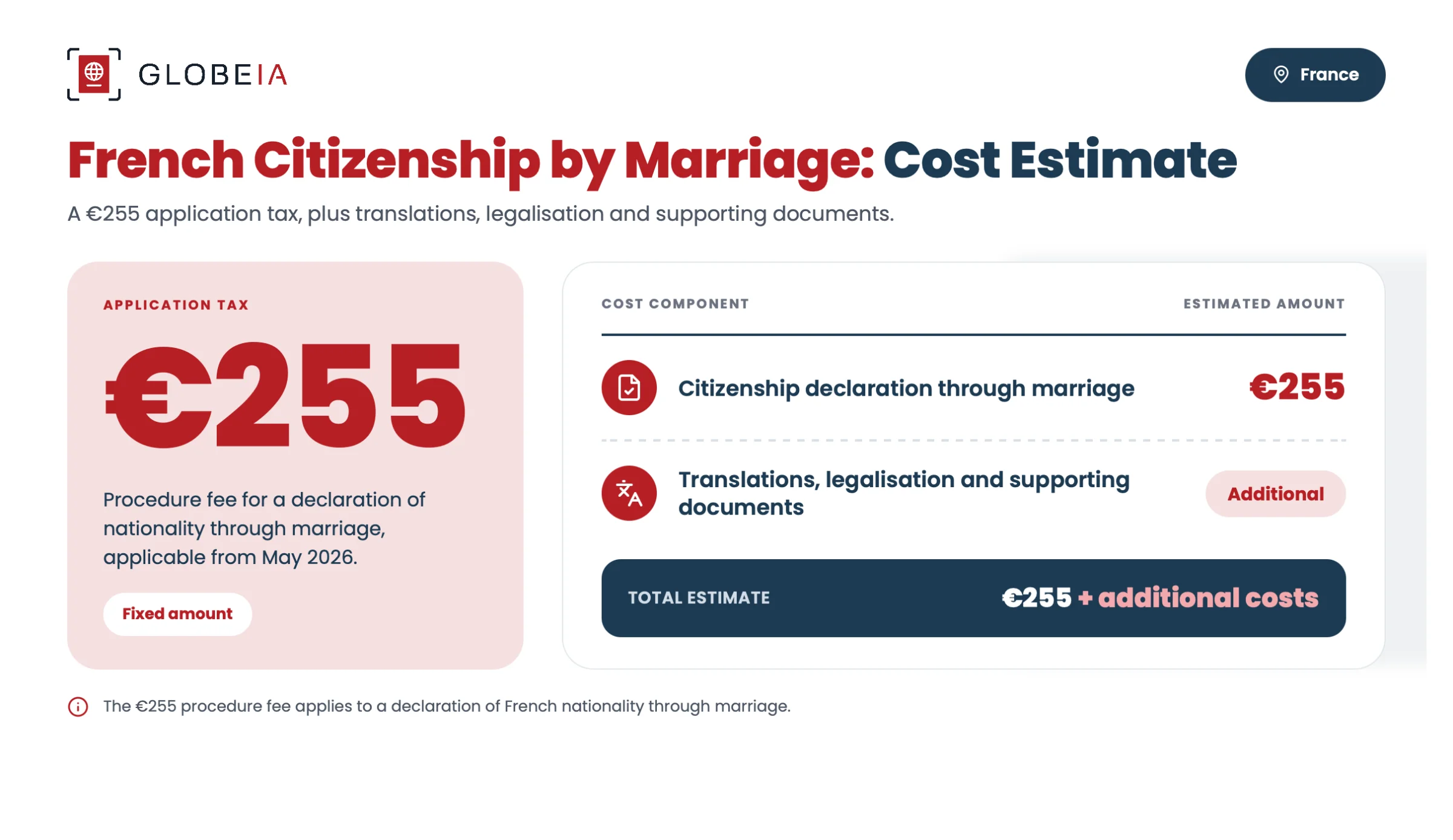
The application tax is €255 from May 2026. Processing times vary. The civic exam required for certain naturalisation applications does not apply to the marriage declaration route.
Cost Estimate
Cost component | Estimated amount |
Citizenship declaration through marriage | €255 |
Translations, legalisation and supporting documents | Additional |
The €255 procedure fee applies to a declaration of French nationality through marriage.
Verdict
France suits couples who have established a genuine life together and can demonstrate strong French proficiency. The four-year route is relatively accessible, but the B2 language requirement calls for preparation.
Naturalisation rewards time over money. Live in a country long enough, meet the conditions, and citizenship may follow. Some countries set the bar much lower than others, with shorter residency periods and simpler requirements. Here are the most accessible naturalisation routes in 2026.

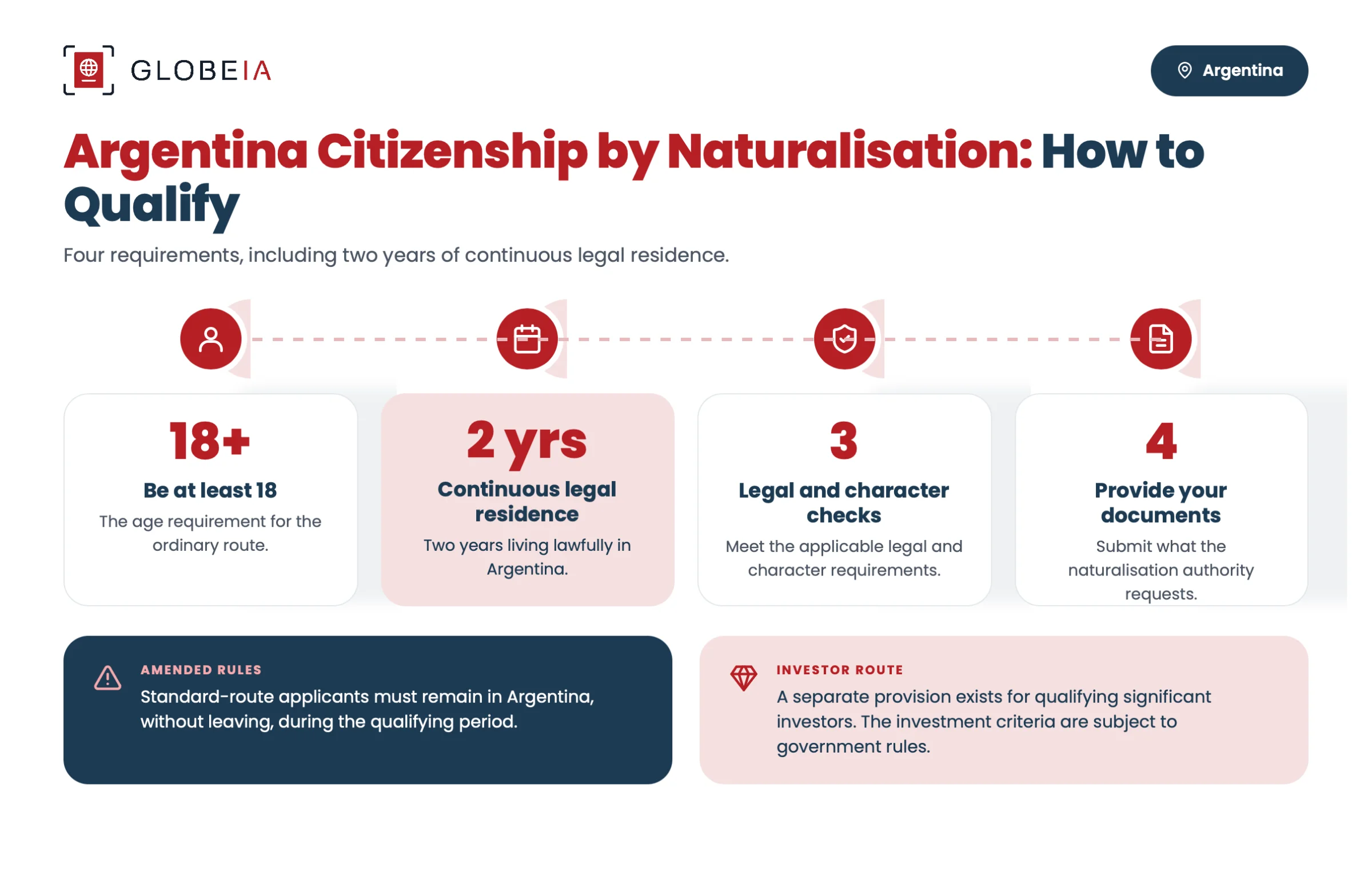
Argentina often tops lists of the easiest countries to get citizenship through naturalisation, due to its short qualifying residence period. Foreign nationals can apply after just two years of residence.
A 2025 legal change brought a stricter interpretation of "continuous residence," making the route less flexible for anyone who travels in and out frequently.
How can you qualify?
Under the ordinary naturalisation route, applicants need to:
Be at least 18 years old.
Complete two years of continuous legal residence in Argentina.
Meet the applicable legal and character requirements.
Provide the documents requested by the naturalisation authority.
The amended rules require applicants under the standard route to remain in Argentina without leaving during the qualifying period.
A separate naturalisation provision for qualifying significant investors also exists, although the relevant investment criteria are subject to government rules.
Cost Estimate
Cost component | Estimated amount |
Naturalisation application | No standard government application fee specified on the official service page |
Argentine and foreign police certificates | Additional, where applicable |
Birth certificate legalisation and other documentation | Variable |

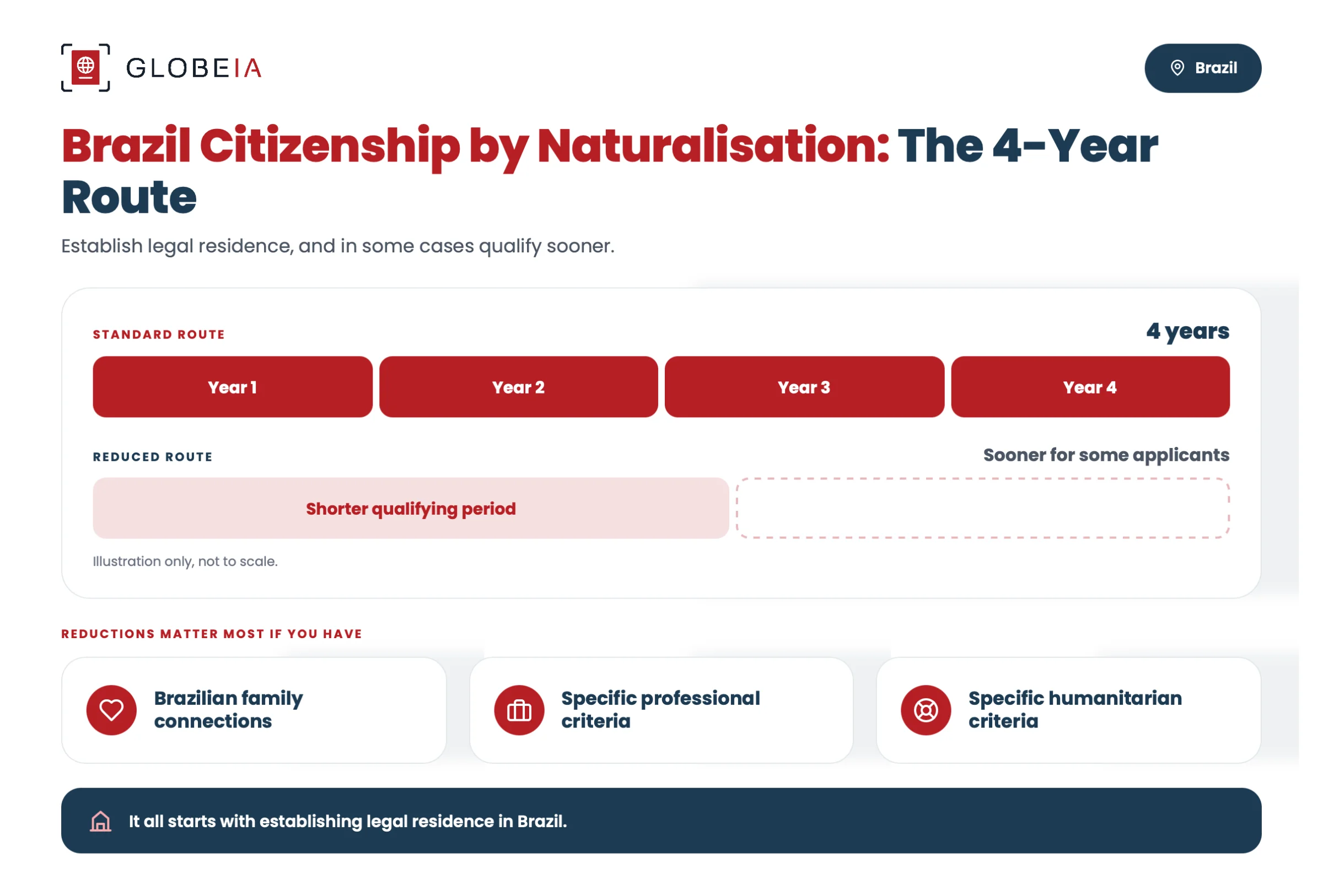
Brazil offers a naturalisation route for foreigners who establish legal residence in the country. The standard qualifying period is four years, though some applicants can qualify sooner. Those reductions matter most if you have Brazilian family connections or meet specific professional or humanitarian criteria.
How can you qualify?
The ordinary naturalisation route requires:
Four years of qualifying indefinite residence.
The ability to communicate in Portuguese.
No disqualifying criminal record, subject to applicable legal provisions.
Compliance with the relevant immigration and nationality requirements.
The residence period can be reduced to one year in certain cases, including applicants with a Brazilian child or spouse or partner.
Certain applicants, including recognised stateless persons and individuals with relevant services or outstanding professional, scientific or artistic capacity, may qualify after two years of residence.
Cost Estimate
Cost component | Estimated amount |
Naturalisation application | Confirm the applicable federal fee before applying |
Criminal-record certificates, translations and document legalisation | Additional |
Other supporting documents | Variable |
Verdict
Brazil can be on the list of options for applicants who want to settle in South America and eventually acquire citizenship. Its shorter family-based naturalisation route is attractive, but most applicants should use the standard four-year requirement as their starting point.

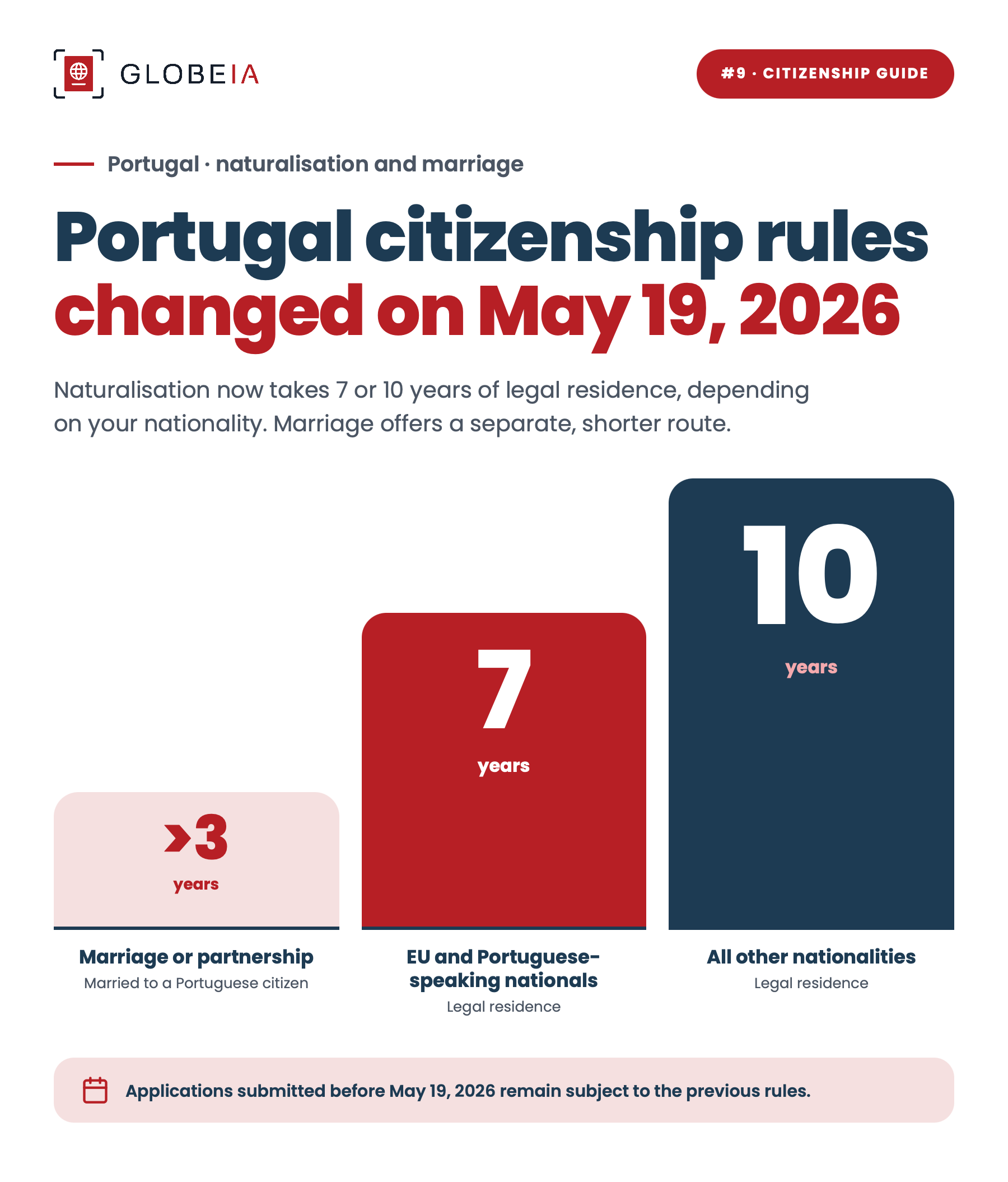
Portugal is a popular destination for people seeking European citizenship, but its rules changed on May 19, 2026. Naturalisation now requires 7 years of legal residence for EU and Portuguese-speaking nationals and 10 years for other nationalities. Marriage offers a separate route after more than three years.
How can you qualify?
Naturalisation by residency
Complete 7 or 10 years of legal residence, depending on your nationality.
Demonstrate knowledge of Portuguese language, culture, history and national institutions.
Meet the criminal-record and other statutory requirements.
Citizenship by marriage or partnership
Be married to a Portuguese citizen for more than three years.
Alternatively, have a qualifying de facto partnership of more than three years, legally recognised by a court.
Applications submitted before May 19, 2026, remain subject to the previous rules.
Cost Estimate
Cost component | Estimated amount |
Nationality application by naturalisation | €250 |
Birth and criminal-record certificates | Additional |
Translations and legalisation | Additional, where required |
Verdict
Portugal remains attractive for people willing to establish long-term ties with the country. The marriage route is considerably shorter, while naturalisation requires a longer residence period and evidence of integration.
Many people think of becoming a Portuguese national through Portugal's Golden Visa. But it only grants residency, not automatic citizenship. Also read: Portugal Golden Visa 2025 Update: How the New Residency Rules Affect Your Citizenship Timeline |
Citizenship by investment route is opened by certain countries for people who can afford to make large investments and get a second passport without spending years living abroad. Government of these countries may grant citizenship for:
an approved contribution,
a property purchase, or
a qualifying business investment,
You'll still need to meet eligibility requirements, but many programmes don't ask you to reside there long-term before citizenship is approved. Some of the most accessible citizenship routes via investment are offered by:

In the Caribbean, Dominica has run its Citizenship by Investment (CBI) Programme since 1993, making it one of the more established options. You can qualify either by contributing to the Economic Diversification Fund or by buying government-approved real estate. Neither route requires you to live there long-term before you apply.
How can you qualify?
There are two main options:
Economic Diversification Fund: Make a non-refundable contribution starting at US$200,000 for a single applicant.
Approved real estate: Invest at least US$200,000 in a government-approved development, subject to the applicable holding time and government-fee requirements.
Provide evidence of the source of their investment funds and undergo background checks and interviews. Eligible family members can also be included, subject to the programme's conditions.
Cost Estimate
Cost component | Estimated amount |
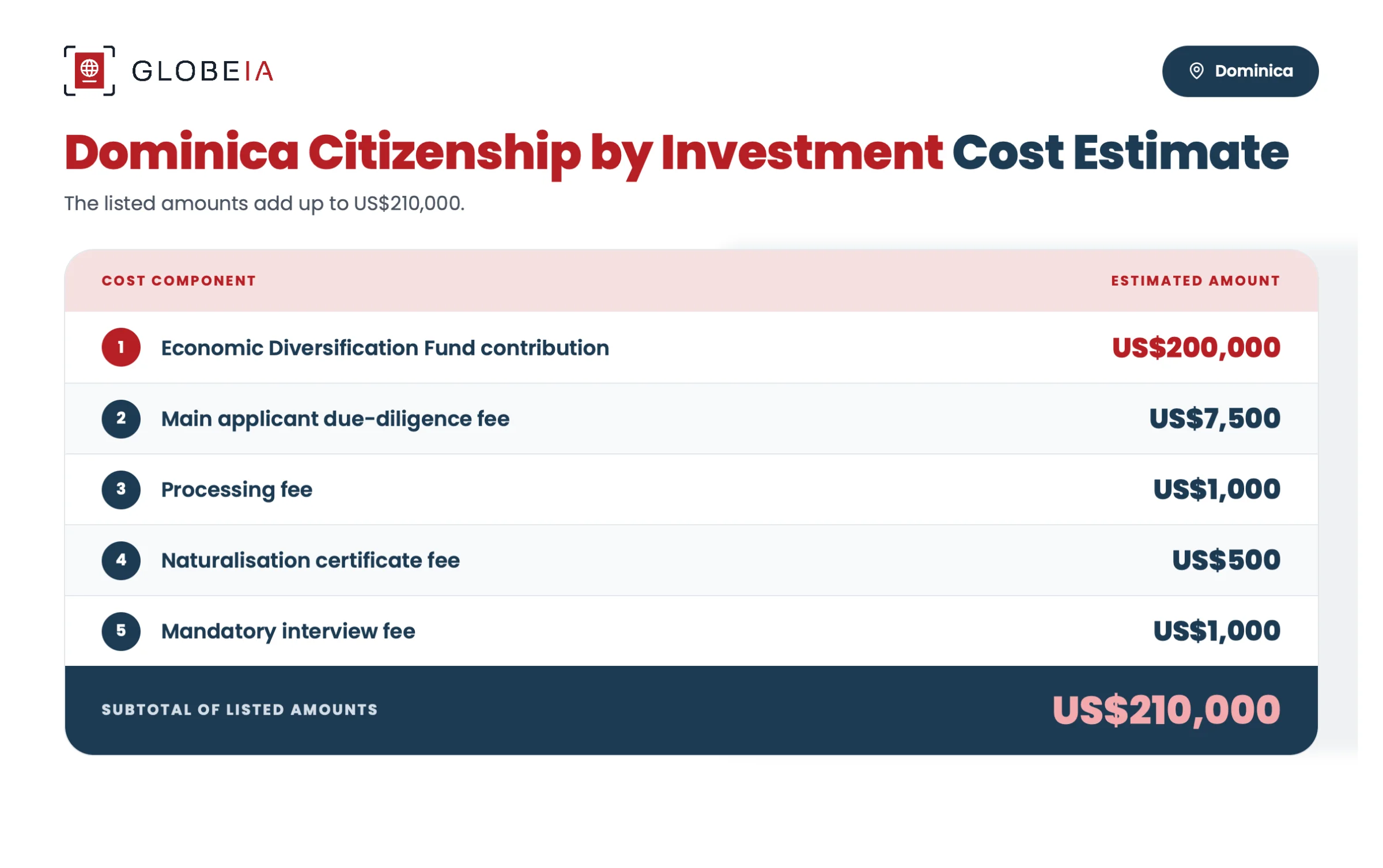
Economic Diversification Fund contribution | US$200,000 |
Main applicant due-diligence fee | US$7,500 |
Processing fee | US$1,000 |
Naturalisation certificate fee | US$500 |
Mandatory interview fee | US$1,000 |
Subtotal of listed amounts | US$210,000 |
This subtotal excludes professional fees, bank charges, passport costs and any additional expenses that may apply.
Verdict
Dominica is a great choice if you want a fairly simple investment route in the Caribbean. The US$200,000 contribution is a useful benchmark to start with, but work out the full cost before deciding between the fund and property options.

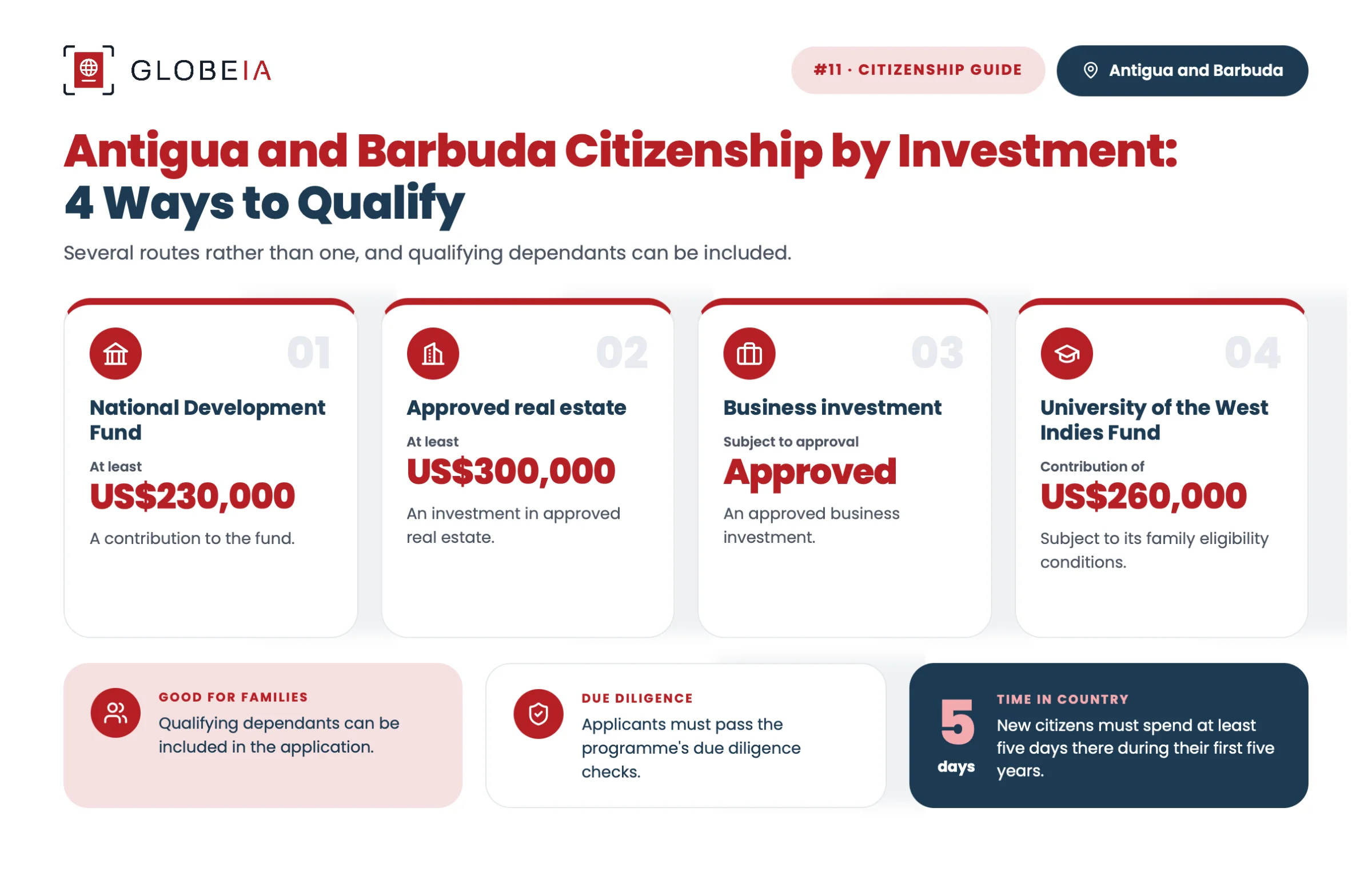
Antigua and Barbuda gives investors multiple ways to qualify rather than just one contribution route. Its Citizenship by Investment Programme includes options through the National Development Fund, approved real estate, business investments, and the University of the West Indies Fund. It's appealing for families, since qualifying dependants can be included in the application.
How can you qualify?
The main investment options are:
A contribution of at least US$230,000 to the National Development Fund.
An investment of at least US$300,000 in approved real estate.
An approved business investment.
A contribution of US$260,000 through the University of the West Indies Fund, subject to its family eligibility conditions.
Applicants must pass the programme's due diligence checks. Unlike some other Caribbean programmes, Antigua and Barbuda also requires new citizens to spend at least five days in the country during their first five years of citizenship.
Cost Estimate
Cost component | Estimated amount |
National Development Fund contribution | US$230,000 |
Main applicant due-diligence fee | US$8,500 |
Processing fee | US$10,000 |
Subtotal of listed amounts | US$248,500 |
Passport and other charges | Additional |
Verdict
Antigua and Barbuda is a good pick if you want to include your family and like having more than one investment option. The five-day visit requirement is manageable for most people, but don't overlook it when comparing programmes.
Grenada is another Caribbean country where foreigners can get citizenship through an approved investment. You can either contribute to the National Transformation Fund (NTF) or invest in government-approved real estate. You can bring along children and certain dependent relatives under the programme rules.
How can you qualify?
You can choose between:
A National Transformation Fund contribution starting at US$235,000 for the applicable applicant category.
An investment in approved real estate, starting at US$270,000, subject to the qualifying project and ownership conditions.
Applicants need to provide financial records, establish the legitimate source of their funds and pass the government's background checks. Applications are submitted through authorised agents.
Cost Estimate

Cost component | Estimated amount |
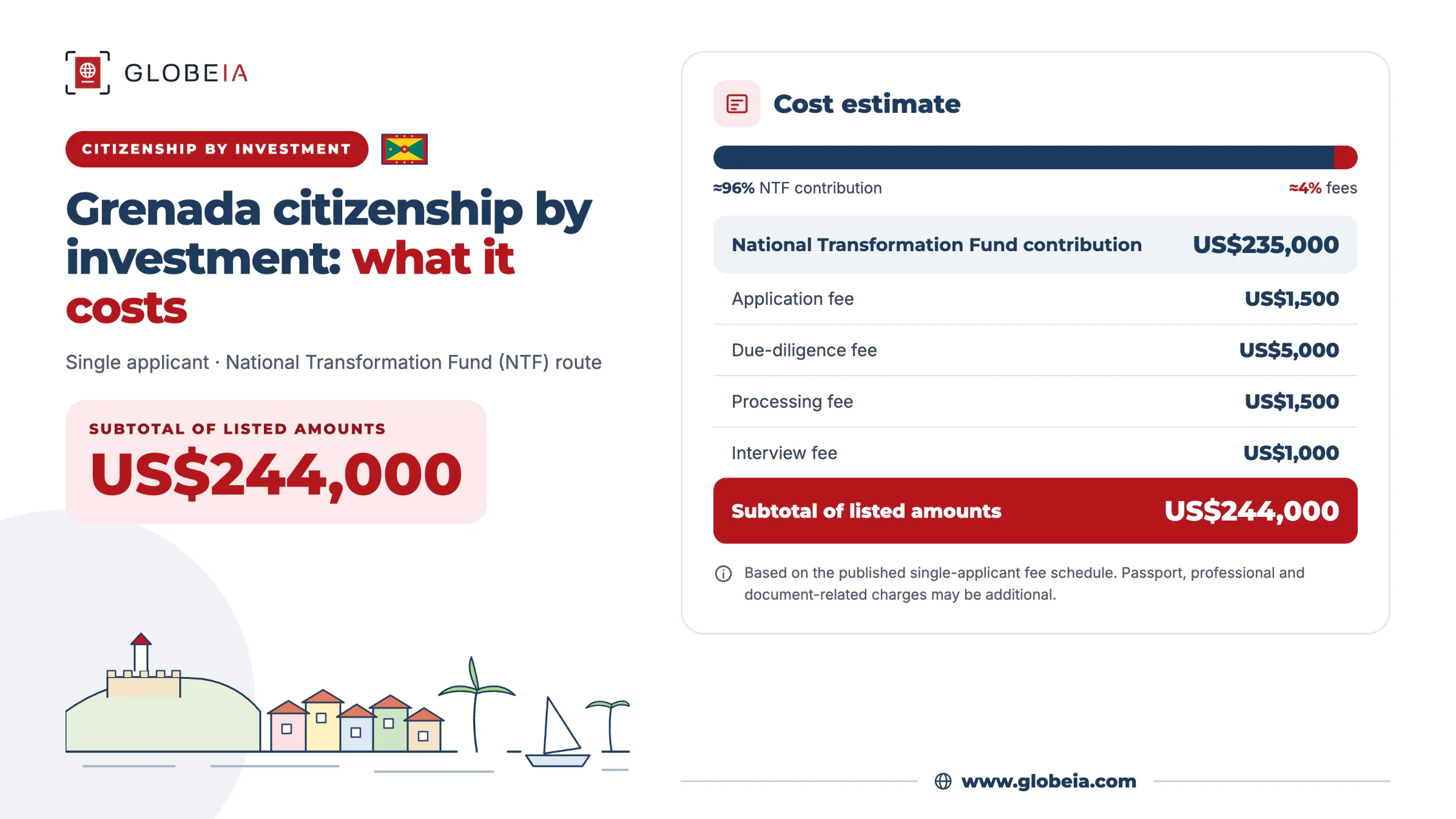
National Transformation Fund contribution | US$235,000 |
Application fee | US$1,500 |
Due-diligence fee | US$5,000 |
Processing fee | US$1,500 |
Interview fee | US$1,000 |
Subtotal of listed amounts | US$244,000 |
The subtotal is based on the published single-applicant fee schedule. Passport, professional and document-related charges may be additional.
Verdict
Grenada works well for investors who want Caribbean citizenship with the flexibility to choose between a government contribution and a property investment. Before deciding, take a close look at its international travel benefits and family eligibility rules.

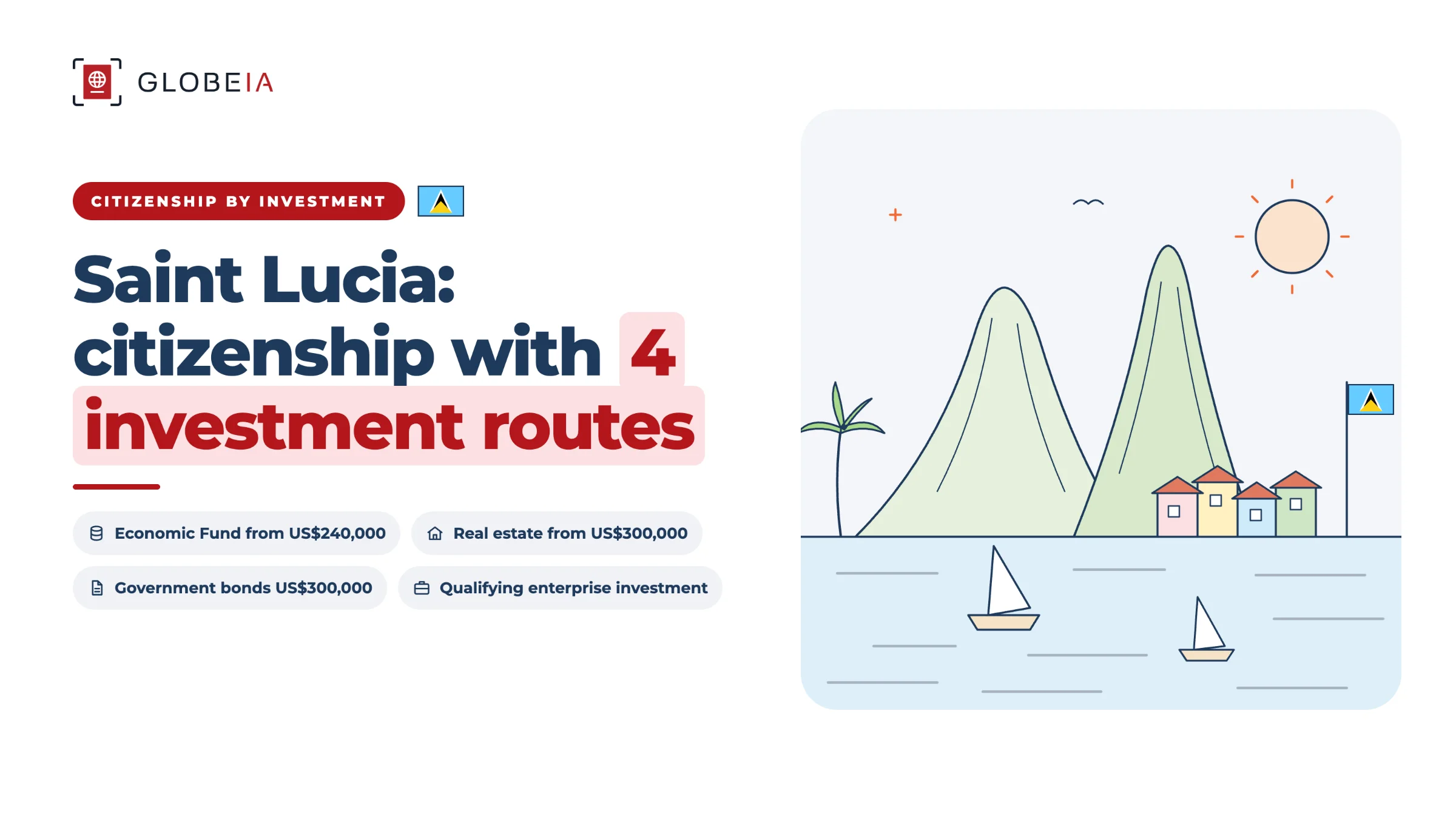
Saint Lucia offers several investment options under its Citizenship by Investment Programme. You can contribute to the National Economic Fund, buy approved real estate, invest in qualifying enterprises, or go for the government bond option. That variety makes it worth a thought if you'd rather not make a straight non-refundable donation.
How can you qualify?
The main routes include:
A National Economic Fund contribution starting at US$240,000 for an applicant with up to three qualifying dependants.
Approved real estate investment starting at US$300,000.
National Action Government Bonds requiring an investment of US$300,000, along with the applicable administration fee.
Qualifying enterprise investments under the programme's rules.
Applicants need to meet the financial, character and due diligence requirements. Family members may be included if they meet the applicable conditions.
Saint Lucia
Cost component | Estimated amount |
National Economic Fund contribution | US$240,000 |
Main applicant due-diligence fee | US$8,000 |
Processing fee | US$2,000 |
Other administration and application charges | Additional |
Indicative starting total | US$250,000+ |
The final amount depends on the chosen investment route and applicable administration charges.
Verdict
Saint Lucia is a good option for investors who want flexibility in choosing how to meet the programme's financial requirements. Its different routes make it worthwhile to compare the total cost of each option rather than choosing solely on the basis of the lowest advertised contribution.

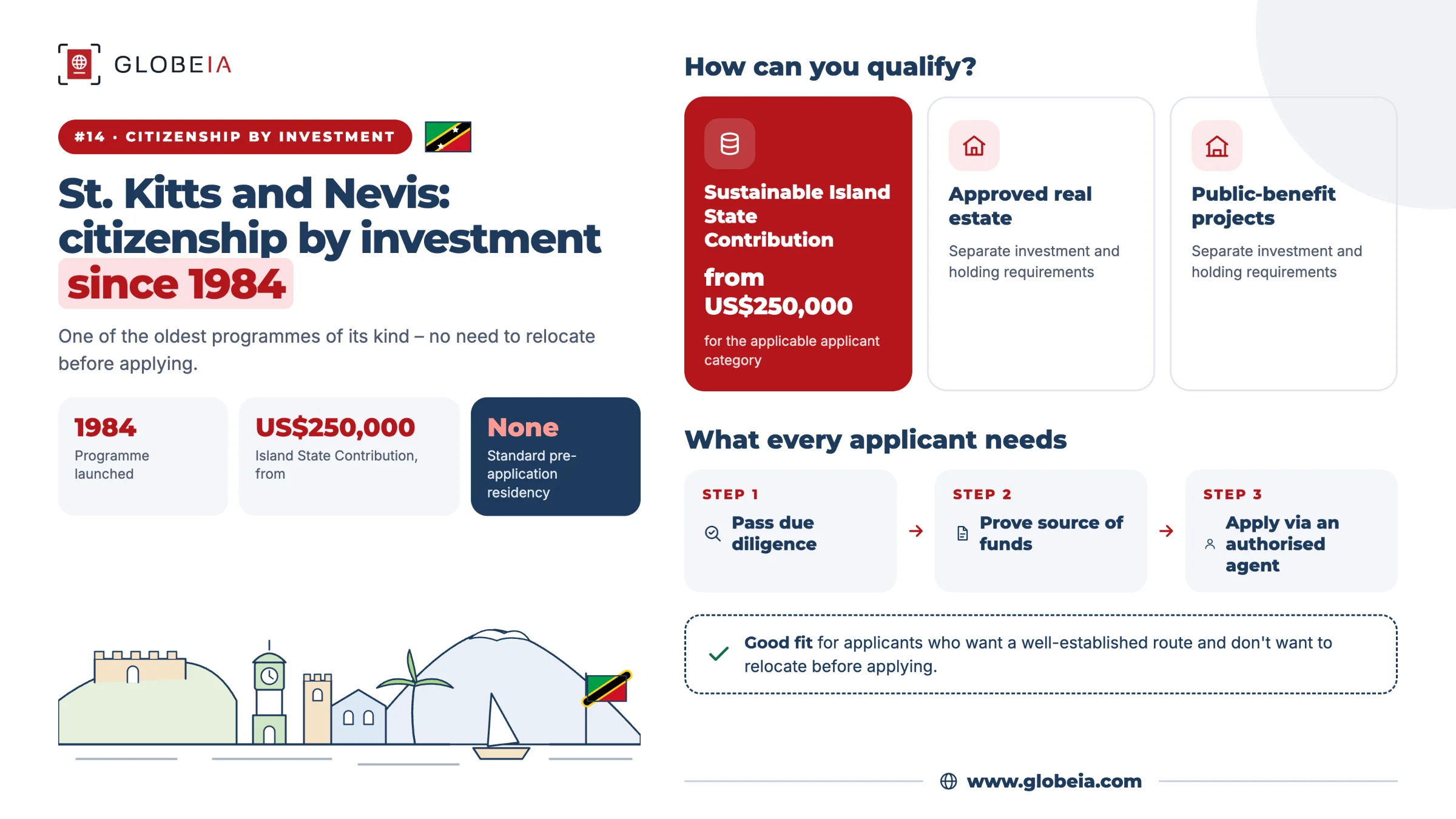
St. Kitts and Nevis launched its Citizenship by Investment Programme back in 1984, making it one of the oldest of its kind. Foreign nationals can qualify by contributing to the Sustainable Island State Contribution, investing in approved real estate, or taking part in other authorised investment options. It's a good fit for applicants who prefer a well-established investment route and don't want to relocate before applying.
How can you qualify?
The Sustainable Island State Contribution starts at US$250,000 for the applicable applicant category. Other routes include approved real estate and public-benefit projects, each with separate investment and holding requirements.
Applicants must pass due diligence checks, establish the source of their funds and submit their applications through an authorised agent. There is no standard pre-application residency requirement.
St. Kitts and Nevis
Cost component | Estimated amount |
Sustainable Island State Contribution | US$250,000 |
Main applicant due-diligence fee | US$10,000 |
Main applicant post-approval application fee | US$25,000 |
Subtotal of listed amounts | US$285,000 |
Other fees, including interview and passport charges | Additional |
The US250,000contributionalsoappliestothePublicBenefitOption.RealestateroutesstartatUS325,000 and have separate fees and holding requirements.
Verdict
St. Kitts and Nevis is worth considering if you value a well-established programme and want citizenship without relocating. Its higher starting contribution won't suit every budget, but its long track record makes it a key player in the Caribbean citizenship-by-investment market.
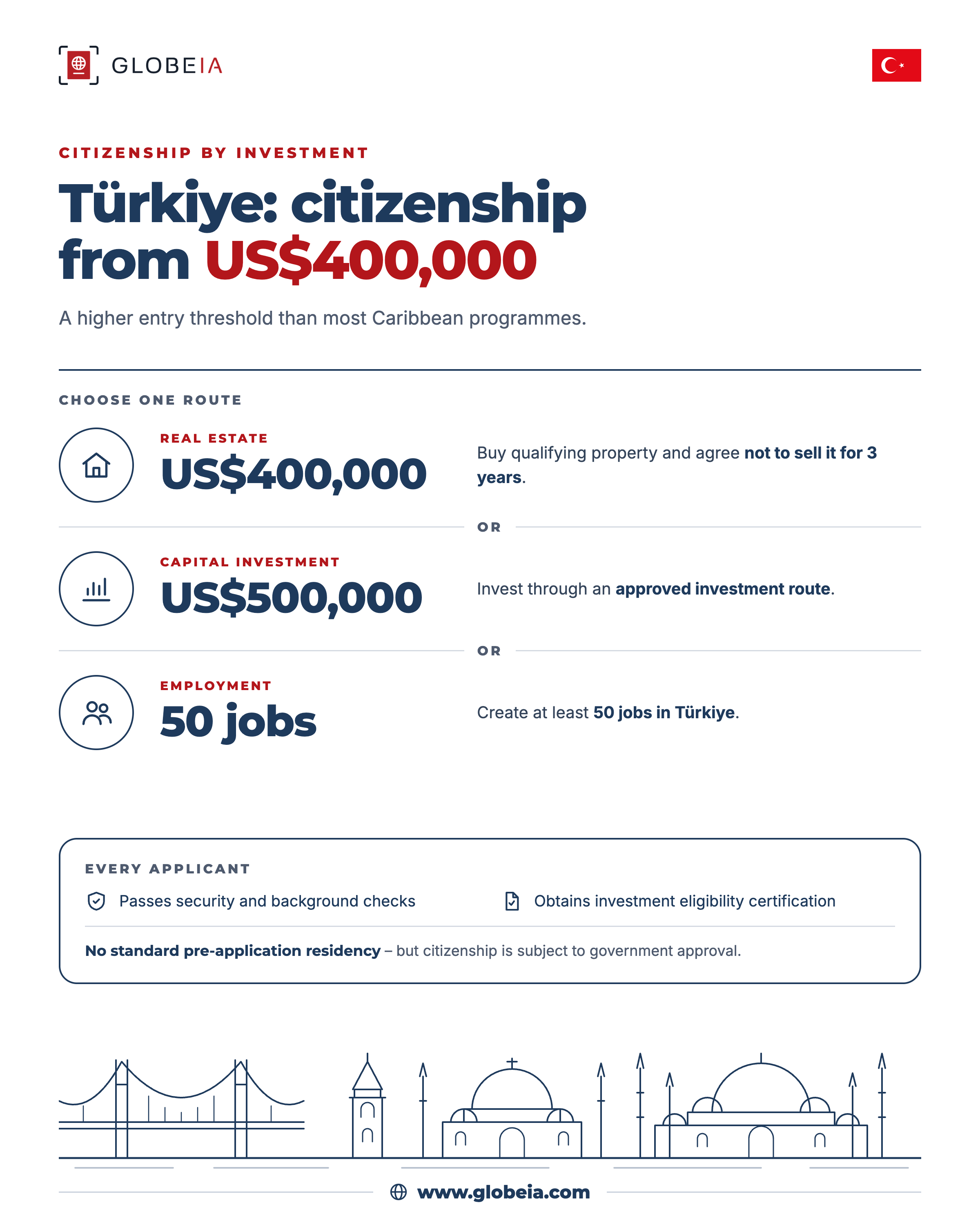
Türkiye offers citizenship through qualifying investments, including real estate purchases and capital investments. Its entry threshold is higher than those of most Caribbean citizenship-by-investment programmes.
How can you qualify?
Purchase qualifying real estate worth at least US$400,000 and agree not to sell it for three years.
Alternatively, invest at least US$500,000 through an approved investment route or create at least 50 jobs in Türkiye.
Pass the required security and background checks and obtain the necessary investment eligibility certification.
There is no standard pre-application residency requirement, but citizenship is subject to government approval.
Cost Estimate
Cost component | Estimated amount |
Minimum qualifying real estate investment | US$400,000 |
Alternative bank deposit, government bonds or qualifying fund investment | US$500,000 |
Property transfer, valuation, legal and registration expenses | Additional |
The property investment must be retained for at least three years. The US$400,000 figure is the minimum qualifying property value, not the total cost of acquiring citizenship.

Verdict
Türkiye suits investors with larger budgets who want to acquire property or make a substantial investment alongside their citizenship application. Compare the full costs and investment restrictions before proceeding.
Citizenship and residency applications involve more than meeting eligibility requirements. Applicants relocating abroad must also prepare supporting documents, understand local procedures and account for administrative requirements. Our article on 10 common mistakes Americans make when moving to Spain offers a practical look at some of these challenges. |
Plenty of countries offer citizenship or investor residency, but not all of them made our cut. The deciding factor wasn't whether citizenship was possible; it was how accessible the route really is once you weigh up:
Here are the countries that were left out from this list:
Paraguay
Paraguay allows naturalisation after three years, but you need to show a genuine profession, trade or business there. Permanent residence doesn’t automatically lead to citizenship, which makes the route less straightforward than the timeline suggests.
Armenia
Armenia offers naturalisation after three years of legal residence. You must also show knowledge of the Armenian language and Constitution, which makes it harder to access than the timeline suggests.
Malta
Malta used to run a citizenship-by-investment programme, but it shut it down after the European Court of Justice ruling in April 2025. Malta still has other citizenship routes, including naturalisation, but its former investment-based option is discontinued.
None of this means these countries are a bad fit for everyone. They simply fall outside the routes we considered comparatively accessible in 2026. A country that's hard to qualify for through investment might still be a practical option if you have family ties or you're willing to relocate.
Yes, but only in rare cases. Some countries have special legal provisions that let them grant citizenship to people whose achievements, expertise, or contributions are seen as valuable to the national interest.
Think internationally recognised scientists, Olympic-level athletes, pioneering entrepreneurs, leading researchers, or philanthropists whose work has made a real difference.
This is known as citizenship by merit, exception, or national interest. Austria, for example, recognises extraordinary achievements in science, business, arts, and sports. Malta also has a legal framework for naturalisation based on exceptional services, contributions, or national interest.
What Makes This a Unique Case
This isn't a programme you can simply pay to join. Each case is assessed individually, and the final say rests with the relevant authorities. A successful career, substantial wealth, or a charitable donation alone doesn't guarantee eligibility.
Unless you have an exceptional professional record or can show a contribution a country considers particularly valuable, the investment, ancestry, and naturalisation routes covered in this article are far more realistic starting points.
A country may make it relatively easy to acquire citizenship, but that does not necessarily mean you can keep your existing nationality. Some countries permit dual or multiple citizenship, while others require applicants to renounce their previous nationality when they naturalise.
This is an important consideration because the rules of both countries matter, not just the country offering the new passport.
What should applicants check?
For example: India does not permit dual citizenship. An Indian citizen who voluntarily acquires foreign citizenship must renounce Indian citizenship and surrender their Indian passport. The Overseas Citizen of India (OCI) status available to eligible former Indian citizens is not equivalent to dual citizenship. |
The "easiest" country to get citizenship might not be the best choice if it means giving up rights or a nationality you actually value. So before you start comparing investment amounts or residency periods, check what a second passport would cost you in terms of the citizenship you already hold.
A passport decides where you may stand, work, and belong, and the place you were born often settles that before you’ve made a single choice. A second citizenship is an attempt to widen that circle. For some people it comes through ancestors who crossed an ocean, for others through a signed contribution, and for others through years of building a life in a place they chose.
None of these routes is simply “easy.” Each one asks for something different: lineage, capital, or time. The best question isn’t which country makes it easiest but which one you’re ready to belong to. Paperwork can make you a citizen, but only a real tie to the place makes it home.


Global Services
State Services