State Apostille Services from USA
Apostille Services in California
Apostille Services in Texas
Apostille Services in Florida
Apostille Services in Washington
Services from Canada
Services from United Kingdom
Services from New Zealand

Over 65 countries now offer a digital nomad visa, but the best ten balance real factors: income rules, taxes, cost of living, approval speed, residency benefits, and overall quality of life. This guide helps you compare the top options based on these criteria. <br><br>Portugal and Spain lead for long-term EU living. The UAE and Croatia offer the lowest taxes. Thailand and Malaysia are the cheapest to live in. None of these visas are permanent fixes. Rules change yearly, so always check the latest numbers before you apply.
Remote work is not slowing down, and more countries want remote workers to come live there. By 2026, over 65 countries will run some kind of digital nomad visa, with new ones appearing almost every year.
That is good news, but it also makes choosing harder. Some visas are fast and cheap. Others take months and ask for a lot of paperwork. Some lead to long-term residency. Others are built to last one year and nothing more.
This guide breaks down the ten digital nomad visas worth taking seriously in 2026, with the real income rules, real costs, and real trade-offs for each one.

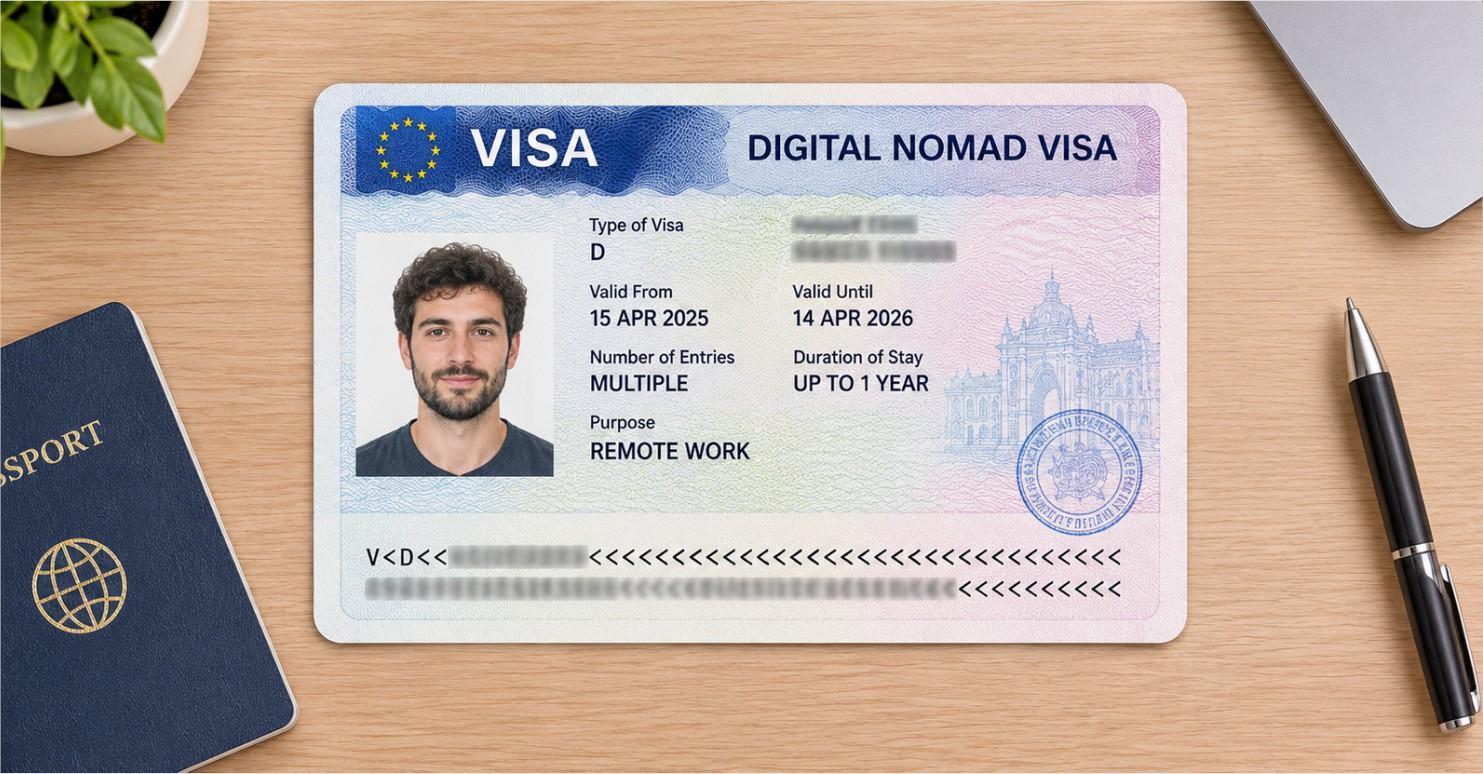
A digital nomad visa lets you live in a country while you keep working for a company or clients somewhere else. It is not a work visa in the usual sense, since you are not taking a local job. You simply get permission to stay longer than a tourist while your income keeps coming from abroad.
Most of these visas ask for the same basic things: proof that you work remotely, proof that you earn enough, and proof that you have health insurance. Meet those three, and you can usually apply.
The two terms get mixed up often, but they are not the same thing.
Every digital nomad is a remote worker. Not every remote worker is a digital nomad. The visa is what makes the difference legal.
Every country asks for different numbers, but the basic requirements rarely change:
In 2026, income limits went up in most countries, since many governments tie the number to local wages. Processing slowed down in a few places, Portugal most of all, simply because more people are applying than the system can handle. A few countries tightened their rules too; the UAE now asks for 6 months of income proof instead of 3. The lesson for 2026 is simple: check the latest number before you apply, since it has probably gone up since last year.
We scored each country on the same eight things: how easy the visa is to get, total cost, taxes, quality of life, internet speed, healthcare, safety, and how smooth the application process is. We also checked each number against more than one source, since many visa rules changed more than once in 2026 alone.

Most nomad visas expire and lead nowhere. The Portugal D8 visa is different: stay long enough, and it turns into full EU residency, then citizenship. That's why it's the top pick for anyone planning a multi-year move. The cost: a higher income bar than Spain or Italy, a tax break that's mostly gone, and a permit office that runs slower than it promises.
It's also one of Europe's most popular nomad visas, and was introduced in October 2022 under Portugal's immigration law reforms, and it's now handled by AIMA, the agency that took over immigration duties from the former SEF in 2023. Lisbon and Porto remain the most popular bases, though smaller cities increasingly compete on cost of living.
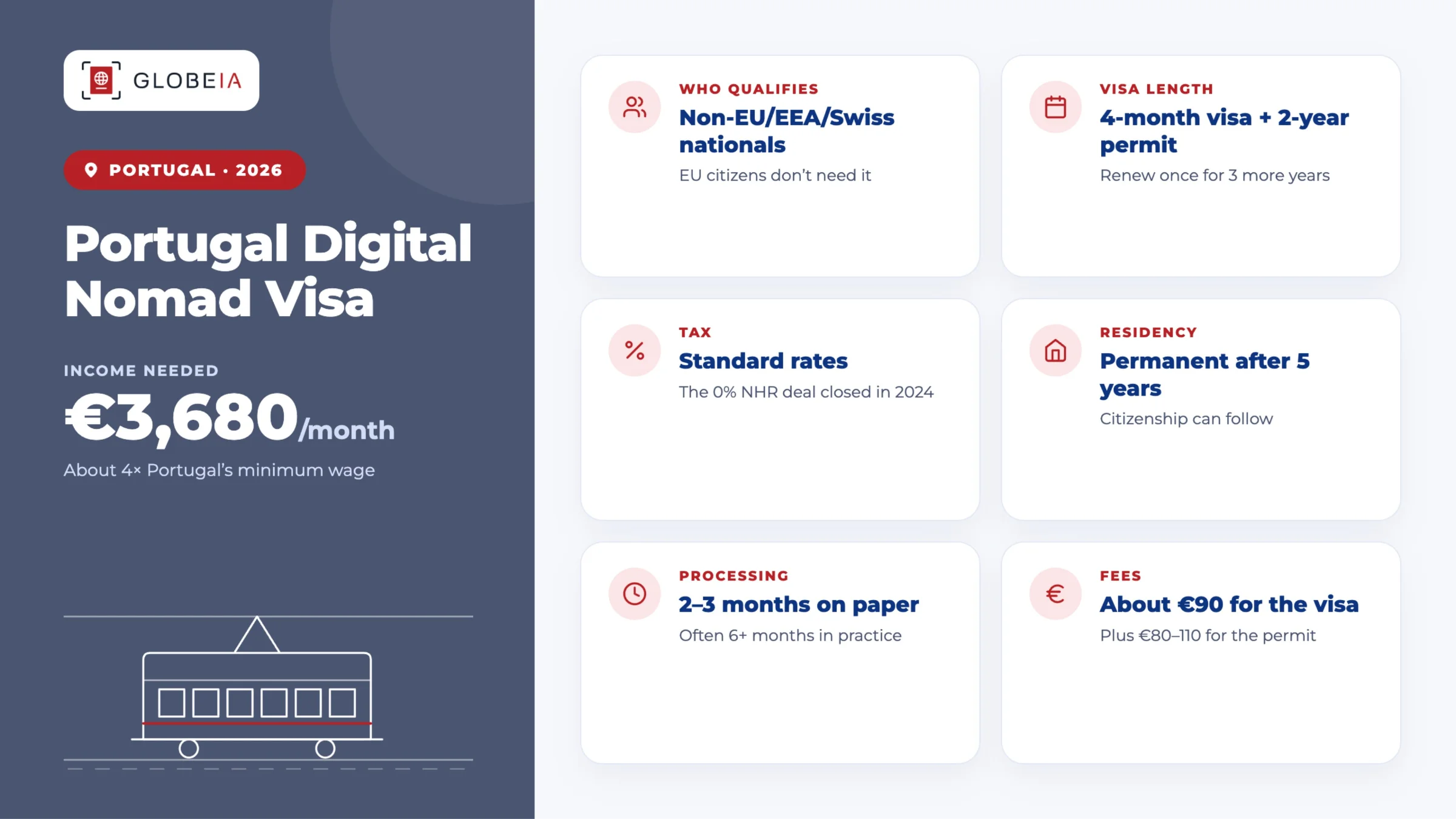
Portugal Digital Nomad Visa (2026)
Citizens that qualify: Non-EU/EEA/Swiss nationals. EU citizens don't need this visa since they already have free movement.
Visa length: A 4-month entry visa, then a 2-year permit. Renew once for 3 more years. That's 5 years total, the point where residency kicks in.
Income needed: €3,680/month, about 4x Portugal's minimum wage.
Tax: Standard rates. The old 0% deal (NHR) closed to new applicants in 2024. Its replacement only covers tech and research jobs, so most remote workers don't qualify.
Leads to residency: Yes, after 5 years. Citizenship is on the table after that.
Processing time: 2 to 3 months on paper. Often 6 months or more in reality.
Fees: About €90 for the visa, plus €80 to €110 for your permit on arrival.
Can you apply remotely?
No. You need an in-person appointment at a Portuguese consulate or other authorized companies in your home country, fingerprints included.
What You'll Need
A passport with several months left before it expires.
3 months of income proof: contracts, invoices, or an employer letter.
Health insurance that's valid in Portugal (travel insurance won't count).
A clean criminal record certificate covering the last 5 years of your residence history
Proof of a place to live.
An in-person appointment at a consulate before you travel, not after you land as a tourist.
Before you gather documents: Requirements vary by consulate and by your home country. Foreign documents such as your criminal record, and sometimes income proof and insurance papers, may need an apostille or certified translation to be accepted. Always confirm the exact list with your consulate or the official Portuguese visa portal before you start.
Investors and firms who want to know about the golden visa read Globeia's complete article on Portugal Golden Visa Update.
Who Portugal Is Best For
Yes, if you want a real EU base, not just a year abroad.
Yes, if you can show €3,680 a month, every month.
Yes, if you're willing to wait out a slow process for residency.
No, if you were counting on tax-free income. That deal is gone for most people.
Read more: Retiring in Portugal: Why the D7 Visa Is the Best Choice for US Expats
Spain’s digital nomad visa - officially called the international teleworking visa - offers one big benefit: a flat tax rate that’s much lower than Spain’s normal tax rates. Apply from outside Spain, and you get 1 year. Apply after you’ve already arrived legally, and you get 3 years instead.
Both employees and freelancers can apply, as long as less than 20% of your income comes from Spanish clients. Spain launched this visa in 2023 to attract skilled workers, after watching many of them move to Portugal instead.
Spain Digital Nomad Visa (2026)
Citizens who qualify: Non-EU/EEA/Swiss nationals.
Visa length: 1 year if you apply from abroad, 3 years if you apply from inside Spain. Renews once to 5 years total, the point at which residency starts counting.
Income needed: €2,849/month, 200% of Spain's minimum wage, adjusted most years.
Tax: The Beckham Law gives most holders a flat 24% rate, up to €600,000, for up to 6 years. No more than 20% of your income can come from Spanish clients.
Leads to residency: Yes, one of only two visas on this list that does.
Processing time: 15 to 45 days.
Fees: About €80, plus smaller card and ID fees once approved.
Can you apply remotely?
Partly. Apply at a consulate abroad, or convert in person if you're already legally in Spain.
What You'll Need
A passport with several months left before it expires.
Income proof: contracts, invoices, or an employer letter.
A criminal record check covering the last 5 years, apostilled (and translated if required).
Private health insurance valid in Spain.
A Spanish NIE (foreigner ID number).
Apply at a consulate abroad, or in person if already in Spain.
Need fingerprinting for your digital nomad visa application? Read Globeia’s latest guide and book your appointment in Spain today.
Who Spain Is Best For
Yes, if you want lower, predictable taxes without giving up real city life.
Yes, if less than 20% of your income comes from Spanish clients.
Yes, if you're already in Spain legally and want to convert.
No, if you need your full income taxed at home-country rates instead.
Also Read: Spain Digital Nomad Visa for Indians
The Estonia digital nomad visa was the world’s first visa of its kind, and it’s still one of the fastest to get approved. The catch is money: Estonia asks for the highest income of any visa on this list. Your total stay is also capped at 1.5 years, with no option to go longer.
People often mix this visa up with Estonia’s e-Residency program, but the two are different things: e-Residency alone does not let you live in Estonia. Estonia’s visa became a model for other early European programs, including Croatia’s, which copied a similar structure soon after. But unlike those later copies, Estonia never added a way to renew in place, so you need to plan your exit just as carefully as your arrival.
Estonia Digital Nomad Visa (2026)
Citizens that qualify: Non-EU/EEA/Swiss nationals.
Visa length: Up to 1 year. It can’t be renewed in place, but you can apply from within Estonia for a second visa to extend your stay to 18 months total.
Income needed: €4,500/month gross, averaged over the 6 months before you apply, the highest bar on this list.
Tax: Around 20–22% if you become a tax resident (the 183-day rule).
Leads to residency: No.
Processing time: 15 to 30 days.
Fees: About €80 to €120.
Can you apply remotely: Partly. You can start the application online, but you'll need an in-person appointment to finish it.
What You'll Need
A passport with several months left before it expires.
6 months of income proof, averaged against the income rule.
A clean criminal record check.
Health insurance with at least €30,000 in Schengen-area coverage.
Proof of a foreign employer or your own business abroad.
An in-person appointment at an embassy or consulate to finish the application.
Who Estonia Is Best For
Yes, if you're well above €4,500/month and can prove it for 6 straight months.
Yes, if speed matters more than a long-term plan.
Yes, if you want Europe's most digital-first government to deal with.
No, if your ultimate goal is permanent European residency or staying longer than 18 months.
Croatia was one of the first countries in Europe to write remote work into law. The Croatia digital nomad permit offers a genuine 0% tax rate on foreign income, but it comes with a hard ceiling and a 6-month cooldown before you can apply again. It's especially popular with remote workers chasing a full Adriatic summer without owing local tax on it.
The permit is tied to the income source you applied with, so switching employers or taking on major new clients mid-stay can complicate a future renewal. Unlike Portugal or Spain, Croatia asks nothing about your professional background or qualifications, only that your income is earned abroad.
Croatia Digital Nomad Permit (2026)
Citizens that qualify: Non-EU/EEA/Swiss nationals.
Visa length: Up to 1 year, extendable once by 6 months for 18 months total. Not renewable after that, and there's a 6-month cooldown before reapplying.
Income needed: €3,622.50/month, 2.5x the average Croatian net salary, recalculated every year.
Tax: 0% on foreign income. The permit never makes you a Croatian tax resident.
Leads to residency: No.
Processing time: 2 to 8 weeks.
Fees: About €60 to €100 in total.
Can you apply remotely: No. Apply in person, either at a police station if you're visa-exempt and already in Croatia, or at an embassy or consulate abroad if you need a visa to enter.
What You'll Need
A passport with several months left before it expires.
6 months of income proof, or savings as an alternative.
A police clearance certificate covering everywhere you've lived recently.
Health insurance valid in Croatia.
Proof your clients or employer are outside Croatia.
An in-person application, either at a local police station or a consulate abroad.
Who Croatia Is Best For
Yes, if you want a genuinely tax-free year (or 18 months) on the coast.
Yes, if you can show €3,622.50/month.
Yes, if the 6-month cooldown before reapplying doesn't bother you.
No, if you want a visa that renews in place or leads to residency.
The Greece digital nomad visa comes with one of Europe's most generous tax breaks: a 50% cut on Greek income tax for up to 7 years, if you elect it yourself. Since February 2026, you also have to apply from your home country before you travel; converting from a tourist stay inside Greece is no longer an option.
The visa covers any part of Greece you choose to settle in, not just Athens. Greece rolled out the visa in 2021 partly to help draw remote workers to islands and smaller towns facing years of youth emigration. Even holders who elect the 50% tax reduction must still file an annual Greek tax return to keep that status active, rather than it applying automatically.
Greece Digital Nomad Visa (2026)
Citizens that qualify: Non-EU/EEA/Swiss nationals.
Visa length: Up to 1 year initially, extendable through a 2-year residence permit.
Income needed: €3,500/month solo, plus 20% for a spouse and 15% per child.
Tax: A 50% reduction for up to 7 years, but you have to elect it yourself.
Leads to residency: No.
Processing time: 1 to 3 months.
Fees: About €75 to €150, depending on the consulate.
Can you apply remotely: No. As of February 2026, you must apply at a Greek consulate before traveling.
What You'll Need
A passport, plus 2 passport photos.
Income or savings proof matching the required bracket.
A criminal record certificate, issued within the last few months.
Health insurance valid in Greece.
A signed declaration that you won't work for a Greek company.
An application at a Greek consulate or embassy before you travel.
Who Greece Is Best For
Yes, if you want the tax break and are willing to apply ahead from home.
Yes, if you can show €3,500/month and plan for family supplements.
Yes, if Mediterranean life matters more to you than a fast approval.
No, if you were hoping to convert from a tourist stay once you're already there.
The Italy digital nomad visa has the lowest income bar in Western Europe, but it asks for something Portugal and Spain don't: proof that you're genuinely "highly skilled" at what you do. Most rejections trace back to weak professional documentation, not low income.
It's built for professionals Italy wants to keep long-term, not simply anyone with a laptop and Wi-Fi. Italy's law was actually passed back in 2022 but sat unimplemented for nearly two years before finally taking effect in April 2024, which is part of why documentation standards still vary noticeably by consulate.
Italy Digital Nomad Visa (2026)
Citizens that qualify: Non-EU/EEA/Swiss nationals, and you must show a degree or several years of documented experience in your field.
Visa length: 1 year, renewable.
Income needed: €28,000/year, about €2,333/month, the lowest in Western Europe.
Tax: Standard progressive rates. A dedicated nomad tax break is only a 2026 budget proposal so far, not law.
Leads to residency: No, not directly.
Processing time: 30 to 90 days at the consulate, plus a separate local permit step after you arrive.
Fees: About €90 to €116.
Can you apply remotely: No. Apply in person at an Italian consulate before you travel.
What You'll Need
A passport with several months left before it expires.
Proof of being highly skilled: a degree or documented relevant experience.
A criminal record certificate, legalized for use in Italy.
Health insurance valid in Italy.
Some consulates also want proof of an Italian address.
An in-person application at a consulate before you travel.
Who Italy Is Best For
Yes, if your income is modest but your professional credentials are real.
Yes, if you're willing to handle extra paperwork for a lower income bar.
Yes, if you want the most reachable visa in Western Europe.
No, if you can't document a degree or relevant work experience.
The Costa Rica digital nomad visa keeps the pitch simple: 0% tax on foreign income, and it's one of the only visas on this list you can apply for entirely online. It also covers family members, though bringing dependents raises the income bar to $4,000 a month.
Costa Rica passed the law in 2021, making it one of the earliest Latin American countries to formalize a remote-work visa after the pandemic. Holders also get a perk unique on this list: duty-free import of personal belongings, and in some cases a vehicle, meant to make settling in for a year or two easier.
Costa Rica Digital Nomad Visa (2026)
Citizens that qualify: All nationalities, though some need a prior consular visa under Executive Decree 36626-G.
Visa length: 1 year, renewable once for 2 years total. Doesn't lead anywhere beyond that.
Income needed: $3,000/month solo, $4,000/month with dependents.
Tax: 0% on foreign income.
Leads to residency: No.
Processing time: About 15 business days online, longer in person.
Fees: About $100.
Can you apply remotely: Yes, fully online through Trámite Ya, or in person at DGME.
What You'll Need
A passport with several months left before it expires.
Income proof matching your bracket.
A police certificate. Globeia has a full guide to this step for Costa Rica specifically..
Health insurance valid in Costa Rica.
Proof of accommodation.
Apply through Trámite Ya online, or in person at DGME.
Who Costa Rica Is Best For
Yes, if you want a genuinely tax-free 1 to 2 year chapter.
Yes, if you'd rather apply online than visit a consulate.
Yes, if $3,000 to $4,000/month comfortably covers you.
No, if you're looking for a path to residency beyond 2 years.
Read more: Navigating Costa Rica Residency: A Complete Guide to FBI Apostille and Residency Application
The UAE Virtual Working Programme offers something no other country on this list matches: 0% personal tax, no conditions attached. It's also the fastest, most fully online application here. It works for employees and business owners alike, though business owners need to show a higher income and proof their company has operated for at least a year.
Dubai launched its own version of this program back in 2021, a year before a parallel track opened for the rest of the UAE, which is why "Dubai Virtual Working Programme" and "UAE Virtual Working Programme" are often used interchangeably online.
UAE Virtual Working Programme (2026)
Citizens that qualify: All nationalities.
Visa length: 1 year, renewable.
Income needed: $3,500/month. As of January 2026, you now need 6 months of bank statements instead of 3.
Tax: 0% personal tax, with no special conditions.
Leads to residency: No.
Processing time: About 1 to 2 weeks.
Fees: About $100 to $287.
Can you apply remotely: Yes, fully online through the GDRFA Dubai portal or u.ae. No in-person visit required.
What You'll Need
A passport and photo
6 months of bank statements
A clean criminal record check
Health insurance valid in the UAE
Proof your employer or clients are outside the UAE
Apply fully online, no in-person step needed
Who UAE Is Best For
Yes, if you want your tax savings to actually show up in the bank.
Yes, if you want the fastest, most online application on this list.
Yes, if you can budget for Dubai's high rent.
No, if you need a path to residency or citizenship.
Thailand's Destination Thailand Visa runs for 5 years, making it one of the longest digital nomad visas available. Unlike many countries, Thailand doesn't require a minimum monthly income. Instead, you need to show enough savings. You must apply for the visa from outside Thailand.
Once approved, you can enter and leave the country as many times as you like during the 5-year validity. Each visit allows you to stay for up to 180 days. Launched in July 2024, the DTV was designed for remote workers, freelancers, digital nomads, and people visiting Thailand for activities like Muay Thai training, cooking courses, or medical treatment.
Thailand Destination Thailand Visa (2026)
Citizens that qualify: Most nationalities.
Visa length: 5 years, multi-entry, 180 days per entry. Extendable once per entry for another 180 days.
Income needed: None. Instead, 500,000 THB (about $14,000) in savings or guaranteed funds.
Tax: Thailand changed its remittance tax rules in 2024. Get current advice if you'll stay more than half the year.
Leads to residency: No.
Processing time: Varies, faster now that it's fully online.
Fees: 10,000 THB, about $280 to $400.
Can you apply remotely: Yes, for most nationalities, through the official e-visa portal, but you must be physically outside Thailand when you apply.
What You'll Need
A passport valid for at least 6 months.
Proof of 500,000 THB in savings or a funding guarantee.
A police clearance certificate.
Proof of remote work or freelance income from outside Thailand.
2 passport photos.
Apply through the e-visa portal while you're outside the country.
Who Thailand Is Best For
Yes, if you want the longest, cheapest, most established base in Asia.
Yes, if you'd rather show savings than prove monthly income.
Yes, if you can apply from outside Thailand, as required.
No, if you were hoping to convert a tourist stay from inside the country.
The Malaysia DE Rantau Nomad Pass has one of Asia's lowest income bars, but only if you work in tech or a digital role. The application is fully online; you never need to set foot in Malaysia to apply. It also covers a spouse, children, and parents as dependents, though they aren't allowed to work locally on the pass.
DE Rantau launched in 2022 under Malaysia Digital, a national initiative run by MDEC, the country's digital-economy agency, and was designed explicitly to compete with Bali and Chiang Mai for the region's remote-work crowd, leaning on Kuala Lumpur and Penang's lower living costs as the pitch.
Malaysia DE Rantau Nomad Pass (2026)
Citizens who qualify: All nationalities except Israel.
Visa length: 12 months initially, renewable to 24 months total. Doesn't lead to residency.
Income needed: $24,000/year for tech and digital roles, $60,000/year for everyone else.
Tax: Foreign income is generally tax-exempt under transitional rules, reviewed periodically.
Leads to residency: No.
Processing time: Historically 2 to 4 weeks, recently closer to 6 to 8 weeks due to demand.
Fees: About RM2,000, roughly $430 to $450.
Can you apply remotely: Yes, fully online through the MDEC portal. No need to be in Malaysia to apply or during review.
What You'll Need
A passport with several months left before it expires.
Income proof matching your category, tech or non-tech.
A clean criminal record, authenticated and legalized for use in Malaysia. Globeia breaks down how that process works.
Proof of a qualifying digital or tech role, if using the lower income bar.
Health insurance valid in Malaysia.
Apply fully online through the MDEC portal.
Who Malaysia Is Best For
Yes, if you work in tech and can show $24,000/year.
Yes, if you want a fully online application from start to finish.
Yes, if low daily costs in KL or Penang matter to you.
No, if you're in a non-tech role and can't clear $60,000/year.
Read more: How to Authenticate and Legalise an FBI Background Check for Use in Malaysia
| Country | Stay | Income Requirement | Visa Cost | Processing Time | Tax Rules | Monthly Cost | Best For | Score |
| Portugal | 1 yr, renewable to 5 | ~€3,480/mo | ~€90 + €80–110 | 60–90 days (often longer) | Standard tax; NHR mostly closed | €1,100–2,000 | EU long-term relocation | 9.2 |
| Spain | 1–3 yrs, to 5 | ~€2,850/mo | ~€80–170 | 15–45 days | Beckham Law, flat 24% | €1,100–2,200 | Flat-tax city life | 8.9 |
| Estonia | Up to 1 yr, non-renewable | ~€4,500/mo | ~€80–120 | 15–30 days | ~20–22% if tax resident | €1,200–1,600 | High earners, speed | 7.8 |
| Croatia | Up to 1 yr, non-renewable | ~€3,620/mo | ~€60–100 | 2–8 weeks | 0% on foreign income | €900–1,300 | Tax-free coastal year | 8.3 |
| Greece | 1 yr, renewable to 3 | €3,500/mo (+20%/+15%) | ~€75–150 | 1–3 months | 50% reduction, 7 yrs | €900–1,300 | Mediterranean + tax break | 8.0 |
| Italy | 1 yr, renewable | ~€28,000/yr | ~€90–116 | 30–120 days | Standard progressive | €900–1,900 | Lowest EU income bar | 8.1 |
| Costa Rica | 1 yr, renewable once | $3,000–4,000/mo | ~$100 | 1–3 months (unofficial) | 0% on foreign income | $1,200–2,000 | Tax-free beach life | 8.4 |
| UAE | 1 yr, renewable | $3,500/mo | ~$100–287 | 5–15 days | 0% personal tax | $2,000–3,000+ | Zero tax, fast approval | 8.6 |
| Thailand | 5 yrs, 180 days/entry | 500,000 THB savings | 10,000 THB | ~30 days | Remittance rules changed in 2024 | $800–2,000 | Longest term, lowest cost | 8.2 |
| Malaysia | 12 mo, renewable | $24k/yr tech, $60k/yr non-tech | ~RM2,000 | Unclear, weeks to 2 months | Territorial, transitional exemption | $700–1,100 | Affordable tech base | 7.9 |
Treat every figure above as a planning estimate, not a legal guarantee. Digital nomad visa rules changed more than once in several of these countries during 2026 alone, and different official sources sometimes publish different numbers for the same requirement. Confirm the current figures with the relevant consulate or immigration portal before you commit to a date or a lease.
The rankings above assume an average reader. Your own priorities will push the answer in a different direction, so here is the same list sorted by what people actually ask for.
Run your situation through these 8 questions before you apply. Most buyer's remorse in this space traces back to skipping one of them.
A few months to a year points toward Thailand or Croatia; a multi-year or permanent move points toward Portugal or Spain.
Thailand and Malaysia stretch furthest; the UAE and Portugal's main cities demand the most.
The UAE, Croatia and Costa Rica offer the clearest zero-tax outcomes on foreign income; Spain's flat 24% is a strong middle ground.
Check the per-dependent income supplements closely. Greece and Italy both add meaningful amounts per spouse and child.
Estonia, the UAE and Thailand's main hubs lead this list; smaller islands and rural areas everywhere lag behind.
Only Portugal and Spain on this list offer a realistic route there; the others are built as temporary stays.
This affects more than scenery. Coworking density, healthcare access and English-language services are almost always stronger in capital cities.
Portugal, Spain, Estonia and the UAE score highest here; confirm what your required private health insurance actually covers before you buy a policy just to tick a visa box.
30 Days Before Applying
Start your paperwork a full month out, even for the fastest programs. Pull your last 3 to 6 months of bank or income statements, confirm your country's apostille process (it is often slower than people expect), and book any required medical or insurance exams early so a delay there doesn't stall the whole file.
Common Documents Checklist
Need help with this step? Globeia handles FBI background checks, fingerprinting, and apostille certification for applicants anywhere in the world.
Read more: What Is an FBI Background Check?
Typical Processing Timeline for Digital Nomad Visa
Fast-track programs like the UAE and Spain's Unidad de Grandes Empresas route can clear in under 3 weeks. Most European consular routes run 1 to 3 months. Portugal is the outlier on this list, where official timelines of 60 to 90 days often stretch to 6 months or more once the local residence permit office is factored in.
What Happens After Approval of Your Nomad Visa
Approval usually means a visa sticker or entry permit, not a finished process. Most countries require a second step after you arrive: registering locally, picking up a residence card, enrolling in social security, or activating your tax number. Treat the visa approval as the halfway point, not the finish line.
Common Mistakes That Get Digital Nomad Visa Applications Rejected
These ten are not the only options out there. A few others are popular with remote workers for their own reasons:
None of these quite matched the top 10 on cost, speed, or tax treatment, but each is worth a look if the top 10 don't fit your plans.
Portugal and Spain suit anyone who wants a long-term EU base. The UAE and Croatia fit people who want the lowest taxes. Thailand and Malaysia work best for the lowest cost of living. There is no single "best" digital nomad visa, only the one that matches your income, your timeline, and how long you actually want to stay.
Visa rules and income limits change every year, sometimes more than once, as 2026 proved for half the countries on this list. Always confirm the latest numbers with the country's own consulate or immigration portal before you book a flight or sign a lease.
Ready to move? Pick your top two countries from this guide, check their official visa pages today, and start gathering your documents now.


Global Services
State Services