Services from United Kingdom

Services from New Zealand

Discover services in other countries
Australia
United Kingdom
United States of America
New Zealand
Portugal
Spain
Bangladesh
Brazil
Bulgaria
Canada
China
Colombia
Costa Rica
Croatia
Czech Republic
Dominican Republic
Ecuador
El Salvador
France
Germany
Greece
Hong Kong
Honduras
Hungary
India
Israel
Kuwait
Malta
Mexico
Netherlands
Norway
Pakistan
Panama
Paraguay
Peru
Philippines
Poland
Qatar
Saudi Arabia
South Korea
Switzerland
United Arab Emirates
Main Menu
RCMP Criminal Record Check
FBI Criminal Record Check
UK Apostille
Canada Apostille
New Zealand Apostille
RCMP Criminal Record Check
Canada Apostille
FBI Criminal Record Check
UK Apostille
New Zealand Apostille
FBI Apostille
RCMP Criminal Record Check
Authentication and Legalization
Canada Apostille
FBI Apostille
US Apostille
FBI Criminal Record Check
UK Apostille
New Zealand Apostille
RCMP Criminal Record Check
FBI Criminal Record Check
New Zealand Apostille
UK Apostille
RCMP Criminal Record Check
Canada Apostille
FBI Apostille
FBI Criminal Record Check
US Apostille
UK Apostille
New Zealand Apostille
RCMP Criminal Record Check
Canada Apostille
FBI Apostille
FBI Criminal Record Check
US Apostille
UK Apostille
New Zealand Apostille
Authentication and Legalization
FBI Apostille
RCMP Criminal Record Check
FBI Criminal Record Check
UK Apostille
New Zealand Apostille
RCMP Criminal Record Check
Canada Apostille
FBI Apostille
FBI Criminal Record Check
US Apostille
UK Apostille
New Zealand Apostille
RCMP Criminal Record Check
Canada Apostille
US Apostille
FBI Apostille
FBI Criminal Record Check
UK Apostille
New Zealand Apostille
RCMP Criminal Record Check
Certified Translation
Police Clearance Canada
Mobile Fingerprinting
Digital Fingerprinting
Police Clearance Certificate USA
Notarization in Canada
Authentication and Legalization
Canada Apostille
Calgary Apostille
Toronto Apostille
Vancouver Apostille
Ottawa Apostille
Ontario Apostille
US Apostille
FBI Apostille
FBI Criminal Record Check
UK Apostille
New Zealand Apostille
FBI Fingerprinting
RCMP Criminal Record Check
Authentication and Legalization
Canada Apostille
FBI Criminal Record Check
UK Apostille
New Zealand Apostille
RCMP Criminal Record Check
Canada Apostille
FBI Apostille
FBI Criminal Record Check
US Apostille
UK Apostille
New Zealand Apostille
RCMP Criminal Record Check
Canada Apostille
FBI Apostille
FBI Criminal Record Check
US Apostille
UK Apostille
New Zealand Apostille
Authentication and Legalization
RCMP Criminal Record Check
Canada Apostille
US Apostille
FBI Apostille
FBI Criminal Record Check
UK Apostille
New Zealand Apostille
RCMP Criminal Record Check
Canada Apostille
US Apostille
FBI Criminal Record Check
FBI Apostille
UK Apostille
New Zealand Apostille
RCMP Criminal Record Check
Canada Apostille
US Apostille
FBI Apostille
FBI Criminal Record Check
UK Apostille
New Zealand Apostille
RCMP Criminal Record Check
Canada Apostille
FBI Apostille
FBI Criminal Record Check
US Apostille
UK Apostille
New Zealand Apostille
US Apostille
FBI Apostille
FBI Criminal Record Check
RCMP Criminal Record Check
Canada Apostille
New Zealand Apostille
UK Apostille
RCMP Criminal Record Check
Canada Apostille
FBI Apostille
FBI Criminal Record Check
US Apostille
UK Apostille
New Zealand Apostille
RCMP Criminal Record Check
Canada Apostille
US Apostille
FBI Criminal Record Check
FBI Apostille
UK Apostille
New Zealand Apostille
RCMP Criminal Record Check
Canada Apostille
US Apostille
FBI Apostille
FBI Criminal Record Check
UK Apostille
New Zealand Apostille
RCMP Criminal Record Check
Canada Apostille
FBI Apostille
FBI Criminal Record Check
US Apostille
UK Apostille
New Zealand Apostille
US Apostille
FBI Apostille
FBI Criminal Record Check
RCMP Criminal Record Check
Canada Apostille
New Zealand Apostille
UK Apostille
RCMP Criminal Record Check
Canada Apostille
US Apostille
FBI Apostille
FBI Criminal Record Check
UK Apostille
New Zealand Apostille
RCMP Criminal Record Check
Canada Apostille
FBI Criminal Record Check
US Apostille
UK Apostille
New Zealand Apostille
RCMP Criminal Record Check
Canada Apostille
US Apostille
FBI Apostille
FBI Criminal Record Check
UK Apostille
New Zealand Apostille
Authentication and Legalization
RCMP Criminal Record Check
FBI Criminal Record Check
UK Apostille
New Zealand Apostille
Authentication and Legalization
RCMP Criminal Record Check
Canada Apostille
US Apostille
FBI Criminal Record Check
FBI Apostille
UK Apostille
New Zealand Apostille
RCMP Criminal Record Check
Canada Apostille
FBI Apostille
FBI Criminal Record Check
US Apostille
UK Apostille
New Zealand Apostille
RCMP Criminal Record Check
Canada Apostille
FBI Apostille
FBI Criminal Record Check
US Apostille
UK Apostille
New Zealand Apostille
RCMP Criminal Record Check
Authentication and Legalization
Canada Apostille
US Apostille
FBI Apostille
FBI Criminal Record Check
UK Apostille
New Zealand Apostille
RCMP Criminal Record Check
Authentication and Legalization
Canada Apostille
US Apostille
FBI Criminal Record Check
UK Apostille
New Zealand Apostille
FBI Apostille
RCMP Criminal Record Check
FBI Apostille
FBI Criminal Record Check
Canada Apostille
US Apostille
UK Apostille
New Zealand Apostille
RCMP Criminal Record Check
Canada Apostille
US Apostille
FBI Criminal Record Check
FBI Apostille
UK Apostille
New Zealand Apostille
RCMP Criminal Record Check
Canada Apostille
US Apostille
FBI Apostille
FBI Criminal Record Check
UK Apostille
New Zealand Apostille
FBI Apostille
RCMP Criminal Record Check
Authentication and Legalization
Canada Apostille
FBI Criminal Record Check
UK Apostille
New Zealand Apostille
RCMP Criminal Record Check
Canada Apostille
US Apostille
FBI Apostille
FBI Criminal Record Check
UK Apostille
New Zealand Apostille
Authentication and Legalization
FBI Apostille
RCMP Criminal Record Check
FBI Criminal Record Check
UK Apostille
New Zealand Apostille
Authentication and Legalization
FBI Apostille
RCMP Criminal Record Check
Canada Apostille
FBI Criminal Record Check
UK Apostille
New Zealand Apostille
RCMP Criminal Record Check
Canada Apostille
US Apostille
FBI Apostille
FBI Criminal Record Check
UK Apostille
New Zealand Apostille
RCMP Criminal Record Check
Canada Apostille
FBI Apostille
FBI Criminal Record Check
US Apostille
UK Apostille
New Zealand Apostille
Authentication and Legalization
RCMP Criminal Record Check
FBI Criminal Record Check
UK Apostille
New Zealand Apostille
State Apostille Service
State Apostille Services
California Apostille
Texas Apostille
Florida Apostille
New York Apostille
Pennsylvania Apostille
Connecticut Apostille
Washington Apostille
Nevada Apostille
North Carolina Apostille
Michigan Apostille
Minnesota Apostille
Georgia Apostille
South Carolina Apostille
Virginia Apostille
Ohio Apostille
New Jersey Apostille
New Hampshire Apostille
West Virginia Apostille
Illinois Apostille
New Mexico Apostille
Massachusetts Apostille
Missouri Apostille
Nebraska Apostille
Mississippi Apostille
Delaware Apostille
Maryland Apostille
Iowa Apostille
Indiana Apostille
Alabama Apostille
Alaska Apostille
Arizona Apostille
Arkansas Apostille
Colorado Apostille
Idaho Apostille
Montana Apostille
Hawaii Apostille
Kansas Apostille
Kentucky Apostille
Louisiana Apostille
Maine Apostille
North Dakota Apostille
Oregon Apostille
Rhode Island Apostille
Tennessee Apostille
Utah Apostille
Vermont Apostille
Wisconsin Apostille
Oklahoma Apostille
blog-banner
Published on August 06, 2026 . Last updated on August 06, 2026
Sejal Jain

Schengen Visa for Multiple Countries from India: How to Choose the Right Embassy for Your Europe Trip

Most Indians travelling to Europe visit more than one country. A two-week trip covering France, Switzerland, Italy, and Germany is not unusual. Neither is a 10-day circuit through Spain, Portugal, and the Netherlands. The Schengen visa makes this possible - one application, one fee, freedom to cross borders without queuing at immigration each time.

But here is where confusion begins. A single Schengen visa means you apply through one embassy - not four. And the rules for deciding which one require more than a guess. Choosing the wrong embassy is one of the most common procedural rejection reasons for Indian applicants, and unlike a missing document, it cannot be corrected after submission. The entire application must be restarted, the original fee is lost, and the appointment slot is gone.

This guide covers the Schengen visa embassy selection process for multi-country Europe trips from India - the official rules, every tiebreaker scenario, eight real itinerary examples, and the mistakes that cost Indian applicants time and money each year.

Why Embassy Selection Matters More Than Most Applicants Realise

blog-image

One Visa, One Application, One Embassy

The Schengen Area operates on a unified visa system. A Type C short-stay visa issued by any one of the 29 member countries is valid across the entire zone. Once you enter through any Schengen external border, you can travel between member countries freely without further immigration checks.

The visa itself carries no country restriction unless it is specifically issued as a Limited Territorial Validity (LTV) visa - which is an exception, not the standard. Your standard Schengen tourist visa issued by France is just as valid in Germany, Austria, or Croatia as it is in France.

You Cannot Apply Through Any Embassy You Choose

The unified visa does not mean you can pick any embassy based on convenience, fees, or speed. EU Regulation No 810/2009 - the Schengen Visa Code - specifies which member state is responsible for processing each application. That responsibility is determined by your travel plan, not your preference.

Applying through the wrong embassy is misrepresentation under Article 4 of the Visa Code. Officers cross-reference your hotel bookings and flight itinerary against the country you applied through. A file showing 10 nights in Germany and 2 nights in Belgium, submitted to the Belgian consulate, does not pass this check.

The Practical Consequence of Getting It Wrong

If the inconsistency is caught before a decision is made, your application is typically refused on procedural grounds. If it is caught at the border after a visa has been issued - because your itinerary shows you never intended to primarily visit the issuing country - entry can be denied.

Neither outcome is recoverable without a fresh application. The fee paid to the wrong embassy is not returned. Appointment slots in peak season may not be available for weeks. The consequences of a wrong embassy choice are disproportionate to the simplicity of getting it right.

Schengen Embassy Selection Rules: Which Country Processes Your Visa Application

There are two rules that decide which embassy handles your Schengen visa. The first rule covers most trips. The second only matters when the first one cannot give you a clear answer.

What Is the Schengen Main Destination Rule?

The Schengen Visa Code says the embassy of your main destination country is responsible for processing your visa. Your main destination is simply the country where you will spend the most nights. If you spend the same number of nights in two countries, then the country where the main reason for your trip is located becomes your main destination.

This rule comes from Article 5 of Regulation EC No 810/2009, which is the official legal document that governs all Schengen visa applications.

Rule 1: Apply Through the Schengen Country Where You Spend the Most Nights

Count your hotel nights in each country. Whichever country has the highest number is where you apply. That is all.

Day trips, airport connections, and transit stops do not count. Only the nights you actually sleep in a country matter.

ItineraryCorrect Embassy
France 7 nights, Italy 4 nights, Switzerland 3 nightsFrance
Germany 6 nights, Austria 3 nights, Netherlands 1 nightGermany
Spain 8 nights, Portugal 2 nightsSpain
Norway 5 nights, Sweden 3 nights, Denmark 2 nightsNorway

Rule 2: What Happens When You Spend Equal Nights in Two Schengen Countries

When two countries have the same number of nights, most people assume the first country they fly into decides where they apply. That is not correct.

The first thing to check is the reason for your trip. If you have a business meeting, a conference, or a family member in one of those two countries, that country becomes your main destination. It does not matter that the nights are equal.

If the reason for your trip is also the same in both countries - for example, you are visiting purely for tourism with nothing specific planned in either - then yes, the first Schengen country you enter from outside Europe decides where you apply.

ItineraryPurpose TiebreakerFirst EntryCorrect Embassy
Germany 5 nights, France 5 nights - business meeting in FrankfurtGermany winsNot neededGermany
Germany 5 nights, France 5 nights - pure tourism, flying into FrankfurtNo clear winnerFrankfurtGermany
Italy 4 nights, Spain 4 nights - pure tourism, flying into RomeNo clear winnerRomeItaly
Netherlands 3 nights, Belgium 3 nights, Czech Republic 3 nights - pure tourism, flying into AmsterdamNo clear winnerAmsterdamNetherlands

The First Entry Myth: Why Flying Into a Country Does Not Always Mean You Apply There

This is the most common mistake Indian travellers make. Many people think they must always apply through the first country their flight lands in. That is not how it works.

Where you fly in only matters as a final backup when two countries are completely tied on both nights and travel purpose. If you are spending 7 nights in Germany and your flight lands in Amsterdam, you still apply through Germany. Amsterdam has nothing to do with it.

Do Airport Transits Count as Schengen Entry?

No. If your flight stops at a European airport and you stay inside the transit area without going through passport control, you have not entered that country. You are simply passing through the airport.

For example, if you fly from Delhi to Frankfurt and then catch a connecting flight to Rome without leaving the Frankfurt airport transit zone, your first Schengen entry is Rome, not Germany.

The only exception is if you actually go through passport control during your stop - for example, to collect your bags and check them in again. In that case, that country becomes your first Schengen entry, even if you spend most of your trip somewhere else.

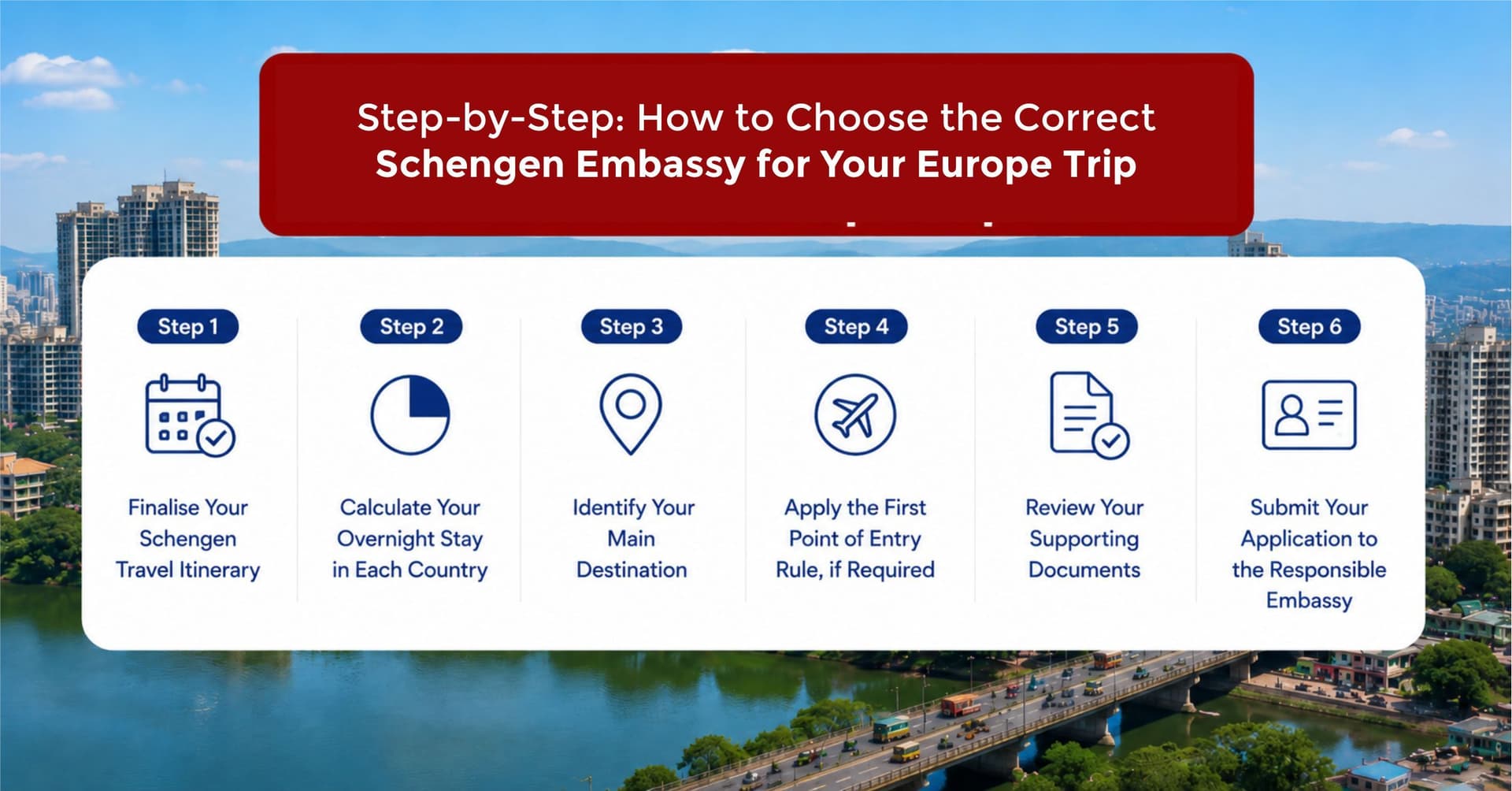
Step-by-Step: How to Choose the Correct Schengen Embassy for Your Europe Trip

blog-image

Selecting the correct Schengen embassy is straightforward when you follow the rules set out in the Schengen Visa Code. The embassy responsible for your application is determined by your travel itinerary - not by appointment availability or personal preference. Use the following steps to identify the correct authority before submitting your application.

Step 1: Finalise Your Schengen Travel Itinerary

Prepare a complete itinerary that lists every Schengen country you intend to visit in the order of travel. Ensure your itinerary accurately reflects your planned destinations and the duration of your stay in each country.

Only Schengen countries should be considered when determining the responsible embassy. Travel to non-Schengen destinations before, during, or after your trip does not affect embassy selection.

Step 2: Calculate Your Overnight Stay in Each Country

Calculate the total number of overnight stays you will spend in each Schengen country based on your confirmed travel plans.

Your main destination is determined by the country where you will spend the greatest number of nights. Day trips, airport transits, and short visits without an overnight stay do not contribute to the total duration of your stay.

Step 3: Identify Your Main Destination

Compare the number of overnight stays across your itinerary. If one Schengen country has a longer stay than every other destination, that country is considered your main destination and its embassy or consulate is responsible for processing your visa application. This is the primary rule used for all multi-country Schengen visa applications.

Step 4: Apply the First Point of Entry Rule, if Required

If two or more Schengen countries have the same highest number of overnight stays, determine which country you will enter first from outside the Schengen Area.

In this situation, the embassy of your first Schengen destination becomes responsible for your visa application. The first point of entry rule is used only when there is no single main destination.

Step 5: Review Your Supporting Documents

Before submitting your application, ensure your travel documents consistently reflect the same itinerary.

Your flight reservations, accommodation details, travel insurance, cover letter, and supporting documents should all match your intended travel plans. Any significant inconsistency may delay the assessment of your application or require additional clarification.

Step 6: Submit Your Application to the Responsible Embassy

Once you have identified the correct Schengen country, submit your application according to the requirements published by its embassy or consulate.

Before booking an appointment, review the latest document checklist, application procedure, and submission guidelines on the official website of the relevant embassy, as requirements may change over time.

Important: Always apply through the embassy responsible for your itinerary under the Schengen Visa Code. Choosing another embassy because appointments appear to be available sooner may result in your application being redirected or rejected for lack of jurisdiction.

Embassy Selection Examples for Multi-Country Europe Trips

Understanding the rules is one thing - seeing them applied to a real trip makes it much clearer. Here are two examples that cover the most common situations Indian travellers face.

Example 1: Italy, Switzerland, and Germany

Say you are planning your first Europe trip - 5 nights in Rome and Florence, 3 nights in Lucerne and Interlaken, and 2 nights in Munich before flying home.

Italy has the most nights (5), so Italy is your main destination. You apply through the Italian consulate regardless of which city you fly into first. Switzerland and Germany both have fewer nights, so they never come into the picture for embassy selection purposes.

Example 2: France and Switzerland - When the Nights Are Equal

Now imagine you plan 4 nights in Paris and 4 nights in Zurich, purely for tourism with no specific anchor in either country. You fly into Paris first.

France and Switzerland are tied at 4 nights each. Since the trip is pure leisure with no specific business meeting or event in either country, the purpose of the visit cannot break the tie. The final tiebreaker is first Schengen entry - you fly into Paris, so France is your first entry point. Apply through the French consulate.

If instead your itinerary included a professional conference in Zurich alongside the 4 Paris nights, Switzerland would be the main destination by purpose - regardless of the equal night count and regardless of where you fly in.

Example 3 - Business Meeting in Germany, Tourism in Austria

Say you have 3 nights in Munich for a business conference and 3 nights in Vienna for sightseeing. The nights are equal. But the purpose is not - your primary reason for the trip is the conference in Germany. That makes Germany your main destination. Apply through the German consulate. The first entry rule never comes into it because purpose already breaks the tie.

Example 4 - Spain, Portugal, and France

You plan 5 nights in Barcelona and Madrid, 3 nights in Lisbon, and 2 nights in Paris. Spain has the most nights by a clear margin. Apply through the Spanish consulate. It does not matter where you fly in or what order you visit the countries. Spain is the main destination, and that is the only thing that counts here.

Common Embassy Selection Mistakes Indian Applicants Should Avoid

Choosing the wrong embassy is one of the most common reasons for delays, additional scrutiny, or jurisdiction-related issues during the Schengen visa application process. Avoid these common mistakes to ensure your application complies with the Schengen Visa Code.

Applying Through the Embassy With Earlier Appointments

Do not choose an embassy simply because it has earlier appointment availability. Your application must always be submitted to the embassy responsible for your itinerary based on the main destination or first point of entry rules. Applying through another embassy without a valid travel itinerary may result in your application being redirected or refused.

Applying Through the Embassy With a Perceived Higher Approval Rate

Some applicants believe applying through a country with a lower visa refusal rate improves their chances of approval. However, visa decisions are based on the merits of your application, not the approval rate of a particular country.

Your itinerary, accommodation, and supporting documents must genuinely reflect the country responsible for processing your application.

Submitting an Inconsistent Travel Itinerary

Your flight reservations, accommodation bookings, travel insurance, and cover letter should all reflect the same travel plans.

Any inconsistencies between your documents may lead to requests for additional information or delays in processing your application.

Making Significant Changes After Submitting Your Application

Once your visa application has been submitted, it is assessed based on the itinerary and supporting documents provided.

If your travel plans change significantly before a decision is made, you may need to withdraw your application and submit a new one. Minor adjustments after a visa has been issued are generally acceptable, provided your original application was submitted in good faith.

Creating an Itinerary Solely to Obtain a Visa

Your travel itinerary should accurately represent your intended journey. Submitting accommodation bookings or travel plans that do not reflect your genuine travel intentions may be treated as a misrepresentation and could affect both your current application and future Schengen visa applications.

Best Practice: Finalise your itinerary first, determine the correct embassy using the Schengen Visa Code, and ensure every supporting document consistently reflects your planned travel. A genuine and well-prepared application is far more important than choosing an embassy based on appointment availability or perceived approval rates.

Documents That Support a Multi-Country Europe Travel Plan

A multi-country application requires more document coordination than a single-destination trip. Every country in your itinerary must be represented in some part of your file - not just the main destination.

Travel Itinerary

A day-by-day breakdown of your entire trip, showing which city you are in on each date. The itinerary must be consistent with every hotel booking, every internal transport booking, and the flight reservation. If your itinerary says Day 4 is Vienna, but your hotel booking shows you checked into Munich on Day 4, the file contains a contradiction.

Keep the itinerary realistic. Four countries in five days with multiple city changes each day invites scrutiny. Officers assess whether the travel schedule is physically achievable given the distances involved. An itinerary that requires a 6-hour train followed by a city tour followed by an overnight flight on the same day reads as rushed at best and implausible at worst.

Hotel Reservations

Every night of your trip must have corresponding accommodation proof. This applies to every country, not only the main destination. A file showing 7 nights of German hotels and nothing for the 5 Italian nights creates a gap that the officer will flag.

Use free-cancellation bookings so you are not exposed financially if your visa is refused. All major booking platforms offer this. Submit the confirmation page from the booking showing your name, check-in and check-out dates, hotel name and address, and booking reference number.

Internal Flight and Train Bookings

For multi-country trips, internal transport between countries adds credibility to the itinerary. A reservation for the Paris–Brussels Eurostar, the Frankfurt–Vienna night train, or a Rome–Barcelona flight supports the claim that you are genuinely planning to travel between those cities on those dates.

These do not need to be purchased tickets - reservation confirmations with booking reference numbers are sufficient for the visa application. Purchase refundable options where possible.

Cover Letter Explaining the Route

The cover letter for a multi-country application carries more weight than for a single-destination trip. It must explain:

  • The reason for visiting multiple countries - leisure, business across multiple cities, attending events in different locations
  • The sequence of travel in plain language
  • Which country is your primary destination and why
  • How the financial plan covers the full trip across all destinations

A cover letter that says "I plan to visit France, Italy, and Switzerland" without any further explanation leaves the officer to piece together the logic independently. A cover letter that says "I will spend my first week in Paris for the Louvre, Versailles, and the Loire Valley day trip, followed by 3 nights in Rome for the Colosseum and Vatican, and 2 nights in Zurich before returning" gives the officer a coherent picture.

Travel Insurance

Insurance must cover the entire Schengen Area for the full duration of your trip - not individual countries and not individual segments. A policy that covers "France and Italy" for a trip that also includes Switzerland is non-compliant. The certificate must state "Schengen Area" as the covered territory.

The insurance dates must span the full trip from Day 1 to the last day of your return. If your itinerary covers 14 days, the insurance must cover a minimum of 14 days. Policies that begin on Day 2 or end on Day 13 do not meet the legal requirement.

Financial Proof for Multi-Country Trips

Multi-country trips are more expensive than single-destination trips. Your bank statements and financial documents must reflect a budget that credibly covers travel across multiple countries with different cost levels.

Switzerland costs significantly more than Poland. If your itinerary combines Zurich (4 nights) and Warsaw (3 nights), the overall budget per day is lower than a 7-night Switzerland trip, but higher than a 7-night Poland trip. Officers understand this and assess whether your stated funds are proportionate to your actual planned itinerary.

For trips combining high-cost Schengen countries (Switzerland, Norway, Iceland, Denmark) with lower-cost ones (Czech Republic, Poland, Slovakia, Hungary), a per-day average calculation helps. Budget approximately €150 per day for Western Europe, €200–250 for Switzerland and Scandinavia, and €80–100 for Central and Eastern Europe.

What Happens If You Change Your Travel Plans?

Before Visa Submission

Before you submit your application, changes to your itinerary are straightforward. Update your hotel bookings, update your internal transport reservations, and update your visa application form and cover letter to reflect the revised plan. The only cost is cancellation fees on bookings, which free-cancellation options eliminate.

After Submission But Before a Decision

Once your application is submitted to the consulate, you cannot amend it. If your itinerary changes significantly - for instance, you add 5 more nights to Germany and reduce France to 2 nights -  the embassy processing your file may no longer be the correct one.

In this case, you have two options. You can proceed with the application as submitted and travel according to the original itinerary. Or you can withdraw the application, lose the fee, and resubmit through the now-correct embassy. The better option depends on how significantly the plan changed.

If the change is minor - one extra night in Austria, one fewer in Switzerland - and the main destination country remains the same, there is no issue with proceeding.

After Visa Approval - During Travel

A Schengen visa issued by France is valid across all 29 Schengen countries. If your plans change after approval and you spend more nights in Italy than originally planned, or skip a country entirely, your visa remains valid for wherever you actually go within the zone.

You are not legally required to travel exactly as stated in your application once the visa is approved. The visa is not revoked if you take a detour or change your internal route.

What Border Officers May Ask

At your first Schengen entry point, officers may ask which countries you plan to visit and where you are staying first. Answer with your original plan. If plans changed after visa approval, you can mention it without consequence - the visa is valid regardless.

Carry your hotel bookings for at least the first 2–3 nights. Officers rarely request documentation for every night of a multi-country trip, but having the first country's bookings accessible avoids any delay at the border.

Expert Tips for Planning a Multi-Country Europe Trip from India

  • Decide the embassy before booking anything: Confirm your night count per country, identify the correct embassy, and only then book flights and hotels in the sequence that reflects that decision. Reversing this order creates constraints and potential mismatches.
  • Start the process 3–4 months before travel:  A multi-country application takes more document preparation time than a single-destination application. Internal transport bookings need to be in place, hotel bookings across multiple countries must all use free cancellation, and the cover letter requires more detail. For summer travel, add the appointment shortage factor - France and Italy slots in peak season can be 6–8 weeks out.
  • Keep all bookings under the same name: Every hotel booking, every internal flight, and every train reservation should show the same name as your passport. A booking under a nickname, initials, or a married name that differs from your passport name requires an explanation letter.
  • Avoid unnecessary country hopping: Visiting 8 countries in 12 days is a legitimate travel goal but a difficult one to represent credibly on paper. Each country transition requires transport time that must show up somewhere in the itinerary. The more countries involved, the more coordination the document package requires. If your goal is to see many countries, plan a return trip for those you do not have time to visit properly on this journey.
  • Submit a realistic itinerary, not an optimistic one: A plan that allows 6 hours of sleep and 18 hours of activity every day for 14 consecutive days is not how most people travel. Officers assess consistency. An itinerary that reads like it was designed to hit every landmark in Europe will not read as a genuine travel plan.
  • Review embassy-specific requirements for every country in your itinerary: The document checklist for the main destination country applies to your application. But some consulates also ask for documentation related to other countries in your itinerary - proof of hotel bookings, transport reservations, or specific country-level financial thresholds. Download the checklist directly from the official consulate website.
  • Carry supporting documents while travelling: Inside the Schengen Area, you are not obligated to show hotel bookings at every border. But if you are stopped for a spot identity check - which can occur anywhere in the zone - having your onward hotel confirmation and return ticket accessible is practical. Keep digital copies on your phone and printed copies in your bag.

Conclusion

Choosing the right Schengen embassy for a multi-country Europe trip is not complicated once you know the rules. Most nights spent in a single country determine where you apply. When nights are equal, the primary purpose of your visit takes precedence. When both are tied, first Schengen entry makes the final call.

Getting this right before you book anything saves you from losing fees, missing appointment slots, and restarting your application from scratch. Plan your itinerary first. Count your nights. Identify your main destination. Then book your flights, hotels, and insurance in that order - not the other way around.

A well-prepared multi-country Schengen application is no harder than a single-destination one. The only difference is the coordination. Get that right, and the rest follows naturally.

FAQs

Which embassy do I apply to if I visit multiple Schengen countries?

Apply through the embassy of the Schengen country where you will spend the most nights. If one country clearly has more nights than any other, that country's consulate processes your application. If two or more countries have equal nights, the country where your primary purpose of visit is located becomes the main destination. If both are still tied to a pure tourism trip with no anchor - apply through the first Schengen country you enter.

Does the first country I fly into always decide my embassy?

No. The first entry country is only a tiebreaker when two or more countries share the most nights. If one country clearly has more nights than any other, that country's embassy is correct regardless of where you fly in.

Can I enter Schengen through a country other than the one that issued my visa?

Yes. A standard Schengen visa is valid at any Schengen external border. Your visa issued by Germany allows you to enter through France, Italy, or any other Schengen country. The issuing country has no special entry requirement.

What if I stay the same number of nights in two countries?

First check the primary purpose of your visit. If your trip has a business meeting, conference, or family visit in one of the two countries, that country becomes your main destination. If the purpose is also equal - pure tourism with nothing specific in either country- then apply through the first Schengen country you enter from outside the zone.

Can I visit countries that were not in my original itinerary?

Yes. Once your visa is approved and you enter the Schengen Area, you can travel freely across all 29 countries. You are not restricted to the countries listed in your application.

Will border officers check my hotel bookings for all countries?

Officers at the first entry point may ask to see accommodation proof. They most commonly check the first few nights. Having all bookings on your phone or in printed form is good practice, but showing 14 different hotel bookings for a 14-night multi-country trip is rarely required on the spot.

Can I use one Schengen visa for travel across all 29 countries?

Yes, provided the visa is issued as valid for "Schengen States" - which standard Type C tourist visas are. A Limited Territorial Validity (LTV) visa is restricted to specific countries, but these are issued only in exceptional circumstances. Standard tourist visa applications do not result in LTV visas.

I originally planned 5 nights in Germany and 3 in France. After getting my visa, I changed to 5 nights in France and 3 in Germany. Is my visa still valid?

Yes. The German-issued visa remains valid across all Schengen countries, including France. You do not need to notify any embassy. The visa covers your actual travel regardless of internal rearrangements.

Does flying business class or travelling on a premium ticket affect embassy selection?

No. Embassy selection is determined exclusively by night count and first entry. No other factor - ticket class, airline, or travel spend - is relevant.

What if the correct embassy has no application centre in my city?

You can apply at any authorised application centre for that country in India regardless of which Indian city you live in. If the nearest application centre requires travel, that cost is part of the application process. Some countries allow applications at their nearest centre in an adjacent country for Indian nationals residing abroad - check the specific consulate's website for current policy.

What if I have no hotel bookings yet - can I still determine the right embassy?

Yes. Embassy selection is based on your planned itinerary, not confirmed bookings. Plan your night count per country first, identify the correct embassy, then book hotels using free-cancellation options. Always finalise your embassy choice before making any bookings - not after.

I am transiting through Dubai (non-Schengen) before entering Schengen. Does Dubai affect my first entry calculation?

No. Only Schengen countries count for first entry purposes. Dubai is outside the Schengen Area. The first Schengen country you physically enter from outside the zone - after clearing that country's immigration - is your first entry point.

My cruise ship docks at three Schengen ports. Which country do I apply through?

If you sleep aboard the ship throughout, apply through the country of your first port of call after the embarkation port. If you book hotel nights in any port city, those count as nights in that country and the standard longest-stay rule applies. Finalise hotel bookings before deciding the embassy for cruise itineraries.

Can I apply to a cheaper country if my nights are close but not exactly equal?

No. If Germany has 7 nights and Slovakia has 5 nights, you apply through Germany regardless of service fee differences. Service fees do not factor into embassy eligibility. Applying through Slovakia in this situation is a misrepresentation.

Does Andorra count toward my night total for Spain or France?

No. Andorra is not part of the Schengen Area. Nights in Andorra do not count toward any Schengen country's total. If your trip includes Andorra, you will re-enter Schengen (through France or Spain) after leaving Andorra, which counts as a new Schengen entry. You need a multiple-entry Schengen visa if your itinerary includes Andorra.

I have a business meeting in Germany for 2 days and then 10 days of tourism in Italy. Which is my main destination?

Italy has more nights (10 vs 2), so Italy is the main destination regardless of the business purpose. Apply through the Italian consulate. Your cover letter should explain both portions of the trip.

If I apply through the wrong embassy and get refused, can I immediately reapply through the correct one?

Yes, but you should confirm the correct embassy before reapplying to avoid a second error. The refusal for procedural reasons (wrong embassy) is less damaging than a refusal for financial or intent-related reasons, but it still appears in your Visa Information System record and must be disclosed on future applications.

What documents specifically prove I will visit the country I applied through?

Hotel bookings in that country for the claimed number of nights, internal transport bookings connecting from or to that country, and an itinerary entry for each day in that country. The cover letter explaining why you are visiting that country as your primary destination adds further support.

I am applying through France but I already have a France Schengen visa that expired 3 months ago. Does my prior French visa affect the new application?

Prior visa history in the Visa Information System is visible to the processing consulate and generally strengthens your application - it demonstrates prior compliance. An expired visa does not create a problem for a fresh application.
Written by :globeia-logo
We are a background screening and document verification agency in Toronto. While we cover the Greater Toronto Area for in-person appointments, the bulk of our clientele uses our online services from different countries of the world. Globeia makes it simple and cost-effective for companies and individuals to navigate governmental red tape without breaking the bank.
Recommended by Globeia
Globeia Offices
Canada
Canada
1185 Victoria Park Avenue, Scarborough, ON M4B 2K5, Canada
USA
USA
1901 Pennsylvania Ave NW, Unit 801, Washington, DC, 20006-3405
Office Location
Send
Globeia Logo
Globeia is your simple and secure background checks and identity solution
©2026 Globeia.com. All rights reserved.