Services from United Kingdom

Services from New Zealand

Discover services in other countries
Australia
United Kingdom
United States of America
New Zealand
Portugal
Spain
Bangladesh
Brazil
Bulgaria
Canada
China
Colombia
Costa Rica
Croatia
Czech Republic
Dominican Republic
Ecuador
El Salvador
France
Germany
Greece
Hong Kong
Honduras
Hungary
India
Israel
Kuwait
Malta
Mexico
Netherlands
Norway
Pakistan
Panama
Paraguay
Peru
Philippines
Poland
Qatar
Saudi Arabia
South Korea
Switzerland
United Arab Emirates
Main Menu
RCMP Criminal Record Check
FBI Criminal Record Check
UK Apostille
Canada Apostille
New Zealand Apostille
RCMP Criminal Record Check
Canada Apostille
FBI Criminal Record Check
UK Apostille
New Zealand Apostille
FBI Apostille
RCMP Criminal Record Check
Authentication and Legalization
Canada Apostille
FBI Apostille
US Apostille
FBI Criminal Record Check
UK Apostille
New Zealand Apostille
RCMP Criminal Record Check
FBI Criminal Record Check
New Zealand Apostille
UK Apostille
RCMP Criminal Record Check
Canada Apostille
FBI Apostille
FBI Criminal Record Check
US Apostille
UK Apostille
New Zealand Apostille
RCMP Criminal Record Check
Canada Apostille
FBI Apostille
FBI Criminal Record Check
US Apostille
UK Apostille
New Zealand Apostille
Authentication and Legalization
FBI Apostille
RCMP Criminal Record Check
FBI Criminal Record Check
UK Apostille
New Zealand Apostille
RCMP Criminal Record Check
Canada Apostille
FBI Apostille
FBI Criminal Record Check
US Apostille
UK Apostille
New Zealand Apostille
RCMP Criminal Record Check
Canada Apostille
US Apostille
FBI Apostille
FBI Criminal Record Check
UK Apostille
New Zealand Apostille
RCMP Criminal Record Check
Certified Translation
Police Clearance Canada
Mobile Fingerprinting
Digital Fingerprinting
Police Clearance Certificate USA
Notarization in Canada
Authentication and Legalization
Canada Apostille
Calgary Apostille
Toronto Apostille
Vancouver Apostille
Ottawa Apostille
Ontario Apostille
US Apostille
FBI Apostille
FBI Criminal Record Check
UK Apostille
New Zealand Apostille
FBI Fingerprinting
RCMP Criminal Record Check
Authentication and Legalization
Canada Apostille
FBI Criminal Record Check
UK Apostille
New Zealand Apostille
RCMP Criminal Record Check
Canada Apostille
FBI Apostille
FBI Criminal Record Check
US Apostille
UK Apostille
New Zealand Apostille
RCMP Criminal Record Check
Canada Apostille
FBI Apostille
FBI Criminal Record Check
US Apostille
UK Apostille
New Zealand Apostille
Authentication and Legalization
RCMP Criminal Record Check
Canada Apostille
US Apostille
FBI Apostille
FBI Criminal Record Check
UK Apostille
New Zealand Apostille
RCMP Criminal Record Check
Canada Apostille
US Apostille
FBI Criminal Record Check
FBI Apostille
UK Apostille
New Zealand Apostille
RCMP Criminal Record Check
Canada Apostille
US Apostille
FBI Apostille
FBI Criminal Record Check
UK Apostille
New Zealand Apostille
RCMP Criminal Record Check
Canada Apostille
FBI Apostille
FBI Criminal Record Check
US Apostille
UK Apostille
New Zealand Apostille
US Apostille
FBI Apostille
FBI Criminal Record Check
RCMP Criminal Record Check
Canada Apostille
New Zealand Apostille
UK Apostille
RCMP Criminal Record Check
Canada Apostille
FBI Apostille
FBI Criminal Record Check
US Apostille
UK Apostille
New Zealand Apostille
RCMP Criminal Record Check
Canada Apostille
US Apostille
FBI Criminal Record Check
FBI Apostille
UK Apostille
New Zealand Apostille
RCMP Criminal Record Check
Canada Apostille
US Apostille
FBI Apostille
FBI Criminal Record Check
UK Apostille
New Zealand Apostille
RCMP Criminal Record Check
Canada Apostille
FBI Apostille
FBI Criminal Record Check
US Apostille
UK Apostille
New Zealand Apostille
US Apostille
FBI Apostille
FBI Criminal Record Check
RCMP Criminal Record Check
Canada Apostille
New Zealand Apostille
UK Apostille
RCMP Criminal Record Check
Canada Apostille
US Apostille
FBI Apostille
FBI Criminal Record Check
UK Apostille
New Zealand Apostille
RCMP Criminal Record Check
Canada Apostille
FBI Criminal Record Check
US Apostille
UK Apostille
New Zealand Apostille
RCMP Criminal Record Check
Canada Apostille
US Apostille
FBI Apostille
FBI Criminal Record Check
UK Apostille
New Zealand Apostille
Authentication and Legalization
RCMP Criminal Record Check
FBI Criminal Record Check
UK Apostille
New Zealand Apostille
Authentication and Legalization
RCMP Criminal Record Check
Canada Apostille
US Apostille
FBI Criminal Record Check
FBI Apostille
UK Apostille
New Zealand Apostille
RCMP Criminal Record Check
Canada Apostille
FBI Apostille
FBI Criminal Record Check
US Apostille
UK Apostille
New Zealand Apostille
RCMP Criminal Record Check
Canada Apostille
FBI Apostille
FBI Criminal Record Check
US Apostille
UK Apostille
New Zealand Apostille
RCMP Criminal Record Check
Authentication and Legalization
Canada Apostille
US Apostille
FBI Apostille
FBI Criminal Record Check
UK Apostille
New Zealand Apostille
RCMP Criminal Record Check
Authentication and Legalization
Canada Apostille
US Apostille
FBI Criminal Record Check
UK Apostille
New Zealand Apostille
FBI Apostille
RCMP Criminal Record Check
FBI Apostille
FBI Criminal Record Check
Canada Apostille
US Apostille
UK Apostille
New Zealand Apostille
RCMP Criminal Record Check
Canada Apostille
US Apostille
FBI Criminal Record Check
FBI Apostille
UK Apostille
New Zealand Apostille
RCMP Criminal Record Check
Canada Apostille
US Apostille
FBI Apostille
FBI Criminal Record Check
UK Apostille
New Zealand Apostille
FBI Apostille
RCMP Criminal Record Check
Authentication and Legalization
Canada Apostille
FBI Criminal Record Check
UK Apostille
New Zealand Apostille
RCMP Criminal Record Check
Canada Apostille
US Apostille
FBI Apostille
FBI Criminal Record Check
UK Apostille
New Zealand Apostille
Authentication and Legalization
FBI Apostille
RCMP Criminal Record Check
FBI Criminal Record Check
UK Apostille
New Zealand Apostille
Authentication and Legalization
FBI Apostille
RCMP Criminal Record Check
Canada Apostille
FBI Criminal Record Check
UK Apostille
New Zealand Apostille
RCMP Criminal Record Check
Canada Apostille
US Apostille
FBI Apostille
FBI Criminal Record Check
UK Apostille
New Zealand Apostille
RCMP Criminal Record Check
Canada Apostille
FBI Apostille
FBI Criminal Record Check
US Apostille
UK Apostille
New Zealand Apostille
Authentication and Legalization
RCMP Criminal Record Check
FBI Criminal Record Check
UK Apostille
New Zealand Apostille
State Apostille Service
State Apostille Services
California Apostille
Texas Apostille
Florida Apostille
New York Apostille
Pennsylvania Apostille
Connecticut Apostille
Washington Apostille
Nevada Apostille
North Carolina Apostille
Michigan Apostille
Minnesota Apostille
Georgia Apostille
South Carolina Apostille
Virginia Apostille
Ohio Apostille
New Jersey Apostille
New Hampshire Apostille
West Virginia Apostille
Illinois Apostille
New Mexico Apostille
Massachusetts Apostille
Missouri Apostille
Nebraska Apostille
Mississippi Apostille
Delaware Apostille
Maryland Apostille
Iowa Apostille
Indiana Apostille
Alabama Apostille
Alaska Apostille
Arizona Apostille
Arkansas Apostille
Colorado Apostille
Idaho Apostille
Montana Apostille
Hawaii Apostille
Kansas Apostille
Kentucky Apostille
Louisiana Apostille
Maine Apostille
North Dakota Apostille
Oregon Apostille
Rhode Island Apostille
Tennessee Apostille
Utah Apostille
Vermont Apostille
Wisconsin Apostille
Oklahoma Apostille
blog-banner
Visa Application Guide
Fingerprinting Services
Published on August 04, 2026 . Last updated on August 04, 2026
Sejal Jain

Schengen Visa for First-Time Applicants from India: What to Expect and How to Prepare

Applying for a Schengen visa for the first time from India can feel more complicated than it actually is. The process involves multiple documents, a specific embassy, biometric submission, and a waiting period - all before you even book a flight with confidence. Most first-time applicants either over-prepare in the wrong areas or miss something small that delays or derails their application entirely.

This guide is written specifically for Indian applicants who have never held a Schengen visa before. It covers the complete application journey - from deciding where to apply to what happens at the European border on arrival. It does not repeat the full requirements covered in a general Schengen visa guide. Instead, it focuses on what is different, harder, and most misunderstood when you are applying for the first time.

Understanding the Schengen Visa for First-Time Indian Applicants

What Is a Schengen Short-Stay Visa (Type C)?

A Schengen Type C visa is a short-stay entry permit that allows you to travel within the Schengen Area for tourism, business visits, family visits, or other permitted short-term purposes. It is issued by the consulate of one Schengen member state but is valid across all 29 Schengen countries once granted.

As of 2026, the Schengen Area includes 29 countries: all European Union members except Ireland and Cyprus, plus Iceland, Norway, Switzerland, and Liechtenstein. One visa, correctly obtained, lets you move freely across all of them without a separate border check at each crossing.

The 90/180-Day Rule - What does this mean?

The 90/180-day rule is the central restriction that governs every Schengen Type C visa. Within any rolling 180-day period, you may spend a maximum of 90 days inside the Schengen Area. This window rolls daily - it does not reset on a fixed calendar date.

If you enter on 1 June and stay for 30 days, your 180-day window on 1 July covers 2 January to 1 July. Those 30 June days fall within it. You have 60 days remaining in that window.

The EU's official Schengen calculator at home-affairs.ec, europa.eu allows you to enter your exact travel dates and receive a precise remaining-days figure. Use it before every trip, not just the first one.

Who Should Apply for a Schengen Visa from India?

Any Indian passport holder who intends to visit a Schengen country for any of the following purposes needs a Type C visa:

  • Tourism and sightseeing.
  • Honeymoon and leisure travel.
  • Visiting family members legally residing in a Schengen country.
  • Attending business meetings, conferences, or trade events.
  • Short medical consultations at European facilities.
  • Participating in cultural, sports, or academic events lasting under 90 days.

Indian citizens do not receive any automatic exemption regardless of income, profession, OCI card status, or frequency of travel. Every Indian passport holder without a valid Schengen visa requires one before entering the Schengen Area.

Activities Permitted Under a Schengen Visa

Permitted ActivityNotes
Tourism and sightseeingIncluding guided tours, cultural visits
Honeymoon travelStandard tourist category
Business meetingsNo employment or contract work
Family visitsHost must be legally residing in Schengen
Attending conferencesAcademic or professional events
Short medical consultationsWith appointment proof from facility
Sports participationOfficial tournaments, not employment

Activities Not Permitted Under a Schengen Visa

Working for any European employer is not permitted. Freelancing for European clients and receiving payment during your stay is also not permitted under a Type C visa, though working remotely for an Indian employer while physically in Europe sits in a grey area that differs across member states.

Enrolling in a formal university degree programme, long-term language courses extending beyond 90 days, and any activity that results in regular compensation from a Schengen-based entity falls outside the scope of a short-stay visa.

Before You Apply: Essential Planning Steps

  • Identify your travel purpose: Confirm whether you're travelling for tourism, business, family visits, study, or another reason. Your purpose determines the visa category and supporting documents.
  • Apply through the correct Schengen country: Submit your application to the country where you'll spend the most time. If your stay is equally divided, apply through your first country of entry.
  • Check your passport validity: Ensure your passport is valid for at least 3 months beyond your planned departure (6 months is recommended), was issued within the last 10 years, and has 2 blank pages.
  • Include previous travel history: If you have an old passport with visas or immigration stamps, include it to demonstrate your international travel history.
  • Know where to submit your application: Apply through the authorised visa application centre for your destination country. The centre collects your documents and biometrics, while the consulate makes the final decision.
  • Plan your application timeline: Apply 8–16 weeks before travel, especially during peak travel months, as appointment slots fill quickly. Applications can be submitted up to 6 months before departure.

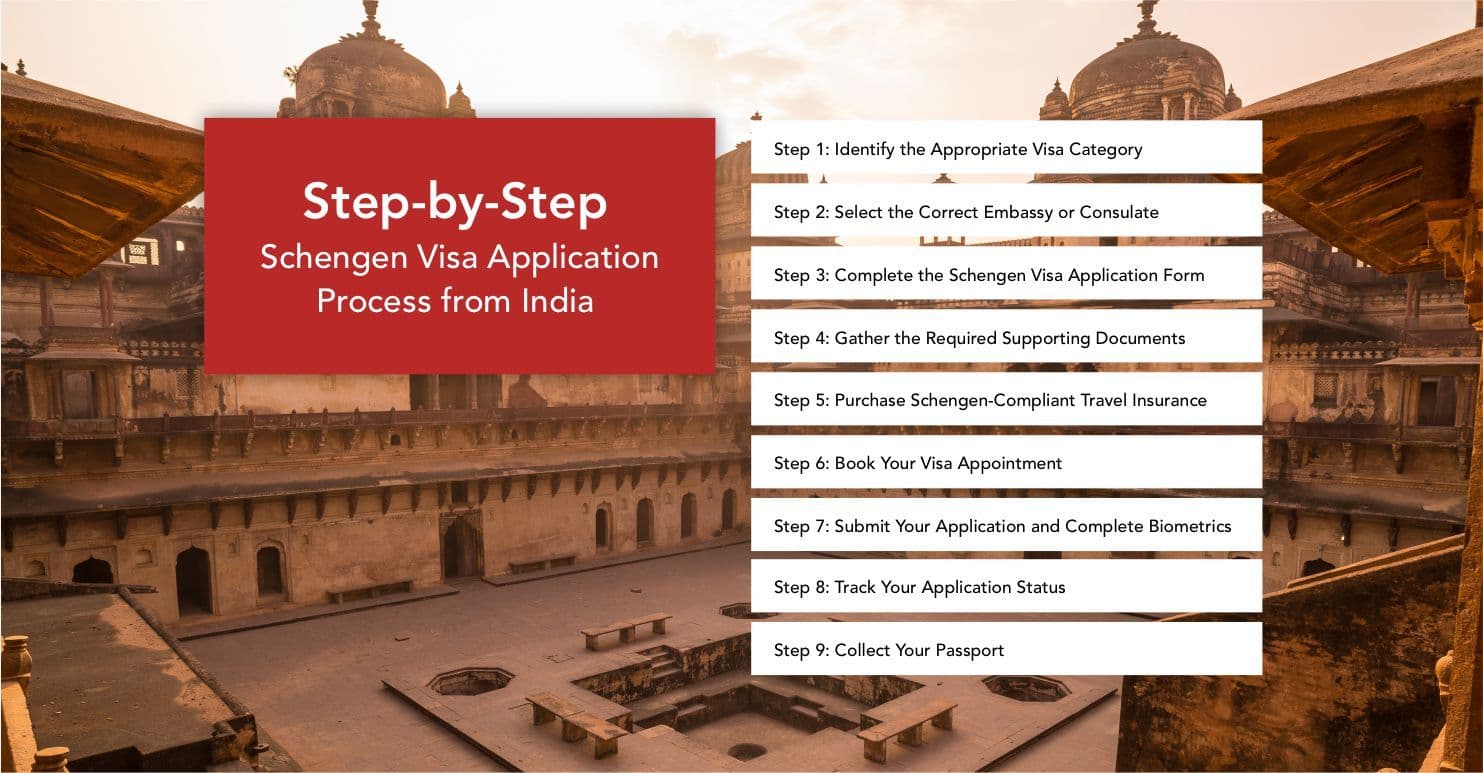
Step-by-Step Schengen Visa Application Process from India

blog-image

Step 1: Identify the Appropriate Visa Category

Select the purpose that most accurately reflects your trip. For most Indian first-time applicants, this is tourism or family visit. Business applicants should have a genuine business purpose and the documentation to support it - not a tourism application with business activities embedded.

Step 2: Select the Correct Embassy or Consulate

Confirm your main destination using confirmed hotel bookings, not a rough plan. Once confirmed, go to the official website of that country's consulate in India. Look up the specific requirements for Indian applicants - requirements vary by country.

Step 3: Complete the Schengen Visa Application Form

The Schengen Visa Application Form is standardised across all countries. Fill it digitally, print it, and sign it by hand. Key points for first-timers:

  • Enter your name exactly as it appears in your passport - including middle name if your passport shows it
  • For "National identity number," your Aadhaar number is acceptable
  • "Previous Schengen visas" - answer No honestly if this is your first application
  • "Have you ever been refused a Schengen visa?" - answer No if you have not. If you have been refused for any reason, disclose it. Non-disclosure is treated as misrepresentation.
  • Leave no field blank. Write N/A for fields that do not apply to you.

Step 4: Gather the Required Supporting Documents

The document package is what separates approved applications from refused ones. For first-time applicants, the document quality and consistency matter more than for experienced travellers, because you have no travel history to fall back on. Documents are covered in detail in the section below.

Step 5: Purchase Schengen-Compliant Travel Insurance

Travel insurance is not optional. It is a legal requirement under Article 15 of the Schengen Visa Code. Purchase it before your appointment, not after.

The certificate - not the full policy document-  is what you submit. It must show your name, policy number, coverage territory (Schengen Area), start and end dates, coverage amount (minimum €30,000), and confirmation that repatriation is included.

Step 6: Book Your Visa Appointment

Visit the official appointment booking portal for your destination country's application centre in India. Create an account, enter your details, and select an available slot.

Do not book your appointment until your documents are at least 90% ready. Booking a slot and then scrambling to gather documents is a poor strategy that often results in either a missed appointment or an incomplete submission.

Step 7: Submit Your Application and Complete Biometrics

Arrive at the application centre 10 minutes before your scheduled time. Bring all original documents and one complete set of photocopies.

At the centre:

  • Staff verify document completeness at the counter
  • Fingerprints are collected (all 10 fingers for adults; children under 12 are exempt from fingerprinting)
  • A photograph is taken
  • Fees are paid in Indian Rupees
  • The fingerprints collected here are stored in the Visa Information System (VIS).
  • These are separate from the EES biometrics collected at the European border on arrival - both collections are required.
  • If you have given fingerprints for a Schengen visa previously and those prints are less than 59 months old, you may not need to give them again. First-time applicants always provide fingerprints.

Step 8: Track Your Application Status

After submitting your application, use the reference number on your receipt to track its status online. Updates usually include Application Received, Forwarded to Consulate, Under Process, Decision Made, and Passport Ready for Collection. A "Decision Made" status does not indicate whether your visa was approved or refused.

Step 9: Collect Your Passport

When you collect your passport, check your visa sticker carefully. Make sure your name, passport number, visa validity dates, number of entries, and "Schengen States" validity are all correct. Report any errors immediately before leaving the application centre.

Documents That Matter Most for First-Time Applicants

  1. Passport: Submit your current passport along with photocopies of all important pages. If you have an old passport with previous visas or travel stamps, include it as well.
  2. Financial Documents: Provide your last 6 months of bank statements, recent ITRs, and any fixed deposit certificates or other proof of financial stability.
  3. Employment or Business Proof: Salaried applicants should submit an employment letter and leave approval. Business owners should provide business registration, GST documents, and business bank statements. Students need an enrollment certificate and a No Objection Certificate (NOC).
  4. Travel Itinerary: Include a clear and realistic travel plan that matches your flight and hotel bookings.
  5. Accommodation Proof: Submit hotel bookings for your entire stay. If staying with family or friends, provide an invitation letter along with the host's passport/residence permit and address proof.
  6. Cover Letter: Write a brief letter explaining the purpose of your trip, your travel plans, how you will fund the visit, and your reasons for returning to India.
  7. Travel Insurance: Purchase travel insurance covering the entire Schengen Area for the full duration of your trip, with minimum coverage meeting Schengen visa requirements.

Additional Documents Based on Your Profile

  1. Retirees: Pension payment order, property documents showing ownership in India, and a cover letter clearly explaining that family and assets remain in India.
  2. Homemakers: Spouse's full financial documentation, signed sponsorship declaration, and marriage certificate.
  3. Applicants with Canadian documents: If you have previously lived or worked in Canada and wish to include Canadian financial or employment records as supplementary proof, those documents may require an apostille before submission. Globeia provides Canadian document apostille services from India for applicants in this situation.

Financial Requirements for a Schengen Visa from India

Your financial documents are one of the most important parts of a Schengen visa application. They help visa officers determine whether you can comfortably afford your trip and return to India without financial difficulties. Rather than focusing on a single bank balance, officers assess your overall financial stability and spending habits.

How Much Bank Balance Should You Show?

A practical reference based on average European travel costs:

Trip ProfileEstimated Trip CostRecommended Minimum Average Balance
Solo, 7 days, Western Europe₹1.5–2.5 lakh₹3–4 lakh
Solo, 14 days, Western Europe₹2.5–4 lakh₹5–7 lakh
Couple, 10 days₹3–5 lakh₹7–10 lakh
Family of 4, 14 days₹7–12 lakh₹12–18 lakh

Switzerland and Scandinavia cost significantly more than Eastern Europe. If your destination is Zurich or Oslo, adjust your balance expectations upward.

There is no official minimum bank balance for a Schengen visa. However, you should have enough money to cover your flights, accommodation, daily expenses, transportation, and any other travel costs. Your available funds should be realistic for the length and purpose of your trip.

Submit Recent Bank Statements

Provide your bank statements for the last six months to show that you have sufficient funds for your trip. Visa officers look for regular income, a stable account balance, consistent spending patterns, and the absence of large unexplained deposits made just before the application.

Include Income Proof

Submit income documents that match your employment status to verify your financial stability. Salaried applicants should provide salary slips, Form 16, and Income Tax Returns (ITRs). Self-employed applicants should include business registration documents, GST returns, business bank statements, and ITRs. Retired applicants can submit pension statements or other proof of regular income.

Provide Additional Financial Assets

You can strengthen your application by including supporting financial documents such as Fixed Deposit (FD) certificates, investment statements, or other savings records. While these help demonstrate your financial strength, they should be submitted as supporting evidence and not as a replacement for your bank statements.

Sponsored Trips

If someone else is funding your trip, provide a signed sponsorship letter, the sponsor's recent bank statements and income proof, and documents that establish your relationship with the sponsor, such as a marriage or birth certificate. These documents help demonstrate that your travel expenses will be fully covered.

Avoid Common Financial Mistakes

To reduce the risk of delays or refusal:

  • Avoid making large cash deposits just before applying.
  • Submit complete financial records for the required period.
  • Ensure your income matches your spending pattern.
  • Keep all financial information accurate and consistent across your application.

How Visa Officers Assess First-Time Schengen Applications

Purpose of Travel

The officer's first question is whether the stated purpose is genuine. A person applying for tourism should have a tourism-consistent itinerary, accommodation in tourist locations, and activities that make sense for a tourist. A person applying under a business purpose with no invitation letter and no company documentation has a mismatch that is immediately visible.

Financial Capacity

The officer must believe you can fund the trip without resorting to illegal employment in Europe. This is assessed through the financial documents described above - not through a single figure, but through the whole pattern.

Travel History (or Lack of It)

First-time applicants have no Schengen history by definition. This is not an automatic disadvantage. Officers are trained to assess first-time applications on the strength of the supporting documents rather than on absence of stamps.

What compensates for no travel history:

  • Strong, stable employment with a credible employer
  • Clear and specific travel plan
  • Solid financial profile
  • Obvious ties to India that make overstaying irrational

Prior travel to the US, UK, UAE, Singapore, or other countries - even on expired visas - adds useful context. Include old passports if they contain these stamps.

Strong Ties to India

The officer must believe you will return. Evidence of ties:

Tie TypeAcceptable Proof
EmploymentEmployer letter with approved leave showing a job to return to
PropertySale deed or property tax receipt
FamilyMention of spouse, children, or dependent parents in cover letter
BusinessActive GST-registered business in India

No single tie is decisive. A combination of employment, property, and family is the strongest profile.

Consistency Across Supporting Documents

Every document in your file tells part of the same story. The dates in your employment letter must match the leave period. The hotel booking dates must match the flight reservation. The flight reservation must match the visa application dates. The insurance validity must cover the full period.

One inconsistency is a question. Two or more inconsistencies begin to look like a carelessly assembled or inaccurate application.

Overall Application Credibility

An officer reviewing 60 to 100 applications in a day forms a quick initial impression from file organisation, document quality, and cover letter clarity. A well-organised file with a clear cover letter is read more carefully and more charitably than a disorganised pile with unclear purpose.

Challenges Faced by First-Time Indian Applicants

No Previous International Travel

Many first-time applicants worry about not having any travel history. However, this is not a reason for visa refusal. You can strengthen your application with stable employment, sufficient financial proof, a well-planned itinerary, and a clear cover letter that explains your travel purpose.

Understanding Embassy Requirements

Each Schengen country's embassy or consulate has its own document checklist and procedures. Always refer to the official checklist for your destination country and ensure you meet all the specific requirements before submitting your application.

Avoiding Documentation Errors

Even small mistakes can delay your application or lead to rejection. Before submitting, check that:

  • Your passport-sized photographs meet the required specifications.
  • Your travel insurance covers the entire trip.
  • You have provided 6 months of bank statements.
  • Your employment letter includes approved leave (if applicable).
  • Your visa application form is complete, signed, and dated.

Booking Your Visa Appointment Early

Appointment slots can fill up quickly, especially during the May to August travel season. Book your appointment 8–16 weeks before your travel date, keep your documents ready in advance, and check appointment availability regularly for cancellations or newly released slots.

Keeping Your Application Consistent

Make sure all the information in your application matches across every document. Your travel dates, flight itinerary, hotel bookings, employment letter, travel insurance, and financial documents should all be accurate and consistent. A well-organised and error-free application improves your chances of approval.

Common Mistakes to Avoid During Your First Schengen Application

blog-image

Choosing the Wrong Embassy

Applying to Slovakia because the service fee is lower when your itinerary shows 10 nights in Germany is a misrepresentation - not a shortcut. Officers check the hotel bookings against the chosen consulate. This error results in refusal and a non-refundable fee loss.

Inconsistent Travel Dates

Every document must show the same travel window. If your visa application says June 10 – June 24 and your insurance covers June 12– June 22, you have two problems. Hotels booked for June 10– June 23 with a flight returning June 24 creates an overnight-gap question. Date consistency is not a detail - it is a structural requirement.

Incomplete Supporting Documents

A missing month of bank statements, a missing salary slip, or a hotel booking that covers 13 nights of a 14-night trip are all grounds for an additional document request - or in some cases, outright refusal. Complete means complete.

Unexplained Financial Transactions

If your account shows a transfer of ₹2,50,000 from an unknown source three weeks before application, be prepared for the officer to question it. If that transfer is legitimate - inheritance, property sale, gift-  include a brief explanation letter with supporting evidence in your file.

Purchasing Non-Compliant Travel Insurance

Insurance rejected for one of these reasons:

  • Territory says "Europe" instead of "Schengen Area"
  • Deductible is €250 when the consulate expects zero
  • Coverage is €20,000 instead of the minimum €30,000
  • Policy start date is one day after the visa application start date

All four are common errors. All four result in the insurance being rejected, which is a direct refusal reason under Article 32(1)(a)(vii) of the Schengen Visa Code.

Waiting Too Long to Apply

The absolute minimum is 15 calendar days before travel. The practical minimum for most countries is 8–10 weeks. For France, Italy, or Spain in summer - 14–16 weeks. Applicants who book flights first and then discover appointment slots are unavailable for the next 6 weeks face a painful choice between losing their flights or missing the application window entirely.

Common Mistakes Checklist

MistakeHow to Avoid
Wrong embassyCount confirmed hotel nights per country before choosing
Inconsistent datesCreate a date matrix - visa form, flight, hotel, insurance, leave letter must all align
Incomplete documentsUse the official consulate checklist, not a third-party list
Large unexplained depositsDo not move borrowed funds into your account before applying
Non-compliant insuranceRead the certificate before purchase - check territory, amount, deductible, dates
Applying too lateApply 10–16 weeks before travel depending on destination
Generic cover letterName specific destinations, activities, hotels, and ties to India

What Happens After You Submit Your Application?

Biometric Enrolment

At your appointment, fingerprints from all 10 fingers and a facial photograph are collected. These go into the Visa Information System (VIS). This is not the same as the EES (Entry/Exit System) biometrics collected at the European border when you arrive - both are required separately.

Children under 12 are exempt from fingerprinting but are still photographed.

Additional Document Requests

The consulate may contact you through the application centre requesting a specific additional document. Common requests: updated bank statement, additional employment proof, or clarification on a financial transaction. Respond promptly and completely. A delayed or incomplete response extends your processing time.

Processing Timeline

Legal standard under the Schengen Visa Code: 15 calendar days from the date your application is deemed complete.

Actual timelines from India in 2026:

CountryOff-PeakPeak (Jun–Aug)
Germany5–10 working days10–15 working days
Netherlands5–8 working days8–12 working days
France15–30 working days30–50 working days
Italy15–30 working days30–55 working days
Greece12–20 working days20–35 working days
Switzerland8–12 working days10–18 working days

Passport Collection

You will receive an SMS or email when your passport is ready for collection. If you opted for courier return, it will be dispatched to your registered address. If collecting in person, bring your original receipt.

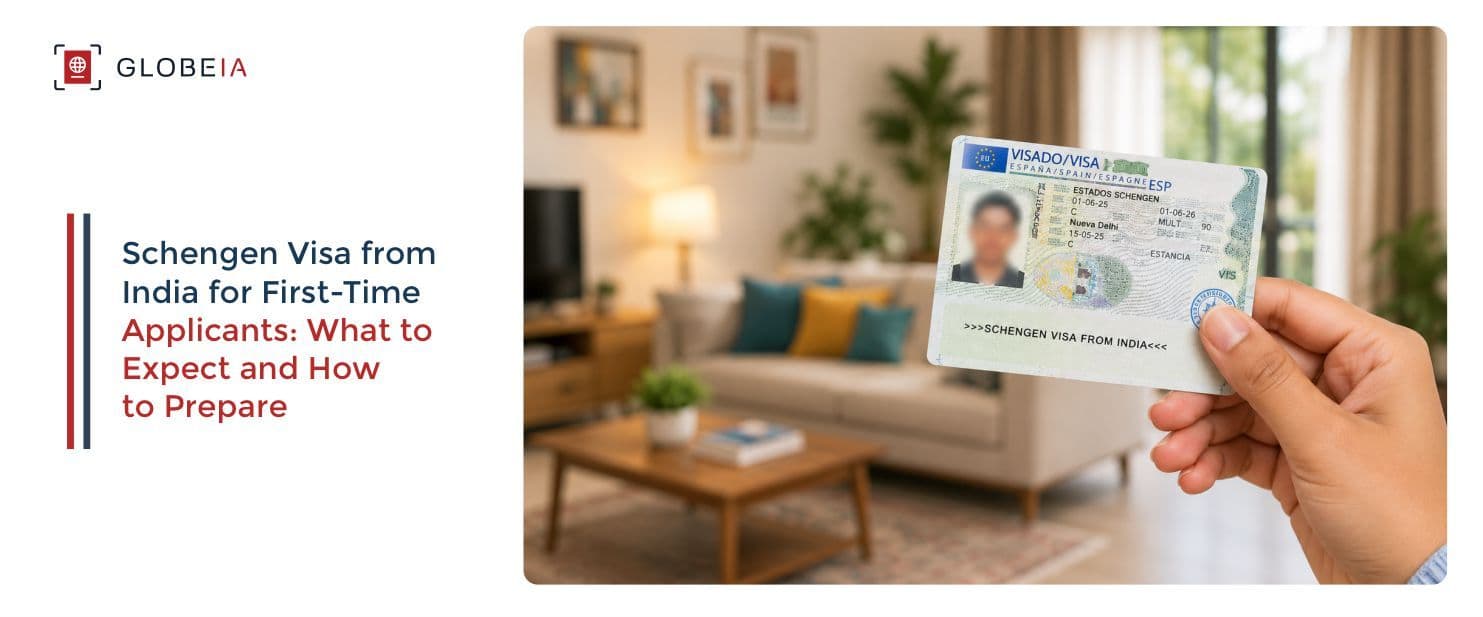
Understanding Your Visa Sticker

When you receive your passport, check:

  • VALID FOR: Should read "Schengen States" - not a single country name
  • FROM and UNTIL: Your permitted entry and exit window
  • NUMBER OF ENTRIES: MULT for multiple-entry, 01 for single-entry, 02 for double-entry
  • DURATION OF STAY: The number of days permitted - usually 90 for standard tourist visas
  • TYPE: C for short-stay

Your visa validity period is not the same as your permitted stay. A visa valid FROM 1 June UNTIL 30 November with 90 days' duration means you may enter and exit within that 6-month window but may not spend more than 90 days in Schengen within any 180-day rolling period.

Preparing for Your First Trip to the Schengen Area

Carry Essential Travel Documents

Before you travel, keep all important documents easily accessible. Carry your passport with the Schengen visa, return flight ticket, hotel booking confirmations, travel insurance certificate, and copies of important documents (printed or digital). It's also helpful to carry some local currency for your initial expenses.

At Immigration

On arrival, border officers will verify your passport, visa, and travel details. Depending on the airport, you may also need to complete fingerprint and facial scan verification under the Entry/Exit System (EES).

Be Ready to Answer Basic Questions

Border officers may ask about the purpose of your visit, where you will stay, how long you plan to remain, and your return flight. Answer confidently, honestly, and ensure your responses match the information in your visa application.

Follow Your Visa Conditions

While in the Schengen Area, carry your passport or identification, stay only for the permitted duration, avoid working unless your visa allows it, and leave before your visa expires. Following these conditions will help ensure a smooth trip and support future visa applications.

Practical Tips to Improve Your First Schengen Visa Application

  1. Start preparing early: The application process from document gathering to passport collection takes 10–16 weeks. Starting 8 weeks before travel is usually too late for France, Italy, or Spain.
  2. Follow embassy-specific instructions:  The official consulate checklist for Germany is not identical to the French consulate checklist. Download the checklist from the official government website for your destination country.
  3. Keep your documentation consistent: Every date, every name, and every financial figure across your entire file must tell the same story. Read all documents together before submission.
  4. Maintain transparent financial records: Do not move money between accounts in ways that require explanation. Officers are experienced at identifying accounts that were artificially inflated before an application.
  5. Organise your file professionally:  Use the order specified in the consulate checklist. Label sections clearly. Do not include documents that were not requested - extra irrelevant documents create confusion, not confidence.
  6. Submit only genuine documents: Fabricated documents result in immediate refusal, a SIS II flag, and potential multi-year entry bans. No amount of visa approval probability justifies falsification.
  7. Review your application before submission: Have someone else read your completed form and cover letter. A second pair of eyes catches inconsistencies that you have become too familiar with to notice.

Conclusion

Planning your first Schengen visa application from India doesn't have to be overwhelming. The key is to understand the requirements, prepare your documents carefully, demonstrate strong financial stability, and ensure every detail in your application is accurate and consistent. Even without previous international travel, a well-organised application with a genuine travel purpose can significantly improve your chances of approval. By starting early, following the correct embassy guidelines, and avoiding common mistakes, you'll be well prepared for a smooth visa process and your first trip to Europe.

FAQs

Can I get a Schengen visa without any previous international travel?

Yes. Having no travel history is not a disqualifying condition. Hundreds of thousands of Indian first-timers receive Schengen visas each year. A strong employment profile, consistent bank statements, and a credible itinerary compensate for the absence of prior stamps.

Is travel insurance mandatory?

Yes. It is a legal requirement under Article 15 of the Schengen Visa Code. Minimum coverage is €30,000 for the entire Schengen Area for the full stay duration.

What happens if my visa is refused?

You will receive a refusal letter citing the specific reason by code under Article 32(1) of the Visa Code. Read the code carefully - it tells you exactly what to fix. You may reapply after addressing the stated reason.

Can I reapply after a rejection?

Yes. There is no mandatory waiting period before reapplying. However, reapplying immediately with an unchanged file almost always results in a second refusal for the same reason. Address the stated problem first.

Can I apply from any city in India?

Yes. Application centres in any city accept applications from applicants regardless of their home state. Choose the city most convenient for you that has an application centre for your destination country.

Do I need to show a confirmed paid ticket before my visa is approved?

No. A confirmed flight reservation with a valid PNR reference is sufficient. You do not need to purchase a non-refundable ticket before visa approval.

What is the difference between the FROM date and UNTIL date on my visa?

The FROM date is the earliest you may enter Schengen. The UNTIL date is the last day by which you must exit. You must both enter after the FROM date and exit on or before the UNTIL date.

Will the EES system cause any problems for first-time visitors?

No problems - but expect 10–20 additional minutes for your initial biometric registration at the border. Subsequent entries will be faster once your EES profile is established.

Can I extend my Schengen visa if I want to stay longer?

Only in cases of documented force majeure or serious personal emergency. A desire to stay longer, enjoyment of the trip, or flight delays caused by personal reasons do not qualify.

What if I lose my passport while in Europe?

Contact the nearest Indian Embassy or Consulate immediately. File a police report in the city where you are. The Indian Embassy issues an Emergency Certificate for return travel. Photograph your passport biographical page and visa sticker separately before travel and store them in cloud storage or email to yourself.

Does my Schengen visa allow me to work remotely for my Indian employer from Europe?

Schengen member states differ in how they interpret this. Working for an Indian employer and receiving income deposited into an Indian bank account while physically in Europe is a grey area. The Type C visa prohibits employment within Schengen. For extended remote work abroad, national Type D digital nomad visas from specific countries (Portugal, Spain, Germany) are the appropriate pathway.
Written by :globeia-logo
We are a background screening and document verification agency in Toronto. While we cover the Greater Toronto Area for in-person appointments, the bulk of our clientele uses our online services from different countries of the world. Globeia makes it simple and cost-effective for companies and individuals to navigate governmental red tape without breaking the bank.
Recommended by Globeia
Globeia Offices
Canada
Canada
1185 Victoria Park Avenue, Scarborough, ON M4B 2K5, Canada
USA
USA
1901 Pennsylvania Ave NW, Unit 801, Washington, DC, 20006-3405
Office Location
Send
Globeia Logo
Globeia is your simple and secure background checks and identity solution
©2026 Globeia.com. All rights reserved.