Services from United Kingdom

Services from New Zealand

Discover services in other countries
Australia
United Kingdom
United States of America
New Zealand
Portugal
Spain
Bangladesh
Brazil
Bulgaria
Canada
China
Colombia
Costa Rica
Croatia
Czech Republic
Dominican Republic
Ecuador
El Salvador
France
Germany
Greece
Hong Kong
Honduras
Hungary
India
Israel
Kuwait
Malta
Mexico
Netherlands
Norway
Pakistan
Panama
Paraguay
Peru
Philippines
Poland
Qatar
Saudi Arabia
South Korea
Switzerland
United Arab Emirates
Main Menu
RCMP Criminal Record Check
FBI Criminal Record Check
UK Apostille
Canada Apostille
New Zealand Apostille
Fingerprinting
RCMP Criminal Record Check
Canada Apostille
FBI Criminal Record Check
UK Apostille
New Zealand Apostille
FBI Apostille
Fingerprinting
RCMP Criminal Record Check
Authentication and Legalization
Canada Apostille
FBI Apostille
US Apostille
FBI Criminal Record Check
UK Apostille
New Zealand Apostille
RCMP Criminal Record Check
FBI Criminal Record Check
New Zealand Apostille
UK Apostille
RCMP Criminal Record Check
Canada Apostille
FBI Apostille
FBI Criminal Record Check
US Apostille
UK Apostille
New Zealand Apostille
RCMP Criminal Record Check
Canada Apostille
FBI Apostille
FBI Criminal Record Check
US Apostille
UK Apostille
New Zealand Apostille
Authentication and Legalization
FBI Apostille
RCMP Criminal Record Check
FBI Criminal Record Check
UK Apostille
New Zealand Apostille
RCMP Criminal Record Check
Canada Apostille
FBI Apostille
FBI Criminal Record Check
US Apostille
UK Apostille
New Zealand Apostille
RCMP Criminal Record Check
Canada Apostille
US Apostille
FBI Apostille
FBI Criminal Record Check
UK Apostille
New Zealand Apostille
RCMP Criminal Record Check
Certified Translation
Police Clearance Canada
Mobile Fingerprinting
Digital Fingerprinting
Police Clearance Certificate USA
Notarization in Canada
Authentication and Legalization
Canada Apostille
Calgary Apostille
Toronto Apostille
Vancouver Apostille
Ottawa Apostille
Ontario Apostille
US Apostille
FBI Apostille
FBI Criminal Record Check
UK Apostille
New Zealand Apostille
FBI Fingerprinting
RCMP Criminal Record Check
Authentication and Legalization
Canada Apostille
FBI Criminal Record Check
UK Apostille
New Zealand Apostille
RCMP Criminal Record Check
Canada Apostille
FBI Apostille
FBI Criminal Record Check
US Apostille
UK Apostille
New Zealand Apostille
RCMP Criminal Record Check
Canada Apostille
FBI Apostille
FBI Criminal Record Check
US Apostille
UK Apostille
New Zealand Apostille
Authentication and Legalization
RCMP Criminal Record Check
Canada Apostille
US Apostille
FBI Apostille
FBI Criminal Record Check
UK Apostille
New Zealand Apostille
RCMP Criminal Record Check
Canada Apostille
US Apostille
FBI Criminal Record Check
FBI Apostille
UK Apostille
New Zealand Apostille
RCMP Criminal Record Check
Canada Apostille
US Apostille
FBI Apostille
FBI Criminal Record Check
UK Apostille
New Zealand Apostille
RCMP Criminal Record Check
Canada Apostille
FBI Apostille
FBI Criminal Record Check
US Apostille
UK Apostille
New Zealand Apostille
US Apostille
FBI Apostille
FBI Criminal Record Check
RCMP Criminal Record Check
Canada Apostille
New Zealand Apostille
UK Apostille
RCMP Criminal Record Check
Canada Apostille
FBI Apostille
FBI Criminal Record Check
US Apostille
UK Apostille
New Zealand Apostille
RCMP Criminal Record Check
Canada Apostille
US Apostille
FBI Criminal Record Check
FBI Apostille
UK Apostille
New Zealand Apostille
RCMP Criminal Record Check
Canada Apostille
US Apostille
FBI Apostille
FBI Criminal Record Check
UK Apostille
New Zealand Apostille
RCMP Criminal Record Check
Canada Apostille
FBI Apostille
FBI Criminal Record Check
US Apostille
UK Apostille
New Zealand Apostille
US Apostille
FBI Apostille
FBI Criminal Record Check
RCMP Criminal Record Check
Canada Apostille
New Zealand Apostille
UK Apostille
RCMP Criminal Record Check
Canada Apostille
US Apostille
FBI Apostille
FBI Criminal Record Check
UK Apostille
New Zealand Apostille
RCMP Criminal Record Check
Canada Apostille
FBI Criminal Record Check
US Apostille
UK Apostille
New Zealand Apostille
RCMP Criminal Record Check
Canada Apostille
US Apostille
FBI Apostille
FBI Criminal Record Check
UK Apostille
New Zealand Apostille
Authentication and Legalization
RCMP Criminal Record Check
FBI Criminal Record Check
UK Apostille
New Zealand Apostille
Authentication and Legalization
RCMP Criminal Record Check
Canada Apostille
US Apostille
FBI Criminal Record Check
FBI Apostille
UK Apostille
New Zealand Apostille
RCMP Criminal Record Check
Canada Apostille
FBI Apostille
FBI Criminal Record Check
US Apostille
UK Apostille
New Zealand Apostille
RCMP Criminal Record Check
Canada Apostille
FBI Apostille
FBI Criminal Record Check
US Apostille
UK Apostille
New Zealand Apostille
RCMP Criminal Record Check
Authentication and Legalization
Canada Apostille
US Apostille
FBI Apostille
FBI Criminal Record Check
UK Apostille
New Zealand Apostille
RCMP Criminal Record Check
Authentication and Legalization
Canada Apostille
US Apostille
FBI Criminal Record Check
UK Apostille
New Zealand Apostille
FBI Apostille
RCMP Criminal Record Check
FBI Apostille
FBI Criminal Record Check
Canada Apostille
US Apostille
UK Apostille
New Zealand Apostille
RCMP Criminal Record Check
Canada Apostille
US Apostille
FBI Criminal Record Check
FBI Apostille
UK Apostille
New Zealand Apostille
RCMP Criminal Record Check
Canada Apostille
US Apostille
FBI Apostille
FBI Criminal Record Check
UK Apostille
New Zealand Apostille
FBI Apostille
RCMP Criminal Record Check
Authentication and Legalization
Canada Apostille
FBI Criminal Record Check
UK Apostille
New Zealand Apostille
RCMP Criminal Record Check
Canada Apostille
US Apostille
FBI Apostille
FBI Criminal Record Check
UK Apostille
New Zealand Apostille
Authentication and Legalization
FBI Apostille
RCMP Criminal Record Check
FBI Criminal Record Check
UK Apostille
New Zealand Apostille
Authentication and Legalization
FBI Apostille
RCMP Criminal Record Check
Canada Apostille
FBI Criminal Record Check
UK Apostille
New Zealand Apostille
RCMP Criminal Record Check
Canada Apostille
US Apostille
FBI Apostille
FBI Criminal Record Check
UK Apostille
New Zealand Apostille
RCMP Criminal Record Check
Canada Apostille
FBI Apostille
FBI Criminal Record Check
US Apostille
UK Apostille
New Zealand Apostille
Authentication and Legalization
RCMP Criminal Record Check
FBI Criminal Record Check
UK Apostille
New Zealand Apostille
State Apostille Service
State Apostille Services
California Apostille
Texas Apostille
Florida Apostille
New York Apostille
Pennsylvania Apostille
Connecticut Apostille
Washington Apostille
Nevada Apostille
North Carolina Apostille
Michigan Apostille
Minnesota Apostille
Georgia Apostille
South Carolina Apostille
Virginia Apostille
Ohio Apostille
New Jersey Apostille
New Hampshire Apostille
West Virginia Apostille
Illinois Apostille
New Mexico Apostille
Massachusetts Apostille
Missouri Apostille
Nebraska Apostille
Mississippi Apostille
Delaware Apostille
Maryland Apostille
Iowa Apostille
Indiana Apostille
Alabama Apostille
Alaska Apostille
Arizona Apostille
Arkansas Apostille
Colorado Apostille
Idaho Apostille
Montana Apostille
Hawaii Apostille
Kansas Apostille
Kentucky Apostille
Louisiana Apostille
Maine Apostille
North Dakota Apostille
Oregon Apostille
Rhode Island Apostille
Tennessee Apostille
Utah Apostille
Vermont Apostille
Wisconsin Apostille
Oklahoma Apostille
blog-banner
Fingerprinting Services
FBI Identity History Summary
Published on August 24, 2026 . Last updated on August 24, 2026
Sejal Jain

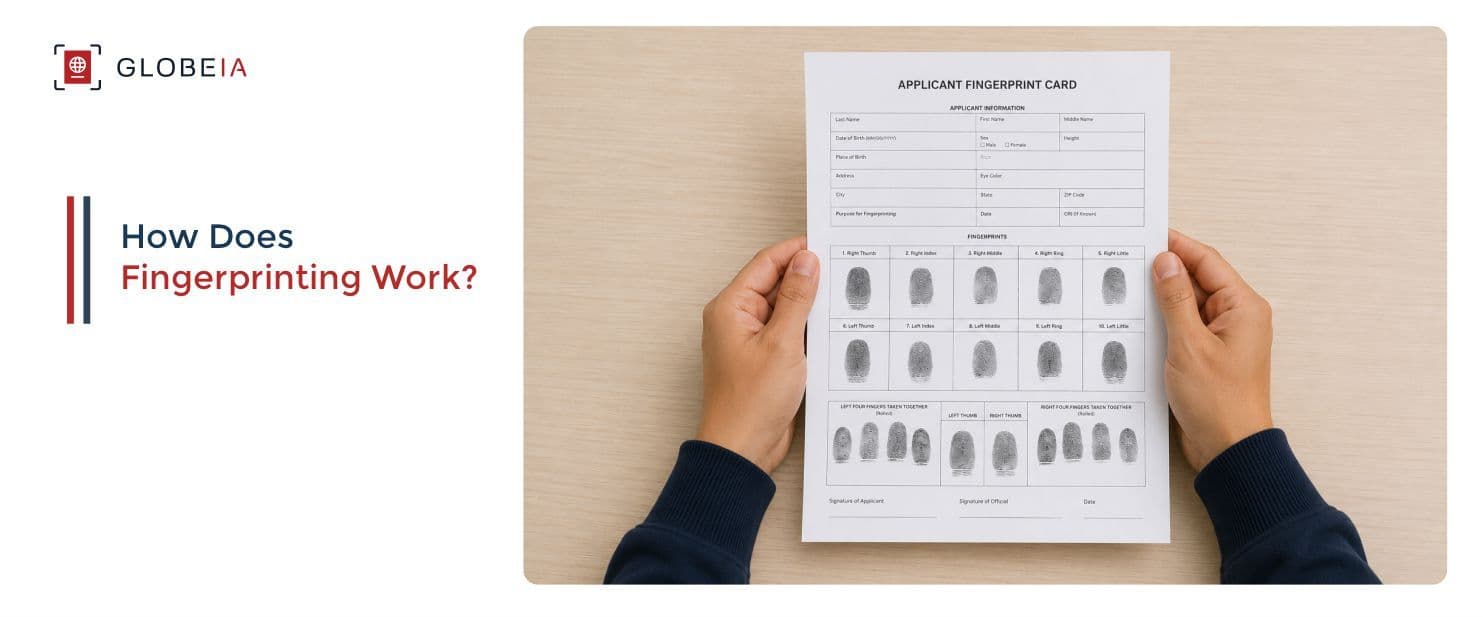
How Does Fingerprinting Work?

Summary

Summary: Fingerprints provide a trusted way to confirm a person’s identity through the unique ridge patterns on their fingers. This guide covers the fingerprinting process, from collection and quality checks to analysis and real-world uses in background checks, visas, employment, and security screening.

Fingerprinting has become one of the most widely used methods for identity verification. Since every person has a different fingerprint pattern, it helps organisations confirm an individual’s identity accurately. From government checks to workplace screening, fingerprints play an important role in verifying personal information. This guide explains how fingerprinting works, how prints are processed, and why they are used.

What Are Fingerprints and Why Is Each One Unique?

Fingerprints are patterns formed by raised ridges of skin on the surface of the fingertips. These ridges create three broad pattern types:

PatternDescriptionFrequency
LoopRidges enter and exit from the same side, curving back on themselvesMost common - around 60–65%
WhorlRidges form circular or spiral patternsAround 30–35%
ArchRidges rise in the centre and flow across the fingerLeast common - around 5%

Fingerprints begin forming during the third and fourth month of pregnancy. The middle layer of skin grows faster than the inner and outer layers, causing the surface to buckle into ridge formations. The exact shape of those ridges depends on physical conditions in the womb - foetal position, pressure, and the movement of amniotic fluid - none of which are the same for any two people. Even identical twins, who share the same DNA, develop different fingerprints because those physical conditions differ between them.

Once formed, the ridge pattern is fixed. It does not change with age. The ridges expand proportionally as a person grows, but the pattern remains the same. Skin damage, aging, or certain manual work can affect the surface clarity of prints, but the underlying structure stays intact.

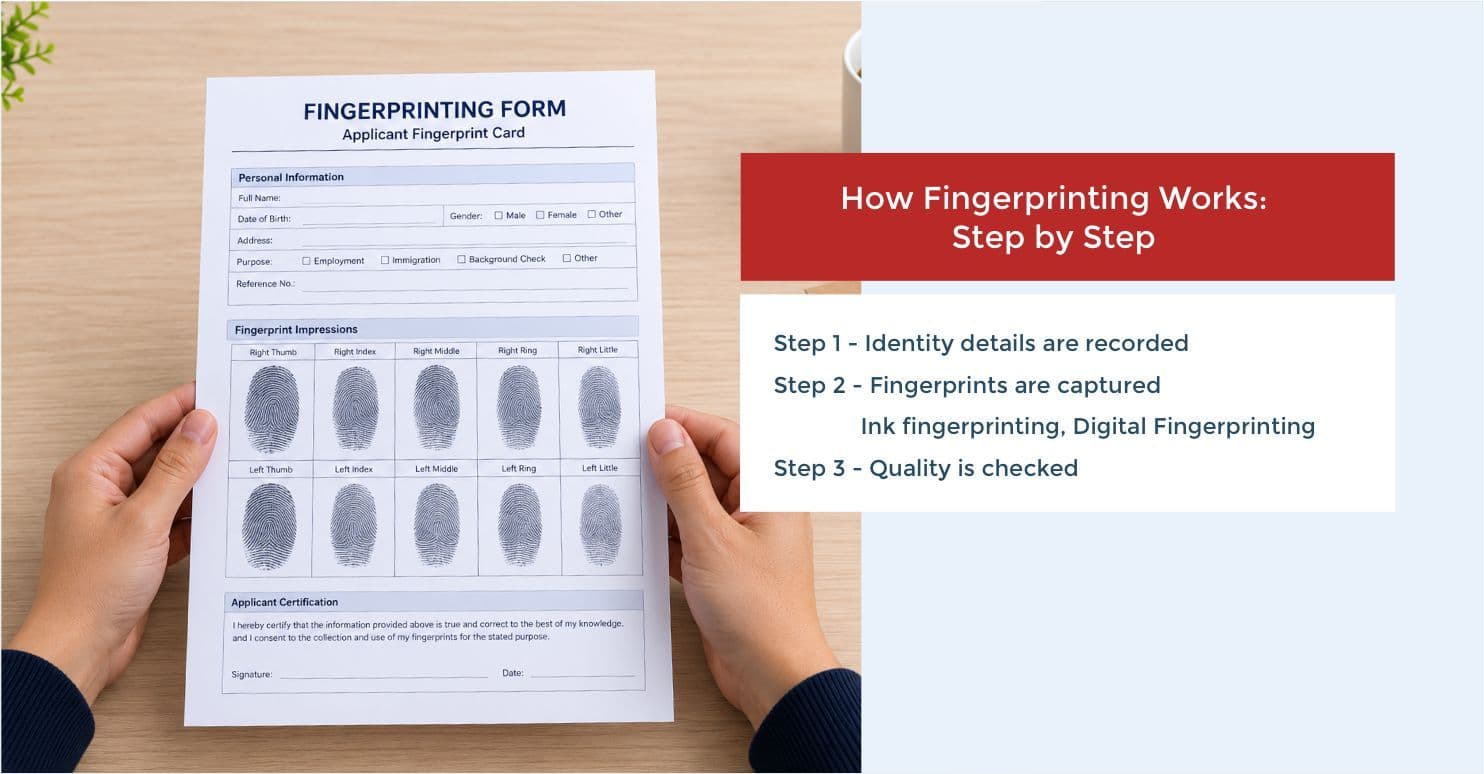
How Fingerprinting Works: Step by Step

blog-image

Step 1 - Identity details are recorded

Before fingerprints are taken, the applicant's personal information is collected. This includes full name, date of birth, identification document details, and the purpose of the fingerprinting. This information is written directly onto the fingerprint card or entered into the digital system. It must match the identification documents exactly - any mismatch can cause delays or rejection.

Step 2 - Fingerprints are captured

There are two methods:

Ink fingerprinting: Each finger is pressed onto an ink pad and rolled firmly onto a fingerprint card - an FD-258 card for FBI submissions, a C216-C card for Canadian RCMP submissions from outside Canada, or the card format required by another authority. Each finger is rolled from nail edge to nail edge to capture the full ridge width. The ink transfers the ridge pattern directly onto the card surface.

Digital fingerprinting (live scan): The finger is placed on an electronic scanner. A sensor reads the ridge pattern and converts it into a digital image, then into a mathematical template stored as a file. No ink is used. The quality of each print can be checked on screen during the session, which means poor prints are retaken immediately rather than discovered after submission.

FeatureInkDigital (live scan)

Equipment
Ink pad and fingerprint cardElectronic scanner
OutputPhysical cardDigital file
Quality checkAfter all prints are takenDuring capture
SpeedStandardFaster processing
Common useFBI, RCMP international submissionsEmployment, border control, device security

Step 3 - Quality is checked

After capture, every print is reviewed. Clear ridge detail, complete impressions, correct finger placement, and no smudging are required. If any print does not meet the standard, that finger is recaptured before the appointment ends. A trained technician reviews the full card before it leaves the session - this step catches most errors before they become resubmissions.

How Fingerprints Are Analysed

Once submitted, fingerprints are compared against stored records using an Automated Fingerprint Identification System (AFIS), or reviewed directly by a fingerprint examiner.

The system does not match the overall shape of the pattern. It looks for specific ridge details called minutiae points -the exact locations where ridges end abruptly, where a single ridge splits into two branches, or where short isolated ridges appear. A human fingertip contains between 75 and 175 of these points. The system compares the submitted print against stored records and identifies whether enough minutiae points align in the same positions to confirm a match.

For checks such as an FBI Identity History Summary or an RCMP criminal record check, the system searches the relevant database and returns any matching records. Fingerprints are more reliable than name-based searches because names can be shared, changed, or misspelled. A fingerprint match is specific to one person.

Types of Fingerprint Scanners

Digital fingerprinting uses different sensor technologies depending on where the system is used:

  • Optical scanners use a light source and camera to photograph the fingertip surface. Ridges and valleys reflect light differently, producing a clear image of the pattern. These are the most common scanners in law enforcement offices and professional fingerprinting services.
  • Capacitive scanners measure the electrical difference between the raised ridges, which touch the sensor surface, and the lower valleys, which do not. This produces a map of the ridge pattern without light. Capacitive sensors are used in most smartphones and building access systems.
  • Ultrasonic scanners use high-frequency sound waves to map the fingerprint surface, including depth beneath the skin. They work through moisture, minor skin damage, and surface contamination that would affect optical or capacitive sensors. Ultrasonic scanners are found in newer mobile devices and some high-security systems.

All three scanner types convert the captured image into a digital template - a mathematical representation of the minutiae points - which is stored and used for comparison. The raw fingerprint image is not what gets stored or compared in most systems.

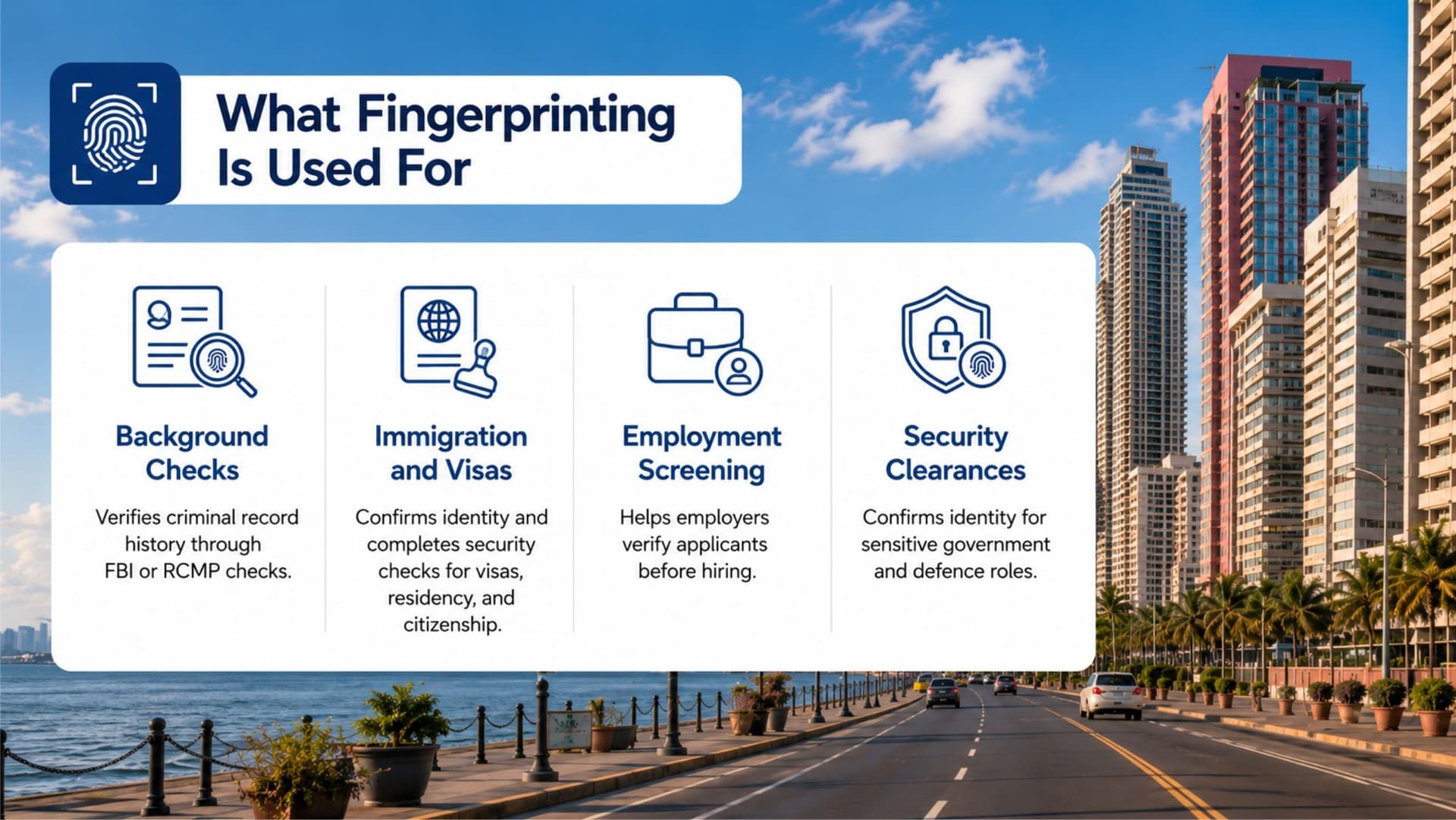
What Fingerprinting Is Used For

blog-image
  • Background Checks: Fingerprints are used to verify a person’s criminal record history through government databases, such as FBI or RCMP checks.
  • Immigration and Visas: Many countries use fingerprints to confirm identity and complete security checks for visas, residency, and citizenship applications.
  • Employment Screening: Employers in healthcare, education, finance, and government roles use fingerprint checks to verify applicants before hiring.
  • Security Clearances: Government and defence organisations use fingerprints to confirm identity for sensitive positions.

Why Fingerprints Are More Reliable Than Other Identifiers

Names, dates of birth, and identity numbers can be shared, changed, or duplicated. A fingerprint is biologically unique to one person and cannot be transferred.

This matters most in large-scale identity checks. When a database holds records for millions of people with similar names or birth dates, a name-based search produces multiple possible matches that must be reviewed manually. A fingerprint search returns only records that match the specific minutiae pattern submitted.

Fingerprints also provide continuity across name changes, document renewals, and jurisdictional borders. A person who has changed their name, used multiple identity documents, or moved between countries can still be matched to their fingerprint records - provided those prints were captured and submitted to the relevant database at some point.

Fingerprinting for International Applications

Applicants based outside the country they are applying to face additional steps that domestic applicants do not. The fingerprint card must meet the receiving authority's approved format, be sent internationally, and returned the same way. Each stage adds time to the total, and any error at the capture stage means the entire process restarts from the beginning.

Shipping documents across borders introduces delays that are outside the applicant's control. Building buffer time into the schedule before any visa, employment, or licensing deadline is essential.

Common challenges international applicants face:

  • Sourcing the correct approved fingerprint card format in their country.
  • Finding a local fingerprinting provider familiar with foreign authority requirements.
  • Managing international courier timelines in both directions.
  • Customs clearance delays holding documents longer than expected.
  • Restarting the full process if prints are rejected after international delivery.

Using an approved channeler, where the receiving authority permits it, reduces the timeline significantly. Channelers submit fingerprints electronically on the applicant's behalf rather than by physical mail, which removes the longest wait in the process. Not all authorities accept channeler submissions from international applicants, so confirming the available options before applying is worth doing.

For applicants in regional or remote areas who cannot reach a fingerprinting provider, mobile fingerprinting services travel to the applicant's location with all required equipment and the correct card formats for the submission destination.

Key requirements for any international fingerprint submission:

  • Use the correct approved card format specified by the receiving authority.
  • Complete every personal information field accurately - no blank fields.
  • Match all names and dates exactly to your identification documents.
  • Send documents flat in a rigid envelope to avoid damage in transit.
  • Use a tracked international courier - untracked mail creates no delivery record and cannot be followed up if lost.
  • Keep copies of all documents before sending the originals.

What to Expect at a Fingerprinting Appointment

Before the appointment: Bring valid photo identification and any forms the requesting organisation requires. Keep your hands clean and dry. Avoid using heavy hand creams immediately before the appointment, as they can affect ink adhesion.

  • During the appointment: The technician verifies your identity using your identification documents. Your fingerprints are captured finger by finger, with each one rolled from side to side. The technician checks each print for quality before moving on.
  • After the appointment: The completed fingerprint card or digital file is submitted to the relevant authority. Processing time depends on the organisation receiving the prints and the type of check being conducted.

Most fingerprinting appointments take 15 to 30 minutes.

Mobile Fingerprinting: How It Works

Mobile fingerprinting is a service where a trained technician travels to the applicant's location - home, workplace, or another agreed site. The technician brings the required equipment and fingerprint cards.

This option is useful for applicants in regional or remote areas, people who cannot travel easily, and businesses or groups needing multiple people fingerprinted at the same time. The process and quality standards are the same as a fixed-location appointment.

How Globeia Provides Fingerprinting Services

Globeia offers professional fingerprinting services across the UK, Australia, India, Spain, Portugal, Germany, France, Switzerland, and other European countries, including regional areas, through trained mobile fingerprinting technicians.

Services support FBI and RCMP fingerprint submissions using the correct fingerprint card formats required by each authority. Every fingerprint set is carefully reviewed for quality before submission to help reduce the risk of rejection.

Globeia also supports the complete Criminal Record Check process, including application assistance, SmartPortal tracking, and apostille services for the USA, UK, and Canada when required.

Conclusion

Fingerprinting works by capturing the unique ridge patterns on a person's fingertips and comparing them against stored records to confirm identity. The process is accurate, consistent, and accepted by governments and organisations worldwide.

Clear prints, the correct card format, and complete personal details are what determine whether a submission is accepted or returned. Using a trained professional removes most of the risk from the process.

FAQs

How accurate is fingerprint identification?

Modern automated fingerprint systems compare prints against millions of records with high accuracy. Errors are almost always caused by poor print quality at the time of capture, not by the matching technology itself.

What is the difference between ink and digital fingerprinting?

Ink fingerprinting uses a physical card; digital uses an electronic scanner. Both capture the same ridge patterns. Digital allows quality to be checked on screen during the appointment. Some authorities - including the FBI for direct submissions - still require ink cards.

Can fingerprints be rejected after submission?

Yes. Smudged, faint, incomplete, or incorrectly rolled prints are rejected. The wrong card format or missing information on the card are also common causes. A rejected submission requires full resubmission, including new fingerprinting and additional fees.

Do fingerprints change with age?

The ridge pattern does not change. However, skin can become thinner and drier with age, making prints harder to capture clearly. Injuries and skin conditions can also affect surface quality without changing the underlying pattern.

Is fingerprint data kept after processing?

This depends on the authority and the purpose of the check. Law enforcement agencies retain fingerprint records in their databases. For most civilian background checks, fingerprint data is handled under the privacy laws of the relevant jurisdiction and used only for the specific purpose requested.

What if my fingerprints are hard to capture?

Dry skin, manual work, skin conditions, and age can all reduce print clarity. A trained technician can adjust technique and equipment to work around most of these issues. Globeia's mobile fingerprinting service includes a quality check on every set of prints before submission, which helps avoid rejections caused by poor capture.

My fingerprints were rejected - what should I do?

You need to start again. A rejection cannot be fixed or appealed - the card is returned, and a new one must be submitted. Book a new fingerprinting appointment with an experienced provider. Make sure they check print quality before sending. Resubmit with a new application and payment.

Why do fingerprint applications get rejected?

Most rejections come down to four things: smudged prints, prints that are too light or too dark, fingers not rolled fully edge to edge, and missing information on the card. Using the wrong card format or a photocopy will also get your application returned. One mistake is enough to reject the whole submission.

How can I improve fingerprint quality?

Wash and dry your hands before the appointment. Skip hand cream, lotion, and sanitiser on the day - they reduce ink transfer. If your skin is very dry, moisturise in the days before but not on the day itself. During the session, let the technician guide your finger. Do not press down or pull away.

Can elderly people give fingerprints?

Yes. Age is not a barrier. Older skin can be thinner and drier, which makes prints harder to capture clearly. A trained technician adjusts their technique to work with this. Most elderly applicants get acceptable results. If prints genuinely cannot meet the required standard, the authority may ask for alternative identity documents.

What if my fingerprints are too light?

Light prints usually mean not enough ink, dry skin, or too little pressure. The technician will reapply ink and recapture the affected fingers. Moisturising your hands in the days before the appointment helps. Do not use lotion on the day. Most light print issues are fixed during the session before the card leaves.

What if I have worn fingerprints?

Worn fingerprints come from years of manual work, chemical exposure, or certain skin conditions. It makes capturing clear prints harder - but not impossible. An experienced technician adjusts their approach for reduced ridge detail. If the prints cannot meet the standard after several attempts, contact the requesting authority. Some will accept a supporting letter and alternative documents.

How long does fingerprinting take?

Most appointments take 15 to 30 minutes. This includes identity verification, capturing all ten fingers, and a quality check. If any prints need retaking, add a few minutes. Processing by the authority and document delivery are separate and add more time on top.

Can fingerprinting be done at home?

Yes. A mobile fingerprinting service sends a trained technician to your home. They bring all the equipment and the correct card formats. The quality and process are the same as any fixed-location appointment. Book in advance to check availability in your area.

How much does fingerprinting cost?

It depends on your location, provider, and submission type. Mobile services cost more than fixed-location appointments due to travel. You also need to budget for the government processing fee from the receiving authority and courier costs if submitting internationally. Contact your provider directly for a quote based on your specific situation.

Can someone come to my office for fingerprinting?

Yes. Mobile fingerprinting services go to offices and workplaces. This works well for employers fingerprinting multiple staff at once - one visit covers the whole group. When booking, confirm the number of people, the card format needed, and the submission destination so the technician arrives prepared.

Do I need an appointment for fingerprinting?

Yes, in most cases. Fixed-location and mobile services both operate by appointment. This ensures the right card format and equipment are ready for your submission. Walk-in availability is limited. Book early if you have a visa, employment, or licensing deadline - you need time to correct any issues before the deadline.

What ID do I need for fingerprinting?

Bring at least one valid government-issued photo ID - a passport or driver's licence. Some submissions require two forms of ID. The name on your ID must match your fingerprint card exactly. Originals only - photocopies are not accepted. Check with your provider or the requesting authority if you are unsure what is needed.

Can I get fingerprinted on weekends?

Some providers offer weekend appointments, including mobile services. Availability varies by location and provider. Check in advance. If you have a firm deadline, a weekday booking gives you more room to reschedule if something changes.
Written by :globeia-logo
We are a background screening and document verification agency in Toronto. While we cover the Greater Toronto Area for in-person appointments, the bulk of our clientele uses our online services from different countries of the world. Globeia makes it simple and cost-effective for companies and individuals to navigate governmental red tape without breaking the bank.
Recommended by Globeia
Globeia Offices
Canada
Canada
1185 Victoria Park Avenue, Scarborough, ON M4B 2K5, Canada
USA
USA
1901 Pennsylvania Ave NW, Unit 801, Washington, DC, 20006-3405
Office Location
Send
Globeia Logo
Globeia is your simple and secure background checks and identity solution
©2026 Globeia.com. All rights reserved.