

If you are moving with children, understanding New Zealand's education system early saves a lot of stress. It’s good-really good-but it works differently from the US K–12 system in ways that often surprise parents.
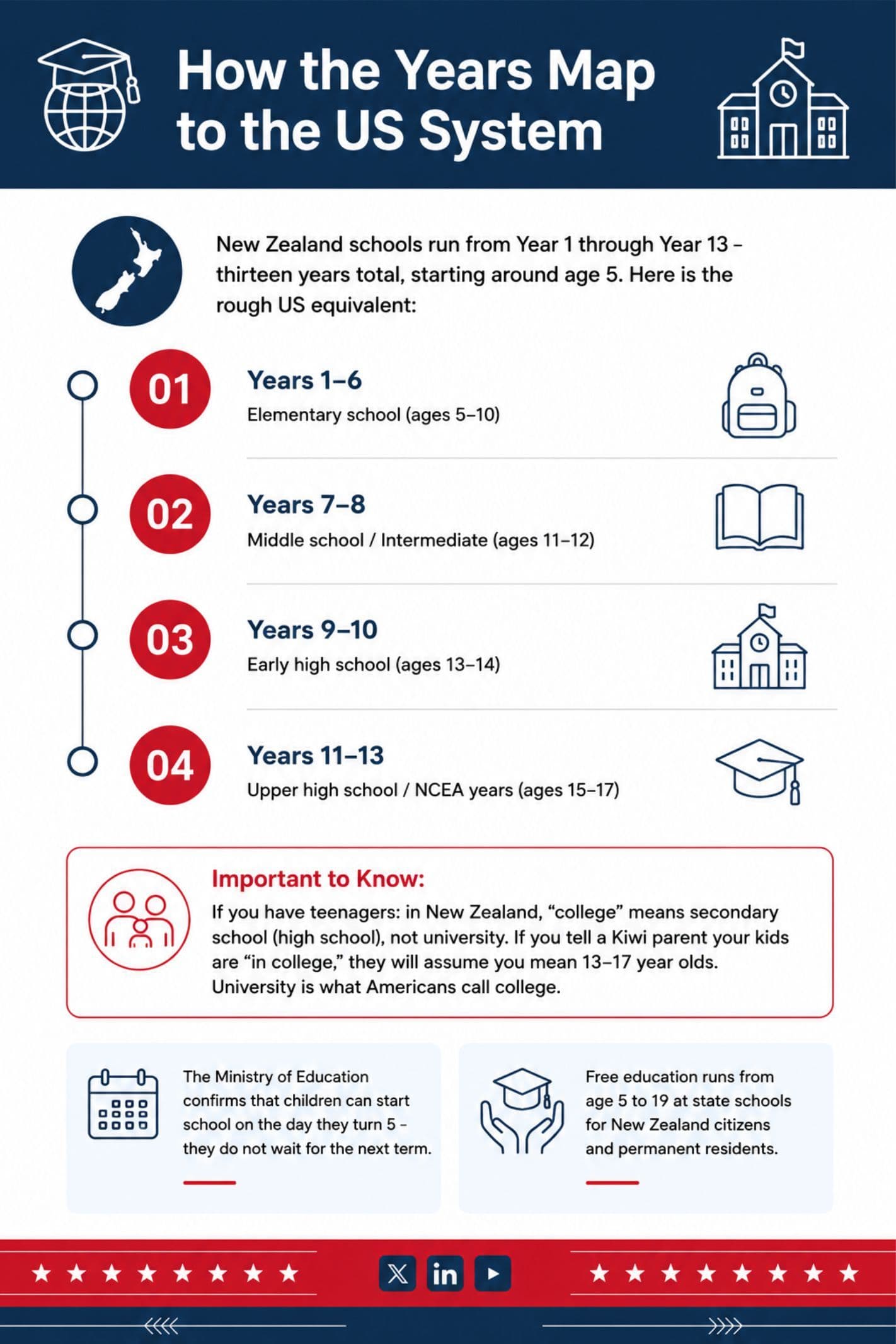
New Zealand schools run from Year 1 through Year 13 - thirteen years total, starting around age 5. Here is the rough US equivalent:
One thing to know immediately if you have teenagers: in New Zealand, "college" means secondary school (high school), not university. If you tell a Kiwi parent your kids are "in college," they will assume you mean 13–17 year olds. University is what Americans call college.
The Ministry of Education confirms that children can start school on the day they turn 5 they do not wait for the next term. Free education runs from age 5 to 19 at state schools for New Zealand citizens and permanent residents.
State schools are government-owned and fully funded. They are free for residents. Parents pay for uniforms, stationery, and school trips.
State-integrated schools are funded by the government but have a particular character often religious, like Catholic or Anglican. They charge a compulsory "attendance due" on top of the government funding.
Private schools charge tuition set by the school. They receive some government funding but operate independently. They offer better facilities and more extracurricular options but can cost NZD $15,000 to $30,000+ per year at secondary level.
There are also international schools in Auckland and Wellington that teach the American, IB, or Cambridge curriculum useful if your stay is temporary and you want continuity for your child.
Most popular state schools operate on a zoning system. If you live in a school's zone, your child has guaranteed enrollment. Outside the zone, you are on a waiting list. This directly affects where many families choose to rent or buy. Research the school zones for your preferred area before signing a lease.
The Ministry of Education's school finder lets you search schools by location and check zone boundaries.
The National Certificate of Educational Achievement (NCEA) is New Zealand's main secondary qualification, administered by the New Zealand Qualifications Authority (NZQA). Students work toward it in Years 11, 12, and 13 at Levels 1, 2, and 3 respectively.
NCEA differs fundamentally from US high school diplomas. Instead of letter grades per subject, students earn credits throughout the year via internal assignments and external exams. They need a minimum number of credits at each level to achieve that NCEA level. Level 3 with sufficient credits and literacy/numeracy requirements earns University Entrance the equivalent of being qualified to apply to a New Zealand university.
Note: the New Zealand government announced in 2025 plans to phase out NCEA between 2028 and 2030 and replace it with subject-based certificates. If your child is in the NZ system now, they will likely still complete NCEA. Keep an eye on NZQA's news page for updates.
NCEA Level 3 is recognised by overseas universities including in the US. Your child does not lose global options by studying in New Zealand.
New Zealand universities do consider US high school transcripts, AP scores, and SAT/ACT results during admissions. They do not run a direct Year 11/12 credit transfer system, but they look at the whole academic picture. If your child is in Years 11–13 and switching mid-stream, talk to NZQA and the receiving school about credit recognition.
New Zealand has eight universities. All are public and government-funded. Fees for domestic students (those with residency or citizenship) are substantially lower than international student fees NZD $7,000 to $9,000 per year for undergraduates. International student fees run NZD $25,000 to $45,000 per year depending on the field.
The moment your children qualify for NZ residency, they access domestic tuition rates. That alone is a financial consideration for families moving permanently.
The eight universities are: University of Auckland, AUT (Auckland University of Technology), Waikato, Massey, Victoria University of Wellington, Canterbury, Lincoln, and Otago.
New Zealand subsidises early childhood education (ECE) heavily. Children aged 3 to 5 receive up to 20 hours per week of subsidised ECE at approved providers. This reduces the cost of childcare, which surprises many American parents used to paying $2,000+ per month for full-time daycare.
Need help with your application or background check?
Contact us now and speak with a dedicated Globeia expert today.

