

The New Zealand job market is small. There are roughly 5 million people in the entire country the population of metropolitan Atlanta. The job market reflects this. It is less competitive than the US in raw volume, but it is also less liquid. There are fewer roles, fewer companies, and fewer corporate ladder rungs to climb. That said, in certain sectors, the demand is persistent and the pathways to work are clear.
Immigration New Zealand's Green List is the single most important document to check if you are a skilled worker. It is updated regularly and identifies occupations New Zealand cannot fill from its domestic workforce.
The Green List has two tiers:
Tier 1 - Straight to Residence: Secure a job offer in a Tier 1 role and you can apply for a resident visa immediately. You skip the two-year work visa stage entirely. Core Tier 1 roles include: specialist doctors (nearly all categories), registered nurses, midwives, medical radiation technologists, dental specialists, and certain engineering roles.
Tier 2 - Work to Residence: Work in a Tier 2 role for 24 months and you qualify for residency. As of August 2025, ten additional trades were added to this tier, Metal Fabricator, Welder, Fitter, Panel Beater, Vehicle Painter, and others. Immigration NZ confirmed this in official news.
The current median wage threshold (updated March 2026) is NZD $35.00 per hour for Green List purposes, based on June 2025 Statistics New Zealand data.
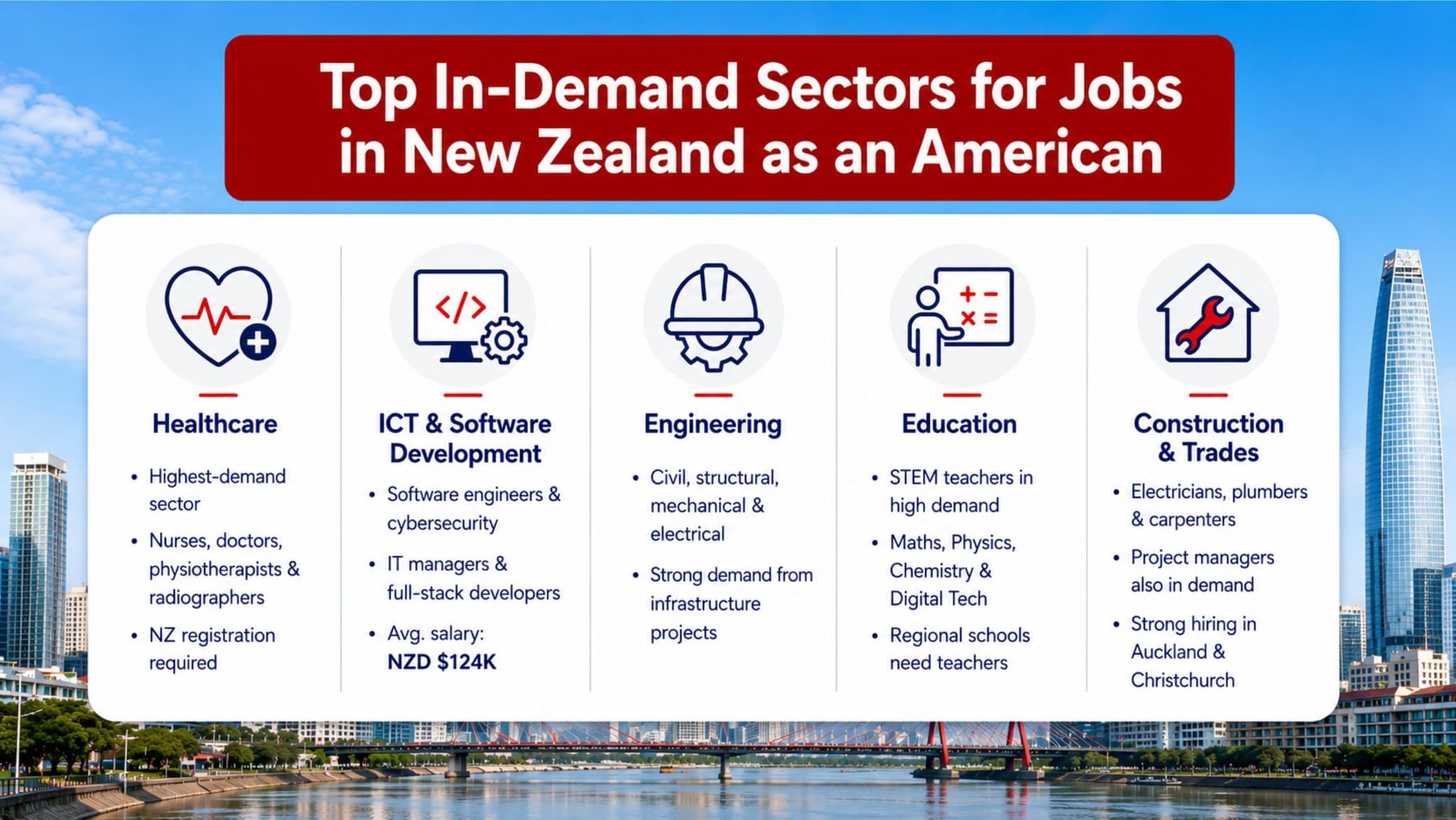
One thing to understand clearly: New Zealand salaries are lower in nominal terms than equivalent US salaries. A software engineer earning $150,000 in the Bay Area might earn NZD $120,000 to $140,000 in Auckland, which at current exchange rates (roughly USD $0.58 per NZD) translates to around USD $70,000 to $80,000. The gap is real.
What partially offsets this: lower healthcare costs, subsidised education, no student loan crisis at the family level, lower crime, and a completely different quality of life. Many Americans take the pay cut consciously and do not regret it. But go in with eyes open.
The main platforms are:
Seek NZ: the dominant job board in New Zealand
Trade Me Jobs: New Zealand's local classifieds/jobs platform
LinkedIn: works well for professional and corporate roles
Careers.govt.nz: government careers and labour market information
For healthcare roles specifically, Health New Zealand's careers site posts roles directly.
Many Americans want to know if they can simply keep working remotely for a US employer while living in New Zealand. The short answer is: sometimes, with caveats.
Visa: A working holiday visa lets you work freely, including remotely, for a US employer. An Accredited Employer Work Visa does not, it ties you to a specific New Zealand employer. Visitor visas prohibit work entirely.Taxes: If you are tax resident in New Zealand and working remotely for a US company, your income may be taxable in New Zealand. This is complex and depends on the structure of your employment and residency status. Get tax advice before assuming remote work from NZ is clean.
New Zealand does not automatically recognise all US degrees and professional credentials. If your occupation requires registration (medicine, nursing, law, engineering, teaching), you need to go through the relevant New Zealand registration body.
For academic credentials, NZQA (New Zealand Qualifications Authority) offers overseas qualification recognition assessments. This tells you how your US degree ranks on the New Zealand Qualifications and Credentials Framework.
Need help with your application or background check?
Contact us now and speak with a dedicated Globeia expert today.

