
By Ayushi Trivedi · Updated September 11, 2026
Reviewed by Vasu Singla
Spain has become favourite relocation destinations for Canadians for many good reasons. The cost of living is lower than in Toronto, Vancouver, or Calgary. The healthcare is good. The weather is not something you have to mentally prepare for. And unlike some European countries, Spain has multiple legal pathways that make long-term residency accessible, whether you're retiring, working remotely, employed by a Spanish company, or investing. Canadians are non-EU nationals, which means there are no shortcuts, no special bilateral agreements, and no option to simply show up and figure it out later. Every long-term stay requires a visa applied for at a Spanish consulate in Canada before you leave and the rules around income thresholds, taxes, and documentation are specific enough.
This guide covers everything you need to move from Canada to Spain. We walk through every visa option available to Canadians with current requirements and updates. Beyond visas, we cover the step-by-step application process from Canada, cost of living, the Spain-Canada tax treaty, healthcare, and the path to permanent residency and citizenship. If you're seriously considering this move, this guide is the starting point.
Yes, Canadians can move to Spain but not the way most people assume. There is no special immigration agreement between Canada and Spain, no fast-track residency program, and no provision that gives Canadians any different standing than other non-EU nationals. What Canada does have is a visa-free relationship with the Schengen Area, which allows Canadians to enter Spain without a visa and stay for up to 90 days within any 180-day period. That's enough for a long vacation.
For anything beyond 90 days, you need a long-stay visa, formally called a Type D visa and it must be obtained before you leave Canada. You cannot enter Spain as a tourist, decide you want to stay, and then apply to convert your status from within the country. The application has to go through a Spanish consulate in Canada, your documents have to be in order before you submit, and you have to wait for approval before boarding a flight with the intention of staying long-term.
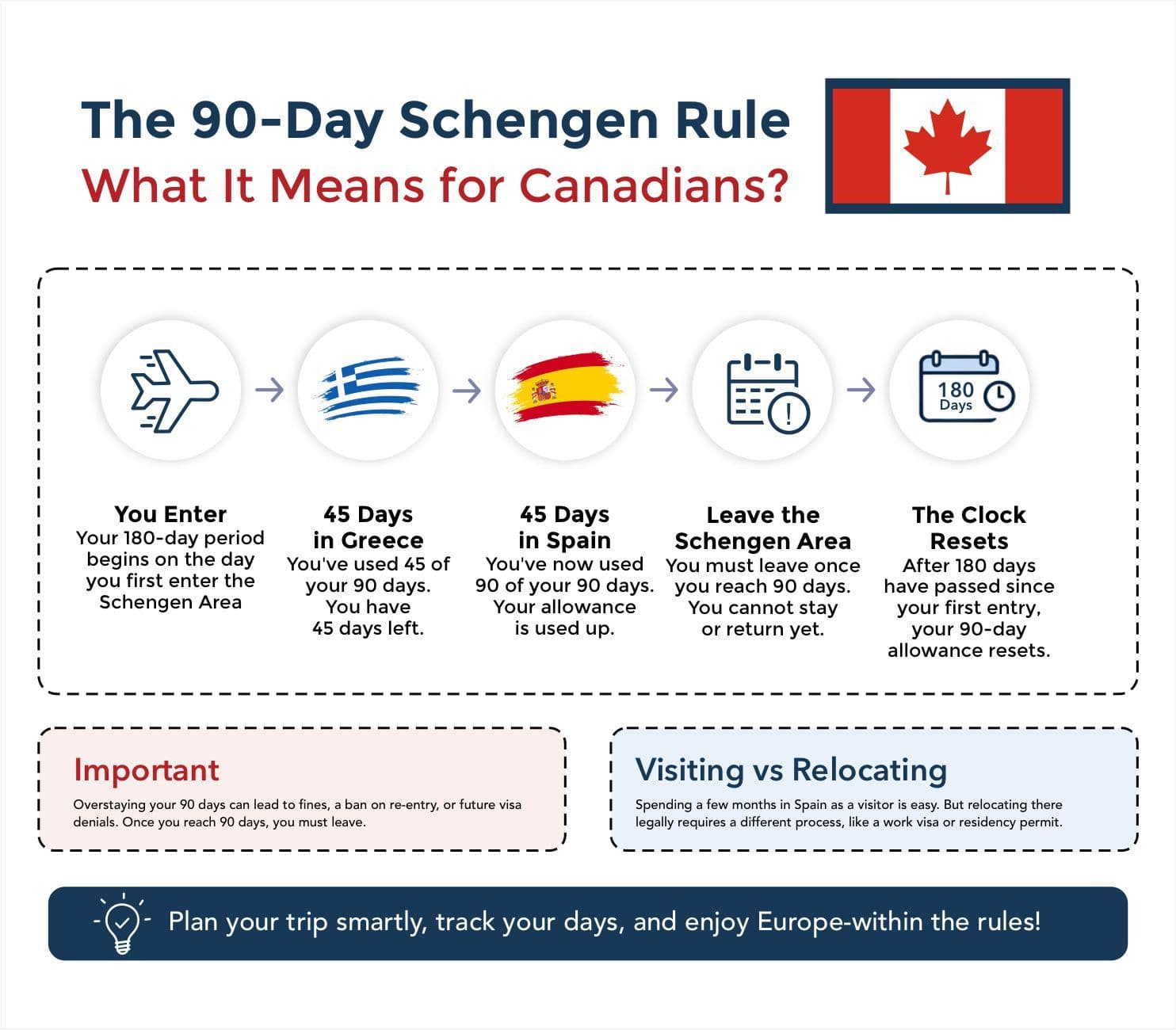
The 90-day limit is a Schengen-wide rule. The Schengen Area includes 29 European countries as of 2025, and the 90 days is calculated across the entire zone, not per country. So if you spend 45 days in Greece and then move to Spain, you have 45 days left in Spain before you've used up your 90-day allowance. The clock resets again after 180 days have passed from your first entry.
Once you reach the 90-day limit, you are required to leave the Schengen Area and cannot return until enough time has passed to reset your allowance. This is where many people run into issues. Spending a few months in Spain is relatively easy; relocating there legally requires a completely different process.
If your goal is to stay in Spain for more than 90 days whether to live, work, retire, or study, you must apply for a long-term visa or residency permit before making the move.
There is no general “move to Spain” visa. Instead, Spain offers several specific residency pathways, each tied to your situation:
Each of these comes with its own eligibility criteria, documentation requirements, and processing timelines.
Once you're on the path to legal residency, the first document you'll hear about constantly is the NIE, which stands for Numero de Identificacion de Extranjero, or Foreigner Identification Number. It's a unique tax identification number assigned to non-Spanish nationals. It is required for almost every significant transaction in Spain like opening a bank account, signing a lease, buying property, registering for healthcare, paying taxes, purchasing a car, and even activating a mobile contract with certain providers.
The NIE is very different from the residence permit. It's an identification number. You can obtain a NIE even as a non-resident. For example, if you're buying property in Spain without intending to live there but for those moving long-term, the NIE is issued as part of the visa and residency process. Once you arrive in Spain on a long-stay visa, you'll apply for your TIE (Tarjeta de Identidad de Extranjero), which is your physical residence card. Your NIE number is printed on it and stays with you permanently. It follows you through every interaction with the Spanish system for as long as you're in the country.
One step that surprises many newcomers is the Empadronamiento - the municipal registration. Within a few weeks of arriving in Spain, you're legally required to register your address with the local town hall (ayuntamiento) of wherever you're living. This applies whether you're renting or own property, whether you're in Madrid or a small village.
The Empadronamiento is also called a padron. It's what proves you actually live where you say you live. It's required to access public healthcare, enroll children in school, apply for certain government services, and eventually as evidence of continuous residence when you apply for permanent residency. The process is straightforward - you bring your passport, your lease or proof of address, and fill out a form at the town hall but it's one of the most important steps that people often delay.
This is the most important section people come looking for. And most guides present there have outdated information.They either list the visas without explaining them, or they cover them so broadly that you finish reading, still unsure which one actually applies to you.
Below is a full breakdown of every visa route available to Canadians. Understanding each visa option will help you sort your future plans of moving.
The Non-Lucrative Visa is the most commonly used route for Canadians who want to live in Spain without working there. It's the go-to option for retirees, people living off investment income, and anyone whose financial situation doesn't depend on earning a Spanish salary. You are not permitted to work in Spain while on this visa. That's the central condition, and Spanish authorities take it seriously.
What are the income requirements for this visa?
For 2026, applicants need to demonstrate a minimum monthly income of approximately €2,400 for a single applicant, with roughly €600 added per additional family member. Always confirm the exact current figures with your consulate before submitting as these numbers shift each year.
What counts as income?
Meeting the financial threshold is not just about the amount - it’s about the type and reliability of income. Spanish consulates look for stable, recurring financial sources, such as pension income, dividends or investment returns, rental income, and substantial long-term savings in some cases. Income that depends on active work such as freelance contracts or remote employment is not considered appropriate under this visa. If your financial situation relies on ongoing work, the Digital Nomad Visa is a better fit.
How does it work?
The NLV is initially granted for one year, renewable for two-year periods. At five years of continuous legal residence, you become eligible for permanent residency.
The 183-Day Rule - A 2025 Change That Affects Renewals
This is a significant change. Under the previous rules, NLV holders could spend extended periods outside Spain - returning to Canada for months at a time without jeopardising their visa status. That flexibility no longer applies to renewals.
What this means practically:
This change does not affect the initial one-year visa grant - only the conditions for renewal. But since renewal is the mechanism through which you build toward five-year permanent residency, meeting the threshold consistently matters from year one.
Few Important Points to Note
Spain's Digital Nomad Visa came into effect in January 2023 under the country's Startup Act, and it was designed for remote workers and freelancers whose income comes from outside Spain. For a significant number of Canadians - especially those in tech, marketing, consulting, or any location-independent field, this is now the most relevant visa on the list. Remote employees must have worked with their employer for at least three months prior to applying.
Up to 20% of your total income can come from Spanish clients. Beyond that, you move outside the DNV framework. For most remote workers this isn't an issue, but freelancers who pick up Spanish clients over time should track this carefully. For qualifying, applicants must demonstrate a minimum income of approximately 200% of Spain’s minimum wage, which in 2026 translates to around €2,849 per month for a single applicant.
Two Ways to Apply
There are two pathways to obtain the DNV, and choosing between them depends on where you are when you apply.
From Canada-Initial Visa
This is the standard route for Canadians applying before they leave. You submit your application at the Spanish consulate in your jurisdiction (Toronto, Montreal, or Vancouver depending on your province), and if approved, you receive a visa valid for one year. This gets you into Spain legally and starts your residency clock. Once in Spain, you exchange this visa for a TIE, your physical residence card.
From within Spain - Residence Authorization
If you're already in Spain on a tourist stay (within your 90-day Schengen allowance), you can apply for the DNV directly through the UGE-CE without going back to Canada. If approved, this is issued as a residence permit for three years. The documentation requirements are the same, and you're working against a 90-day clock while your application is processed.
Processing Times
From the consulate route in Canada, processing takes 4-8weeks after submission, though this varies by consulate and time of year - Vancouver and Montreal tend to move faster than Toronto during peak periods. Factor in an additional two to three months beforehand to gather, apostille, and translate your documents.
Spain's Highly Skilled Professional Visa processed under Spain's Startup Act framework is designed for non-EU nationals who hold advanced qualifications and have secured employment with a Spanish company in a role that demands specialist expertise. For Canadians with backgrounds in engineering, medicine, technology, finance, research, or senior management, this is the most structured pathway into legal residency in Spain.
This visa requires a confirmed job offer from a Spanish employer before you apply. It is not a pathway for those still exploring the job market. If you have that offer in hand, the route is well-defined. This visa has many advantages including competitive processing times and access to Spain's expat tax regime, making it one of the more attractive options for professionals at this stage of their careers.This visa is also the primary route under the EU Blue Card program, which Spain participates in.
Qualifying professions include:
The common thread is that the role must require a level of expertise that cannot be readily filled from within the local labour market. Your employer will need to demonstrate this as part of the application process.
Note: The contract must be full-time, for a minimum duration of one year, and the salary offered must meet the applicable income threshold. Temporary, part-time, or project-based contracts do not qualify.
Income Thresholds
The salary requirement for the Highly Skilled Professional Visa is set at a minimum of 1.5 times the average Spanish gross annual salary. As of 2026, this translates to approximately €40,000 gross per year, though the exact figure is updated annually and varies slightly by sector.
Visa Duration and Renewals
The Highly Skilled Professional Visa is initially granted for the duration of your employment contract, up to a maximum of two years. It is renewable as long as your employment continues and the salary threshold is maintained. At five years of continuous legal residence, you become eligible for long-term residency. At ten years, you may apply for Spanish citizenship.
The EU Blue Card - What It Means for Canadians
Alongside Spain's Highly Skilled Professional Visa, there is a parallel route about - the EU Blue Card. The two are separate permits with overlapping eligibility, and depending on your circumstances, the Blue Card may be the stronger choice.
The EU Blue Card is a standardised high-skilled worker permit introduced by the European Union and adopted by most EU member states, including Spain. It was designed to attract qualified professionals from outside the EU by offering a single permit framework with consistent rights and a degree of mobility across EU countries that standard national work visas do not provide. Where Spain's Highly Skilled Professional Visa is a national permit tied specifically to Spain, the EU Blue Card operates under a broader European framework.
The Mobility Advantage
The most significant practical benefit of the EU Blue Card for Canadians with international career ambitions is intra-EU mobility. After holding an EU Blue Card in Spain for 12+ months - the exact threshold varies by destination country, you become eligible to move to another EU member state to work in a highly skilled role without starting the immigration process from zero.
This means that if your career takes you from Madrid to Berlin, or from Barcelona to Amsterdam, the groundwork you laid in Spain carries forward. You apply under the receiving country's Blue Card framework rather than as a new applicant with no EU residency history. Processing is generally faster and the documentation burden is lighter than a first-time application.
For Canadians who are not certain they want to stay in Spain long-term, this is a meaningful strategic advantage that the standard Highly Skilled Professional Visa does not offer.
Blue Card vs Highly Skilled Professional Visa - Which One Is Right for You
The differences come down to your salary, age, and how certain you are about staying in Spain long-term.
The EU Blue Card can be a better fit earlier in your career, especially if you are a recent graduate or working in a high-demand field.
In these cases, the salary threshold may be reduced, compared to the standard threshold of roughly €40,000+. It also offers greater long-term flexibility, as it is designed to support mobility within the EU, making it a strong option if you may want to work in other European countries in the future.
The Highly Skilled Professional Visa makes more sense if you are fully committed to Spain long-term, if your employer already has an established relationship with Spanish immigration authorities, or if your role and salary clearly meet the standard threshold and EU mobility is not a priority
This particular visa is for Canadians who want to move to Spain and run their own business there. Instead of working remotely for clients outside Spain, but actually operate a business within the Spanish economy. Think of it as the route for someone opening a restaurant in Seville, launching a consulting firm in Madrid, or setting up a small retail operation in Valencia.
This visa is distinct from the Digital Nomad Visa. The DNV is for people whose work happens to be location-independent. The self-employment visa is for people actively building something in Spain.
What you need to demonstrate:
Spanish immigration authorities evaluate the business plan, and there's no fixed checklist that guarantees approval. Working with a Spanish immigration lawyer who understands the economic viability criteria is strongly recommended. Processing times are also longer than most other categories - budget for four to six months minimum.
How long is the visa active?
The self-employment visa is initially granted for one year. During this period, you are expected to establish your business, register as autonomo, and demonstrate that the operation is active. The visa is renewable for two-year periods, provided your business remains operational and you continue to meet the financial requirements. At five years of continuous legal residence, you become eligible for permanent residency.
Income Consideration
Unlike other visa types, the self-employment visa does not have a fixed minimum income requirement. Instead, Spanish authorities assess whether you have sufficient funds to both launch your business and support yourself during its early stages. This means showing startup capital, access to personal savings, and realistic financial projections. While there’s no official threshold, your financial capacity should align with Spain’s cost of living (often comparable to IPREM-based benchmarks). Applications with weak financial backing or overly optimistic projections are less likely to be approved.
Any Canadian enrolling full-time in a program at a Spanish institution that is officially recognised by Spanish educational authorities. This includes public and private universities, accredited language schools, postgraduate programs, and vocational training courses. The institution and program must be formally recognised - enrollment in an unaccredited course does not qualify. It is a legitimate long-term strategy for moving to Spain.
The Student Visa is issued for the duration of your academic program. For programs longer than one year, the visa is renewed annually as long as you remain enrolled and in good academic standing. There is no fixed upper limit tied to the visa itself - a four-year undergraduate degree, for example, would involve an initial visa followed by three annual renewals.
Financial Requirements
You must demonstrate that you can fund your stay in Spain without relying on employment as your primary income source. Spanish consulates look for evidence of at least €700-€900 per month for the duration of your program. Acceptable evidence includes bank statements, proof of a scholarship or institutional funding, parental financial support documentation, or a combination of these.
Working While Studying
Spain updated its student work rules in 2025, with different limits depending on your program. University students (bachelor’s, master’s, PhD) can now work up to 30 hours per week, while language school students remain capped at 20 hours with stricter conditions. Work authorization is not automatic - you must obtain approval through your TIE process before starting any job. While full-time work may be allowed during official holidays, part-time income should not be relied on as your primary financial support for the visa.
After Graduating - The Post-Study Job Search Permit
One of the most valuable features of the Student Visa pathway is what happens after you finish your program. Upon graduating, you are eligible to apply for a 12-month post-study job search authorisation, which allows you to remain legally in Spain while you look for employment. This permit functions similarly to the Job Search Visa covered later in the guide - you cannot work during this period, but you can pursue opportunities, attend interviews, and engage with the Spanish job market from within the country. Once you secure a qualifying job offer, you transition to a standard work authorization, without needing to return to Canada.
Job Search Visa is one of the lesser-known options, as it's relatively new, not all consulates process it with equal familiarity, and it's specifically designed for a narrow use case. But for the right person, it's genuinely useful. Canadians who want to move to Spain before they have a job, without being limited to a 90-day tourist stay. This visa is also available to recent graduates of Spanish universities who want to stay and find work after finishing their studies.
The visa grants a temporary stay of up to 12 months, during which you can legally be in Spain while searching for employment or exploring self-employment options. It does not authorize you to work during this period. Once you secure a job offer, you transition to a standard work visa. One point that often catches applicants off guard is that the 12 months cannot be extended. If you haven't secured a qualifying job offer and initiated the transition to a work visa before your Job Search Visa expires, you are required to leave Spain. There is no grace period and no in-country renewal mechanism.
Requirements
Transitioning to a Work Visa
Securing a job offer during your Job Search Visa period is the goal, and the good news is that the transition to legal work status is handled from within Spain - you do not need to return to Canada to apply for a new visa. The process is a formal modification of your residency status, filed at the local Immigration Office in Spain, or in some cases submitted online.
Step 1: Secure a formal job offer
You need a signed employment contract from a registered Spanish employer. If you entered Spain on the graduate sub-category of the Job Search Visa, the role should align with your field of study. For professionally qualified applicants, the role needs to fall within a skilled occupation relevant to your credentials.
Step 2: Verify your employer's standing
Your employer must be registered with Spain's Social Security system and current on their tax obligations. Most legitimate employers will already meet this requirement, but it is worth confirming before you proceed - the application will stall if the employer's records are not in order.
Step 3: Prepare your documentation
Gather the following before filing:
Step 4: File the status modification
Submit the application to modify your status from job seeker to work at your local Immigration Office or through the online portal. File this before your Job Search Visa expires - submitting in time protects your legal status during the processing period even if a decision hasn't been issued yet.
Step 5: Obtain your TIE
Once your modification is approved, apply for your updated TIE (Tarjeta de Identidad de Extranjero). This is your physical residence and work authorization card and is required before you formally begin employment.
The standard Work Visa is for Canadians who have a confirmed job offer from a Spanish employer and are relocating to Spain specifically for that position. Unlike most other visa routes on this list, the process here is driven primarily by your employer rather than by you. You cannot initiate this application independently - the employer must move first, and their willingness and capacity to navigate Spanish bureaucracy on your behalf is the single most important variable in how smoothly this goes.
How It Works
The process has two distinct stages: employer authorisation and employee visa application.
Stage 1: Employer authorisation
Stage 2: Employee visa application
With the employer authorisation in hand, you apply for your work visa at the Spanish consulate with jurisdiction over your Canadian province. This stage is your responsibility, and the documentation requirements are comprehensive.
This visa is formally known as the Reagrupación Familiar in Spain which allows you to join a family member who is already a legal resident in Spain and live there under their residency status. It is not an independent visa in the traditional sense. Your right to be in Spain is anchored to someone else's legal standing, which creates both advantages and dependencies that are worth understanding clearly before you rely on this route.
For the right family situation, it is one of the more straightforward pathways available and the full work rights it grants from day one make it more flexible than several other options on this list.Who Qualifies - Eligible Family Members
Not all family relationships qualify. Spanish immigration law recognises the following categories for reunification:
How the Process Works
The reunification process has two sequential stages.
Stage 1: Sponsor's application in Spain
Stage 2: Applicant's visa application in Canada
Work Rights
Visa Duration and the Path to Independence
There is a visa pathway to Spain that most guides skip entirely, and for Canadians between 18 and 35 it is often the most practical first move available. Canada and Spain have a bilateral Youth Mobility Agreement under the International Experience Canada (IEC) program, which allows eligible Canadians to live and work in Spain for up to one year on a working holiday visa.
It is faster, cheaper, and lower-barrier than every other long-stay visa on this list. For younger Canadians who want to experience Spain before committing to a longer-term route, or who want to find work and transition to a permanent visa from within the country, it is a useful option that deserves to be on your radar.Who Qualifies
To apply for the Spain Working Holiday Visa, you must:
What It Allows
The Working Holiday Visa allows you to:
Unlike most other visas on this list, there is no restriction on the type of work you can take on. You can work in hospitality, retail, education, an office, or any other field. The visa is open-ended in terms of employment. Processing time can be very fast, sometimes even within a few days or weeks of application.
Two Participations- Up to 24 Months Total
Each Working Holiday Visa is issued as a 12-month permit. The visa itself is not renewable - you cannot extend it once issued. However, under the Spain-Canada Youth Mobility Agreement, Canadians can participate up to twice, meaning you can apply for a second separate visa after completing your first. This gives a combined maximum of 24 months in Spain through the program, though each stint requires a fresh application rather than a single two-year grant.
One Important Limitation
The Working Holiday Visa period does not count toward the five-year continuous legal residence required for permanent residency. Your permanent residency clock starts only when you are on a qualifying long-stay residency permit. Factor this into your planning if long-term residency is your ultimate goal.
Spain's Golden Visa program, formally the Visado de Residencia para Inversores - no longer exists. The program was officially terminated on April 3, 2025, and no new applications have been accepted since that date. If you have encountered guides, immigration websites, or advisers still presenting the Golden Visa as a live option for 2026, that information is outdated.
The decision to end the program was driven primarily by housing affordability concerns. Spain's major cities like Madrid, Barcelona, Valencia, and the Balearic Islands, have experienced sustained pressure on housing supply and rental prices over the past decade. The Golden Visa's real estate route, which allowed residency in exchange for a property purchase of €500,000 or more, was increasingly criticised for channelling foreign capital into already strained housing markets and contributing to price increases that pushed locals out.
The Spanish government under Prime Minister Pedro Sánchez announced the intention to abolish the program in April 2024 and followed through with full termination in April 2025.
What This Means for Existing Golden Visa Holders
If you or a family member already holds a Golden Visa issued before April 3, 2025, your permit remains valid for its current duration and can be renewed under transitional provisions, provided the original investment is maintained and renewal conditions are met. Abolition of the program applies to new applicants only - it does not retroactively cancel existing permits.
If you are an existing holder approaching renewal, it is strongly recommended to work with a Spanish immigration lawyer to confirm your specific transitional rights, as the details of the transitional framework continue to be clarified through administrative guidance.
Below section we will cover all eight routes that are available to Indians, in the depth you actually need to make an informed decision.
The Digital Nomad Visa (DNV), came into force under Spain's 2023 Startup Act . It was created to solve a very specific problem for thousands of remote workers who were already living in Spain on tourist stays, working for foreign companies, and existing in a legal grey zone. The DNV formalised this, gave it a legal structure, and made Spain one of the first major EU countries to have a dedicated remote work visa.
For Indians, a large percentage of work in technology, consulting, and digital services for US, UK, or European employers- this visa arrived at exactly the right moment.
Getting the DNV approved comes down to satisfying three conditions clearly and completely:
Condition 1: You work remotely for a company or clients based outside Spain.
You must be employed by a foreign company or working as a freelancer serving clients based outside Spain. If you are employed, your employer must have been operating for at least one year. You can work for Spanish companies or clients, but only up to 20% of your total income can come from Spanish sources, the remaining 80% must come from abroad.
Condition 2: You meet the income threshold.
The minimum income requirement is set at 200% of Spain's Minimum Interprofessional Wage (SMI). Based on the 2025 SMI, approximately €2,849 per month. If you bring family members, the threshold increases- an additional 75% of SMI for a spouse or partner, and 25% of SMI for each dependent child. These are minimum figures; consulate officers often look more favourably on applications that demonstrate income comfortably above the threshold.
Condition 3: You have no criminal record and valid health insurance.
A clean criminal record certificate from India and private health insurance covering Spain are mandatory. The health insurance must cover the full duration of your initial stay.
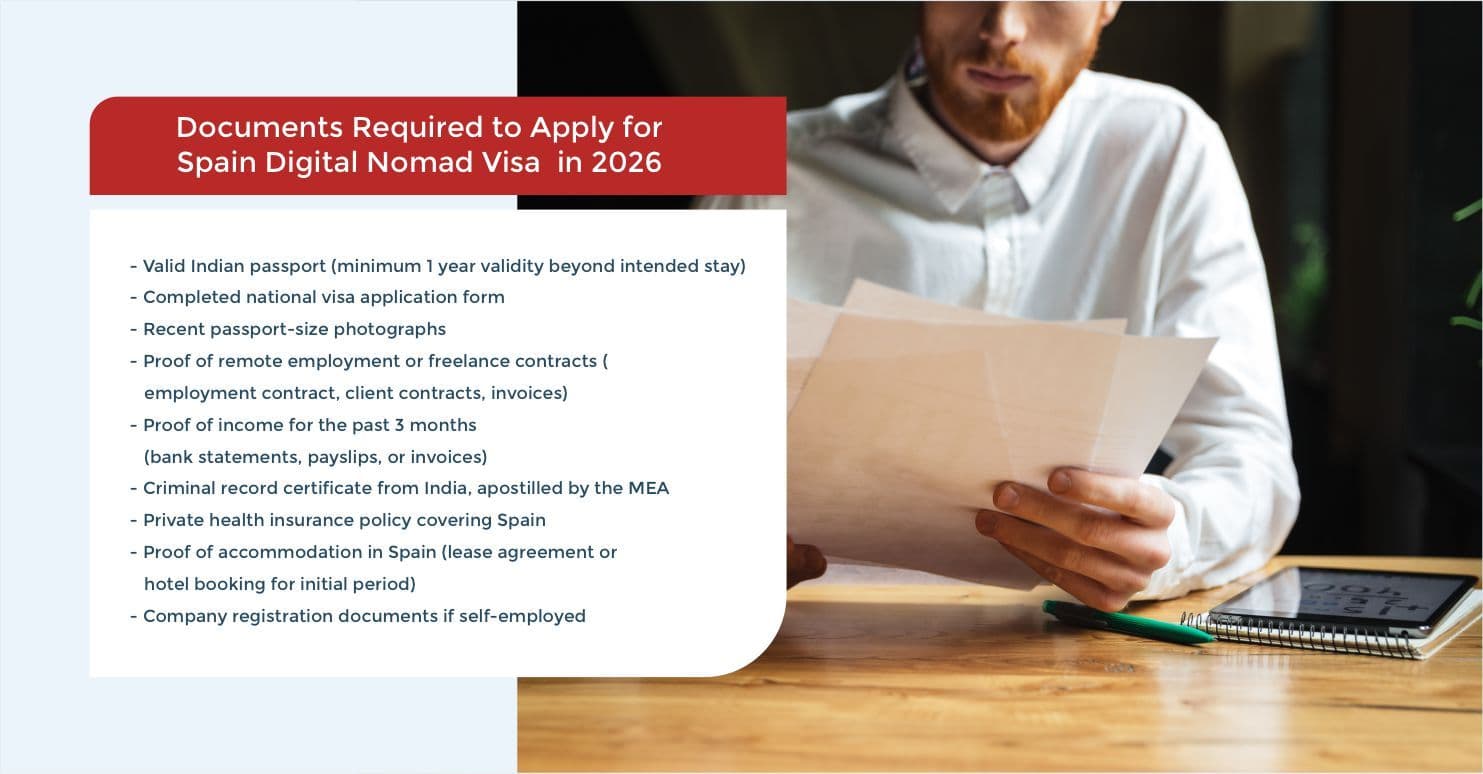
The DNV is applied for at the Spanish Consulate General in your jurisdiction in India- New Delhi, Mumbai, Chennai, or whichever consulate covers your home state. You apply before travelling to Spain, not from within Spain.
Core documents required:
Processing time: 2 to 4 weeks from a Spanish consulate in India, though appointment wait times at busy consulates like Mumbai and New Delhi can push the overall timeline to 6-10 weeks. Apply well in advance.
The DNV is initially granted for 1 year. Once in Spain, you apply for your TIE within 30 days of arrival. After the first year, you can renew for a 2-year period, then renew again for another 2 years. After 5 years of continuous legal residence in Spain, you become eligible for long-term EU residency. After 10 years, Spanish citizenship.
Yes. The DNV includes family reunification from the outset like your spouse or civil partner and dependent children can apply alongside you or join you later. Family members on the DNV are permitted to work in Spain, which is an advantage over some other visa categories.
DNV holders who are newly arriving in Spain may qualify for Spain's Beckham Law, which allows qualifying new residents to pay a flat 24% tax rate on Spanish-sourced income up to €600,000 for the first 6 years, rather than the standard progressive rates which go up to 47%.
The standard Spanish work visa is employer-sponsored. This means a Spanish company must not only offer you a job but must go through a formal government process to hire you. It is not the fastest or easiest route, but for Indians who secure a role with a Spanish employer, it is the most common path into the Spanish job market.
Before a Spanish employer can hire a non-EU national, they must demonstrate that no qualified Spanish or EU/EEA candidate was available for the role. This involves advertising the position through Spain's public employment service (SEPE) and waiting for a defined period.
This is important for Indians in skilled roles, the labour market test is waived for occupations on Spain's official shortage list. This list includes certain engineering specialties, data science and AI roles, specific healthcare positions, and other technical profiles where Spain has documented shortages. If your occupation is on the shortage list, your employer can hire you without going through the full labour market test, which speeds up the process.
The employer, not the candidate, initiates most of the work permit process in Spain. Your employer files the application with the regional immigration authority in the province where you will work. The employer must demonstrate financial solvency- proof that they can sustain the salary they are offering and provide the employment contract, company registration details, and evidence of the job offer.
Once the work permit is approved on the Spanish side, the file is transferred to the Spanish consulate in India, where you apply for the actual visa. The entire employer-side process takes 2 to 4 months before it reaches the consulate stage.
What You Need to Prepare in India
Degree recognition is a separate process worth understanding. For regulated professions like medicine, nursing, law, architecture, teaching, your Indian degree must be formally recognised by the Spanish Ministry of Education before you can practise. This process can take 6 to 18 months and should be initiated well before your visa application. For non-regulated professions (IT, finance, consulting, marketing), formal homologación is generally not required, though employers may ask for transcript evaluations.
Salary and Duration the work visa is initially granted for 1 year, it is renewable. Your salary must meet or exceed Spain's minimum wage (SMI) around €1,221 /month, most skilled professional roles pay above this. After 5 years of legal residence, you qualify for long-term EU residency.
If you are a freelancer working for clients based outside Spain, the DNV is your route. If you want to set up a freelance practice or small business in Spain and serve Spanish clients or if you want to register as autónomo (self-employed) in Spain and operate within the Spanish economy, the Autónomo visa/ Self-employment visa is what applies.
For Indian entrepreneurs who want to physically establish a business in Spain, hire local staff, or build a client base within Spain, this is the correct visa category.
What Spain Requires You to Prove
This visa has no single income threshold the way the DNV does. Instead, you must demonstrate economic viability through a business plan and financial projections. The Spanish consulate and immigration authority evaluate whether your proposed business or freelance activity is commercially credible, whether you have sufficient funds to sustain yourself while building it, and whether your activity is legal and registered in Spain. Key requirements:
Important Note for Indians to Know
Once registered as autónomo in Spain, you are required to pay monthly Social Security contributions regardless of your income level in the early months. Spain has a progressive contribution system for autónomos based on actual income. Lower-earning autónomos pay lower contributions. New autónomos also benefit from a flat rate for the first 12 months, which is approx €80/month- before moving to the income-based contribution system.
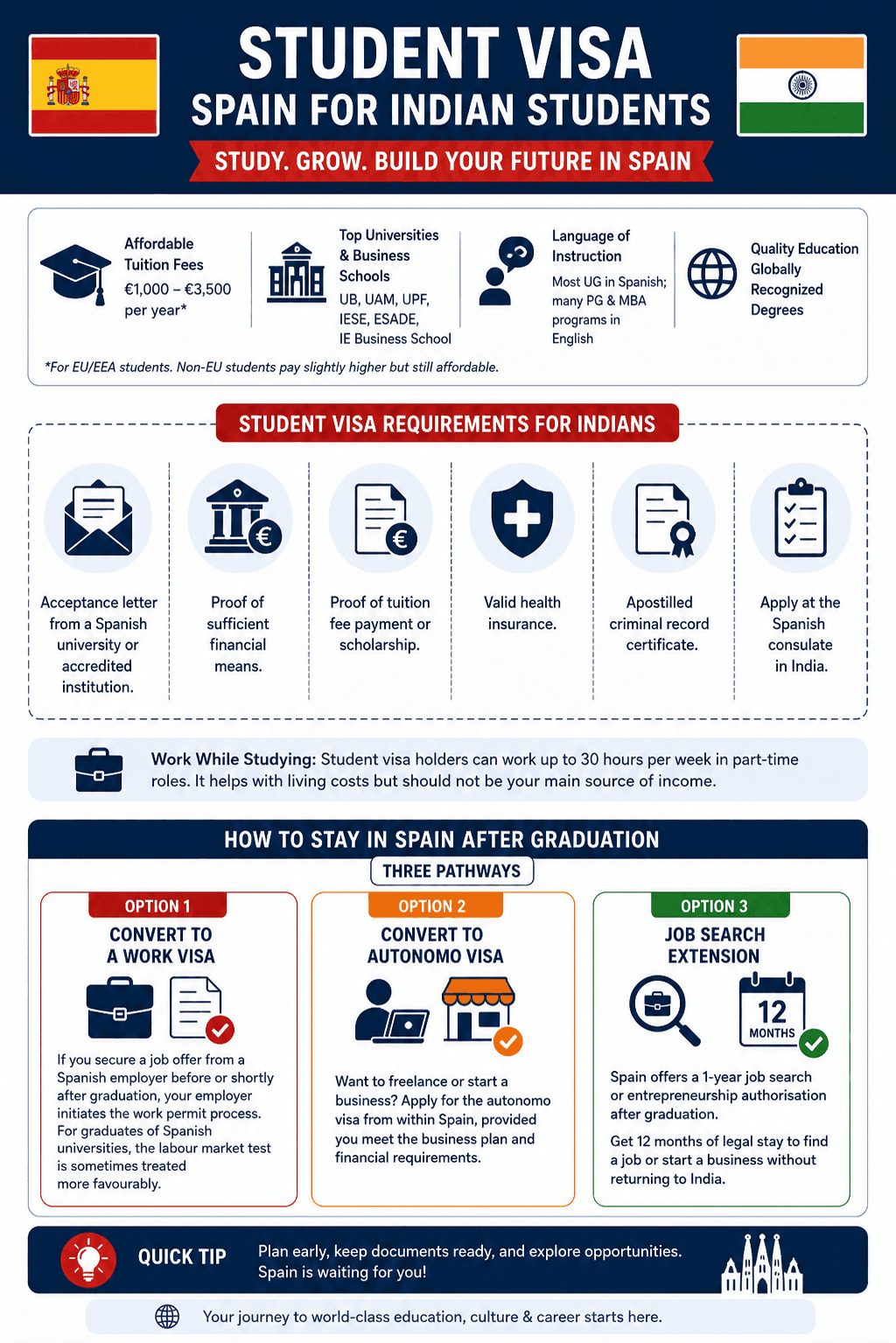
Spain is underrated as a study destination for Indians. Tuition fees at Spanish public universities are substantially lower than UK, Australian, or US institutions. Typically between €1,000 and €3,500 per year for EU/EEA students and somewhat higher for non-EU students, but still more affordable than comparable destinations. Spain has several globally ranked universities, including Universidad de Barcelona, Universidad Autónoma de Madrid, and Universidad Pompeu Fabra, as well as strong private business schools like IESE, ESADE, and IE Business School- the latter two being well-regarded for MBA programs and actively recruiting Indian students.
But language of instruction matters, most undergraduate programs are in Spanish, while postgraduate programs like MBAs, engineering master's degrees, and data science programs increasingly offer full English-medium instruction.
Student Visa Requirements for Indians
The student visa is applied for at the Spanish consulate in India. You must have:
The student visa does not automatically permit full-time work. Student visa holders in Spain can work up to 30 hours per week in part-time roles, which is useful for supplementing living costs but should not be relied on as a primary income source.
There are three pathways:
This visa is for people who want to live in Spain full-time without working in the Spanish economy. It is the right visa if you have sufficient savings, a pension, rental income from Indian properties, dividend income, or any other passive income stream that can sustain your life in Spain without employment. It is popular among:
The critical restriction: NLV holders cannot work in Spain- not for a Spanish employer, not as autonomo, not remotely for a foreign company. Violating this condition is treated seriously and can jeopardise your entire residency. If there is any chance you will work during your stay in Spain, then NLV is not your visa.
Income Requirements
The NLV income threshold is based on Spain's IPREM (Public Income Indicator for Multiple Effects). The main applicant must demonstrate passive income of at least 400% of the monthly IPREM which is approximately €2,400 per month (€28,800 annually) for a single applicant. For each additional family member, you must demonstrate an additional 100% of the monthly IPREM (approximately €600/month per person).
These funds must be demonstrated through bank statements, pension documents, investment portfolio statements, or rental income documentation- all covering the previous 6 to 12 months.
Practical Considerations for Indians
Spanish consulates want to see recurring income, not just a large bank balance. If your income comes from Indian fixed deposits, property rental in India, or stock dividends, you will need to document these clearly and have them translated by a sworn translator.
The NLV is initially granted for 1 year, renewable for 2-year periods. After 5 years, you can apply for long-term EU residency but note that during this time you still cannot work, which is a constraint for those who are not fully retired.
The EU Blue Card is a pan-European work permit designed specifically for highly qualified non-EU professionals. It is employer-sponsored, like the standard work visa, but comes with better conditions like a faster processing track, higher mobility rights within the EU, and a faster path to long-term EU residency.
For Indian professionals who qualify, it is often a superior option to the standard work visa and worth requesting from a Spanish employer.
Qualification Requirements
To qualify for the EU Blue Card in Spain, you must meet all three of the following conditions:
1. Higher education qualification: A university degree or equivalent professional qualification requiring at least three years of full-time study. Indian bachelor's degrees (B.Tech, MBBS, CA, MBA) generally qualify, but your specific degree may need to be evaluated for equivalence.
2. A valid employment contract or binding job offer for at least one year with a Spanish employer.3. A salary threshold: Your gross annual salary must be at least 1.5 times the average gross annual salary in Spain. The average gross annual salary in Spain is approximately €27,000 - €29,000, meaning the Blue Card salary threshold is roughly €40,000 - €43,500 gross annually.A feature of the EU Blue Card that standard Spanish work visas do not offer is EU mobility. After 18 months of holding a Blue Card in Spain, you can move to another EU member state for work without going through a full new immigration process from scratch. For Indian professionals whose career ambitions extend beyond Spain to Germany, the Netherlands, or elsewhere in the EU, this is a meaningful long-term advantage.
Path to Long-Term Residency
EU Blue Card holders in Spain qualify for long-term EU residency after 5 years of legal residence in EU member states but the calculation can include time spent in other EU countries on a Blue Card, not just Spain. This makes the Blue Card advantageous for internationally mobile professionals.
Intra-Company Transfer Visa
If you are an Indian professional currently employed by a multinational company like an IT services firm, a consulting company, a bank, a technology company and your employer is transferring you to their Spanish office or a client engagement in Spain, then this Intra-Company Transfer visa is your route.
This is the most common pathways for Indian IT professionals entering Spain, given the large number of Indian IT services companies (TCS, Infosys, Wipro, HCL, Tech Mahindra and others) with operations and client engagements in Spain, as well as multinational companies with offices in both India and Spain.
Requirements and Process
The ICT visa requires that:
You have been employed by the company (or within the same corporate group) for at least 3 months prior to the transfer.
The transfer is for a specific professional purpose: manager, specialist, or trainee.Your salary in Spain meets or exceeds the equivalent role's market rate in Spain.The transfer is for a defined period.Your application is initiated by the Spanish entity of your employer and your company's Spanish office files the transfer request with Spanish immigration authorities. Processing is faster than a standard work visa, and many large multinationals have dedicated HR or immigration teams that manage this process routinely.
Duration and Renewal
This visa is granted for the duration of the assignment, up to a maximum of 3 years for managers and specialists and 1 year for trainees. It is renewable if the assignment continues. Time spent in Spain on an ICT visa counts toward the 5-year long-term residency requirement, which is important if you are considering making Spain a longer-term base beyond your initial assignment.
Family reunification in Spain is not a standalone visa category. It is a residency authorization that the primary visa holder, already legally resident in Spain, applies for on behalf of their family from within Spain. Once approved, the family member then applies for the reunification visa at the Spanish consulate in India. This two-stage process- Spain approval first, India consulate application second. You cannot simply bring your family on your visa. The process must be formally initiated and completed before they travel.
Who Qualifies
Can the Spouse Work?
Yes and this is something many guides get wrong. A spouse admitted under family reunification receives a TIE that includes full work authorization. This allows them to work in Spain both as an employee and as a self-employed professional without needing a separate work permit. For dual-income families, this is a financial advantage.
Timeline and Duration
The process takes 4-6 months, involving a 1-3 month authorization in Spain by the sponsor, followed by a 4-8 week visa application by the family in India at BLS International. Family reunification visas for Indians in Spain are granted for 1 year initially, matching the sponsor's residency, and are renewable for up to 4 more years.
Indian Documents Needed
Marriage certificate, spouse's birth certificate, children's birth certificates, spouse's police clearance certificate (Criminal Record Check), and adoption documents if applicable. Allow 4 to 8 weeks for the apostille process in India before the consulate stage.
Children's Rights in Spain
Children admitted under family reunification have full access to free public education and public healthcare in Spain from the moment their TIE is issued, the same rights as Spanish children.
This is the section where most guides currently circulating on the internet are out of date, and it matters. Spain's real estate-based Golden Visa which previously allowed non-EU nationals to obtain residency by purchasing Spanish property worth at least €500,000 was officially abolished in April 2025. The Spanish government announced the closure of this route citing housing affordability concerns.
Indian investors who were planning to use the property route must note that this option no longer exists as of April 2025. Applications that were submitted before the closure deadline were processed, but no new property-based Golden Visa applications are being accepted.
The checklist below covers what you need to submit a Spanish long-stay visa application from Canada. Most documents are common to every application. Where a document applies only to a specific visa or set of visas, that is noted in brackets.
Identity and Travel Documents
Application Forms
Financial Proof
Health Insurance
Criminal Record Checks
Medical Certificate
Employment and Professional Documents
Academic and Professional Qualifications
Student-Specific Documents
Business Documents
Family Reunification Documents
Apostille and Translation Requirements
Additional Notes

The Spanish visa application process is not that complicated if you know the process, thousands of Canadians complete it every year. This section walks you through the process from start to finish so you know exactly what to expect.
Spain does not have a single consulate that processes all Canadian applications. Your application must go through the consulate that has jurisdiction over the province where you currently live.
| Province / Territory | Spanish Consulate |
| Ontario | Consulate General of Spain - Toronto |
| Quebec, New Brunswick, PEI, Newfoundland and Labrador | Consulate General of Spain - Montrea |
| British Columbia, Alberta, Saskatchewan, Manitoba, Yukon, NWT, Nunavut | Consulate General of Spain - Vancouver |
If you live in a province and apply at the wrong consulate, your application will be rejected on procedural grounds regardless of how complete your documents are. Verify your jurisdiction on the consulate's website before you do anything else.
Every Spanish consulate in Canada requires an in-person appointment to submit a long-stay visa application. You cannot drop off documents without one, and you cannot submit by mail for most visa categories.
Appointment availability at Canadian consulates, especially at Toronto and Vancouver can be extremely limited. During peak periods, waits of six to ten weeks for an available slot are not unusual. This is one of the most common reasons Canadians miss their intended move date.
Book your appointment as early as possible. Ideally as soon as you've decided on your visa category and before you've fully assembled your documents. You can always continue gathering paperwork while you wait for the appointment date. What you cannot do is recover lost weeks because you waited until your documents were ready before looking at the calendar.
The documents required depend on which visa category you are applying for. Refer to the Documents Every Canadian Needs to Move to Spain section of this guide. It covers the core checklist that applies to all categories, plus the visa-specific additions for each route.
One timing note that applies regardless of visa type: apostilling and translating your documents is the step that takes long and surprises most applicants. Build at least 6-8 weeks into your timeline for this stage alone before your intended consulate appointment date.
This is the step that surprises most first-time applicants and causes the delays. Spain requires that official Canadian documents - criminal record checks, birth certificates, marriage certificates, and sometimes even medical certificates to be authenticated through an apostille before they are accepted.
An apostille is a standardized international certification under the Hague Convention that verifies the authenticity of a document for use in another member country. Canada and Spain are both signatories, which means apostilles are the accepted method, not embassy legalization.
How to get an apostille in Canada?
Global Affairs Canada is the designated apostille authority for federal documents like RCMP background checks. Provincial documents like birth certificates, marriage certificates, provincial criminal record checks, are apostilled by the relevant provincial authority, the provincial government's authentication office.
Some provincial documents, those issued or notarized in Manitoba, New Brunswick, Newfoundland and Labrador, Northwest Territories, Nova Scotia, Nunavut, Prince Edward Island, and Yukon, might also need to be sent to Global Affairs Canada for authentication, depending on the type of document and the requirements of the country where it will be used.
Translation requirements
Spanish consulates require certified Spanish translations for most supporting documents, even when the originals are in English. This applies to your medical certificate, criminal background checks, academic qualifications, and any other supporting documents in your application. Quebec residents whose documents are in French face the same requirement. Translations must be completed by a sworn translator (traductor jurado). General translation services are not accepted. Confirm the full list of documents requiring translation with your specific consulate before submitting.
On the day of your appointment, bring every document in the order specified by the consulate - originals and photocopies of everything. Spanish consulates are specific about how documents are organized and presented. Check the consulate's instructions carefully the week before your appointment.
At the appointment, a consular officer will review your documents, take your biometrics if required, and collect the visa application fee. You will not receive a decision on the day. Your application goes into processing.
Once your application is submitted, it moves into the consulate’s review process. At this stage, all you can do is wait. Processing times are not fixed. They vary by visa type, consulate workload, time of year, and how complete your application is. Some categories move faster than others, but even within the same visa type, two applications submitted weeks apart can have very different timelines.
The single biggest factor you control is document quality. If anything is missing, expired, or unclear, the consulate may request additional documents and that can delay your application. The practical approach is to build buffer time into your plans.
When your visa is approved, the consulate will notify you to come in and collect your passport with the visa. Read it carefully before you leave - check the validity dates, the number of entries authorized, and your name spelling.
Your visa is valid for 90 days from the issue date, within which you must enter Spain. Once you enter, you have 30 days to begin the in-country process of formalizing your residency.
This is where the process continues, not ends. Arriving with a visa is not the finish line - it's the starting line for your Spanish residency. Here's what needs to happen within your first month:
Register your address (Empadronamiento)
Go to your local town hall (ayuntamiento) with your passport, visa, and proof of address (your lease or property deed). This is a mandatory step. Do it in the first two weeks - almost everything else depends on it.
Apply for your TIE card
The “Tarjeta de Identidad de Extranjero” is your physical residency card. It contains your NIE number and serves as your primary identification document in Spain. Applications are submitted at the Oficina de Extranjeria (foreigner's office). Appointments can be booked online through the Spanish government's appointment system. Bring your passport, visa, Empadronamiento certificate, passport photos, and the relevant application form.
Register with Social Security (if applicable)
If you're on the DNV or a work visa, register with Spain's Social Security system as soon as possible. For DNV holders, this triggers the six-month window to apply for the Beckham Law tax regime - a deadline that cannot be extended.
Open a Spanish bank account
Most major Spanish banks like BBVA, Santander, CaixaBank, Sabadell, will open an account for a legal resident with a valid passport, NIE, and Empadronamiento certificate. Online banks are easier to open initially and can bridge the gap while you get established.
The consulate jurisdiction table tells you where to send your application. What it doesn't tell you is that applying from Toronto is a meaningfully different experience from applying from Vancouver or Montreal. Appointment availability, apostille authorities, provincial criminal record check processes, and translation expectations all vary enough to affect your timeline and preparation. This section breaks down what that looks like province by province.
Consulate: Consulate General of Spain, Toronto. The Toronto consulate handles the largest application volume in Canada and consistently has the longest appointment wait times as a result. During peak periods between January through April and September through October, waits of 8-12 weeks for an available slot are not unusual. This is the single biggest timeline risk for Ontario applicants. Book your appointment the moment you have decided on your visa category, before your documents are fully assembled.
Provincial criminal record check: Obtained through the Ontario Provincial Police (OPP) or a local police service. Must be apostilled before submission to the Spanish consulate.
Apostille authority for Ontario documents: The Ontario Ministry of Public and Business Service Delivery, located at 222 Jarvis Street, Toronto. Ontario has its own designated apostille authority - provincial documents do not go through Global Affairs Canada. Federal documents like RCMP background checks always go through Global Affairs Canada regardless of province.
Translation: The Toronto consulate applies strict translation requirements. Assume all supporting documents in English require certified Spanish translation by a sworn translator (traductor jurado), including medical certificates, criminal background checks, and academic qualifications. Confirm the current list with the consulate before submitting - requirements can shift.
Practical timeline for Ontario applicants: Allow 2 to 4 weeks for the Ontario apostille process on provincial documents, plus 8-14 n weeks for Global Affairs Canada to process the RCMP apostille. Combined with the appointment wait, Ontario applicants should plan for a minimum of 4-5 months of total preparation time before their target move date.
Consulate: Consulate General of Spain, Vancouver
Covers: British Columbia, Alberta, Saskatchewan, Manitoba, Yukon, Northwest Territories, Nunavut
The Vancouver consulate generally moves faster than Toronto on appointment availability. Wait times are typically 4-6 weeks, and processing after submission tends to sit at the lower end of the 4-8 week range for most visa categories.Consulate: Consulate General of Spain, Montreal
Covers: Quebec, New Brunswick, Nova Scotia, Prince Edward Island, Newfoundland and Labrador
The Montreal consulate serves a large geographic area but lower overall volume than Toronto. Appointment wait times are generally 4- 6 weeks. Processing after submission is comparable to Vancouver.This is where most applicants get confused. Your consulate jurisdiction and your apostille authority are two different things determined by two different criteria.
| Province / Territory | Consulate | Apostille Authority |
| Ontario | Toronto | Ontario Ministry of Public and Business Service Delivery |
| British Columbia | Vancouver | BC Ministry of Attorney General |
| Alberta | Vancouver | Alberta Ministry of Justice |
| Saskatchewan | Vancouver | Saskatchewan Ministry of Justice |
| Quebec | Montreal | Ministère de la Justice du Québec |
| Manitoba | Vancouver | Global Affairs Canada |
| Nova Scotia | Montreal | Global Affairs Canada |
| New Brunswick | Montreal | Global Affairs Canada |
| PEI | Montreal | Global Affairs Canada |
| Newfoundland and Labrador | Montreal | Global Affairs Canada |
| Yukon | Vancouver | Global Affairs Canada |
| Northwest Territories | Vancouver | Global Affairs Canada |
| Nunavut | Vancouver | Global Affairs Canada |
| Federal documents (all provinces) | Your jurisdiction | Global Affairs Canada |
Key rule: Your consulate is determined by where you currently live. Your apostille authority is determined by where the document was issued, not where you live now. If you were born in Manitoba but live in Ontario, your Ontario documents go to the Ontario apostille authority and your Manitoba documents go to Global Affairs Canada.
These are the errors that come up repeatedly and most are avoidable with a bit of planning:
This is one of the most searched questions people find answers for. The reality is that rejections happen, they are not always the applicant's fault, and knowing what comes next before you apply is more useful than finding out under pressure.
There can be multiple reasons as to why your application was rejected like insufficient income documentation, incomplete apostille, health insurance that does not meet requirements, or eligibility criteria not met for the visa category applied for.Can you reapply?
Is there an appeal process?
One of the main reasons Canadians consider moving to Spain is the cost of living. Spain is more affordable than major Canadian cities but the difference depends heavily on where you choose to live and how you structure your lifestyle. Rent, dining, transportation, and everyday services are where the biggest savings show up. Where you land on the spectrum depends on the city you choose.
These figures cover rent, groceries, dining, transport, and day-to-day expenses for one person. They do not include private health insurance premiums, which are a required ongoing cost for most visa holders, or one-time setup costs like rental deposits and relocation expenses.
A few categories where Spain surprises people on the upside:
Spain is not cheap in the way that some destinations are marketed as cheap. It is a developed Western European country with good infrastructure, strong healthcare, and a high standard of living. The affordability is relative and for Canadians, the comparison is favourable across almost every spending category that matters in daily life.
The cost of living section gives you the numbers. This section gives you the reality of what it takes to actually secure a place to live as a Canadian without a Spanish employment history, a local credit record, or anyone in the country who can vouch for you.
Renting in Spain is harder than the headline figures suggest. Not impossible, Canadians do it every month but the process is different enough from Canada that going in unprepared wastes time and money.
How the rental market actually works
Spain's rental market runs heavily through agencies and platforms like Idealista, Fotocasa, and Habitaclia. Unlike Canada where a completed application and first and last month's rent closes a rental, Spanish landlords have more flexibility in what they can require from tenants - particularly foreign tenants with no local financial footprint.
Standard requirements in most cities: one to two months deposit (legally capped at two months for residential rentals under Spain's Urban Leasing Law), plus the first month's rent upfront. So budget three months of rent in cash before you land.
Non-standard requirements you will encounter as a foreign national: proof of income at three to four times the monthly rent, a Spanish guarantor (aval), or a bank guarantee (aval bancario) from a Spanish bank. If you cannot provide a local guarantor and most Canadians arriving for the first time cannot then landlords often ask for additional months of rent upfront, sometimes three to six, held as additional security.
This is not illegal. It is the market reality for anyone arriving without a local financial history, and it is the detail most relocation guides leave out.
Short-term first, long-term second
The practical approach most successful Canadian movers take is to arrive with a month or two of short-term accommodation already booked - a furnished apartment on Airbnb or a serviced flat and spend that time physically looking for a long-term rental. Trying to secure a long-term lease from Canada before you have an NIE, a Spanish bank account, or the ability to meet a landlord in person is possible but significantly harder.
Once you are on the ground with your Empadronamiento in hand, a Spanish bank account open, and a TIE application submitted, you look considerably more like a tenant a landlord will accept.
Madrid and Barcelona
Both cities have extremely tight rental markets. Vacancy rates in desirable central neighbourhoods are low and competition is high. Budget at the upper end of the ranges in the cost of living section and be prepared to move quickly when you find something suitable. Landlords in these cities receive multiple applications for good properties within days.
Valencia, Seville, Malaga
More inventory, less competition, faster processes. These cities are where the math of moving to Spain works most clearly - lower rents, more negotiating room, and landlords who are more accustomed to dealing with foreign tenants given the established expat communities.
What to know about the lease
Spanish residential leases are signed for one year with automatic annual renewals up to five years under current legislation. The landlord cannot terminate within that period without legally defined cause. You can terminate with 30 days notice after the first six months. Read the lease before signing - if it is in Spanish and you are not fluent, pay for a translation. The legally binding version is the Spanish one regardless of any English summary provided.
Most people don’t think about taxes until something goes wrong and by that point, it’s usually too late and very expensive to fix. The financial consequences of getting your tax situation wrong when moving from Canada to Spain can be significant in both directions. You could end up double-taxed on income you shouldn't be. You could trigger penalties in Spain for assets you didn't know you had to declare. Or you could leave Canada without properly severing your tax residency and spend years filing returns in both countries unnecessarily. This section covers what you actually need to understand.
The moment you spend more than 183 days in Spain in a calendar year, you are considered a Spanish tax resident - regardless of your visa type, your nationality, or where your income comes from.
Spanish tax residents are taxed on their worldwide income. That means income from Canadian pensions, rental properties in Canada, investment accounts, and any other source outside Spain is all potentially subject to Spanish tax once you cross that 183-day threshold. This is the part that surprises most newcomers and it's why understanding the Spain-Canada Tax Treaty matters.
Canada and Spain have a tax treaty, formally the Convention Between Canada and Spain for the Avoidance of Double Taxation. This treaty determines which country has the right to tax specific types of income when you're a resident of one and earning from the other. The core principle is that you shouldn't be taxed twice on the same income.
In practical terms, here's how the main income types are treated:
Employment income
Canadian pensions- CPP, OAS, and workplace pensions
RRSP and RRIF withdrawals
Rental income from Canadian property
Dividends and interest
If you are moving to Spain to work whether for a Spanish employer, as a remote worker, or as a highly skilled professional, there is one tax benefit before you arrive. Spain offers a special tax regime for qualifying foreign workers that significantly reduces what you pay in income tax for your first six years of residency. It is commonly called the Beckham Law.
What It Does
Beyond the income tax rate, the Beckham Law carries three additional advantages that are:
Who Qualifies ?
Canadians who qualify include remote workers employed by foreign companies (including most Digital Nomad Visa holders), employees relocated to Spain by an international employer, and highly skilled professionals hired by Spanish companies (including EU Blue Card holders). The regime also applies to approved entrepreneurs and startup founders, as well as individuals working in research, development, or training roles where a significant portion of income comes from these activities. In many cases, accompanying family members can also benefit under the same framework, subject to meeting the relevant conditions.
The Six-Month Window - Do Not Miss It
It is important to understand what is needed before you leave Canada. Getting your Spanish visa sorted is half the job. Leaving Canada correctly is the other half.
In the year you leave Canada, you file a single tax return known as a departure return. This is your final return as a Canadian tax resident. It reports your worldwide income from January 1 up to your departure date. After that point, you are generally taxed as a non-resident, meaning Canada only taxes certain Canadian-source income (such as rental income or investment income).
Your departure date is not simply when you board a flight. It is typically the date you sever significant residential ties with Canada and establish them elsewhere. This includes factors like giving up your home, relocating your spouse or dependents, and establishing a primary residence abroad.
The Deemed Disposition
On your departure date, the CRA treats you as having sold most of your assets at fair market value. This is called the deemed disposition, and it can trigger capital gains tax on unrealised gains - even though you haven't actually sold anything.
Assets subject to deemed disposition include non-registered investment accounts, shares in private companies, rental properties, and most foreign assets. Assets generally exempt include your principal residence (up to the applicable exemption), RRSPs, RRIFs, and TFSAs.
If you have a non-registered investment portfolio that has grown significantly, calculate your potential deemed disposition exposure before you set a departure date. In some cases, it makes sense to crystallise gains or losses in the year before departure to manage the tax impact. This is one of the most compelling reasons to work with a cross-border tax adviser before you leave, not after.
If you are uncertain whether you have truly severed Canadian tax residency, you can file an NR73 (for individuals who have already left Canada) or NR74 (for those planning to leave) with the CRA. These forms ask the CRA to make a formal determination of your residency status based on your specific circumstances.
Filing an NR73 or NR74 is not required, but it provides certainty and has value when the alternative is years of ambiguity about whether you owe Canadian taxes. If you have significant Canadian ties remaining after your move (property, dependants, business interests), consider requesting a formal determination.
Provincial healthcare does not continue indefinitely once you leave Canada. Each province has its own rules, but most will end coverage after a defined period of absence or once you establish residency elsewhere.
The exact timelines vary, but the practical takeaway is simple: do not assume your Canadian health coverage remains valid while living in Spain. Before leaving:
Gaps in coverage are avoidable with basic planning.
If you are receiving or approaching eligibility for CPP or OAS, notify Service Canada of your change in residency status. As a non-resident, Canadian withholding tax applies to these payments - the rate under the Spain-Canada tax treaty is 25% for lump sums and 15% for periodic payments.
Service Canada will issue an NR4 slip annually showing the amounts paid and tax withheld. You will need this for your Spanish tax return to claim the foreign tax credit.
If you have not yet applied for CPP or OAS and are planning to do so from Spain, applications can be submitted from abroad through Service Canada's international agreement process.
Closing every Canadian account before you leave is neither necessary nor always advisable. What matters is notifying your financial institutions of your change in residency status so they apply the correct non-resident withholding rates to any income generated.
Your bank, investment broker, and any mutual fund companies need to know you are a non-resident. Failure to notify them results in incorrect withholding - either too much (which you then have to reclaim) or too little (which creates a compliance problem). Update your address to your Spanish address and confirm your non-resident status in writing with each institution.
TFSA Rules for Non-Residents
The TFSA is one of the most misunderstood accounts for Canadians moving to Spain. The confusion comes from the fact that Canada and Spain treat the same account in completely opposite ways and both treatments apply simultaneously once you are a Spanish tax resident.
What Canada Does
From Canada's perspective, your TFSA remains exactly what it has always been, that is a tax-sheltered account. Growth inside the account - dividends, interest, capital gains, continues to accumulate with no Canadian tax, even after you become a non-resident. You can keep the account open indefinitely. The Canadian tax treatment does not change because you moved.
The one thing you cannot do as a non-resident is contribute. Any contributions made after your departure date are subject to a 1% monthly penalty tax on the excess amount for every month it remains. This compounds quickly if not corrected. Stop contributing the moment you leave Canada and notify your financial institution of your non-resident status.
What to do before you leave
Max out your TFSA before your departure date. Because the account continues growing tax-free for Canadian purposes even while you are abroad, the more you have in it before you leave, the more benefit you capture from that Canadian tax sheltering. The contribution room you do not use before departure cannot be recovered by contributing after.
What Spain Does
Spain does not recognise the TFSA as a tax-sheltered account. From Spain's perspective, it is a standard foreign investment account, and income generated inside it - dividends received, interest earned, capital gains realised, is taxable in Spain annually as part of your worldwide income.
This means the same dividends and gains that Canada exempts from tax inside your TFSA, Spain will want to tax each year. You declare this income on your Spanish tax return and pay Spanish income tax on it at the applicable rate.
In simple words:
The same account, in the same year, is treated two completely different ways:
There is no foreign tax credit available to offset this because Canada charges no tax on TFSA income, there is nothing to credit against Spain's tax bill.
What This Means Practically
For Canadians with large TFSAs generating significant annual income- dividends from a dividend portfolio, for example, this is a meaningful ongoing cost. Some Canadians reassess their asset allocation inside the TFSA before leaving, shifting toward growth-oriented holdings that generate less annual taxable income and more unrealised gains. Others consider whether the account structure still makes sense at their income and asset level once Spanish tax is applied. These are decisions worth discussing with a cross-border tax adviser before your departure date, not after.
Before you board that flight, work through the following:
One of the most consequential decisions Canadians face before moving to Spain is what to do with property they own in Canada. It is also one of the least-covered topics in relocation guides. The choices are- sell, rent, or leave vacant but have meaningful tax implications on both sides of the move, and getting it wrong is expensive.
Option 1 - Sell Before You Leave
Selling your Canadian property before you establish Spanish tax residency is the cleanest option from a tax perspective. If the property is your principal residence, the principal residence exemption shelters the capital gain from Canadian tax for the years it qualified. Once you become a non-resident of Canada, that exemption continues to apply for years of Canadian residency but not for years of non-residency.
Selling before your departure date means the gain is calculated entirely during your period of Canadian residency, ensuring the gain is attributed primarily to your period of Canadian residency. Selling after you leave as a non-resident means the gain for post-departure years is subject to Canadian capital gains tax without the principal residence shelter for those years.
One important clarification: Canadian real estate is not subject to the deemed disposition rules on departure. Unlike non-registered investment portfolios or shares, capital gains on Canadian property are only triggered when the property is actually sold - not when you leave the country. This gives you flexibility on timing. Selling before departure simply gives you more control over the tax outcome and allows you to use any losses elsewhere in your final Canadian return to offset the gain.
Option 2 - Rent It Out
Renting out your Canadian property while living in Spain is a legitimate choice and common among Canadians who want to preserve the option of returning. But it comes with ongoing obligations on both sides of the border.
Option 3 - Leave It Vacant
Leaving the property vacant is the simplest option administratively but the least financially efficient. You carry the ongoing costs - mortgage, property tax, maintenance, insurance without rental income to offset them. There are no additional Canadian tax implications until the property is sold.
This option makes sense if you have a strong expectation of returning to Canada within a defined timeframe and do not want the complexity of a rental arrangement. For those planning a long-term or permanent move, it is rarely the right choice financially.Spain's public healthcare system is consistently ranked among the best in the world. It provides comprehensive care at virtually no cost at the point of use - GP visits, specialist referrals, hospital treatment, maternity care, and emergency services are all covered for enrolled residents. For Canadians accustomed to provincial healthcare, the quality and structure will feel familiar. The main difference is how you access it, which depends entirely on your visa category and how you are contributing to Spain's Social Security system.
How Access Works
Access to Spain's public healthcare system is tied to Social Security registration, not simply to having a visa or being a legal resident. This is the distinction that matters most for Canadians planning their move.
Private health insurance in Spain is widely used, it is good quality, and more affordable than the equivalent in Canada or the United States. For visa applicants, it serves a dual purpose. It meets the mandatory insurance requirement for your application and provides real, practical healthcare coverage once you arrive.
Costs are age-dependent:
These are general ranges. Actual premiums vary by provider, coverage level, and region. Get quotes from multiple Spanish-approved insurers before applying - the difference between providers at the same coverage level can be significant.
For visa purposes, your policy must meet three specific conditions: it must be issued by a provider authorised to operate in Spain, it must cover the full initial visa period, and it must have no co-payments or deductibles. Standard international travel insurance policies do not meet these requirements. Make sure the policy documentation explicitly states compliance with Spanish visa requirements before you submit your application.
Beyond the visa requirement, private insurance in Spain offers faster access to non-urgent specialist care than the public system, which can have waiting lists for certain treatments. Many long-term residents in Spain, including those with public system access, maintain a private policy alongside their public coverage for this reason.
After five years of continuous legal residence in Spain, you can apply for long-term permanent residency. This is the most significant milestone in the residency journey, it removes the need to renew your visa every one or two years and gives you the right to live and work in Spain indefinitely under conditions broadly equivalent to Spanish nationals.
What counts toward the five years?
Time spent in Spain on any legal long-stay visa counts like NLV, DNV, work visa, student visa, family reunification. The visa type doesn't matter as long as your residency was continuous and legal throughout.
What doesn't count?
Time spent in Spain as a tourist (under the 90-day Schengen allowance) does not count toward the five-year clock. Neither does time spent outside Spain, you need to have been physically present in the country for the majority of each year. The permanent residency application requires you to demonstrate actual residence, not just legal status.
What you need to apply:
Spanish citizenship for non-EU nationals requires ten years of continuous legal residence. This is one of the longer pathways in Europe. But it is achievable and the rights it confers are substantial: full EU citizenship, the right to live and work anywhere in the European Union, and a Spanish passport that ranks among the most powerful in the world for visa-free travel.
Requirements for naturalization:
The dual citizenship issue
Moving to Spain from Canada is very doable. The people who have the smoothest experience are the ones who choose the right visa early, get their documents in order ahead of time, and understand how their taxes will work before they leave. Everything else becomes easier once those pieces are in place. In this guide we have covered the full picture - from visa options and paperwork to costs, taxes, and much more so that you can move forward with a clear plan.
Applying for a Schengen visa from India in 2026? Get the full process, document checklist, fees, processing times, and rejection-proof tips in one guide.

Planning a move to Portugal from the USA? Learn about visas, documents, housing, banking, taxes, healthcare, and settling in with a step-by-step guide.

Everything you need for a UK apostille in 2026 - FCDO process, fees, timelines, document types, non-Hague countries, and common rejection fixes.
Need help with your application or background check?
Contact us now and speak with a dedicated Globeia expert today.