

Guide for Canadians Moving to Spain


Can Canadians Move to Spain?
Yes, Canadians can move to Spain but not the way most people assume. There is no special immigration agreement between Canada and Spain, no fast-track residency program, and no provision that gives Canadians any different standing than other non-EU nationals. What Canada does have is a visa-free relationship with the Schengen Area, which allows Canadians to enter Spain without a visa and stay for up to 90 days within any 180-day period. That's enough for a long vacation.
For anything beyond 90 days, you need a long-stay visa, formally called a Type D visa and it must be obtained before you leave Canada. You cannot enter Spain as a tourist, decide you want to stay, and then apply to convert your status from within the country. The application has to go through a Spanish consulate in Canada, your documents have to be in order before you submit, and you have to wait for approval before boarding a flight with the intention of staying long-term.
The 90-Day Schengen Rule: What It Means for Canadians
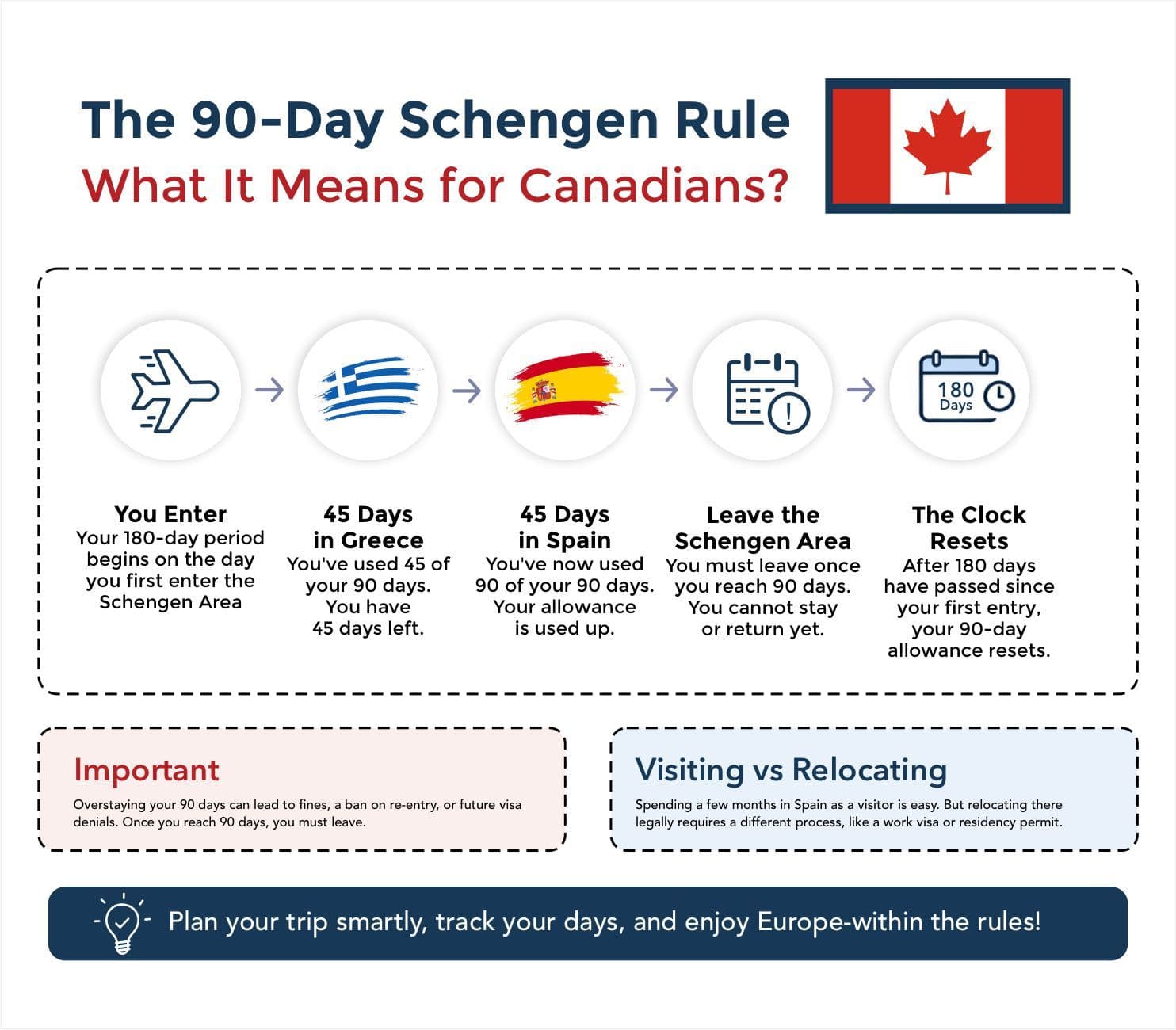
The 90-day limit is a Schengen-wide rule. The Schengen Area includes 29 European countries as of 2025, and the 90 days is calculated across the entire zone, not per country. So if you spend 45 days in Greece and then move to Spain, you have 45 days left in Spain before you've used up your 90-day allowance. The clock resets again after 180 days have passed from your first entry.
Once you reach the 90-day limit, you are required to leave the Schengen Area and cannot return until enough time has passed to reset your allowance. This is where many people run into issues. Spending a few months in Spain is relatively easy; relocating there legally requires a completely different process.
Long-Term Stays: You Need a Visa
If your goal is to stay in Spain for more than 90 days whether to live, work, retire, or study, you must apply for a long-term visa or residency permit before making the move.
There is no general “move to Spain” visa. Instead, Spain offers several specific residency pathways, each tied to your situation:
- If you work remotely for a non-Spanish company - Digital Nomad Visa
- If you have sufficient savings or passive income - Non-Lucrative Visa
- If you have a job offer from a Spanish company - Work Visa
- If you plan to run your own business - Self-Employed (Autónomo) Visa
- If you are studying - Student Visa
Each of these comes with its own eligibility criteria, documentation requirements, and processing timelines.
NIE Number Spain: What It Is and Why You Need It
Once you're on the path to legal residency, the first document you'll hear about constantly is the NIE, which stands for Numero de Identificacion de Extranjero, or Foreigner Identification Number. It's a unique tax identification number assigned to non-Spanish nationals. It is required for almost every significant transaction in Spain like opening a bank account, signing a lease, buying property, registering for healthcare, paying taxes, purchasing a car, and even activating a mobile contract with certain providers.
The NIE is very different from the residence permit. It's an identification number. You can obtain a NIE even as a non-resident. For example, if you're buying property in Spain without intending to live there but for those moving long-term, the NIE is issued as part of the visa and residency process. Once you arrive in Spain on a long-stay visa, you'll apply for your TIE (Tarjeta de Identidad de Extranjero), which is your physical residence card. Your NIE number is printed on it and stays with you permanently. It follows you through every interaction with the Spanish system for as long as you're in the country.
What is Empadronamiento?
One step that surprises many newcomers is the Empadronamiento - the municipal registration. Within a few weeks of arriving in Spain, you're legally required to register your address with the local town hall (ayuntamiento) of wherever you're living. This applies whether you're renting or own property, whether you're in Madrid or a small village.
The Empadronamiento is also called a padron. It's what proves you actually live where you say you live. It's required to access public healthcare, enroll children in school, apply for certain government services, and eventually as evidence of continuous residence when you apply for permanent residency. The process is straightforward - you bring your passport, your lease or proof of address, and fill out a form at the town hall but it's one of the most important steps that people often delay.
Need help with your application or background check?
Contact us now and speak with a dedicated Globeia expert today.