

There are eight active visa options for Americans who want to live in Spain. One closed permanently in April 2025. Each one is designed for a specific situation - choose the wrong one and your application will fail. Here is exactly what each visa is, who it is for, and what you need to qualify.
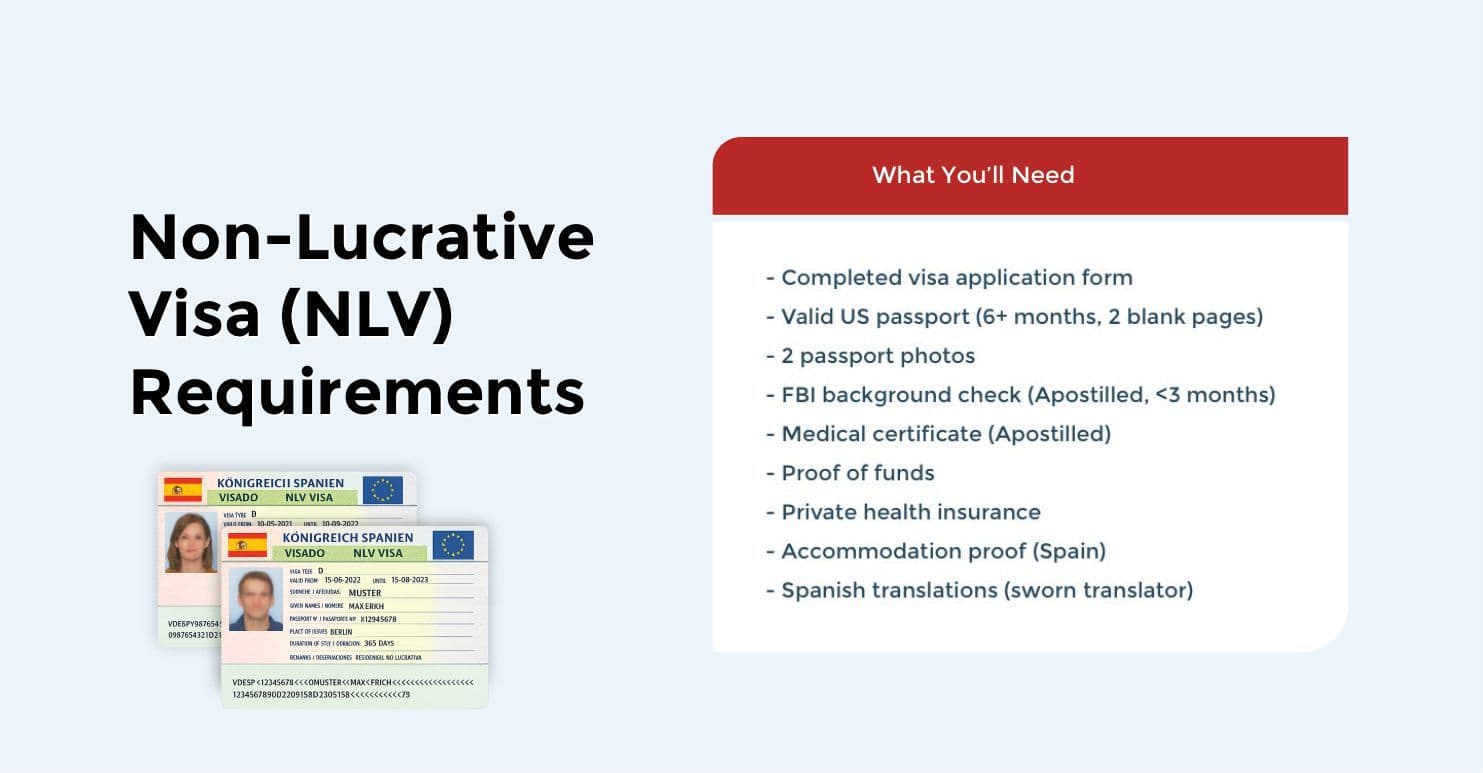
The Non-Lucrative Visa is the most popular route to Spanish residency for American retirees. Spain will grant you residency as long as you can prove you will not become a financial burden on the state. In return you agree not to work for anyone. Not for a Spanish employer, not as a freelancer, not remotely for a US company. If your income comes from a pension, investments, Social Security, rental properties, or dividends and you do not need a Spanish paycheck to get by, this is likely your visa.
Under Royal Decree 1155/2024, anyone renewing their NLV from 2026 onwards must demonstrate they have physically lived in Spain for at least 183 days in the preceding year. This threshold of 183 days is exactly the point at which Spain considers you a tax resident. In other words, renewing your visa now automatically triggers Spanish tax residency, which means Spain taxes your worldwide income.
For many retirees this is manageable. Spain's tax rates on pension income are not punishing. And the US-Spain double taxation treaty means you won't be taxed in full by both countries. But if you have significant investment income, rental income from US properties, or other passive streams, you need to sit down with a cross-border tax adviser before you apply - not after. The financial picture is very different for someone drawing $40,000 a year in Social Security versus someone drawing $120,000 from a brokerage account.The minimum is €28,800 per year in passive income for a single applicant, which is roughly €2,400 per month. Each dependent adds €7,200 per year to that threshold. Salary, freelance income, or any form of active earnings don't count and are not permitted under this visa. Acceptable sources are pension payments, Social Security, rental income, dividends, and investment returns. A large bank balance can support your application but won't substitute for demonstrated ongoing income. Consular officers want to see that the money keeps coming in, not just that you have an amount.
Health Insurance RequirementYou must have comprehensive private health insurance from a provider authorized to operate in Spain. The policy must meet all of the following conditions:
You must apply in person at the Spanish consulate that has jurisdiction over your US state of residence. You cannot apply online or at a consulate outside your jurisdiction. Book your appointment as early as possible - appointments at major consulates such as New York and Los Angeles can be booked out several weeks in advance.
4 to 8 weeks from the date of your appointment, though this varies by consulate and time of year.
Spain introduced the Digital Nomad Visa in 2023 under the Startup Act (Law 28/2022). This visa filled a gap that had existed for years. Americans working remotely for US companies or international clients finally had a legal, clearly defined route to Spanish residency that reflected how they actually worked - rather than having to squeeze into visa categories that were never designed for them.
If you earn your income from a company or clients outside Spain and you want to live in Spain legally - this is your visa. It is the only correct legal route for remote workers. Using a tourist visa or the Non-Lucrative Visa while working remotely is not permitted under Spanish law regardless of where your employer is based or where the money comes from. Who qualifiesYou must demonstrate one of the following. Either a university degree / postgraduate qualification from a recognized institution or a minimum of 3 years of documented professional experience in your field.
Employment DocumentationIf employed by a company then a work contract with a foreign employer that is at least 3 months old, plus written confirmation from the employer that remote work is permitted. And if self-employed or freelance then contracts or agreements with international clients demonstrating ongoing work and income.
Duration and RenewalsApproximately 20 working days when applied for at a Spanish consulate. Faster when applied for directly in Spain through the Large Business Unit (Unidad de Grandes Empresas - UGE).
This visa only works if a Spanish employer wants to hire you and is willing to do the paperwork to prove it. The company has to apply on your behalf first. You cannot initiate this process yourself. And they have to demonstrate either that your role fills a shortage occupation or that they could not find a qualified EU candidate. It is a high bar. Americans with a confirmed job offer from a Spanish employer in a specialized or in-demand role need a work visa.
How the process worksThe Work Visa process has two distinct phases:
Phase 1: Your Spanish employer applies for work authorization from Spanish immigration authorities. You must be in the US during this phase.Phase 2: Once approved, you apply for your entry visa at your Spanish consulate. You travel to Spain, sign the contract officially, and apply for your TIE and social security registration.Employment conditionsSpanish labor law sets the floor at approximately €1,323 per month (paid across 14 payments per year, which is the Spanish standard). You're entitled to a minimum of 30 days paid annual leave and the full protections of the Spanish labor code - significantly more employee-protective than most US employment law. Healthcare through the public system becomes available once you're registered with social security.
Duration and RenewalsGetting a Spanish work visa as an American is very competitive. Spanish employers face bureaucratic hurdles in hiring non-EU workers and must justify the hire to immigration authorities. Your chances improve significantly if you have highly specialized skills not readily available in the EU labor market, are fluent in Spanish, or are being transferred within a multinational company.
Documents RequiredThe Highly Skilled Professional Visa runs on a completely different track. Where the standard Work Visa takes months and requires your employer to prove they couldn't find a European for the job, this one processes in 10 to 20 business days and skips the EU candidate search requirement entirely. For the right person, it's one of the cleanest paths into Spain that exists.
The right person is fairly specific though. You need to be coming in as a manager or senior professional at a medium or large Spanish company earning at least €54,000 gross per year. Also as a researcher, lecturer, or scientist hired by a university or government institution at a minimum of €40,000. The salary thresholds are not flexible - if the offered compensation falls below them, you'll need the standard Work Visa route instead.One practical difference from the standard work visa is you can already be in Spain when your employer starts the application. You don't have to be sitting in the US waiting for paperwork to clear. For people who are already in Spain exploring opportunities, this matters.The document list mirrors the standard work visa with three additions: written evidence of your seniority or research role, salary confirmation from your employer, and verification of company size. Beyond those, the core requirements are the same - valid US passport, FBI background check (apostilled), medical certificate (apostilled), employment contract, academic or professional credentials, and sworn translations of all non-Spanish documents.
Visa fee: $183-$190 for US citizens.
Duration: Initial permit is 2 years, renewable, with permanent residency eligibility after 5 continuous years of legal residence.This visa is for Americans who want to build a business within Spain - serving Spanish and international clients as a registered autónomo or through a Spanish company. It is different from the Digital Nomad Visa which is for people earning from outside Spain. This one is for people who want to plant a commercial flag in Spain itself.
Core RequirementsYou need to demonstrate professional qualifications to operate in your sector, have sufficient personal funding to support yourself and launch the business, and submit a detailed business plan covering your services or products, target market, projected revenue, funding sources, and intended impact. Compliance with Spanish business registration and licensing requirements for your specific sector also applies from day one.
Duration and Renewals1 year initially, renewable up to four times (one additional year per renewal). At each renewal you must show the business is viable and still generating positive local impact. Permanent residency eligibility after 5 continuous years.
Visa Fee$200-$260 for US citizens - the highest fee in the Spanish visa schedule for Americans, due to the reciprocal fee agreement.
The Student Visa is for Americans who have been accepted into a qualifying educational program in Spain like university degrees, postgraduate programs, accredited language courses, research programs, and unpaid internships. It is also one of the most common entry points for younger Americans who eventually want to work in Spain, as it can lead directly to the Job Search Visa upon graduation and from there to a work visa or permanent residency.
There are three categories depending on your program length. Programs up to 90 days fall under the Schengen Student Visa and require no residence permit. Programs between 90 and 180 days use the Short-term Student Visa. Anything over 6 months which covers most university degrees, master's programs, and longer language courses requires the Long-term Student Visa. This is the category most American students will need.The 2025 work hour changesThe Student Visa saw the most significant rule changes in 2025 and the distinction now matters depending on what you are studying.
University-level students who are pursuing bachelor's, master's, and PhD programs, can now work up to 30 hours per week, up from the previous 20-hour limit. This is a meaningful change for anyone planning to support themselves partially through part-time work while studying. Work authorization must be obtained from Spanish immigration before you start employment, applied through your TIE application.Students enrolled in Spanish language courses are treated differently following the 2025 update. Work remains capped at 20 hours per week and this category now faces stricter restrictions overall. Language courses are no longer treated the same as tertiary qualifications. If you were planning to use a language course as a route to working rights in Spain, the rules have changed and that pathway is more limited than it used to be.
What Is needed to applyValid US passport, your acceptance or enrollment letter from the Spanish institution, proof of sufficient funds to cover tuition and living costs, private health insurance valid in Spain, FBI background check (apostilled), medical certificate (apostilled), proof of accommodation, and sworn translations of all non-Spanish documents.
Apply at your jurisdictional US consulate up to 3 months before your program start date - processing takes 2 to 4 weeks.Visa fee: $150–$160 for US citizens.
The Job Search Visa is a bridging visa that allows Americans who have completed a qualifying degree at a Spanish university to remain in Spain after graduation while they search for employment. It is important to understand what this visa is and what it is not: it is not a work permit. It does not authorize employment. It is a legal status that keeps you in Spain while you transition from student to worker.
Once you find a job, you must then apply for the appropriate work visa or permit before you begin working.Eligibility RequirementsFollowing the 2025 update to this visa, eligibility has been tightened:
This is valid for 1 year which is a non-renewable visa. If you have not secured employment and the appropriate work authorization within this year, you must leave Spain. The processing time is approximately 20 working days from application.
Documents RequiredVisa fee: approximately $135
Most of this guide is written for people making the move on their own terms - their own visa, their own income, their own application. The Family Reunification Visa works differently. Here, someone else's legal status in Spain is what makes your move possible.
If a close family member is already legally resident in Spain and has been for at least a year, they can sponsor you to join them. The visa grants you the right to both live and work in Spain which makes it one of the more generous visa categories in terms of what it allows and your validity is tied directly to theirs. When they renew, you renew. If their status lapses, yours becomes complicated.
The sponsor must have held legal residency for at least one year and must demonstrate they have enough income to support both themselves and you. The qualifying relationships are: spouse or legally recognized civil partner, children under 18, children over 18 who are dependent due to disability, and parents or parents-in-law aged 65 or over who are financially dependent on the sponsor. The income threshold is assessed against Spain's IPREM (public income indicator) and varies by family size.
The Family Reunification Visa is valid for as long as the sponsoring family member's own residence permit or TIE card remains valid. When the sponsor renews their residency, the family member's status is renewed accordingly.
Documents RequiredThe Spanish Golden Visa, formally known as the Investor Visa, previously allowed non-EU citizens including Americans to obtain Spanish residency by making a qualifying investment in Spain. The most common route was a minimum real estate investment of €500,000. Other qualifying routes included €1 million in company shares or bank deposits, €2 million in Spanish treasury bonds, or a significant investment in a new business creating local employment.
The Golden Visa was popular among Americans for several reasons: it included work authorization, allowed dependent family members to join immediately, did not require the holder to actually live in Spain for most of the year, and provided a relatively fast path to residency.The Spanish government, under Prime Minister Pedro Sanchez, announced the closure of the Golden Visa program citing concerns about its contribution to housing unaffordability in major Spanish cities, particularly Madrid and Barcelona. The program formally closed to new applications on April 3, 2025.
If you have seen the Golden Visa mentioned as an active option in other guides or websites, please note that those sources are outdated. This program is permanently closed to new applicants.
Need help with your application or background check?
Contact us now and speak with a dedicated Globeia expert today.

