

Before 2021, moving to Spain as a British citizen required nothing more than a decision. Brexit ended that entirely. UK nationals are now treated the same as any non-EU citizen which means visas, income thresholds, and a formal application process that did not exist before, for a move that millions of British people made freely for decades.
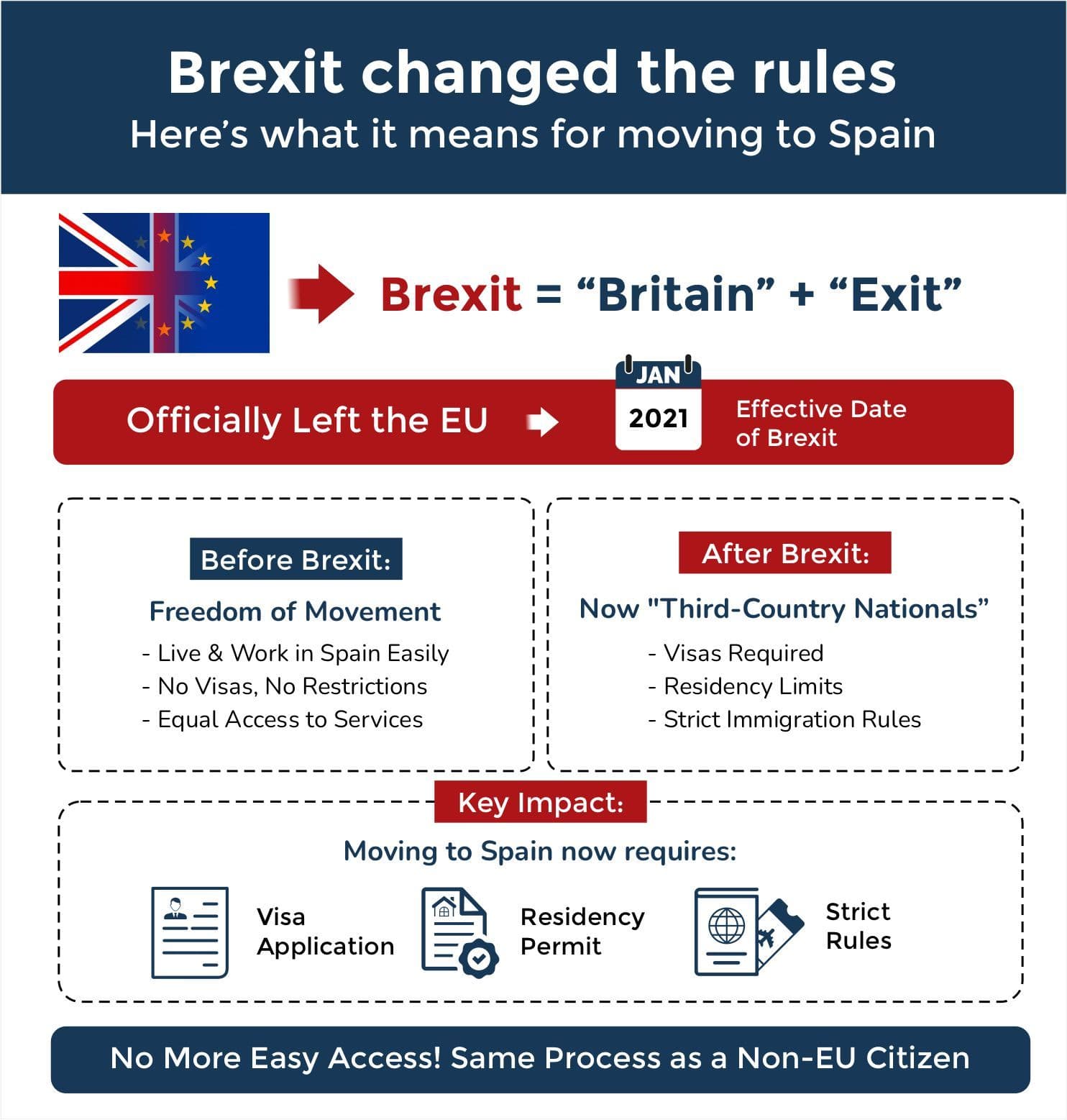
Brexit is the term used for the United Kingdom's decision to leave the European Union. The word is a blend of "Britain" and "exit." The UK voted in a referendum in June 2016 to leave the EU, and after years of political negotiations, the departure officially took effect on January 1, 2021. Before that date, the UK was a full member of the European Union.
Freedom of movement meant that any British citizen could pack up, move to any EU country including Spain, live there indefinitely, work without any special permission, and access public services like healthcare and education on the same terms as local citizens. No visa. No income thresholds. No paperwork beyond registering your address. Millions of British people took advantage of this over the decades.
When the UK left the EU, that freedom of movement ended. Britain negotiated its own separate deal with the EU - the Trade and Cooperation Agreement but it did not include freedom of movement for individuals. From January 1, 2021, British citizens became what immigration law calls "third-country nationals" in Spain, meaning they are treated the same way as someone arriving from the United States, Canada, or Australia. You are welcome to visit, but living there long-term now requires going through a formal visa process - the same as any non-EU citizen would. That is the single most important thing Brexit changed for anyone in the UK who wants to make Spain their home.
The 90/180-Day Rule Explained
If you've heard people say "you can only stay 90 days in Spain now," that's technically true but it's only half the picture, and misunderstanding it leads to a lot of unnecessary panic. Since January 1, 2021, UK citizens are subject to the Schengen Area's 90/180-day rule, which means you can spend a maximum of 90 days in any rolling 180-day period across the entire Schengen Zone without a visa. This isn't 90 days per country, it's 90 days across all 29 Schengen member states combined. So if you spent three weeks in France and two weeks in Portugal, those days count against your Spain allowance too. The rule applies to tourism, casual visits, and short stays. The moment you want to stay longer than 90 days, work, or establish your life in Spain, you need a long-stay visa. There are no grey areas, and border checks have become more thorough since Brexit.
What Rights Were Protected - The Withdrawal Agreement
Not everything changed overnight, and this is a critical point that many guides don't include. The UK-EU Withdrawal Agreement protected the rights of British citizens who were already legally resident in Spain before December 31, 2020. If you were living in Spain with registered residency (a green NIE certificate or TIE card) before that date, you fall under the Withdrawal Agreement and your rights are substantially preserved. You can continue to live, work, and access services in Spain under broadly the same conditions as before Brexit. You were required to exchange your old green residency certificate for the new biometric TIE card (Tarjeta de Identidad de Extranjero) - a process that was supposed to be completed by the end of June 2021. If you were resident before the cut-off but never made the switch, it is still worth seeking legal advice, as your status may be more complicated now. For everyone who arrived after January 1, 2021, the Withdrawal Agreement does not apply - the new visa system is the only route.
UK vs EU Citizens Moving to Spain
The contrast between what an EU citizen and a UK citizen can do when moving to Spain is stark, and understanding it removes any remaining confusion about why a visa is now required.
| Factor | EU Citizen | UK Citizen (Post-Brexit) |
| Visa required? | No | Yes (for stays over 90 days) |
| Right to work immediately? | Yes | Only with work-authorised visa |
| Public healthcare access | Yes (automatic) | Via S1 form, insurance, or employment |
| Time to apply before moving | None | 1-3 months minimum |
| Freedom of movement | Full Schengen | 90/180-day rule applies |
| Path to residency | EU registration certificate | TIE card via long-stay visa |
| Driving licence exchange | Not required | Required after 6 months residency |
| Voting rights (local elections) | Yes | No |
There's an enormous amount of outdated and wrong information circulating online about British people moving to Spain.
"You can just move to Spain and sort the paperwork later."
False. You must apply for and receive your long-stay visa from the Spanish Consulate in the UK before you travel. You cannot enter Spain as a tourist and then switch to a long-stay visa while already there. Attempting to do so will almost certainly result in your application being rejected and potentially complicating your immigration history.
"The 90-day rule resets when you cross the border."
False. The 90/180-day calculation is a rolling window, not a calendar reset on January 1. Spanish border authorities calculate it backward from any given date across the entire Schengen Area.
"I can work remotely in Spain on a tourist visit - no one will know."
Legally, this is working without authorisation in Spain, even if your employer and clients are based entirely in the UK. Tax residency rules also mean that if you spend more than 183 days in Spain in a calendar year, you become a Spanish tax resident regardless of whether you have a visa. The Spanish Digital Nomad Visa exists precisely to address this situation legitimately.
"I don't need to do anything if I was already living in Spain before Brexit."
Pre-Brexit residents are protected under the Withdrawal Agreement, but you were required to exchange your old green residency certificate for the new biometric TIE card. If you haven't done this, your legal position in Spain may be uncertain and you should take advice from an immigration lawyer.
"You can get Spanish residency through an Irish or EU passport easily."
If you hold dual UK-Irish citizenship and have a valid Irish passport, you do have full EU freedom of movement rights in Spain. However, obtaining an Irish passport solely as a workaround is a legal process in itself. It requires documented Irish ancestry and can take a year or more. It is not a quick fix, though it is a legitimate path worth exploring if you have Irish heritage.
Need help with your application or background check?
Contact us now and speak with a dedicated Globeia expert today.

