

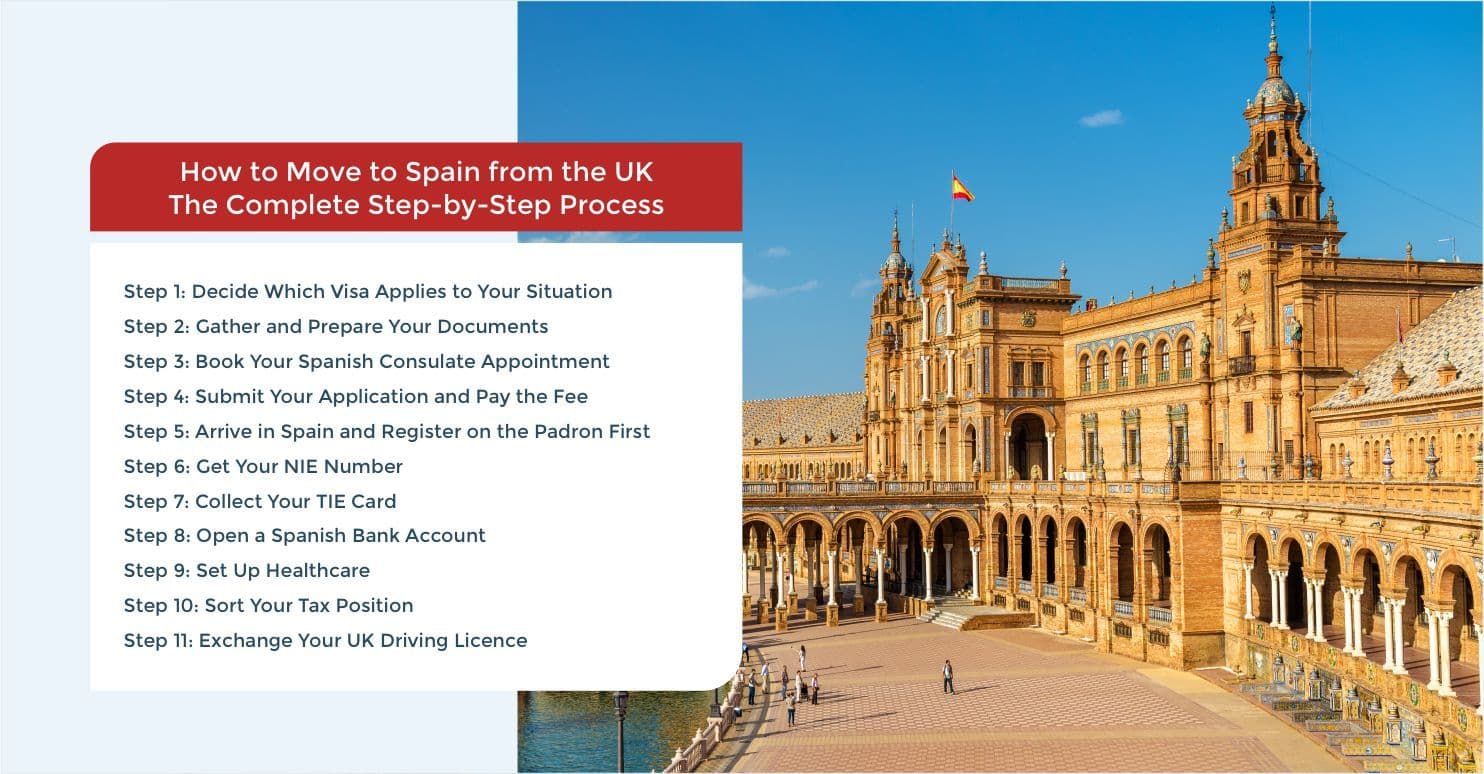
Most people who run into serious problems during their move to Spain don't fail because they chose the wrong visa or couldn't meet the financial requirements. They failed because they didn't understand the sequence. The Spanish immigration process has a specific order of operations, and doing things out of that order like applying for the wrong document first, arriving before your visa is issued, or missing a 30-day registration window, can set you back by months. This section walks through the entire process from the decision to move through to having your residency card in hand and your life set up in Spain.
Before you touch a single document, you need to be absolutely clear on which visa you are applying for. The visa determines every document you need, every threshold you must meet, and every consulate form you fill in. Applying for the Non-Lucrative Visa when your situation actually fits the Digital Nomad Visa or vice versa can wastes months and consulate fees.
If your situation is complex consult with a Spanish immigration lawyer before proceeding.
This is the step that takes the longest and where most delays happen. Give yourself a minimum of 6-7 weeks for document preparation, and longer if any of your documents are complicated to obtain. The exact list depends on your visa type but the documents that apply across almost all long-stay visa applications are as follows.
1. Valid Passport: Must be valid for at least one year beyond your intended stay and have a minimum of two blank pages remaining.
2. ACRO Criminal Records Certificate (Apostilled): The standard DBS check is not accepted, you specifically need the ACRO Criminal Records Certificate. Once obtained, it must be apostilled through the FCDO Legalisation Office. Apostilling takes approximately 2 weeks by post or can be done same-day in person.
3. Financial Evidence: Bank statements covering the last 3-6 months showing consistent income at or above the required threshold for your visa type. High balance on one statement date is not sufficient. Consulate officers look for regular, reliable income over time.
4. Private Health Insurance Policy: Must be from a provider authorised to operate in Spain, with no excess or copayments, and full coverage including hospitalisation and medical repatriation. The policy must be active from your intended date of entry into Spain. Providers commonly accepted by the Spanish Consulate include Sanitas, Cigna, AXA, and Allianz Care.
5. Proof of Accommodation in Spain: Accepted formats are a signed rental contract in your name, a property deed showing your ownership, or a letter of invitation from a host accompanied by their own proof of property ownership.
6. Certified Spanish Translations of All Non-Spanish Documents: Every document not originally issued in Spanish must be translated by a sworn translator (traductor jurado).
Long-stay visa applications for Spain must be submitted in person at the Spanish Consulate that covers your area of residence in the UK. The London Consulate covers England and Wales, the Edinburgh Consulate covers Scotland, and the Manchester Consulate covers Northern England.
You must apply at the consulate covering your registered address, you cannot choose based on convenience or availability. Appointment availability is one of the most frustrating parts of this process. The London Consulate runs backlogs, and appointment slots can be booked out 4-5 weeks in advance during busy periods.
When you attend your appointment, bring every document in both original and photocopy form. Consulate staff will retain the originals or certified copies of most documents. The appointment itself lasts 20 to 40 minutes.
At your consulate appointment, you submit your complete application pack, pay the visa fee. Check the specific payment method accepted before attending. The consulate will give you a receipt and a reference number to track your application.
From this point, the official processing window is up to 3 months. If the consulate requires additional documents or clarification, they will contact you - respond promptly as delays on your end extend the overall timeline. Once approved, you will be notified to collect your visa in person at the consulate. The visa is affixed directly into your passport as a sticker and will state the type of visa, the validity period, and the number of entries permitted.
The very first thing you do after arriving in Spain is registered on the Padron Municipal - Spain's official population register maintained by your local town hall (Ayuntamiento). This must happen before anything else because the Padron certificate proving your registered address is required for your NIE appointment and your TIE application. Without it you cannot move forward with either. Registration is free, done in person at your local Ayuntamiento, and requires your passport and proof of your address in Spain - a signed rental contract or property deed. The certificate of Empadronamiento is issued the same day or within a few days. Keep multiple certified copies as it will be requested repeatedly throughout your life in Spain.
With your Padron certificate in hand, your next step is obtaining your NIE (Número de Identidad de Extranjero)- your Spanish tax identification number. You cannot open a bank account, sign contracts, buy property, or handle any financial or legal matter in Spain without it. Book an appointment at your local Oficina de Extranjeria or Policia Nacional. You will need your passport, a completed EX-15 form, your Padron certificate, a brief written justification for needing the NIE, and the fee to be paid via Modelo 790 at a Spanish bank beforehand. Processing is same-day or within a few days.
With both your NIE and Padron certificate in hand, you can now apply for your TIE (Tarjeta de Identidad de Extranjero) - your physical residency card. You must do this within 30 days of arriving in Spain. Book your appointment at the Oficina de Extranjeria in your province as soon as you arrive - in larger cities slots can be 2-3weeks.
For the appointment you will need your passport and visa, your NIE number, your Padron certificate, one recent passport photograph, and the TIE fee paid via Modelo 790 Codigo 12 at a Spanish bank before the appointment. After submitting your application you will be given a collection date. In the meantime your passport with the long-stay visa serves as proof of your legal status. When you collect the TIE check all details carefully - name spelling, date of birth, and visa category must all be accurate
A Spanish bank account is not legally required immediately upon arrival, but you will eventually need one within weeks. Landlords expect rent paid from a Spanish account, utility direct debits require one, and many Spanish administrative payments cannot be made from a foreign account.
To open an account you will need your passport, TIE card or NIE number, proof of address , and in some cases proof of income or employment. The main high street banks like Santander, BBVA, CaixaBank, and Sabadell, all serve expat customers, though the experience and English-language support varies considerably by branch and city. During the transition period before your TIE arrives, some banks will open a non-resident account using your NIE number alone, which you can later upgrade to a resident account. International options like Wise and Revolut are useful for managing money during the transition but are not a substitute for a Spanish account for day-to-day life.
How you access healthcare in Spain depends on your visa type and personal situation. If you hold a Non-Lucrative Visa, your private health insurance, which you already needed for the visa application, is your primary healthcare arrangement. Some NLV holders also become entitled to access the Spanish public health system over time, particularly after paying into the Spanish social security system or via the S1 form route for UK state pensioners.
If you are working in Spain under any work-authorised visa, you will pay into Spanish social security from your salary or autonomo contributions, which entitles you to full SNS access.
Many people leave this step too late and find themselves in an unexpectedly complicated tax situation as a result. Spain considers you a tax resident if you spend more than 183 days in the country in a calendar year. Once you are a Spanish tax resident, Spain taxes your worldwide income including your UK salary, rental income, pension, and investments.
You must also notify HMRC that you are leaving the UK by completing a P85 form, which triggers an assessment of your UK tax position and results in a UK tax code change. The UK-Spain Double Taxation Treaty prevents you from being taxed twice on the same income, but the administrative process of claiming relief under the treaty requires proper advice.
If you qualify for the Beckham Law, apply for it within six months of registering with Spanish social security. This deadline is fixed and missing it means losing the benefit for your entire stay. Hiring a Spanish gestor (a licensed administrative professional) or tax advisor for your first year is strongly recommended.
If you plan to drive in Spain, you have 6 months from the date your residency is registered to exchange your UK driving licence for a Spanish one. After that window, your UK licence is no longer valid for driving in Spain as a resident. The exchange is handled through the Direccion General de Trafico (DGT) and requires your TIE card, Padron certificate, your original UK licence, a medical certificate from a DGT-authorised medical centre, and the exchange fee.
The medical examination includes vision, basic reflexes, and general fitness and costs approximately €35 to €50. You do not need to retake a driving test. Your UK licence is surrendered as part of the process, and the DGT notifies the DVLA in the UK. Processing times vary by province, during which you will be given a temporary authorisation document to carry with you when driving.
Need help with your application or background check?
Contact us now and speak with a dedicated Globeia expert today.

