

The U.S. does not issue a single unified Criminal Record Check. Instead, records are maintained at federal, state, and local levels, each serving a different purpose. Understanding how these systems work together is key to knowing which clearance your application actually requires.
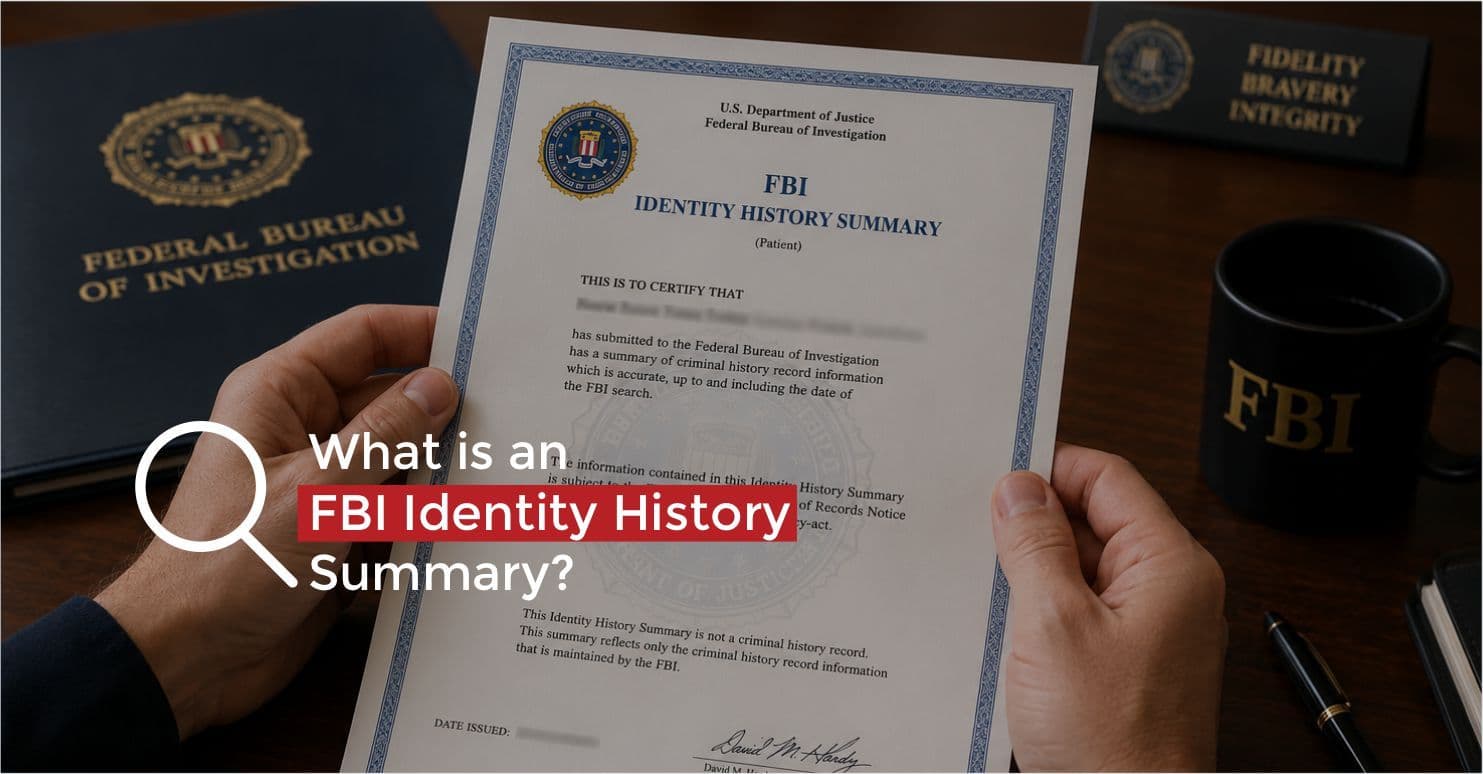
An FBI Identity History Summary is the official federal document that compiles all arrest and conviction data submitted to the FBI by law enforcement agencies across the United States. It is maintained by the FBI's Criminal Justice Information Services (CJIS) Division, headquartered in Clarksburg, West Virginia which is the central repository for the country's criminal history records.
When someone is arrested in the United States and fingerprinted, then those prints along with the charge and disposition data, are transmitted to the FBI and stored in the Next Generation Identification (NGI) system. The Identity History Summary is the compiled output of everything linked to a person's fingerprints within that system.
It is issued to the individual the record belongs to. It is not the same as a third-party background check, which employers or agencies run through separate authorized channels.
The United States does not have a single, unified national criminal database. Records exist across three levels of government. These are federal, state, and local, each with its own record-keeping systems and procedures.
Federal: Managed by the FBI’s Criminal Justice Information Services (CJIS) Division. It includes records submitted by federal agencies as well as data reported by state and local law enforcement. This is what you access through an FBI Identity History Summary.
State: Each of the 50 states maintains its own criminal history repository, through the State Bureau of Investigation or State Police. Reporting to the FBI is not always consistent or instantaneous which means gaps can exist between what the federal record shows and what a state actually holds.
Local: County and municipal law enforcement agencies maintain their own arrest records. These are shared with state systems, though processes and timelines differ by jurisdiction.
Because of this decentralized structure, the FBI Identity History Summary is considered the primary federal record, but in some cases it may not reflect every detail held at the state or local level. For that reason, certain immigration or regulatory authorities may request both a federal clearance and additional state-level clearances, depending on the applicant’s history and place of residence.
The Criminal Justice Information Services (CJIS) Division is the FBI unit responsible for managing the systems behind U.S. criminal record checks. Established in 1992, it collects, maintains, and shares criminal justice information with law enforcement agencies, courts, and through the Identity History Summary program, individuals requesting their own records.
Several CJIS systems play a role in the background check process:
Next Generation Identification (NGI): The FBI’s primary biometric database, containing fingerprint records along with other identifiers such as palm prints and facial recognition data. All fingerprint-based background checks are processed through NGI.
Interstate Identification Index (III): A system that links federal and state criminal history records, allowing authorized agencies to locate records across multiple states through a single query.
National Crime Information Center (NCIC): A separate nationwide database used by law enforcement for real-time information on wanted persons, missing persons, and stolen property. It is not part of the public background check process and is not accessible to individuals.
Integrated Automated Fingerprint Identification System (IAFIS): The fingerprint system that has now been fully incorporated into NGI, which handles fingerprint matching and identity verification.
A common misconception is that the FBI Identity History Summary captures every interaction a person has had with law enforcement. It does not. The report reflects only the information that has been submitted to the FBI by participating agencies.
Typically included:
Typically not included:
A “No Record” result does not mean a person has no criminal history anywhere in the United States but it means no record was found in the FBI’s database at the time of the search. For certain immigration or regulatory purposes, authorities may also request state-level clearances to supplement the federal record.
| Type of Clearance | Issued By | Coverage | Best For |
| FBI Identity History Summary (Federal) | Federal Bureau of Investigation (CJIS Division) | National-level (based on records reported by federal, state, and local agencies) | International visa applications, immigration, foreign employment, intercountry adoption |
| State Criminal Record Check | State Police, Department of Justice, or State Bureau of Investigation (varies by state) | That specific state only | State-specific requirements, professional licensing, or when individual state clearances are requested |
| Local / County Criminal Record Check | County Sheriff’s Office or Local Police Department | That specific county or city | Rarely required for international purposes; used for local legal or administrative matters |
Need help with your application or background check?
Contact us now and speak with a dedicated Globeia expert today.

