By Sejal Jain · Updated September 11, 2026
Reviewed by Vasu Singla
A Schengen visa gives Indian travellers access to 29 European countries through a single application but the process involves several decisions that materially affect your outcome: which country's embassy to apply through, how to document your finances, how much insurance coverage you actually need, and how to time your application against seasonal processing delays.
This guide walks through the process in full, reflecting the current rules for 2026. It covers how to identify the correct consulate based on your itinerary, rather than simply the country you're most excited to visit. It explains how to assemble a document file - bank statements, employment proof, travel insurance, accommodation records - that holds up under consular scrutiny rather than inviting further questions. It sets out realistic costs and processing timelines by country, so you can plan around them instead of being surprised by them.
Recent structural changes are addressed throughout as well: the EU's new biometric border checks, the multi-year visa pathway now available to frequent Indian travellers, and the country-specific transit exemptions introduced this year. Rather than treating these as footnotes, this guide integrates them into the core process, so what you're reading reflects how the system actually works right now - not how it worked two or three years ago.
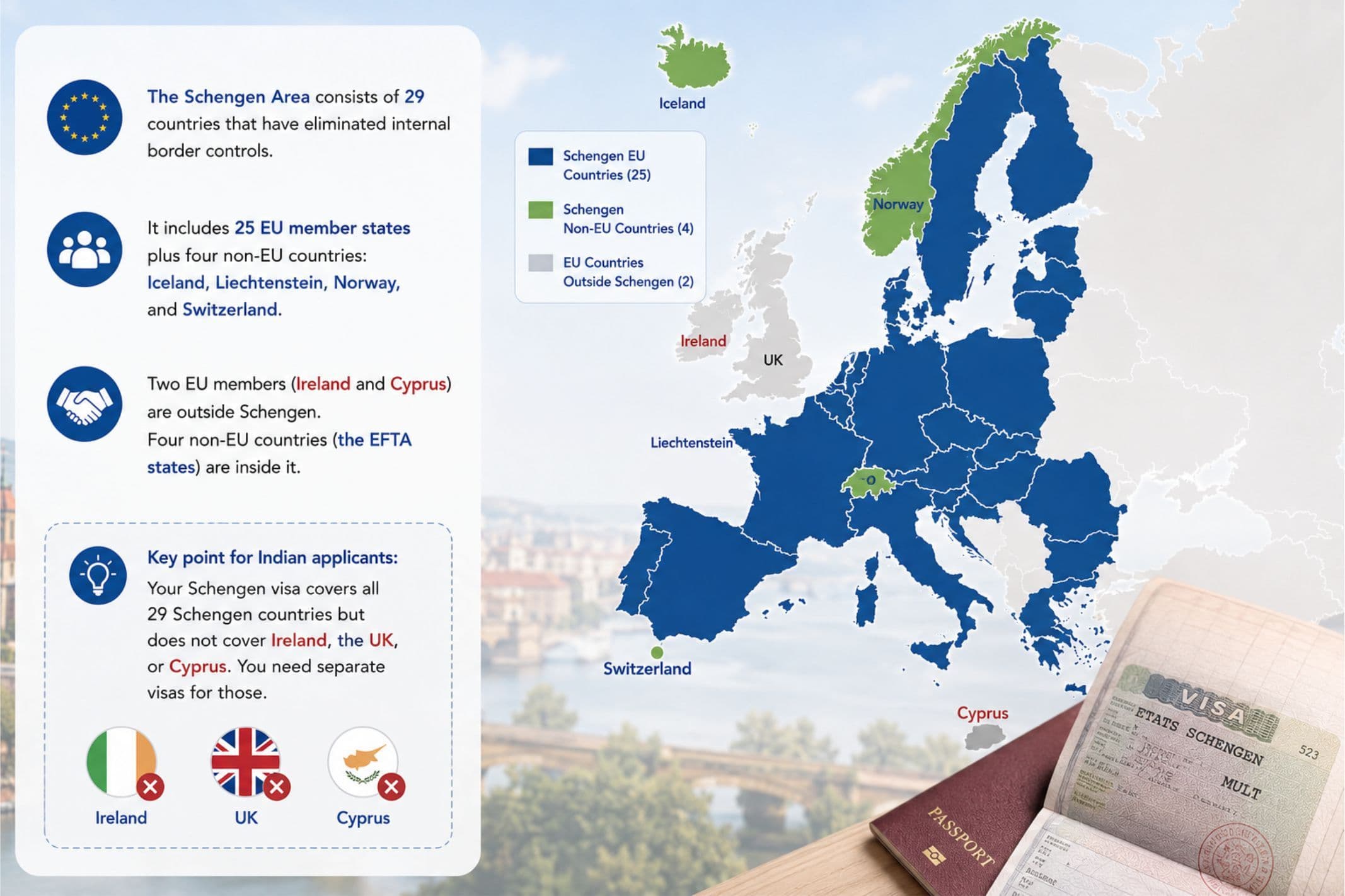
The Schengen Area is a group of 29 European countries that have abolished routine passport controls at their shared internal borders. Once you enter one Schengen country through an official external border point, you can travel freely to any other Schengen country without stopping at border checkpoints or showing your passport again at every crossing.
For Indian travellers, this is enormously practical. Instead of applying for nine separate visas to visit France, Germany, Italy, Spain, Switzerland, Austria, the Netherlands, Belgium, and Portugal, you apply once through one embassy and get a single visa that covers all of them.
The agreement that created this system was signed on 14 June 1985 in Schengen, a small village in Luxembourg where the borders of Luxembourg, France, and Germany meet. The location was symbolic: by signing on a boat in the middle of the Moselle River, the five founding countries (France, Germany, Belgium, Luxembourg, and the Netherlands) chose a point that existed precisely at the intersection of national boundaries.
The original Schengen Agreement was not part of the European Union system. It was a separate intergovernmental treaty created because EU member states could not reach unanimous agreement on border-free travel within the broader EU framework. The five founding signatories decided to proceed independently.
The Schengen Convention, which established the practical rules for implementing border-free travel, was signed in 1990 and came into force on 26 March 1995. On that date, Belgium, France, Germany, Luxembourg, the Netherlands, Portugal, and Spain became the first countries to actually open their internal borders.
The Schengen Agreement was absorbed into EU law by the 1997 Treaty of Amsterdam, which came into force in 1999. This integration meant that all new EU member states after 1999 became legally obligated to join Schengen once they met the technical and legal requirements.
When you hold a valid Schengen visa and enter through any official Schengen external border point, whether that is Charles de Gaulle Airport in Paris, Frankfurt Airport in Germany, or Leonardo da Vinci Airport in Rome, you are free to travel to any other Schengen country without a secondary immigration check.
There are no passport booths between France and Germany. There are no immigration officers between Italy and Austria. The only border formality you will experience is when you first enter the Schengen Area from outside it, and when you leave.
This does not mean you can travel without carrying your documents. Schengen member states retain the right to conduct identity checks within their territory and at internal borders in specific circumstances, particularly during periods of elevated security. Police or border officers can ask to see your passport at any time. Your Schengen visa must be valid for your entire stay, regardless of which internal borders you cross.
The most important practical rule for Indian travellers is the 90-day stay limit. Within any rolling 180-day period, you may spend a maximum of 90 days inside the Schengen Area. This limit applies across all 29 countries combined, not per country. Spending 30 days in France, 30 days in Italy, and 30 days in Germany uses your entire 90-day allowance for that 180-day window.
Another section in this guide covers this calculation in detail. For now, understand that this limit exists regardless of how many Schengen visas you hold or how many times you enter and exit.
Indian applicants frequently confuse these four terms. Each one refers to a different group of countries and a different set of rules. Understanding the distinction matters because it affects which visa you need, where you can use it, and what rules apply to your travel.
The European Union is a political and economic union of 27 member states. These countries have transferred significant sovereign powers to EU institutions, including a shared legal framework, a single market for goods and services, free movement of EU citizens between member states, and a common external trade policy.
The 27 EU member states as of 2026 are: Austria, Belgium, Bulgaria, Croatia, Cyprus, Czech Republic, Denmark, Estonia, Finland, France, Germany, Greece, Hungary, Ireland, Italy, Latvia, Lithuania, Luxembourg, Malta, the Netherlands, Poland, Portugal, Romania, Slovakia, Slovenia, Spain, and Sweden.
Key point for Indian applicants: Being in the EU does not automatically mean a country is in Schengen. Ireland and Cyprus are EU members but are not in the Schengen Area. A Schengen visa does not give you entry to Ireland or Cyprus.
The Schengen Area consists of 29 countries that have eliminated internal border controls. As covered in this guide, it includes 25 EU member states plus four non-EU countries: Iceland, Liechtenstein, Norway, and Switzerland.
Two EU members (Ireland and Cyprus) are outside Schengen. Four non-EU countries (the EFTA states) are inside it.
Key point for Indian applicants: Your Schengen visa covers all 29 Schengen countries but does not cover Ireland, the UK, or Cyprus. You need separate visas for those.
The Eurozone is the group of EU member states that use the Euro (€) as their currency. As of 2026, it consists of 20 EU countries. Not all Schengen countries use the Euro. Switzerland, Norway, Sweden, Denmark, Iceland, the Czech Republic, Hungary, Poland, and Romania all use their own national currencies despite being in Schengen.
Key point for Indian applicants: Currency is entirely separate from visa requirements. You do not need different documentation for countries that use different currencies. Budget appropriately in local currency for each destination.
The EEA consists of the 27 EU member states plus Iceland, Liechtenstein, and Norway. These three non-EU countries participate in the EU's single market but are not EU members. Switzerland has a separate bilateral agreement with the EU and is not in the EEA, though it cooperates closely.
Key point for Indian applicants: Citizens of EEA countries have free movement rights within the Schengen Area and EU. You, as an Indian citizen, do not. The EEA designation is mostly relevant for employment rights and is not something that directly changes your visa requirements.
| Zone | Members | Indian Visa Needed? |
| Schengen Area | 29 countries | Yes - Schengen Visa |
| EU only (not Schengen) | Ireland, Cyprus | Separate national visa |
| Non-EU Schengen | Iceland, Norway, Switzerland, Liechtenstein | Covered by Schengen Visa |
| UK (not EU, not Schengen) | United Kingdom | UK visa required separately |
As of 2026, there are 29 countries in the Schengen Area. Croatia joined in January 2023. Bulgaria and Romania completed accession in two phases - air and sea borders opened on 31 March 2024, and land border controls were lifted on 1 January 2025, making both countries fully integrated across all border types.
| Schengen Country | Capital | Currency | Key Information |
| Austria | Vienna | Euro (EUR) | Central European country known for its alpine landscapes, historic cities, and cultural heritage. |
| Belgium | Brussels | Euro (EUR) | Home to the headquarters of the European Union and NATO. |
| Bulgaria | Sofia | Bulgarian Lev (BGN) | Air and sea borders: 31 March 2024. Land borders: 1 January 2025. Fully integrated across all border types. |
| Croatia | Zagreb | Euro (EUR) | Joined the Schengen Area on 1 January 2023. |
| Czech Republic | Prague | Czech Koruna (CZK) | Popular destination for historic architecture and cultural tourism. |
| Denmark | Copenhagen | Danish Krone (DKK) | Greenland and the Faroe Islands are not part of the Schengen Area. |
| Estonia | Tallinn | Euro (EUR) | Northern European country recognized for its digital government services. |
| Finland | Helsinki | Euro (EUR) | Known for its extensive forests, lakes, and northern Arctic region. |
| France | Paris | Euro (EUR) | The world's most visited country and one of the most popular Schengen destinations. |
| Germany | Berlin | Euro (EUR) | One of the leading Schengen destinations for Indian travellers, students, and professionals. |
| Greece | Athens | Euro (EUR) | Famous for its ancient history, islands, and Mediterranean coastline. |
| Hungary | Budapest | Hungarian | Well known for thermal baths, architecture, and cultural landmarks. |
| Iceland | Reykjavik | Forint (HUF) | Not a European Union member but part of the Schengen Area. |
| Italy | Rome | Icelandic Krona (ISK) | One of Europe's most visited countries for tourism, education, and business. |
| Latvia | Riga | Euro (EUR) | The Baltic nation is known for its medieval old town and coastal scenery. |
| Liechtenstein | Vaduz | Euro (EUR) | Not an EU member and one of the world's smallest sovereign states. |
| Lithuania | Vilnius | Swiss Franc (CHF) | Largest of the Baltic states and a member of the Schengen Area. |
| Luxembourg | Luxembourg City | Euro (EUR) | Small European country with major financial and EU institutions. |
| Malta | Valletta | Euro (EUR) | Mediterranean island nation known for tourism, education, and residency programs. |
| Netherlands | Amsterdam | Euro (EUR) | Popular destination for tourism, higher education, and international business. |
| Norway | Oslo | Norwegian Krone (NOK) | Not an EU member but participates in the Schengen Agreement. |
| Poland | Warsaw | Polish Zloty (PLN) | Growing destination for higher education, employment, and tourism. |
| Portugal | Lisbon | Euro (EUR) | Schengen coverage includes Madeira and the Azores autonomous regions. |
| Romania | Bucharest | Romanian Leu (RON) | Air and sea borders: 31 March 2024. Land borders: 1 January 2025. Fully integrated across all border types. |
| Slovakia | Bratislava | Euro (EUR) | Central European Schengen member using the Euro. |
| Slovenia | Ljubljana | Euro (EUR) | Popular for alpine scenery, lakes, and sustainable tourism. |
| Spain | Madrid | Euro (EUR) | Schengen coverage includes the Canary Islands and Balearic Islands. |
| Sweden | Stockholm | Swedish Krona (SEK) | Nordic Schengen country known for innovation and quality of life. |
| Switzerland | Bern | Swiss Franc (CHF) | Not an EU member but part of the Schengen Area and one of Europe's leading financial centres. |
A valid Schengen visa allows you to enter and travel freely across all 29 countries listed above for the duration stated on your visa sticker, subject to the 90/180-day rule.
Cyprus is an EU member that remains outside Schengen as of 2026. The country has been working toward accession and is in active discussions, but the complexity of the Cyprus political situation involving the northern part of the island controlled by Turkey has slowed progress. There is no confirmed accession date as of mid-2026.
A Schengen visa does not cover every country in Europe. If your itinerary includes any of the following, you will need to apply for additional visas.
Three major developments directly affect Indian Schengen visa applicants in 2026. All three represent significant changes from previous years and require careful attention.
The European Union's Entry/Exit System became progressively operational from 12 October 2025 and reached full operation across all 29 Schengen external border crossing points on 10 April 2026. This is the single most significant change to Schengen border management in the system's 40-year history.
What EES replaces: Before EES, border officers stamped physical passports to record entry and exit dates. This manual system had several weaknesses: stamps could be forged, passport pages ran out, stamps could be illegible or missing, and there was no centralised database to verify stay durations across all Schengen countries. Overstayers could sometimes evade detection.
What EES does: EES is a centralised digital database that records every non-EU national's entry and exit from the Schengen Area. Upon your first entry under EES, border officers collect:
This biometric and document data is stored in the EES database for three years. On subsequent entries, your profile already exists in the system. The border officer scans your passport, the system retrieves your stored biometrics, verifies your identity, and records the new entry. The process is significantly faster after the initial registration.
What this means for Indian travellers:
Your first entry into Schengen under EES will take longer than previous visits. Budget at least 15 to 20 minutes of additional time at the border. At major airports like Frankfurt, Amsterdam, or Paris, airports have warned of longer initial queues during the system's bedding-in period through 2026.
After first registration, subsequent entries should be faster because your data is already stored.
The 90/180-day rule is now automatically enforced by the system. Border officers no longer need to manually count passport stamps. The EES database calculates your remaining days in real time. If you have used 80 of your 90 permitted days and attempt to enter again, the system flags this immediately.
An important distinction: The biometric data you provided at your Schengen visa application centre when applying is separate from EES. Even if you gave fingerprints for a previous visa application, you must give biometrics again at the border under EES. The two databases are distinct systems.
Who is not covered by EES:
Who IS covered by EES (including Indians): All third-country nationals who hold a short-stay Schengen visa (Type C) and enter for a visit of up to 90 days are subject to EES registration.
On 18 April 2024, the European Commission adopted new rules specifically for Indian nationals under what is officially called a "visa cascade regime." This policy change means eligible Indian travellers can now obtain multi-year, multiple-entry Schengen visas based on their travel history, rather than applying for single-entry or short-validity visas every time.
The cascade structure:
Stage 1 - First-time or standard applicants: Indian citizens with no prior Schengen visa history, or insufficient history to qualify for cascade benefits, receive the standard visa. This may be single-entry or multiple-entry with a typical validity of three months to one year, depending on the consulate's assessment and your application.
Stage 2 - Two-year multiple-entry visa: Once you have obtained and lawfully used two Schengen visas within the previous three years, you become eligible for a two-year multiple-entry Schengen visa. "Lawfully used" means you entered on those visas and complied with all conditions - you did not overstay, did not work illegally, and complied with the stated purpose of travel.
Stage 3 - Five-year multiple-entry visa: After using a two-year visa and continuing to comply with all Schengen conditions, you become eligible for a five-year multiple-entry visa. The five-year visa cannot exceed the remaining validity of your passport. If your passport expires in four years, the visa will be valid for four years at most.
What the cascade visa means in practice: A five-year cascade visa essentially gives you travel access similar to visa-free status. You can plan Europe trips without applying for a new visa each time. You still have to comply with the 90/180-day rule on every trip, and the visa still does not permit employment.
Eligibility conditions for the cascade regime:
Important note on airport transit visas and LTV visas: If you have only been issued airport transit visas or country-specific restricted visas in the past, these do not contribute to your cascade eligibility count. Only full Schengen Area (C-type) visas that were actually used count toward the cascade qualification.
On 27 January 2026, India and the European Union signed a Memorandum of Understanding on a Comprehensive Framework for Cooperation on Mobility at the 16th India-EU Summit held at Hyderabad House, New Delhi. Prime Minister Narendra Modi and European Commission President Ursula von der Leyen witnessed the signing. External Affairs Minister S. Jaishankar and EU Trade Commissioner Maroš Šefčovič signed the document alongside the India-EU Free Trade Agreement.
The pact commits to facilitating mobility for four professional categories: business visitors, intra-corporate transferees, contractual service suppliers, and independent professionals. Additional commitments include a unified EU visa portal for Schengen applications (target: September 2026), standardised document requirements across all 29 member states, a 10-working-day target processing time, and expanded access for Indian students and researchers through EU programmes including Erasmus+ and Marie Skłodowska-Curie.
The EU Legal Gateway Office opened in New Delhi in February 2026 as a one-stop information hub for Indian students, researchers, and professionals navigating European visa and qualification recognition processes.
What this means for tourist applicants in 2026
The Mobility Pact does not change the Schengen visa requirements for tourism. Indian travellers still apply through the standard Type C process with all standard documents. The pact primarily targets professionals, students, and researchers seeking long-stay national visas or work permits. The unified portal, standardised documents, and faster processing targets are aspirational commitments - none are in operational effect as of July 2026. Apply through the standard process described in this guide.
On 1 January 2025, Bulgaria and Romania completed their transition to full Schengen membership, including the lifting of internal land border controls with other Schengen countries. This expansion means your single Schengen visa now covers 29 countries instead of 27.
For Indian travellers, this practically means that visiting Bucharest, Cluj-Napoca, Sofia, or Black Sea resorts in Bulgaria no longer requires a separate Romanian or Bulgarian visa - your Schengen visa covers these destinations.
The EU has begun introducing digital Schengen visas, which will eventually replace the physical sticker placed in your passport. The digital visa is a secure credential stored electronically rather than printed on a foil sticker. This rollout is in phased introduction as of 2026. Most Indian applicants in 2026 will still receive the traditional visa sticker. Full transition to digital visas is not expected until 2028. When the digital visa becomes standard, applicants will likely receive credentials via email or a secure digital system rather than through physical passport stamping.
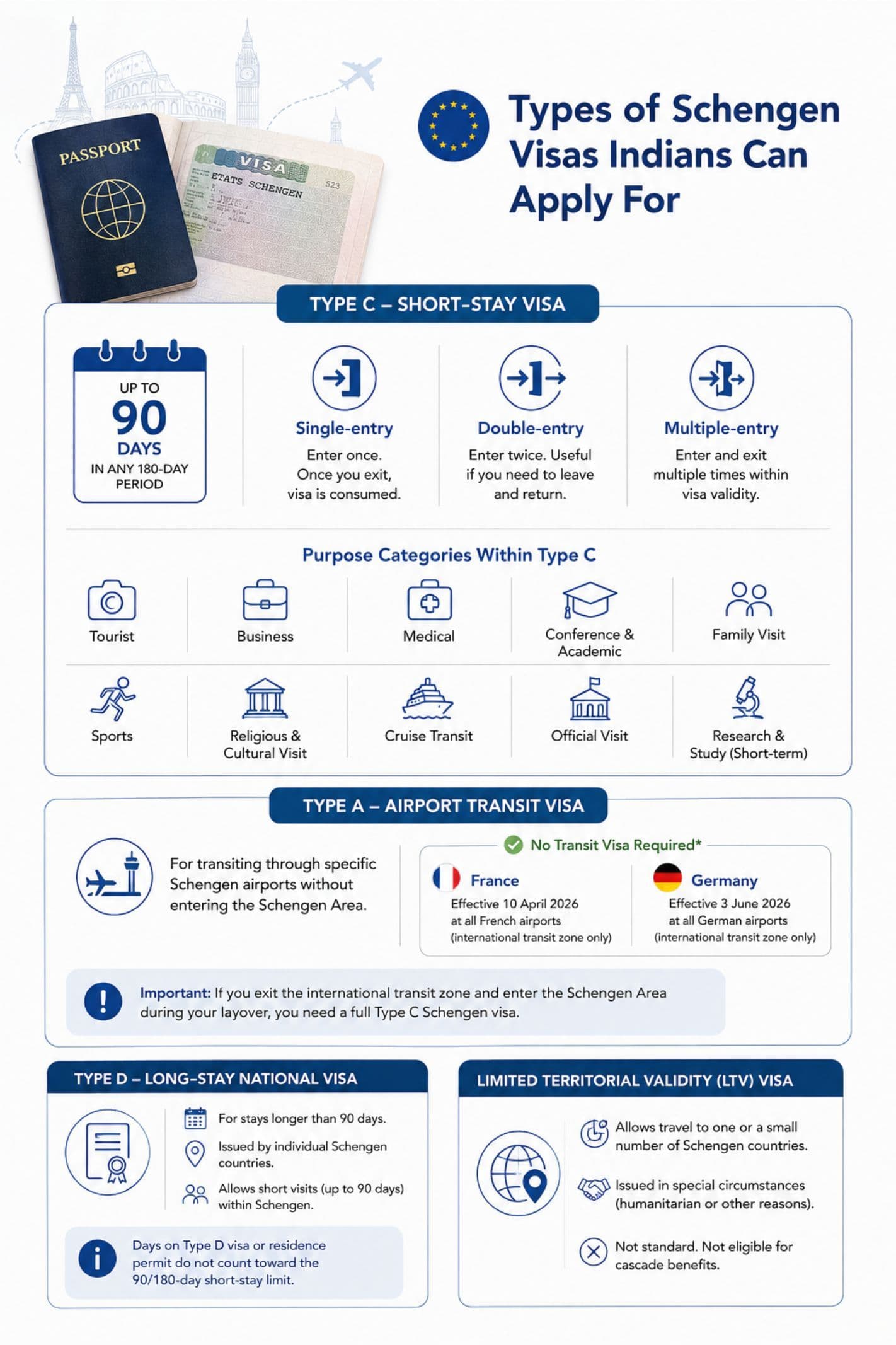
The Schengen Visa Code (EU Regulation EC No 810/2009) defines several categories of Schengen visas. Each type corresponds to a different purpose of travel and comes with specific documentation requirements.
The Type C visa is what most Indian travellers apply for. It permits stays of up to 90 days within any 180-day period and can be issued as:
The Type C visa can be issued with different validity periods (three months, six months, one year, two years, five years), but the permitted stay is always a maximum of 90 days in any rolling 180 days.
An airport transit visa is required for Indian citizens transiting through specific Schengen airports without entering the Schengen Area. If you are flying from India to the United States with a connection at Frankfurt, for example, and you remain in the international transit zone without passing through immigration, you technically do not need a Schengen visa for that stop.
However, not all Indian citizens qualify for transit exemptions. At certain airports and under certain conditions, a Type A airport transit visa is required to transit through the international zone without actually entering the Schengen Area.
Indian passport holders are not required to hold an airport transit visa at most Schengen airports. Two specific exemptions formalised in 2026 are worth noting:
Both exemptions apply only when remaining within the international transit zone - airside connections only. If you plan to exit the transit zone and enter the Schengen Area during your layover, you need a full Type C Schengen visa regardless of these transit exemptions. Always verify the current transit visa requirement for your specific routing and airport before travel.
Important: If you plan to exit the international transit zone and enter the Schengen Area during your layover, you need a full Type C Schengen visa, not a transit visa.
A Type D visa is issued by individual Schengen countries for stays longer than 90 days. It is not the same as a Schengen visa. A Type D visa is issued by and is valid primarily for the issuing country. Holders of a valid Type D visa issued by any Schengen country may also travel within the broader Schengen Area for short visits of up to 90 days, subject to national rules.
If you are going to Germany for a six-month internship, a full-year degree programme in France, or a long-term work assignment in the Netherlands, you need a Type D national visa from that specific country, not a standard Schengen visa.
Days spent on a Type D national visa or a residence permit do not count toward your 90/180-day Schengen short-stay allowance.
An LTV visa restricts your travel to one or a small number of Schengen countries. It is typically issued in special circumstances, such as when a full Schengen visa cannot be granted but there are humanitarian grounds or other special reasons to allow travel to a specific country. LTV visas are not standard and are not something you would normally seek. As noted in the cascade section, LTV visas do not count toward cascade regime eligibility.
Every Indian passport holder who wishes to visit any of the 29 Schengen countries for tourism, business, a family visit, a conference, or any other permitted short-stay purpose is required to apply for a Schengen visa. There are no exemptions based on income, profession, or education level. However, the strength of your application and the specific documentation required does vary significantly by applicant category.
This is the standard applicant category. You must apply at the Schengen embassy or consulate (or authorised visa application centre) of the country you intend to visit as your main destination.
You must apply from India. If you are currently residing outside India, even temporarily, your application process may differ. See the overseas applicant note below.
If you are an Indian national currently residing in the United States, the UK, Canada, Australia, or any country other than India, you apply for your Schengen visa through the embassy or consulate of your main destination in your country of current legal residence, not in India.
For example, an Indian national with a valid US Green Card living in New York applies through the relevant Schengen embassy in New York or Washington DC, using documentation that reflects their US residency (US address, US-based financial proof, etc.), not Indian documents.
However, if you are in India at the time of application, you apply through India-based consulates and application centres.
Employed applicants have a relatively straightforward documentation requirement. You need your employment contract or appointment letter, recent salary slips (usually the last three to six months), an employer's NOC (No Objection Certificate) or leave approval letter, and bank statements showing regular salary credits.
The key concern for employed applicants is demonstrating strong ties to India - that you have a job to return to. A signed leave approval letter from your employer serves this purpose.
Self-employed professionals and business owners face somewhat heavier documentation requirements because their financial situation is less standardised. You need proof of business registration (like a Certificate of Incorporation or proprietorship registration), GST registration and filings, business bank statements (separate from personal accounts), proof of business continuity (client agreements, invoices, ongoing contracts), Income Tax Returns for the last two to three years, and a self-written letter explaining your business and the purpose of your trip.
The consulate assesses not just whether you have sufficient funds, but whether your business is credible and whether leaving India temporarily makes sense in the context of your work.
Student applicants in India need their college or university enrollment letter confirming current status, the institution's NOC permitting travel during the stated dates, financial proof from parents or sponsors (since most students do not have independent income), a bank statement from the sponsoring family member, a sponsorship declaration, and the student's own ID card or bonafide certificate.
For students applying independently with their own funds (scholarship recipients, for example), documentation of the scholarship and the institution's letter are central.
Freelancers and remote workers represent an increasingly common applicant category. The challenge is that Schengen consulates were designed around traditional employment and tourism categories. Freelancers must demonstrate a legitimate, stable income from identifiable sources.
Useful documents for freelancers include a freelance registration if formally registered, contracts or agreements with clients, invoice history showing consistent income, bank statements demonstrating regular earnings, Income Tax Returns for the past two to three years, and a clear cover letter explaining the nature of your work and why your trip is for tourism or a permitted purpose (not remote work for Schengen clients, which would require a different visa).
Important note: A Schengen Type C visa does not permit you to work, including remote work on behalf of non-Schengen clients in some interpretations. Working remotely while on a Schengen tourist visa is a legal grey area and varies by country. Some Schengen states are introducing specific digital nomad visas (Germany, Portugal, and Spain have been exploring this), but these are national long-stay visas (Type D), not standard Schengen Type C visas.
Retired Indian applicants often have excellent financial profiles but may face questions about travel purpose and ties to India. Pension documents (including PPF statements, EPF pension, government pension letters), property ownership documents, family ties (adult children in India), and medical fitness documentation all strengthen retired applicants' cases.
The key document for retired applicants is proof of regular pension or investment income. Bank statements showing consistent monthly credits from pension sources are important.
Senior citizens (typically those over 60 or 65 depending on the definition used) may also want to pay careful attention to travel insurance requirements. Standard Schengen-compliant insurance policies often have age-based pricing tiers and sometimes require additional medical screening.
Homemakers who are not independently employed face specific challenges in demonstrating financial self-sufficiency. Most homemaker applicants apply as sponsored travellers, with a spouse or other family member as the financial sponsor.
Key documents include the marriage certificate (linking the homemaker to the sponsoring spouse), the sponsor's employment and financial documents, a formal sponsorship letter, the sponsor's bank statement, and any personal savings the homemaker holds. Property ownership, gold ownership, or other assets also strengthen the profile.
Children under 18 require a Schengen visa if they are Indian citizens and do not hold another nationality that is visa-exempt. The specific documentation depends on the child's travel situation:
For children under six, Schengen travel insurance must still be purchased. Children under 12 are exempt from providing fingerprints under the EES biometric system.
Overseas Citizen of India (OCI) cardholders who hold a non-Indian passport from a country that is visa-exempt for Schengen travel (such as a US, UK, Canadian, or Australian passport) do not need a Schengen visa and should travel on their non-Indian passport for Europe visits.
OCI cardholders who hold an Indian passport (i.e., dual nationality is not possible for most Indians, but if you hold OCI status with an Indian passport plus another nationality passport) should consult their specific situation carefully.
If you are an Indian citizen with only an Indian passport and hold an OCI card but not a second nationality passport, the OCI card does not exempt you from the Schengen visa requirement. You still need a visa.
One of the most commonly misunderstood aspects of the Schengen application process for Indian travellers is knowing which country's embassy or consulate to apply through. Getting this wrong can result in your application being rejected for procedural reasons before the officer even looks at your documents.
You apply for your Schengen visa at the embassy or consulate (or authorised application centre) of the Schengen country that is your main destination.
Your main destination is the country where you will spend the most nights during your trip.
You are planning a 14-day Europe trip. Your planned itinerary is:
In this case, France is your main destination (6 nights, the most of any single country). You must apply through the French consulate or the French-authorised application centre.
If you will spend an equal number of nights in two or more Schengen countries, the rule changes slightly. The tie-breaking principle is that you apply through the country of first entry.
Example: You plan 7 nights in Germany and 7 nights in Italy. You will fly first into Frankfurt (Germany). You apply through the German consulate.
A persistent misconception among Indian travellers is that you must always apply through the country where you first set foot in Europe. This is incorrect for most itineraries. First entry is only the determining factor when two or more countries share the maximum stay duration. Otherwise, the main destination (most nights) determines where you apply.
Applying to the wrong embassy when a clear main destination exists is one of the most common procedural errors. The consulate will typically reject such applications as inadmissible and tell you to apply to the correct embassy. This wastes your appointment slot and delays your trip.
If you plan to spend equal time in several countries and your first entry country is not clear or you genuinely cannot identify one main destination, the rule permits you to apply through the country of your first planned entry into Schengen.
No. This is a strict rule under the Schengen Visa Code and is not at the discretion of the applicant. If you apply to the German consulate but your itinerary shows eight nights in Spain and only two nights in Germany, the German consulate should reject your application as improperly filed, and you will need to submit your application to the Spanish consulate. The fee you paid to Germany is non-refundable.
Many Indian travellers plan trips designed around which country is fastest or easiest to get a visa from. For example, trying to apply through Slovakia (which has lower application centre fees) when their main destination is France. This approach carries significant risks:
Your itinerary must honestly reflect your actual travel plans. If you apply through Slovakia showing a Slovakia-focused itinerary but then travel primarily to France, this is misrepresentation. If discovered, it can result in visa cancellation, an entry ban, and damage to your future visa record.
The correct approach is to plan your trip first, identify where you will spend the most time, and apply accordingly. Do not reverse-engineer your itinerary based on visa fees or processing speed.
Each Schengen country authorises its visa applications through specific cities in India. Most major Schengen countries have authorised application centres in Delhi, Mumbai, Chennai, Bengaluru, Hyderabad, Kolkata, and Pune. Some smaller countries or those with lower application volumes may only have centres in Delhi and Mumbai.
If the consulate with jurisdiction over your state is not in your city, you may need to travel to submit your application or use a registered authorised representative. Verify the specific jurisdiction rules for your state on the relevant consulate's website.
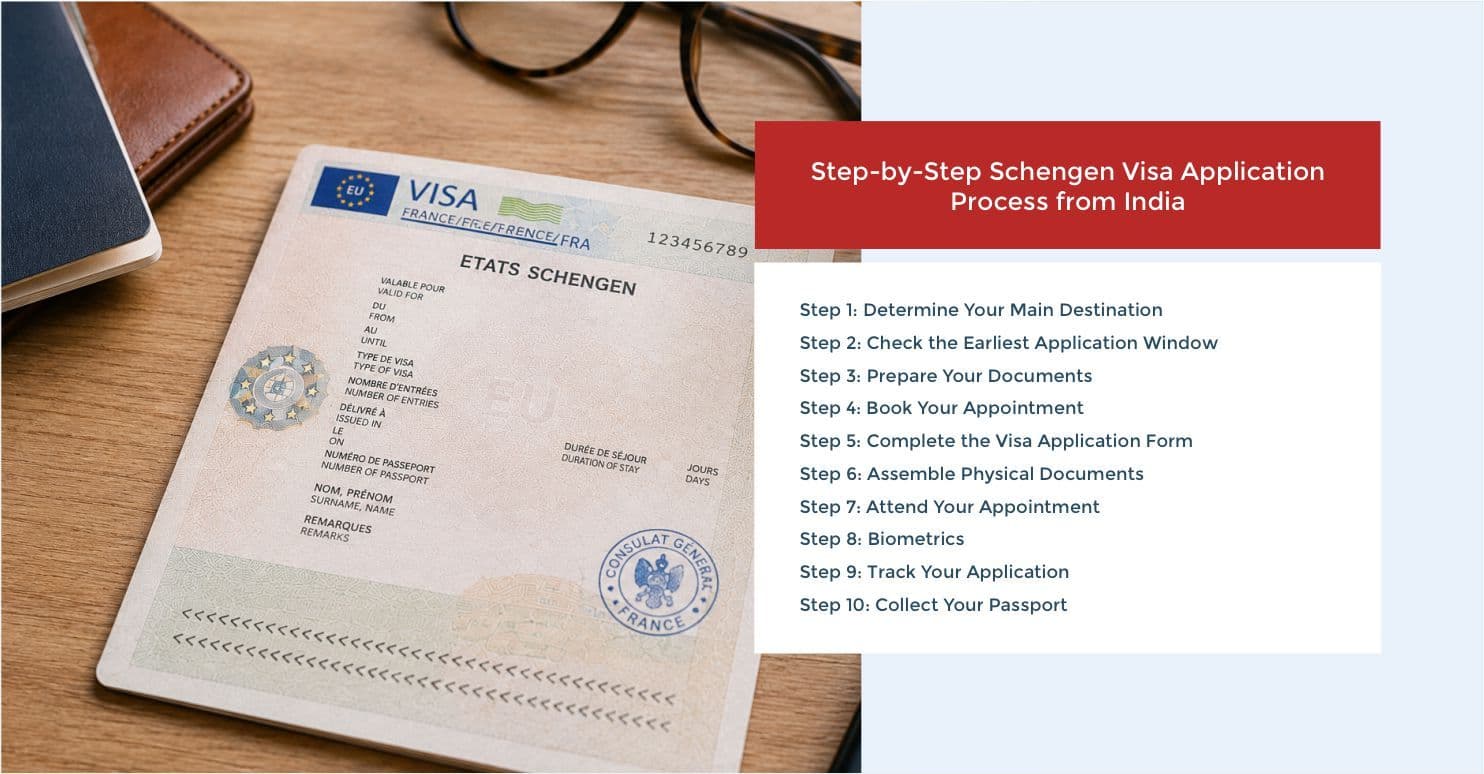
The Schengen visa application process in India follows a standard sequence across all 29 Schengen countries. The specific application centre used may vary by country, but the overall process is consistent.
Before doing anything else, finalise your travel itinerary and determine which Schengen country you will spend the most nights in. This tells you which country's consulate to approach. This step must come first - it determines everything else.
Under the Schengen Visa Code, you may apply for a Schengen visa no earlier than six months before your intended travel date and no later than 15 days before travel. The recommended timing is at least three months in advance for routine trips and four to five months in advance for summer travel to France, Italy, Spain, or Greece, where appointment slots and processing times are longest.
Do not apply more than six months in advance; applications submitted earlier than six months before travel will be rejected as premature.
Gather every required document before booking your appointment. Missing documents after booking your appointment can result in your application being returned incomplete.
Key documents to prepare first: valid passport, recent bank statements (three to six months), income tax returns, employment proof, and travel insurance certificate.
Visit the official website of the authorised application centre for your chosen country. Application centre websites change periodically, so verify the current official portal from the relevant consulate's official website rather than from any third-party source.
Appointment slots, especially for France, Germany, Italy, Spain, and Greece during summer months, fill within days or sometimes hours of release. Set calendar reminders and check frequently. New slots are often released in batches at specific times - in many cases early morning.
You will need to create an account on the booking system and fill in basic personal information to secure a slot.
The Schengen visa application form is standardised across all 29 member states. You fill it in online through the respective country's system or through the application centre portal.
The form asks for:
Print the completed form, verify all details against your passport, and sign it. Any corrections must be initialled. Do not leave fields blank - write "Not Applicable" where questions do not apply to you.
Organise your document file in the order specified by the application centre. Most require:
Keep the original documents separate from photocopies. Originals may be returned after inspection while photocopies are retained.
Arrive at least 10 minutes before your scheduled appointment time. Bring all documents, both originals and copies.
At the application centre:
The visa fee of €90 (for adults) is paid in Indian Rupees equivalent at the current consular exchange rate. The application centre fee is a separate charge. Both are non-refundable.
You will receive a receipt confirming your submission and a reference number for tracking.
If you have never given biometrics for a Schengen application, or if your previous biometric submission is more than 59 months (approximately five years) old, you must provide fingerprints and a photograph at the application centre.
If your biometrics are already on file in the Visa Information System (VIS) from a recent application, you may be exempted from re-submission. The application centre officer will tell you whether fresh biometrics are needed based on your records.
Biometric exemptions exist for:
Use the tracking reference number provided at submission to check your application status online. Status updates typically follow this sequence: documents received, forwarded to consulate, under process at consulate, decision made, passport ready for collection.
Processing time begins from the date your application is accepted as complete by the consulate, not from the date you submitted documents at the application centre. There is typically a delay of one to three business days between your appointment and the consulate receiving your file.
Once you receive notification that a decision has been made, collect your passport from the application centre or arrange courier delivery (a paid additional service).
If the visa is approved: Your passport will contain the Schengen visa sticker. Check every detail on the sticker immediately before leaving the application centre. Verify your name, passport number, travel dates, number of entries, and duration of stay.
If the visa is refused: You will receive a refusal letter explaining the reason using standard Schengen Visa Code refusal codes.
The document requirements for a Schengen visa from India are extensive but follow a logical structure. Every document serves a specific verification purpose. Understanding why each document is requested helps you prepare more compelling submissions. These requirements are based on the supporting documents listed under the Schengen Visa Code.
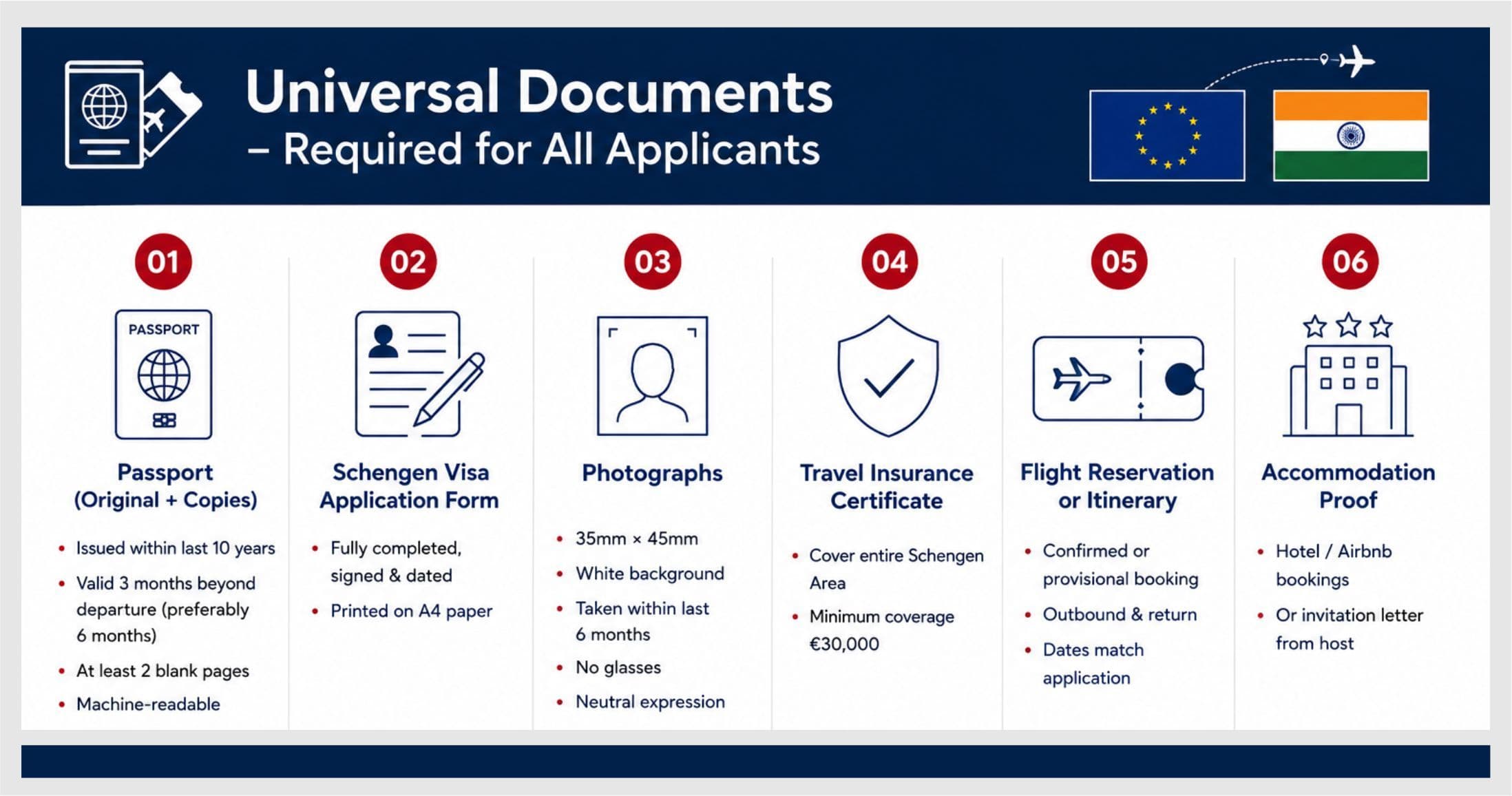
Your passport must be:
Provide photocopies of: the main biographical data page (page with your photo), the last page with address details, any pages with previous Schengen or other foreign country visa stamps, and any pages with previous entries into Schengen countries.
If you have an old passport containing relevant visa stamps or entry records, submit that old passport alongside your current passport. This is particularly useful if you have prior Schengen travel history that demonstrates your compliance record.
Why this document is required: The consulate verifies your identity, confirms your nationality as an Indian citizen, checks passport validity, and reviews your travel history.
2. Schengen Visa Application Form
The standardised form must be completed fully, signed by the applicant (or parent/guardian for minors), and dated. Print it on A4 paper. Do not staple it to other documents separately - it usually goes on top of your file.
Why this document is required: It is the formal legal application and contains the declarations you are making about your identity, travel purpose, and compliance intent.
3. Photographs
Two recent passport-format photographs. The standard Schengen photograph specification is:
Do not use photographs taken more than six months ago. Do not use photographs with a coloured or grey background.
Why this document is required: Biometric and identity verification.
4. Travel Insurance Certificate
A valid travel insurance policy covering the entire Schengen Area for the full duration of your stay. Minimum coverage: €30,000 for medical emergencies and repatriation.
Why this document is required: The Schengen Visa Code requires proof of insurance as a mandatory condition for every visa. The €30,000 floor is a legal minimum, not a suggestion.
5. Flight Reservation or Itinerary
A confirmed or provisional flight booking showing:
Your name matching the passport
Outbound flight from India to the Schengen Area
Return flight from Schengen to India (or onward if continuing travel)
Dates that match the dates on your visa application form
Many airlines and online platforms provide "reservation-only" itineraries that are not yet ticketed but hold a confirmed booking reference. These are acceptable for most consulates. You do not need a fully paid ticket at the application stage - a confirmed itinerary is sufficient.
Why this document is required: To verify your travel dates, confirm you have a return plan, and verify your entry and exit points.
6. Accommodation Proof
One of the following for every night of your stay in Europe:
Accommodation proof must cover the entire duration of your stay. A gap in accommodation documentation (for example, hotel confirmed for 10 nights but your application covers 14 nights) creates questions about your itinerary and finances.
Why this document is required: To verify where you will stay, confirm your trip logistics, and support the financial assessment (officers can verify whether the accommodation cost is consistent with your stated budget).
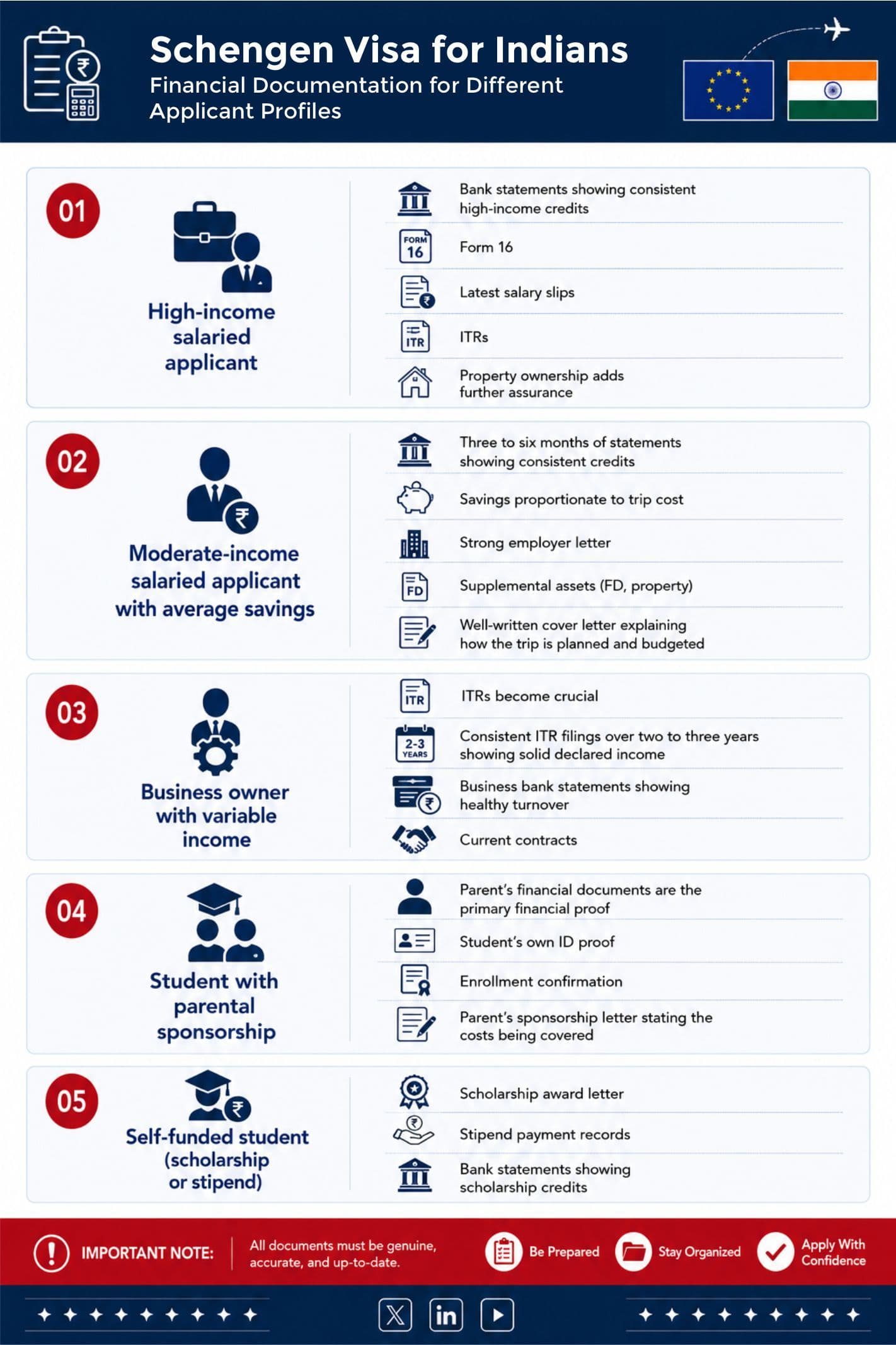
Original bank statements from your Indian bank accounts covering the most recent three to six months. Must be:
Provide statements for all accounts you intend to use to demonstrate financial means - savings accounts, current accounts, fixed deposits. Fixed deposit certificates are also useful supporting documents.
Why this document is required: Primary financial verification. Officers assess your average balance, spending patterns, regularity of income credits, and whether any suspicious large deposits appear shortly before the application.
Last two to three years of filed Income Tax Returns with acknowledgement receipts from the Income Tax Department. These confirm your declared income.
For salaried employees: Form 16 from your employer may also be submitted.
For self-employed and business owners: ITR is critical. Recent GST returns are also highly relevant.
Why this document is required: ITR provides an independently verified declaration of your income, distinct from what your bank statement shows. Consistency between your ITR-declared income and your bank statement is a positive indicator. Large discrepancies invite scrutiny.
For Salaried Employees:
The employment letter is one of the most important documents for salaried applicants. It must be dated recently (not months old), signed by an authorised person, and include the company's contact information for verification.
For Business Owners and Proprietors:
For Freelancers:
For Students:
For Retired Applicants:
For Homemakers:
If you are visiting a relative or friend in the Schengen Area, an official invitation letter significantly strengthens your application. The letter should be:
Depending on the country, the invitation letter may need to be officially certified or stamped by local authorities (for example, in Germany, formal Verpflichtungserklärung - an official sponsorship declaration - can be submitted). Check the specific requirements of your destination country.
Additionally, provide proof of the host's legal status in the Schengen Area: their residence permit, national identity card, or Schengen passport copy.
For business trip applicants, a letter from the inviting European company or organisation should specify:
Copies of previous passports or pages from your current passport showing past travel - particularly previous Schengen entries, US or UK visas, or visits to any country - are highly beneficial. They demonstrate that you are an experienced traveller who has complied with immigration rules previously.
If you own property in India (residential, commercial, agricultural), providing the sale deed, property tax receipt, or municipal record demonstrates your ties to India and an asset base.
Marriage certificate (if married), children's birth certificates (if applicable), documents showing dependents in India. These demonstrate personal reasons to return to India after your visit.
Proof of owning a vehicle in India is another tie-to-India indicator. Not critical, but supportive.
Financial assessment is one of the primary reasons Schengen visa applications are refused. Consulates want to verify that you can fund your trip without needing to work in Europe and that you have sufficient means of subsistence, as required during the visa assessment under Article 21 of the Schengen Visa Code.
No single official EU-wide minimum bank balance is specified for Schengen tourist visas. Each member state sets its own financial guidelines, and amounts are not always publicly published. However, general patterns emerge across consulates based on application outcomes.
As a practical guideline widely referenced in consulate processing:
Some Indian embassies post specific guidelines. The German embassy, for example, has historically cited approximately €45 to €65 per person per day for tourist trips. France and Italy tend to look at whether your balance is proportionate to your declared financial profile, rather than applying a strict per-day formula.
What this means in practice for a 10-day tourist trip (two adults):
Estimated trip costs: €1,500 to €2,000 (flights, hotels, food, activities) Suggested minimum bank balance at time of application: ₹3,00,000 to ₹5,00,000 or more, depending on your broader financial profile and whether you have other assets
These figures are illustrative. A stronger overall financial profile, demonstrated through ITR, fixed deposits, property, or other assets, means the bank statement requirement is assessed holistically, not mechanically.
You are not required to fund your own trip. It is perfectly legitimate to have a sponsor - your parents, spouse, or another close relative - fund part or all of your travel.
Sponsored applications require:
Fully sponsored applications: If the sponsor is covering everything and you have minimal personal funds, this is acceptable but draws closer scrutiny. Consulates want to see that the sponsor genuinely has the capacity to fund the trip and that the relationship is real. Submitting a sponsorship letter from a stranger or distant acquaintance raises questions.
Partially sponsored applications: More common and generally viewed more positively. If you have some personal funds (say ₹1,00,000 to ₹2,00,000) and the sponsor is covering the balance, this demonstrates that you also have personal financial standing, not just dependency.
Travel insurance for Schengen visa applications is not optional. Article 15 of EU Regulation No 810/2009 (the Schengen Visa Code) makes it a mandatory requirement for all applicants. Understanding exactly what qualifies - and what does not - is critical because insurance is one of the more common technical rejection reasons.
Your travel insurance for a Schengen visa from India must meet all of the following conditions:
1. Minimum medical coverage of €30,000 (approximately ₹27,00,000 to ₹30,00,000 at current exchange rates).
This is the hard floor set by EU law. Many policies offer higher coverage - €50,000, €100,000, or even unlimited medical coverage - and higher coverage is generally better for your application. However, the critical threshold is €30,000 minimum.
2. Coverage across all Schengen countries.
Your policy must specify "Schengen Area" or explicitly name all Schengen countries as covered territory. A policy that covers only specific countries (for example, "Europe excluding Eastern Europe" or "limited to France and Germany") will not satisfy the requirement.
3. Coverage for the entire duration of your intended stay.
The policy start date must be on or before your visa start date, and the policy end date must be on or after your visa end date. A slight buffer of two to three extra days of coverage beyond your planned travel dates is advisable to account for delays.
4. Includes medical repatriation coverage.
The policy must cover the cost of medically necessary repatriation to India if you are too ill or injured to travel on a standard flight. This is an explicit requirement of the Visa Code.
5. Issued by a recognised insurer.
The insurer must be a legitimate, regulated insurance company. Most Indian insurance companies authorised by IRDAI (Insurance Regulatory and Development Authority of India) that offer international travel insurance policies meet this standard.
The document you submit is the insurance certificate or policy schedule, not the full policy wording booklet. The certificate must state:
Some consulates check whether the insurer is on their approved or known insurer list. The German, French, and Italian consulates in India are known to be thorough in insurance verification.
Based on documented applicant experience and consulate familiarity, the following Indian insurers are widely recognised and accepted by Schengen consulates:
Purchase from the official IRDAI-registered insurer directly or through authorised agents. Do not purchase from overseas aggregators for Indian Schengen applications, as the certificate format may not be recognised.
Insurance premiums vary by age, trip duration, and coverage level. Indicative 2026 price ranges per person per trip:
| Age | 15-day trip | 30-day trip |
| 18–35 years | ₹800 – ₹1,500 | ₹1,200 – ₹2,500 |
| 36–55 years | ₹1,200 – ₹2,500 | ₹2,000 – ₹4,500 |
| 56–70 years | ₹2,500 – ₹6,000 | ₹4,000 – ₹10,000 |
| Above 70 years | ₹6,000 – ₹20,000+ | ₹10,000 – ₹25,000+ |
Prices vary significantly by insurer, plan, and coverage level. Senior citizens typically face higher premiums, and some insurers have age caps or require medical questionnaires for travellers above 60 or 70.
If you plan to visit Europe more than twice in a year, annual multi-trip insurance policies are more economical. Annual policies from Bajaj Allianz and ICICI Lombard typically cost ₹3,000 to ₹8,000 per year for adults. These policies cover multiple trips within the year with each trip capped at a certain duration per visit (usually 30 to 60 days per trip). For each Schengen application, you submit the annual policy certificate covering the relevant travel dates.
Travel insurance covering Schengen visa requirements is medical-focused. It does not necessarily cover:
For senior citizens with existing medical conditions, purchase a policy that explicitly covers or does not exclude your condition. "Pre-existing condition exclusion" clauses are common and can mean that your most likely medical need in Europe is the one thing your insurance does not cover.
Understanding the actual total cost of a Schengen visa from India requires looking at several separate fees, not just the government fee displayed on the consulate's website.
The Schengen visa fee is set by the European Commission under Article 16 of the EU Visa Code and is identical regardless of which Schengen country you apply through. As of 2026 (following an increase in June 2024 from €80 to €90):
| Applicant Category | Fee in EUR | Approximate INR |
| Adults (18 and above) | €90 | ₹8,200 – ₹8,700 |
| Children aged 6–11 | €45 | ₹4,100 – ₹4,350 |
| Children under 6 | Free | ₹0 |
Fee exemptions (no visa fee charged):
In addition to the government visa fee, you pay a separate service fee to the visa application centre (typically the facility that accepts your documents and forwards them to the consulate). This fee also covers the centre's services: receiving documents, providing biometric equipment, transferring files to the consulate, and notifying you of the decision.
In November 2025, service fees in India were revised upward by 15–20% compared to earlier rates. The service fee varies by destination country:
| Destination Country | Service Fee (Approximate, inclusive of GST) |
| Germany | ₹1,933 |
| France | ₹2,100 – ₹2,500 |
| Italy | ₹1,500 – ₹2,000 |
| Spain | ₹2,000 – ₹2,300 |
| Netherlands | ₹1,800 – ₹2,100 |
| Portugal | ₹2,800 – ₹3,111 |
| Switzerland | ₹2,000 – ₹2,400 |
| Austria | ₹1,700 – ₹2,000 |
| Greece | ₹1,800 – ₹2,200 |
| Slovakia | ₹400 – ₹600 |
Note: Service fees are updated periodically and vary slightly by application centre city. Verify the current fee on the official booking portal before your appointment.
The service fee is also non-refundable regardless of the visa outcome.
Putting it all together, here is a realistic 2026 cost breakdown per adult applicant for a typical 10 to 14-day Schengen tourist visa:
| Cost Component | Amount |
| Government visa fee (€90) | ₹8,200 – ₹8,700 |
| Application centre service fee | ₹1,933 – ₹3,111 |
| Travel insurance (basic, 14 days) | ₹800 – ₹2,000 |
| Photographs (if not already available) | ₹100 – ₹300 |
| Document photocopying | ₹100 – ₹300 |
| Optional courier return | ₹500 – ₹1,000 |
| Total per adult | ₹11,600 – ₹15,400 |
For a family of four (two adults, two children aged 6–11), minimum costs in 2026:
The government visa fee (€90 equivalent in INR) and the application centre service fee are paid in cash or via card at the application centre on the day of your appointment. Specific accepted payment methods vary by centre - check the official website.
You cannot pay the visa fee online in advance in most cases. Payment happens at the counter on appointment day.
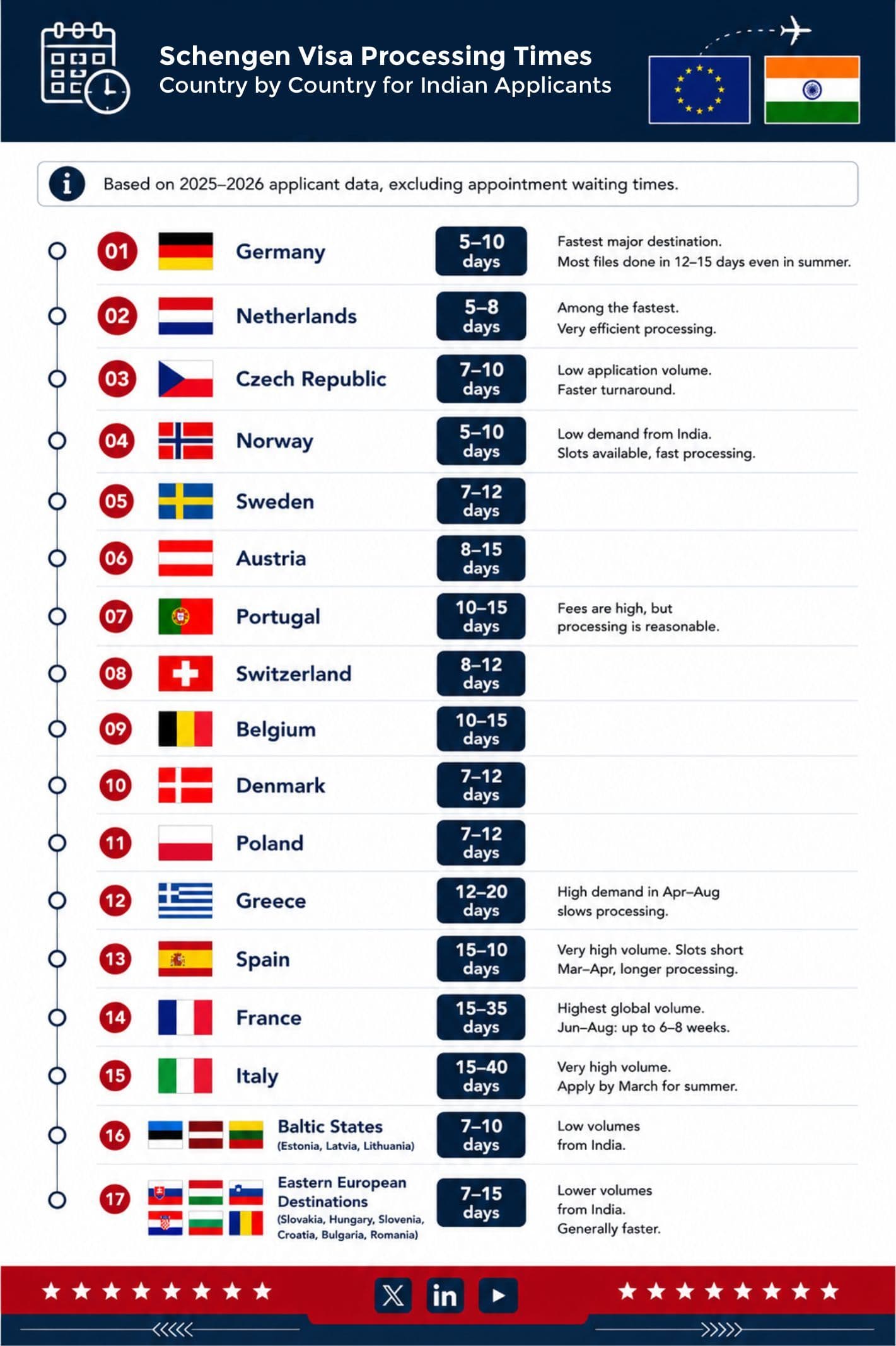
Processing time is the duration between the consulate formally receiving your application (which may be a day or two after your appointment) and making a decision. It does not include the time you spend waiting for an appointment slot before your visit.
The EU Visa Code sets three processing time tiers:
The 15-day legal standard is the benchmark. In practice, many consulates process straightforward applications faster, while some regularly take longer during peak season.
The following processing times are based on patterns from 2025–2026 applicant data, excluding appointment waiting times:
When people ask how long a Schengen visa takes, the answer involves three distinct time periods:
Appointment wait time: The wait between when you try to book and when your appointment is available. This can be 2 weeks to 8 weeks depending on the country and season.
Document preparation time: Before your appointment, you gather bank statements, book flights and hotels (provisionally), get insurance, have photos taken, and fill out the form. Allow 1–2 weeks minimum.
Processing time: After your appointment, 5 to 40 working days depending on country and season.
Total realistic timeline from "starting the process" to "passport returned":
The critical rule: Apply at least six to eight weeks before travel for most destinations. For France or Italy during summer, apply 12–16 weeks before travel.
Incomplete applications: Files sent back to applicants for missing documents add days or weeks to total processing time.
Prior visa refusals: If you have a previous Schengen refusal in your history, consulates cross-check the previous application and may request additional documentation or clarification, adding time.
SIS check results: The Schengen Information System is a shared database across all 29 member states containing alerts about persons of interest, entry bans, and other flagged individuals. If your name generates a SIS hit (even an erroneous one), manual investigation is required before a decision, adding 7 to 14 days or more.
Under-resourced consulates: Some smaller Schengen countries have fewer consular staff in India. What should be a 10-day process can take three weeks.
The cascade regime represents the most significant policy shift for Indian Schengen travellers since the original Visa Code came into force. Understanding it in full - including the eligibility conditions, the upgrade pathway, and what it means for your planning - gives frequent Europe visitors a clear roadmap.
The European Commission adopted the cascade regime for Indian nationals on 18 April 2024 through a specific implementing decision under the Schengen Visa Code. It is separate from the standard Visa Code provisions and applies exclusively to Indian citizens residing in India who apply for Schengen visas in India.
The policy creates an incentive structure: the more compliantly you use Schengen visas, the easier and longer your subsequent access becomes. It is the EU's formal recognition that frequent Indian travellers with clean compliance records represent low migration risk and should not be burdened with repeat single-entry applications.
Stage 1: Establishing Your History (First and Second Visas)
If you are applying for your first or second Schengen visa as an Indian citizen, you are in the base stage. The consulate assesses your application normally according to standard Visa Code requirements. You may receive a single-entry or multiple-entry visa for a standard validity (typically 30 days to 12 months) based on your trip and documentation.
Your compliance at this stage is the foundation for cascade eligibility. Both visas you hold and use must be used lawfully - you must not overstay, not work illegally, not violate your visa conditions.
Stage 2: The Two-Year Multiple-Entry Visa
Once you have obtained and lawfully used two Schengen visas within the preceding three years, you become eligible for a two-year multiple-entry Schengen visa.
"Lawfully used" means:
If you meet this criterion, the consulate may issue you a multiple-entry visa valid for two years on your next application. The word "may" is deliberate - the cascade regime creates eligibility, not an entitlement. The consulate retains discretion based on your full profile, and if your financial situation, employment, or other factors have changed, they may still issue a shorter-validity visa.
Applicants with a documented travel history should explicitly reference their previous visas and their travel record in their cover letter when applying for the next visa. This makes it easier for the officer to apply the cascade regime.
Note: The standard Schengen Visa Code cascade for most nationalities includes an intermediate one-year multiple-entry step before the two-year tier. The India-specific implementing decision (Commission Decision C(2024) 2434, adopted 18 April 2024) removes this intermediate tier entirely. Indian nationals residing in India go directly from standard visas to the two-year visa, and then to the five-year visa - skipping the one-year step that applies to other nationalities.
Stage 3: The Five-Year Multiple-Entry Visa
After successfully holding and using a two-year cascade visa in compliance with all conditions, you become eligible for a five-year multiple-entry visa on your next application.
The five-year visa is capped by passport validity. If your passport expires in three years, your visa will be valid for three years (not five). You should ensure your passport has at least five years of remaining validity before applying for a five-year cascade visa, to get the maximum benefit.
It does change:
It does NOT change:
If the only Schengen visa stamps in your passport are airport transit visas (Type A), these do not count toward your cascade eligibility tally. You need two full short-stay Type C Schengen visas that you actually entered on and used lawfully.
As of 2026, multiple consulates are actively issuing cascade visas to eligible Indian applicants. The French consulate in Bengaluru has been noted as particularly active in implementing the cascade regime, with Indian applicants reporting five-year visa issuances within four working days for eligible profiles. Germany and the Netherlands have also been processing cascade eligibility claims efficiently.
Not all consulates are at the same stage of cascade regime implementation. If you believe you qualify but your recent visa was not upgraded, you can mention your eligibility in your cover letter, list your two previous Schengen visas (dates and issuing country), and request consideration under the cascade regime.
Rahul, a software engineer from Pune, took his first Schengen trip to Paris in October 2022 on a France single-entry visa (used the visa, 12 days in France, left on schedule).
In April 2024, he applied again for a Germany-based trip with a German multiple-entry visa valid for one year. He entered Germany twice over the year, each time staying for 10 days.
In January 2026, Rahul applied for a France visa again. He now has two lawfully used Schengen visas within the past three years (October 2022 France visa, 2024 Germany visa used twice). He is eligible under the cascade regime for a two-year multiple-entry visa.
He submits his application, includes his previous visa copies and entry/exit stamps in his file, mentions his cascade eligibility in his cover letter, and receives a France multiple-entry visa valid for two years.
In 2028, after using the two-year visa compliantly, Rahul will be eligible for a five-year cascade visa.The 90/180-day rule is the foundational limit on how long any non-EU traveller can stay in the Schengen Area on a short-stay visa. Getting this calculation wrong, even by a day, creates serious consequences. The rule is now enforced automatically by EES.
You may be present in the Schengen Area for a maximum of 90 days in any rolling 180-day period. Both the 90-day maximum and the 180-day window are critical to understand.
The 180-day window is not a fixed calendar period. It is a rolling window that looks backward 180 days from any given date. On any day that you are inside the Schengen Area, the system counts how many days (including that day) you were inside the zone during the 180 days preceding it. If that count reaches or exceeds 90, you have used your allowance and must exit.
Many first-time Schengen travellers believe the 90-day allowance "resets" every six months, or that spending time outside Europe means your 90 days start fresh. This is incorrect.
The 180-day window rolls every single day. Consider this example:
You enter France on 1 January and stay for 90 days, leaving on 31 March. You believe your 90 days have "reset" and try to re-enter on 1 April.
On 1 April, the system looks back 180 days (from 1 April to 5 October). During that period, you were inside Schengen for all 90 days from January 1 to March 31. Your allowance is fully used. You cannot enter again on 1 April.
To be able to enter on 1 April with no prior days used, you would need the 90 days you already spent to fall outside the 180-day lookback window. That means you need to wait until the first day you spent in Schengen (1 January) to be more than 180 days in the past - which would be around 30 June.
The commonly cited "90 days, then 90 days out" approach works only if you leave precisely when you hit 90 days and wait 90 days before re-entering. Even then, a small number of prior-period days can remain within the 180-day window, reducing your available days on return. Use the European Commission's official Schengen calculator at home-affairs.ec.europa.eu to verify every re-entry calculation.
The safest way to calculate remaining Schengen days manually:
If your remaining allowance is 0 or less, you cannot enter.
Example:
You entered Schengen on 10 March for 20 days (leaving 30 March). Then you re-entered on 15 June for 15 days (leaving 30 June). Now it is 1 August. Can you enter again?
Days in Schengen during last 180 days (from today, 1 August, back to 3 February):
You can enter on 1 August and stay up to 53 days (until approximately 23 September).
Days that count:
Days that do NOT count:
Important: Days in Ireland or the UK do not reduce your Schengen day count. These countries are outside Schengen. However, days in Monaco, San Marino, and Vatican technically do count, even though those micro-states are not formal Schengen members (they operate within the zone).
Since EES became fully operational on 10 April 2026, overstays are flagged automatically at exit border points. There is no longer any possibility of an undetected overstay being "missed" due to a manual stamping oversight.
Consequences of overstaying:
European Commission Official Calculator: The EU provides a free calculator at: https://home-affairs.ec.europa.eu/policies/schengen/short-stay-visa_en
This calculator is the official tool. Enter your past entry and exit dates and it tells you how many days you have used and how many remain. Use it before every trip.
This section covers the system in full operational detail - how it works at the physical border, what to expect as an Indian traveller, and how it changes the practical experience of entering Europe.
Ireland and Cyprus: These two non-Schengen EU members are not part of the EES system.
On your first entry under EES, a border officer or self-service kiosk collects:
This data is stored in the central EES database for three years if you had a legal stay, or up to five years if you were flagged for a violation or refused entry.
On every subsequent entry within the same three-year window, the border officer scans your passport, the system retrieves your stored biometrics, verifies your identity through a quick face scan or fingerprint check, and records the new entry. You do not need to re-enrol each time.
The EU launched a "Travel to Europe" app in conjunction with EES. Indian travellers can pre-register their biometric data using this app before they board their flight. Pre-registration is voluntary but strongly recommended during the system's rollout period.
Pre-registration reduces time spent at the border on first entry because your data is already partially in the system. When you present your passport, the border officer retrieves your pre-registered profile and completes enrolment faster.
Note: Pre-registration does not guarantee faster processing - the border officer still completes the formal entry registration and identity verification. But it reduces the time for the biometric collection phase.
Major international airports (Frankfurt, Amsterdam, Paris, Rome, Vienna, Madrid):
These airports have installed self-service EES kiosks in addition to staffed immigration lanes. As an Indian visa-holding traveller, you may be directed to a kiosk for initial biometric capture, followed by a brief officer interaction for verification and formal entry stamp. Expect the process to take 5 to 20 minutes for first-time EES enrolment.
EES Queue Reality - Summer 2026
Since EES reached full operation on 10 April 2026, first-time arrivals have faced significantly longer queues at major Schengen entry airports during peak hours. Paris Charles de Gaulle has recorded the worst congestion, with reported waits of 3–5 hours in Terminal 2E during morning arrival peaks. Amsterdam Schiphol, Frankfurt, Rome Fiumicino, Lisbon, Athens, and Madrid Barajas have all seen queues of 2–4 hours during summer peak periods. IATA has warned of potential 6-hour waits at the busiest hubs during July and August 2026.
Practical adjustments for summer 2026 travel:
Smaller airports and land border crossings:
At lower-traffic entry points, the process is fully manual with the officer using a tablet or fixed-station system. The biometric capture and registration happen at the officer's station. May take 10 to 30 minutes during busy periods.
Cross-channel terminals (Eurostar, Eurotunnel):
EES checks here happen before you board in the UK (at St Pancras or Folkestone), not upon arrival in France. This is a key distinction for passengers travelling from the UK to Schengen via tunnel or rail.
The EES database computes your Schengen day count automatically in real time. When you present your passport to enter Schengen, the system:
You will no longer be able to argue that a stamp is missing or unclear. The digital record is precise. The only remaining uncertainty is if there are brief technical outages, in which case border authorities revert to manual passport stamping as a fallback - but the EES record is primary once the system is back online.
EES works alongside, not in replacement of, the Visa Information System (VIS). The VIS stores biometric data collected during the visa application process (the fingerprints you give at the application centre). EES records biometric data at the border crossing.
When you present your passport at EES entry:
If your fingerprints at the border do not match your VIS record from the visa application, this is a serious discrepancy. Always ensure you present yourself (not someone else) at both the visa application centre and the border.
Your EES data is retained for three years from your last exit from Schengen (assuming no violations). This means border officers on future trips can see a clear digital record of all your Schengen visits for the past three years - entry dates, exit dates, countries visited, and visa used.
This actually benefits compliant travellers. If you have a clean three-year history of short, lawful visits, that record supports future visa applications and can accelerate cascade regime eligibility. The data effectively vouches for your compliance history in a way that physical passport stamps (which could be faded, torn, or disputed) never could.
ETIAS, the European Travel Information and Authorisation System, is frequently mentioned in the context of Schengen travel and causes considerable confusion among Indian travellers. The core fact to understand immediately is:
ETIAS does not apply to Indian citizens. Indian passport holders are not eligible for ETIAS. An Indian passport holder will never use ETIAS.
ETIAS is a pre-travel authorisation system for citizens of countries that are already visa-exempt for Schengen travel. Think of it as the EU's version of the US ESTA, Canada's eTA, or Australia's ETA.
Countries like the United States, the United Kingdom, Canada, Australia, New Zealand, Japan, South Korea, Mexico, and many others do not require a Schengen visa. Their citizens can enter Schengen without any advance visa process. ETIAS will require these visa-exempt travellers to obtain an online authorisation before boarding a flight to Schengen.
ETIAS is NOT a visa. It does not replace visa requirements for countries that currently need visas. It only affects countries that currently have visa-free access to Schengen.
India is not on the EU's list of visa-exempt countries. Indian citizens require a Schengen visa (Type C) for every short-stay visit to any Schengen country. Because Indians already need a visa, they go through a far more comprehensive assessment process than ETIAS. ETIAS is unnecessary for Indian applicants - the Schengen visa itself serves as the pre-travel authorisation.
When ETIAS launches, it will affect American, British, Canadian, and Australian travellers coming to Europe. It will not affect Indian travellers in any way.
ETIAS has no confirmed launch date as of July 2026. The EU removed its previous Q4 2026 target from the official ETIAS website in mid-July 2026 following reporting that eu-LISA - the agency building the system - has internally concluded a 2026 launch is no longer feasible. A revised timeline is expected after eu-LISA's September 2026 board meeting; a 2027 launch is the current realistic expectation. ETIAS does not apply to Indian passport holders regardless of when it launches - it targets visa-exempt nationalities only.
If you read an article or see a post saying "Indians will need ETIAS for Europe" - that information is incorrect. You will continue to need a Schengen visa, exactly as before. The visa process described in this guide applies to Indian citizens. ETIAS is a separate system for a different group of nationalities.
A cover letter (sometimes called a cover note, personal statement, or application letter) is one of the most powerful tools an Indian Schengen visa applicant has. It is not mandatory at all consulates, but at those that ask for it and even at those that treat it as optional, a strong cover letter significantly improves your application.
The cover letter is your opportunity to speak directly to the visa officer. Your documents are data points - the cover letter is the narrative that connects those data points into a coherent, credible story. It explains:
A well-written cover letter pre-empts questions the officer might otherwise raise as concerns, demonstrating transparency and preparation.
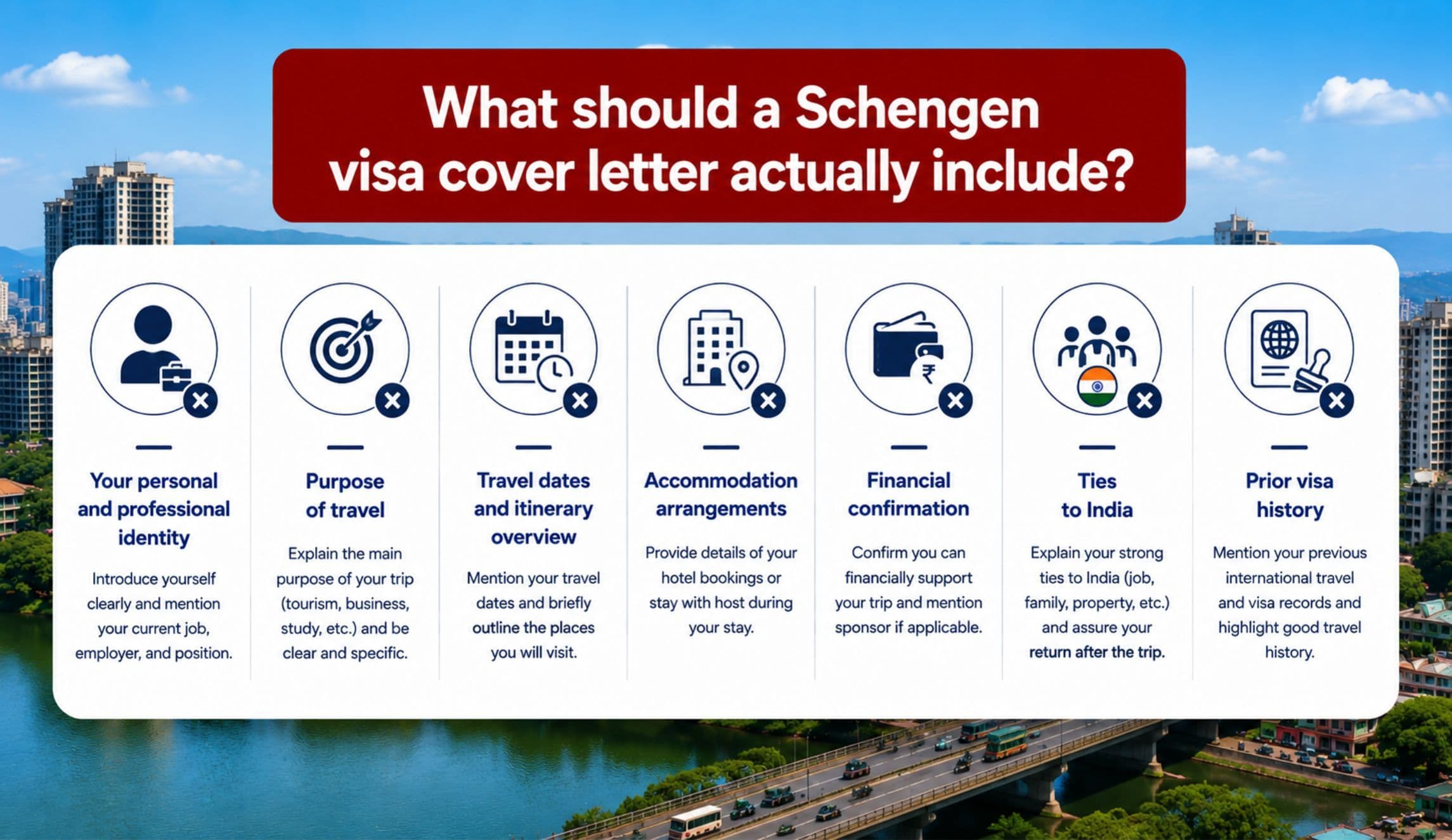
Your personal and professional identity: State your full name, occupation, employer name (if employed), or business name (if self-employed), your role, and how long you have been in your current position or profession.
Purpose of travel: Be specific. "Tourism" is not enough. State which cities you plan to visit, what specific things you want to see or do, and why this particular trip is meaningful to you. If you are visiting friends or family, state this clearly.
Travel dates and itinerary overview: Summarise your planned itinerary. You do not need to list every hour of every day, but a brief day-by-day or city-by-city overview shows that your travel plan is genuine and thought-through.
Accommodation arrangements: State where you will be staying, whether hotel, Airbnb, or with a host.
Financial confirmation: State explicitly that you are funding your own trip (or that a named sponsor is funding it), that you have adequate funds, and that copies of your bank statements are enclosed.
Ties to India: This is the most critical section. You must demonstrate that you will return to India after your visit. Ties that should be mentioned: your employment and leave approval, your business and its ongoing activities, family members in India (spouse, children, parents), property you own, and any other reasons you have to return.
Prior visa history: If you have previous Schengen visas or visas for other countries (US, UK, Canada, Australia), mention them. They demonstrate your compliance history and travel credibility.
Do not write a generic, template-heavy letter that could apply to any applicant. Officers read hundreds of these. A letter that starts with "I am very excited to visit Europe" and uses phrases like "I promise to abide by all laws" without any specific content is essentially worthless.
Do not make claims you cannot support with documents. If you write "I own property in Mumbai," make sure you have a property document in your file. Inconsistencies between the letter and the documents damage credibility.
Do not be defensive or apologetic about past refusals or limited financial means. Address them factually and positively. "My previous application in 2023 was refused due to insufficient financial documentation. Since then, I have maintained consistent savings as shown in my bank statements, with a current balance of ₹X" is far better than ignoring the prior refusal.
Do not write an extremely long letter. One to two pages is ideal. Cover the key points clearly. Officers spend minutes, not hours, on each application.
The question of flight and hotel reservations causes significant anxiety among Indian Schengen applicants because of the apparent catch: you need confirmed reservations to apply for the visa, but if you buy non-refundable tickets before knowing whether the visa is approved, you risk losing thousands of rupees.
The solution is to use the reservation and hold systems available through airlines and booking platforms.
Most Schengen consulates require a flight reservation (also called an itinerary or PNR) rather than a fully paid, non-refundable ticket. The difference matters:
A flight reservation: A confirmed booking with a valid PNR (Passenger Name Record) showing your name, flight numbers, dates, and booking reference. You have reserved the seat but may not have paid in full. The booking can typically be cancelled within 24 to 72 hours without a full penalty, or it may be held for a few days at no cost.
A paid non-refundable ticket: The full ticket price paid. If the visa is refused, you lose the ticket cost.
Direct airline hold: Many major airlines allow you to hold a booking for 24 to 72 hours for free or for a small fee. Book the flight on the airline's website or through a travel agent, and ask them to hold the reservation while you attend your visa appointment. The PNR reference is valid for the visa application.
Refundable ticket purchase: Some airlines (Air India, Lufthansa, Air France, and others) offer fully refundable fare classes that allow cancellation before departure with a full refund. These fares cost more than basic economy, but they eliminate the visa rejection risk entirely.
Third-party itinerary services: Several online services specifically offer visa-compliant flight reservation letters. These provide a genuine PNR from real airlines without requiring full payment. The reservation typically expires after five to seven days, which is usually sufficient to cover your visa appointment and a brief initial period. After the visa is approved, you then actually purchase your tickets.
Always ensure the reservation shows a round trip (outbound from India to Europe and return from Europe to India). A one-way reservation alone raises questions about your return intent.
Booking.com and similar platforms: Many hotels on Booking.com offer free cancellation policies. Book such hotels for your visa application. If the visa is approved, you keep the booking or switch to your preferred property. If the visa is refused, you cancel without cost. Do not book non-refundable hotel rates for a trip whose visa has not yet been approved.
What the hotel booking must show:
A reservation "under process" without a confirmed reference number may not be accepted. Ensure all bookings show confirmed status.
Accommodation gaps: Every night of your stay in Europe must have a corresponding accommodation record. A gap of even one or two nights without a hotel booking or hosting arrangement invites questions.
Your travel insurance dates, flight booking dates, accommodation dates, and visa application dates must all be internally consistent. If your visa application says you plan to travel from 10 July to 24 July, then:
A mismatch between these documents is a red flag that suggests the application is not genuine or is poorly prepared.
In 2024, approximately 15% of Schengen visa applications from India were refused - around 1 in every 6 to 7 applications. France, Germany, and Italy account for a significant share of rejections. Understanding exactly why applications fail is the most effective way to ensure yours does not.
This is the single most frequent reason, accounting for over 30% of Indian Schengen rejections. Officers conclude that the applicant cannot fund the trip without resorting to unauthorised work or overstaying.
What triggers this rejection:
How to avoid it:
Officers assess whether your trip is genuine. If your stated purpose is tourism but your documents raise doubts, or if your itinerary is vague and disconnected from your stated goals, this triggers refusal.
What triggers this rejection:
How to avoid it:
This is the second most common theme underlying Schengen refusals for Indians. The officer must be satisfied that you have sufficient reason to return to India after your trip. If you cannot convincingly demonstrate that reason, your application faces difficulty.
What triggers this rejection:
How to avoid it:
Mechanical errors in the application file - missing documents, wrong documents, or inconsistent information - account for a significant share of refusals.
What triggers this rejection:
How to avoid it:
A prior Schengen refusal, a previous overstay in any country, or a recorded deportation or entry ban anywhere in the world is a significant negative factor.
What triggers this rejection:
How to avoid it:
What triggers this rejection:
How to avoid it:
Filing your application at the consulate of a country that is not your main destination is a procedural error that results in rejection as inadmissible, not as a substantive refusal.
How to avoid it:
When your Schengen visa is approved, a sticker is placed in your passport. This is your visa. Understanding every field on the sticker prevents confusion at the border and helps you verify that the information is correct.
A standard Schengen visa sticker contains the following fields:
Example: A visa FROM 15 July UNTIL 14 August means you must enter on or after 15 July AND you must exit by 14 August. If you enter on 10 August and want to stay 10 days (to 20 August), your visa does not permit this - you must exit by 14 August.
NUMBER OF ENTRIES: This shows 1, 2, or MULT (multiple).
DURATION OF STAY: The maximum number of days you may spend in the Schengen Area on any single visit or in total (depending on visa type). Most tourist visas show "90" meaning you may stay up to 90 days total within the validity period.
ISSUED IN: The city or country where the visa was issued (for example, "NEW DELHI" or "MUMBAI").
ON [DATE]: The date the visa was issued.
TYPE: Most Indian tourist applicants receive "C" (short-stay). The type field specifies the visa category.
PASSPORT NO: Should exactly match your passport number. Verify this immediately.
SURNAME, NAME: Your full name as per your passport. Verify spelling exactly - even a minor spelling difference can cause issues at the border.
Holographic and security elements: The sticker contains holograms, watermarks, and machine-readable elements. These cannot and should not be tampered with.
Before leaving the application centre:
If any field is incorrect, report it immediately at the application centre. Do not travel with a visa containing incorrect information - this can cause problems at the border.
A Schengen visa refusal is not the end of the road. Indian applicants have a formal right to appeal a refusal, provided the appeal is made within the correct timeframe and through the correct process.
When your visa is refused, you receive an official refusal letter. This letter is crucial; it contains the specific reason(s) for refusal, referenced by codes under the Schengen Visa Code Article 32.
Common refusal codes include:
Each code corresponds to a specific weakness that was identified in your application.
The refusal letter must inform you of your right to appeal, the applicable deadline, and the authority to whom an appeal should be addressed. This information varies by Schengen country.
Each Schengen member state has its own appeal process:
Germany: You may file a formal objection (Widerspruch) with the issuing consulate within one month of receiving the refusal. If this fails, a court appeal to an administrative court in Germany is technically possible but rarely pursued by Indian applicants.
France: The appeal process runs through the French courts. In practice, most Indian applicants choose reapplication rather than a formal appeal through French administrative courts, given the time and cost involved.
Italy: Appeals go to the administrative tribunal (TAR). Again, mostly a theoretical option for Indian applicants.
Spain: An appeal can be filed with the Consulate of Spain or elevated to the administrative authorities.
In most practical cases, Indian applicants do not pursue formal legal appeals through Schengen member state courts. The costs, language barriers, and time make reapplication a more realistic option.
Many consulates allow an informal written objection to the specific refusal decision. This is a letter addressed to the consulate explaining why the decision was incorrect, addressing the specific reasons cited in the refusal letter, and providing any additional supporting information.
This informal objection must be submitted promptly - usually within 30 days - and must directly address the stated refusal reason. It is not a new application; it is a challenge to the existing decision.
This approach sometimes results in the consulate reconsidering the original decision without a formal legal appeal.
The appeal deadline varies by country but is typically 30 to 60 days from the date of the refusal decision. Missing this deadline means your appeal right for that decision expires. After the deadline, your only option is a new application.
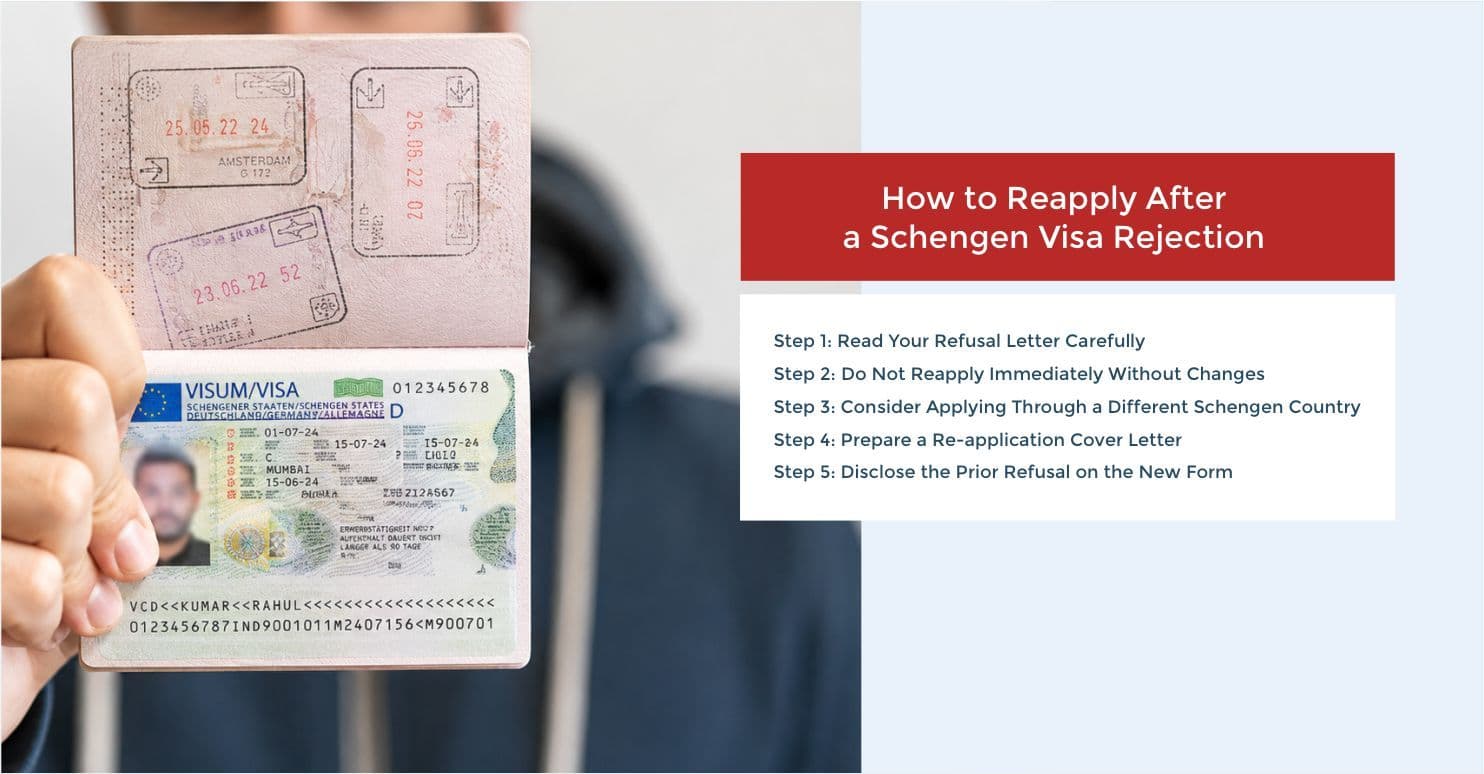
Reapplication after a refusal is far more common than formal appeals and often more effective. The key is to understand why you were refused, genuinely address that reason, and submit a stronger application.
The refusal letter is not a formality - it is the specific diagnosis of your application's weakness. Read it thoroughly. Identify the exact reason or reasons cited.
If the reason is "insufficient financial proof," gather better financial documents. If the reason is "no justification for travel purpose," write a stronger cover letter with a more specific itinerary. If the reason is "risk of irregular migration," address your ties to India more forcefully.
Reapplying within days of a refusal with the same documents is not productive. Consulates see your prior refusal history. A rapid resubmission without substantive changes signals that you did not understand or accept the reason for refusal, and may result in another refusal on the same grounds.
Wait until you have genuinely addressed the stated reason. For financial documentation, this may mean waiting three to six months until your bank statements reflect improved savings. For employment ties, it may mean waiting until your new employment letter is available.
If your main destination was France and France refused your application, consider whether your itinerary can be restructured to make Germany, the Netherlands, or another country your main destination. A different consulate, with a fresh set of eyes and potentially different internal assessment standards, may view your application more favourably.
Note: This only works if the alternative country genuinely becomes your main destination. Pretending to have a different main destination while planning primarily to visit the refused country is misrepresentation.
Your reapplication cover letter must acknowledge the prior refusal, explain what has changed, and directly address the stated reason. Be factual, not emotional. "My previous application was refused because financial documentation was deemed insufficient. I have since maintained consistent savings as shown in my updated bank statements attached, with an average monthly balance of ₹X over the past six months" is the right approach.
The visa application form asks whether you have previously been refused a visa. Always answer truthfully. Non-disclosure of a prior refusal is a misrepresentation that can result in a refusal on those grounds alone, and in more serious cases, it can result in an entry ban.
While the Schengen Visa Code standardises the core requirements, each member state's consulate applies the rules through its own internal guidelines, processing culture, and administrative practices. Understanding country-specific differences improves your application.
France is the world's most visited country and one of the most popular Schengen destinations for Indian travellers. It is also among the more challenging countries for visa approval.
Rejection rate: Approximately 14–16% of Indian applications are refused. This is above the average Schengen rejection rate.
Application centre: TLScontact manages French Schengen visa applications in India. Application centres are in Delhi, Mumbai, Chennai, Bengaluru, Hyderabad, Kolkata, and Ahmedabad.
Processing time: 15 to 35 working days. During summer (June to August), French visa processing from India regularly stretches to six to eight weeks. Apply at least 12 weeks before summer travel to France.
Specific notes:
Paris tip: If you are visiting Paris, consider a phased visit between Paris and other French cities or neighbouring Schengen countries. An itinerary that shows Paris plus Lyon, Nice, or Bordeaux demonstrates genuine tourism interest beyond just the Eiffel Tower.
Germany is the preferred Schengen destination for Indian business travellers and the fastest-processing major Schengen consulate in India.
Rejection rate: Approximately 10–12% of Indian applications. One of the lower rejection rates among popular Schengen destinations.
Application centre: Primarily managed through TLScontact in India. Centres in Delhi, Mumbai, Chennai, Bengaluru, Hyderabad, and Kolkata.
Processing time: 5–10 working days for most complete applications. Among the most reliable for quick decisions.
Specific notes:
Italy is extremely popular with Indian tourists and one of the most challenging for appointment availability and processing times during summer.
Rejection rate: Around 12–15% depending on the consular post.
Application centre: Via Italy's authorised centres in India.Processing time: 15–40 working days. Among the slowest in peak season. Apply by March for June–September Italy travel.
Specific notes:
Spain attracts large numbers of Indian tourists and has a particularly well-recognised backlog problem during summer.
Rejection rate: Approximately 10–13%.
Application centre: Managed through centres in India.
Processing time: 15–30 working days during normal periods. Six to eight weeks during peak summer season. Spain appointment availability in India collapses by April for summer travel.
Specific notes:
One of the best countries for Indian Schengen applicants due to fast processing and efficiency.
Rejection rate: Approximately 8–10%.
Processing time: 5–8 working days. Fastest among major Schengen destinations for Indian applicants.
Specific notes:
Switzerland is non-EU but Schengen, and the Swiss consulate in India operates somewhat independently in terms of documentation expectations.
Processing time: 8–12 working days.
Specific notes:
Greece, particularly the islands, is an increasingly popular destination for Indian travellers.
Rejection rate: Around 12–15%.
Processing time: 12–20 working days.
Specific notes:
Portugal has grown rapidly as an Indian tourist destination in recent years.
Processing time: 10–15 working days.
Specific notes:
Vienna and Salzburg are popular with Indian classical music and arts visitors, and Austria is also a gateway for Indian travellers exploring Central Europe.
Processing time: 8–15 working days.
Specific notes:
Brussels (EU headquarters) draws significant business and conference travel from India, along with tourists visiting Bruges, Ghent, and Antwerp.
Processing time: 10–15 working days.
Specific notes:
Prague is one of Europe's most visited cities and is increasingly popular with Indian tourists.
Processing time: 7–10 working days. Among the faster options.
Specific notes:
Warsaw and Krakow have seen growing Indian tourist interest in recent years.
Processing time: 7–12 working days.
Specific notes:
The Nordic countries attract Indian travellers for their natural landscapes (Northern Lights, fjords, midnight sun) as well as for business travel.
Processing time: 5–12 working days.
Specific notes:
These Schengen members are emerging as interesting destinations for Indian travellers and are also used strategically by applicants seeking faster processing.
General notes:
Very small countries with specific appeal:
General approach: Each family member (including young children and infants) needs their own visa application, their own photographs, and (for those under 12) is fingerprint-exempt under EES but still requires standard documentation.
What simplifies a family application:
What complicates a family application:
Financial note: For a family trip, bank statements must demonstrate the capacity to fund all family members' expenses, not just the applicant's own costs.
Solo female travellers from India represent a growing category of Schengen applicants. There is no specific category or different rule for women applicants - the same document requirements apply.
Practical strengths:
Common concerns:
Practical travel tips:
Student applicants face a specific challenge: most are not independently employed and must rely on parental or institutional sponsorship. The key is demonstrating that the trip is genuinely educational or touristic and that the student has a clear reason to return (unfinished degree programme, institutional affiliation).
Key documents:
Multi-city student trips: Students who want to do a multi-country Europe trip during college holidays are perfectly eligible. The application should be structured as clearly as any other tourist application - specific itinerary, accommodation booked, insurance secured, parent's financial documents strong.
Self-employed applicants and business owners sometimes face more scrutiny than salaried employees because income documentation is more complex. The key is demonstrating business legitimacy, financial stability, and ties to the ongoing business in India.
Strongest document combination:
What hurts business owner applications:
Retirement is increasingly a visa application challenge because it removes the employment-based tie-to-India argument. However, retirees often have stronger financial profiles than younger employed applicants, which compensates.
Strongest document combination:
Insurance note: Senior citizens above 60 face higher insurance premiums. Those above 70 may face difficulty finding zero-deductible policies with standard coverage. Some specialist insurers offer senior travel plans with appropriate coverage. Compare Bajaj Allianz, TATA AIG, and Care Health for senior-specific Schengen travel insurance products.
Processing note: Retired applicants with a clean travel history and strong financial profile have good approval rates. The key is demonstrating property and family ties to India, since the employment-based tie argument is no longer available.
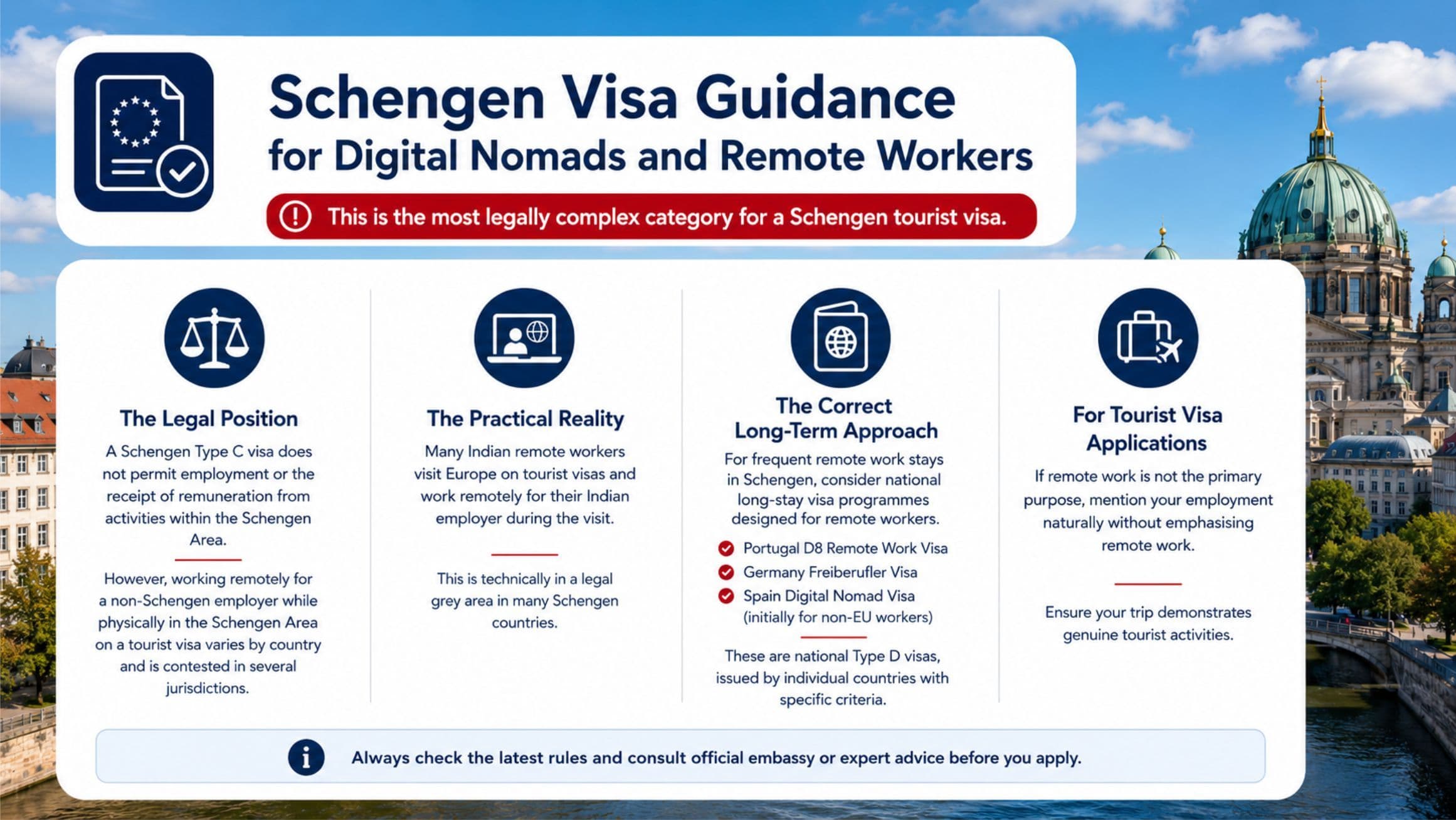
This is the most legally complex category for a Schengen tourist visa.
The legal position: A Schengen Type C visa does not permit employment or the receipt of remuneration from activities within the Schengen Area. However, the legality of working remotely for a non-Schengen employer while physically in the Schengen Area on a tourist visa varies by Schengen country and is contested legal territory in several jurisdictions.
The practical reality: Many Indian remote workers do visit Europe on tourist visas and work remotely on their Indian employer's payroll during the visit. This is technically in a legal grey area in many Schengen countries.
The correct long-term approach: For frequent remote work stays in Schengen, consider national long-stay visa programmes specifically for remote workers. Portugal's D8 Remote Work Visa, Germany's Freiberufler visa, and Spain's Digital Nomad Visa (initially for non-EU workers) are national Type D programmes designed for this purpose. These are not Schengen-wide; they are issued by individual countries and require meeting that country's specific criteria.
For a tourist visa application where remote work is not the primary purpose, mention your employment naturally without emphasising remote work aspects, and ensure your trip demonstrates genuine tourist activities.
Indian patients travelling to Schengen countries for medical treatment need a specific document set beyond the standard tourist checklist.
Additional documents required:
Medical visa applicants should apply through the consulate of the country where treatment is planned. Processing times may be faster for documented medical urgency.
Internal Schengen Travel
The most liberating aspect of the Schengen Area is the ability to travel between countries without internal border formalities. You can:
What you must have with you at all times: Your passport (or a national ID if you are an EU citizen, but as an Indian citizen, your passport is your primary document) and your Schengen visa. Police spot checks can happen anywhere.
If you decide to extend your stay in one country and shorten another, or add a country you did not include in your original application, this is generally permitted under a multiple-entry Schengen visa. The visa covers the entire Schengen Area.
However: your total stay must still comply with the 90/180-day rule, your visa validity must cover all dates of travel, and the number of entries used must not exceed what your visa permits (if single-entry, once you leave Schengen, you cannot re-enter).
If you visit a non-Schengen destination (UK, Balkans, Turkey, Morocco, etc.) mid-trip and then re-enter Schengen, this counts as a new entry into Schengen. This uses one of your permitted entries.
Plan non-Schengen excursions carefully if you do not hold a multiple-entry visa.
In exceptional circumstances, yes. In routine tourist situations, no.
The Schengen Visa Code permits short-stay visa extensions under Article 33 only in limited situations:A desire to stay longer because you are enjoying your trip does not qualify for an extension. Missing a flight does not automatically qualify. Wanting to visit more cities does not qualify.
Applications for a short-stay visa extension are submitted to the immigration authority of the Schengen country where you are currently located. You must apply before your current visa or authorised stay expires.
Required documentation includes evidence of the force majeure or serious personal reason - for example, a doctor's certificate if the reason is medical, or official documentation of the natural disaster or civil unrest.
Each Schengen country handles extensions through its national immigration authority. In Germany, this is the local Ausländerbehörde. In France, the Préfecture. In Italy, the Questura. Processing timelines and procedures vary by country.
If you need more time in Europe:
The following official sources were used to compile and verify information in this guide. Indian applicants are encouraged to consult these directly for the most current updates, as policies change periodically.
Consulate websites are updated periodically, and specific document checklists, fee amounts, and contact information change. Always verify the current requirements on the official consulate website for your destination country before submitting your application. This guide reflects information accurate as of July 2026 based on official sources and verified applicant data, but individual consulate practices may vary.
Before closing this guide, here are the most important facts to hold clearly in mind:
You need a Schengen visa. India is not on the visa-exempt list. There are no exceptions for income, profession, or education. You apply to the consulate of your main destination - the country where you spend the most nights.
The 90/180-day rule is strictly enforced by EES. You cannot spend more than 90 days inside the 29 Schengen countries during any rolling 180-day period.Travel insurance covering €30,000 minimum is mandatory, non-negotiable, and a common rejection reason when done incorrectly. The visa fee is €90 for adults, non-refundable, plus the application centre service fee.EES is now fully operational. Your biometrics and entry/exit data are recorded digitally at every Schengen external border.
The cascade regime gives Indian nationals with two prior compliant Schengen visits a pathway to two-year and five-year multiple-entry visas. ETIAS does not apply to Indian citizens. Do not let any article claiming otherwise confuse you. The most common rejection reasons are insufficient financial proof, weak ties to India, and incomplete documentation. Address all three proactively in every application.A refusal is not permanent. Understand the reason, genuinely address it, and reapply with a stronger file.Apply early. For France and Italy in summer, apply 12 to 16 weeks before travel. For most other destinations, apply 8 to 10 weeks ahead.

Planning a move to Portugal from the USA? Learn about visas, documents, housing, banking, taxes, healthcare, and settling in with a step-by-step guide.

Everything you need for a UK apostille in 2026 - FCDO process, fees, timelines, document types, non-Hague countries, and common rejection fixes.

Complete 2026 guide to US apostilles: state vs. federal authorities, fees by state, processing times, document requirements, and step-by-step instructions.
Need help with your application or background check?
Contact us now and speak with a dedicated Globeia expert today.