
By Sejal Jain · Updated September 11, 2026
Reviewed by Vasu Singla
Using UK documents overseas isn't always as simple as sending a copy of your certificate. Whether you're applying for a visa, accepting a job abroad, getting married in another country, studying overseas, opening a business, or buying property, foreign authorities may ask you to complete additional document authentication before they'll accept your paperwork.
For many people, this is an unfamiliar process. Different documents follow different requirements, some need certification before they can be submitted, and the steps can vary depending on the country where the document will be used. Without understanding the correct process, it's easy to face delays, rejected applications, or unnecessary costs.
This guide explains the complete UK apostille process from start to finish. You'll learn which documents qualify, who can certify them, how the application process works, when embassy legalisation is required, the latest fees and processing times, common reasons applications are rejected, and practical tips to help you prepare your documents correctly the first time.

Most people encounter the word apostille at the worst possible time. A job offer abroad has been made, a visa application is ready, or a property transaction is waiting to complete, and the foreign authority sends back a single line: this document must be apostilled. No further explanation. Just that word.
An apostille is an official certificate attached to a UK document that tells the receiving country: the signature, seal, or stamp on this document is genuine. The person or body who signed this document is who they say they are. That is the full extent of what an apostille does.
It does not translate the document. It does not verify whether the information inside it is accurate. It does not guarantee the receiving institution will accept the document for any specific purpose. It is a certificate of authenticity for the signature on the page, nothing more.
The certificate follows a standard international format agreed under the Hague Convention of 1961. Every member country agreed to issue apostilles in the same ten-field format, so a document apostilled in the United Kingdom is recognised as authenticated in Australia, Spain, the USA, India, and all other member countries without needing any further embassy involvement. As of July 2026, 129 countries are members.
The word itself comes from French and means a marginal note or certification. In the English legal system it has come to mean specifically this standardised authentication certificate.
One thing people consistently get wrong: an apostille is not a stamp you can get from a solicitor, a notary, or the Post Office. Only the UK Foreign, Commonwealth and Development Office Legalisation Office issues apostilles for UK documents. Everything else, from solicitor certification to notarisation, is preparation work that happens before the FCDO can issue the apostille itself.
Every UK apostille, whether attached to a paper document or embedded in a digital PDF, must contain exactly ten pieces of information set by the Hague Convention:
| Field | What It Records |
| Country | United Kingdom of Great Britain and Northern Ireland |
| Name of signatory | The person who signed the underlying document |
| Capacity of signatory | Their role: Registrar, Solicitor, Notary, HMRC Officer, etc. |
| Seal or stamp | The official mark used on the document |
| Place of issue | Milton Keynes (FCDO Legalisation Office) |
| Date of issue | Date the apostille was issued |
| Issuing authority | FCDO Legalisation Office |
| Certificate number | Unique reference, used for verification |
| Seal of the FCDO | The FCDO's own embossed or digital seal |
| Signature of FCDO officer | FCDO authorised signatory |
The certificate number matters. Any recipient of an apostilled document, anywhere in the world, can enter that number at the official GOV.UK verification portal to confirm the apostille is genuine. This is how receiving authorities check authenticity. It is also how you would identify a fraudulent document if a service provider returned something that does not pass verification.
For paper apostilles, the FCDO attaches the certificate physically to the document using glue and an embossed seal. The document and certificate become one unit. For electronic apostilles, the certificate is embedded inside a cryptographically signed PDF. Both formats carry identical legal authority under the Hague Convention.
Almost every misunderstanding in the apostille process comes from four terms being used interchangeably when they mean completely different things.
Legalisation is the umbrella term. It describes any process that makes a document acceptable to a foreign authority. An apostille is one form of legalisation. Embassy attestation is another. The term does not specify which method is being used.
Apostille is the specific method used for Hague Convention member countries. If a foreign authority says this document needs to be legalised and the country is a Hague member, they almost certainly mean apostilled.
Notarisation is what a notary public does to a document before it can go to the FCDO. The notary verifies the document is genuine, witnesses signatures, and applies their registered seal. Notarisation is preparation for the apostille, not the apostille itself.
Authentication is used inconsistently. In UK government language it often refers to the FCDO's verification process. In some foreign countries it refers to the embassy attestation step. Always confirm what the requesting authority means by this word before acting on it.
None of these terms substitutes for another. Using the wrong preparation route based on confusing these terms is the single most common source of rejection.
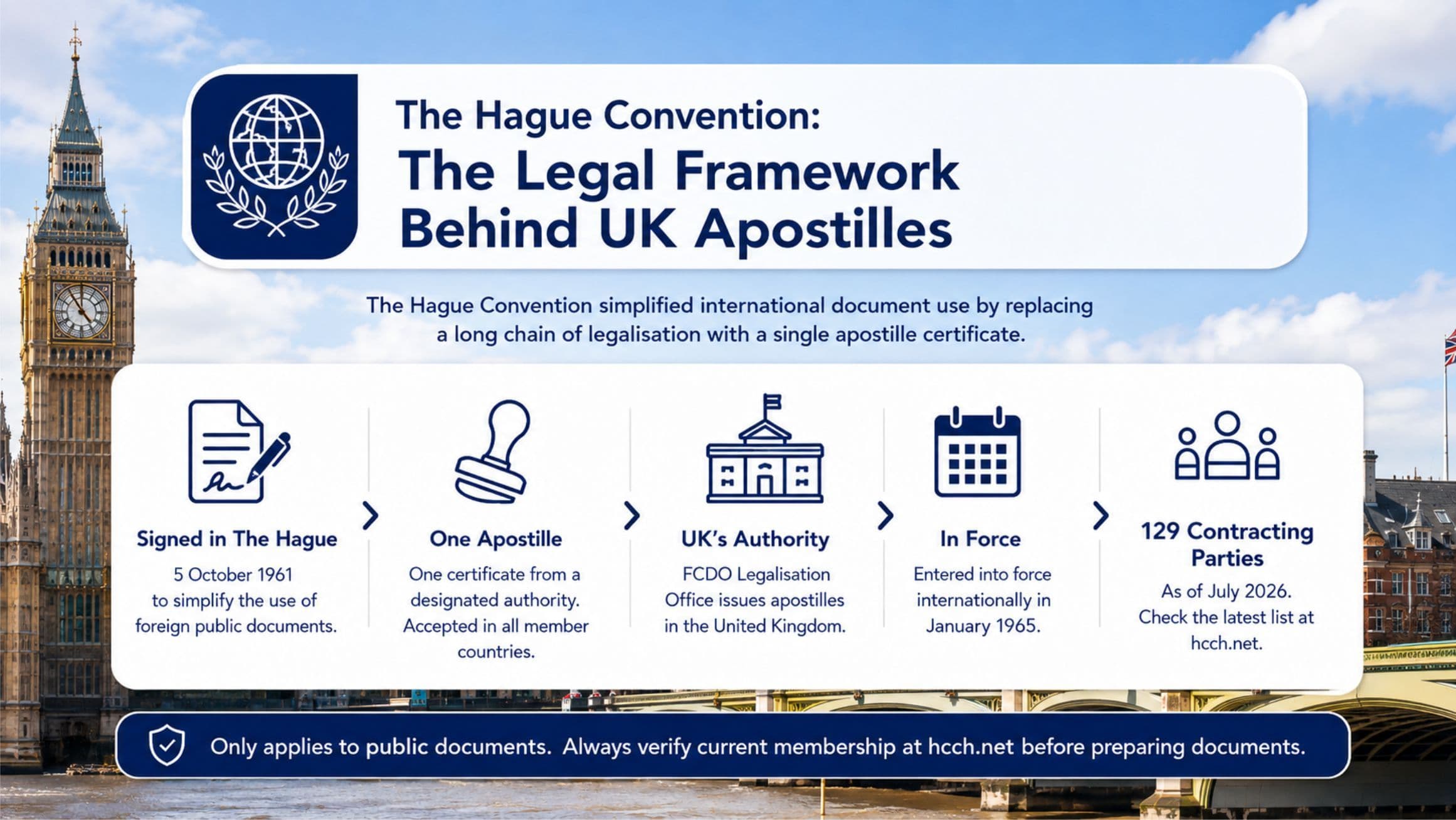
Before 1961, using a British document in another country required sending it through a chain of government departments. A local official would verify a registrar's signature. A national ministry would verify that official's authority. The foreign embassy would verify the ministry's seal. The foreign government's own ministry would sometimes verify the embassy's stamp. The process took months, cost considerable money, and varied country by country.
The Convention Abolishing the Requirement of Legalisation for Foreign Public Documents, signed in The Hague on 5 October 1961, replaced that chain with a single certificate. One stamp from a designated authority in the document's country of origin, accepted by every other member country without further authentication. That is the apostille.
The United Kingdom signed the Convention from the outset. The UK's designated authority under the Convention is the FCDO Legalisation Office. The Convention entered into force internationally in January 1965.
The Hague Conference on Private International Law (HCCH) administers the Convention. As of July 2026, there are 129 Contracting Parties. The HCCH maintains a live status table at hcch.net, which is the only authoritative source for current membership. Any list printed in any guide, including this one, is a snapshot. Always verify current membership at hcch.net before preparing documents for a specific destination.
The Convention applies to public documents only. Not every document qualifies. Under the Convention, public documents include documents from courts and tribunals, administrative documents from government departments, notarial acts, and official certificates placed on documents signed by private individuals such as a solicitor certifying a copy.
The Convention explicitly excludes commercial invoices, customs documents, and documents handled by diplomatic or consular agents. This exclusion catches some businesses out: an export invoice or a customs declaration is not apostillable under the Convention, regardless of how official it looks.
Several countries joined between 2022 and 2026. These changes affect which route UK document users must take.
Only one body in the United Kingdom can issue apostilles for UK documents: the FCDO Legalisation Office. It is part of the Foreign, Commonwealth and Development Office, formed in September 2020 when the Foreign and Commonwealth Office merged with the Department for International Development. Apostilles issued before September 2020 carry the FCO name and remain fully valid.
The office is based in Milton Keynes. Members of the public cannot visit it in person. Applications are submitted by post through the public route or through registered service providers who have direct counter access.
When the FCDO processes a document, it does one specific thing: it checks the signature, seal, or stamp on the document against its internal database of registered UK officials, solicitors, notaries, and government department signatories. If the signature matches a registered entry in that database, the apostille is issued. If it does not match, the document is returned with an explanation.
The FCDO does not check whether the content of the document is accurate. It does not contact the issuing institution. It does not evaluate qualifications or verify the facts stated in a court order. It only verifies that whoever signed the document is a legitimate registered UK official or professional.
This is why documents from private institutions such as universities, hospitals, or employers cannot go directly to the FCDO. The university registrar's signature is not in the FCDO database. A solicitor's or notary's signature is. So the solicitor or notary certifies the document first, and then the FCDO verifies the solicitor's or notary's signature instead.
People regularly ask the FCDO to do things it has no power to do.
Many UK documents cannot go to the FCDO directly. They need a certification step first: a registered professional confirms the document is genuine and adds their own verifiable signature. The FCDO then verifies that professional's signature instead of trying to verify the original document's issuing authority.
Three types of professionals can perform this function. Understanding the differences between them prevents the most common preparation errors.
A solicitor regulated by the Solicitors Regulation Authority (SRA) can certify copies of documents for FCDO purposes. The solicitor's signature must be registered in the FCDO's own database. Being SRA-regulated does not automatically mean the signature is in the FCDO database. Some newly qualified solicitors, recently moved solicitors whose details have changed, or firms that do not regularly handle international documents may not be registered. Before using a high street solicitor, ask them directly whether their signature is currently registered with the FCDO Legalisation Office.
The wording the solicitor uses on the certified copy must be precise. The FCDO requires the certification to say, word for word: I certify this to be a true copy of the original document. The solicitor must then add their full name, SRA registration number, firm name and address, date, and signature. Any variation in the wording or any missing element causes rejection.
What a solicitor cannot certify for FCDO apostille purposes: Powers of Attorney, company deeds, or documents that foreign authorities specifically require to be notarised. They also cannot certify their own firm's documents.
A notary public is a separate legal professional regulated by the Faculty Office of the Archbishop of Canterbury in England and Wales. In Scotland, notaries are also solicitors regulated by the Law Society of Scotland. The notary's certification carries higher evidential weight under international law than a solicitor's.
Notarisation is required in specific circumstances: Powers of Attorney for use abroad in property transactions, legal proceedings, or business matters; deeds and other formal legal instruments; when the receiving foreign country or institution specifically requires a notary rather than a solicitor; statutory declarations and affidavits for use in civil law countries where solicitor-witnessed declarations may not be recognised.
The notary must apply their FCDO-registered notarial seal. If a notary has recently qualified and not yet registered their seal with the FCDO, or if they have renewed their seal without re-registering, the apostille application will be rejected. This is one of the less obvious but surprisingly common reasons for rejection.
Notary fees in England and Wales typically range from £75 to £250 per document depending on complexity and location. Book an appointment in advance.
A commissioner for oaths can witness statutory declarations and affidavits. Many solicitors also hold this qualification. For statutory declarations going abroad, a commissioner for oaths can witness the declaration, but if the receiving country is a civil law jurisdiction, a notary is the more reliable choice.
Legal executives who are not also SRA-regulated solicitors, accountants and chartered accountants, Justices of the Peace for most document types, GPs certifying non-medical documents, bank managers, HR managers, company secretaries, estate agents, and financial advisers are not authorised to certify documents for UK apostille purposes.
The core trigger is this: if a UK-issued document is being submitted to a foreign government body, regulatory authority, court, employer, educational institution, or any official organisation in another country, and that country is a Hague Convention member, an apostille will almost certainly be required.
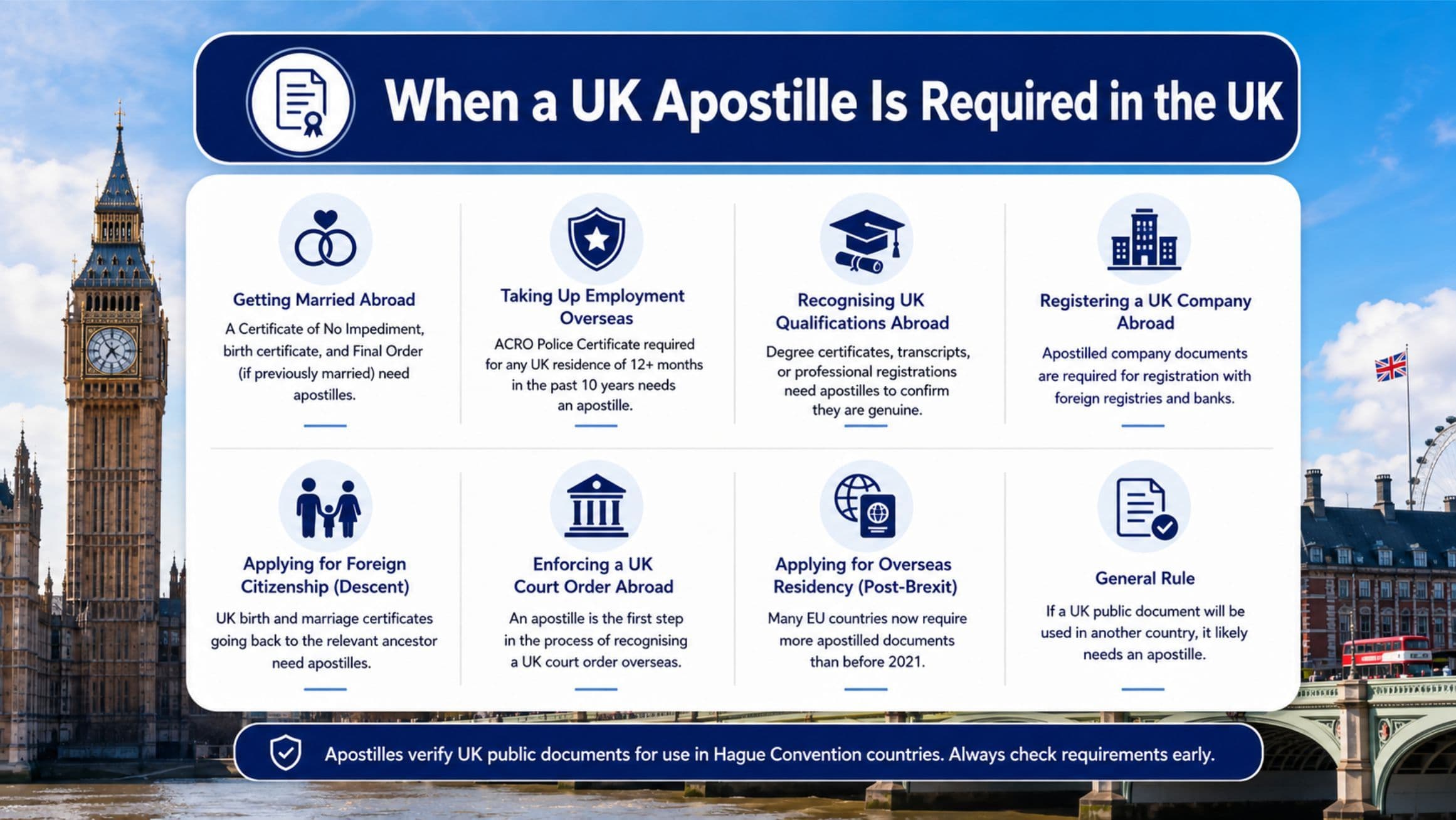
The HCCH maintains the authoritative live membership table at hcch.net under Status Table for Convention No. 12. The table below provides a regional overview for planning purposes.
| Region | Coverage |
| Europe | All EU member states, Norway, Iceland, Switzerland, Albania, Bosnia, North Macedonia, Serbia, Ukraine, Moldova, Georgia, Armenia, Azerbaijan |
| North America | USA, Canada (2024), Mexico |
| South America | Brazil, Argentina, Colombia, Chile, Peru, Ecuador |
| Asia-Pacific | Australia, New Zealand, Japan, South Korea, China (March 2024), India (January 2025), Philippines, Singapore |
| Middle East | Israel, Saudi Arabia (December 2022), Bahrain, Oman |
| Africa | South Africa, Morocco, Tunisia, Botswana, Namibia, Senegal |
| Newly effective | Vietnam (September 11, 2026), Algeria (July 9, 2026) |
| Country | London Embassy/High Commission | Route Required |
| United Arab Emirates | UAE Embassy, London | FCDO apostille, then UAE Embassy, then MOFA attestation in UAE |
| Qatar | Qatar Embassy, London | FCDO apostille, then Qatar Embassy attestation |
| Kuwait | Kuwait Embassy, London | FCDO apostille, then Kuwait Embassy attestation |
E-apostilles cannot be used when embassy legalisation is required. Embassies must physically stamp a paper document. This is a structural limitation with no workaround.
Hague membership means a country cannot legally require additional embassy legalisation after a valid apostille. If a Hague member institution demands embassy verification, provide the HCCH documentation confirming their country's membership and note that under Article 3 of the Convention, a Contracting State cannot require further legalisation once an apostille has been obtained. Most institutions accept this.
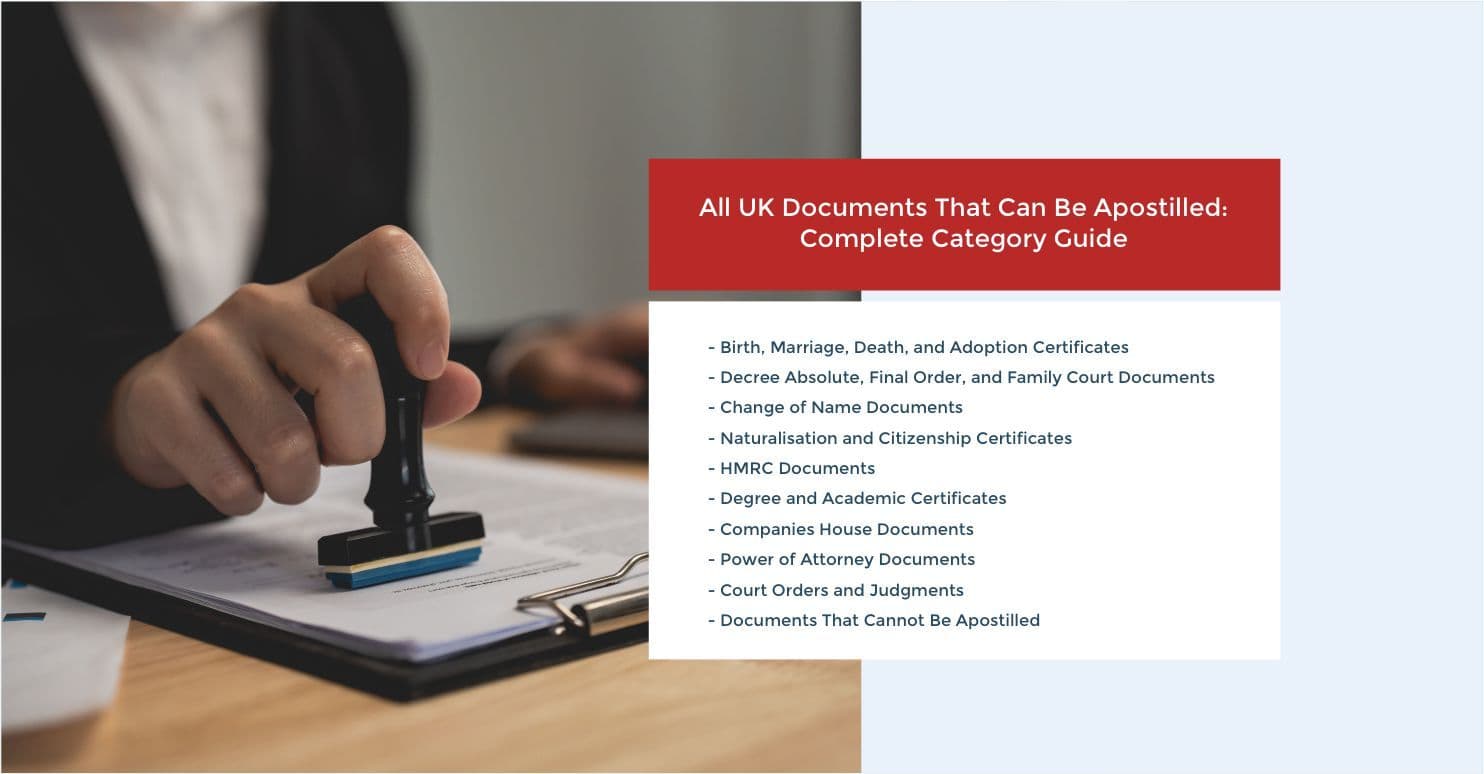
The FCDO will apostille any UK document that carries a signature, seal, or stamp it can verify. The preparation route depends on whether that signature is already in the FCDO database or needs to be bridged through a solicitor or notary.
Issued by the GRO (England and Wales), NRS (Scotland), and GRONI (Northern Ireland). All go directly to the FCDO without any solicitor preparation step. Original certificates only. Plain photocopies are not accepted. Laminated certificates cannot be apostilled. Birth, marriage, death, and adoption certificates are not eligible for the e-apostille service. The paper route is the only option.
These are court documents, not civil registration documents. A decree absolute (now called a Final Order for divorces filed after April 2022) is a sealed court order. It must be solicitor-certified before submission to the FCDO. The document submitted must be the sealed version bearing the court's official stamp.
An enrolled deed poll, registered with the Senior Courts, carries an official court seal and can go directly to the FCDO. An unenrolled deed poll or statutory declaration of change of name requires notarisation before the FCDO will accept it.
Issued by the Home Office. Go directly to the FCDO without solicitor preparation. Only one original naturalisation certificate is ever issued. Do not post it without using a tracked and insured service.
Tax residency certificates (the RES1) go directly to the FCDO. P60s and payslips are private employer documents and require notarisation for overseas use. HMRC letters signed by named HMRC officers go directly if the officer's signature is registered.
University-issued degree certificates are private institutional documents. A solicitor must certify a copy before it can go to the FCDO. Academic transcripts are separate from degree certificates and need separate apostille preparation. The e-apostille route is available for degree certificates and transcripts when the solicitor certifies them using a Qualified Electronic Signature.
Certificate of Incorporation: direct route to the FCDO. Certificate of Good Standing: must be ordered from Companies House before submission. Memoranda and Articles of Association: solicitor certification required. Annual confirmation statements: solicitor certification required.
A standard Power of Attorney for use abroad requires notarisation by a UK notary public. A Lasting Power of Attorney, sealed by the Office of the Public Guardian, can go to the FCDO directly but may not be recognised in foreign legal systems.
Sealed orders from the County Court, High Court, or Court of Appeal require solicitor certification before FCDO submission.
Documents issued outside the United Kingdom. Plain photocopies with no solicitor or notary certification. Laminated documents. Documents with illegible signatures or seals. Private letters and personal correspondence with no official signature.
For many people, the apostille process begins with obtaining or replacing the underlying document.
The GRO issues birth, death, marriage, civil partnership, and adoption certificates for events registered in England and Wales. Applications can be made online at gro.gov.uk, by telephone, or by post.
A standard certificate costs £11 per copy as of 2026 (verify at GRO portal as fees change). Standard service takes approximately 10 working days. Priority service is available for an additional fee and typically takes 3 to 5 working days.
When ordering for apostille purposes, order at least two copies. Having a spare prevents delay if one is damaged in the post or if a second destination requires another apostille later.
Applications are made online at nrscotland.gov.uk or by post to the NRS offices in Edinburgh. The NRS can also provide authenticated extracts for some records, which is a distinct NRS service and should not be confused with the FCDO apostille.
Applications are made through online GRONI Portal or by post to the GRONI offices in Belfast.
Contact the academic registry of the issuing university directly. Most universities will reissue degree certificates, though some charge a fee ranging from £30 to £100. Processing times vary from a few days to several weeks.
For A-Level and GCSE certificates, contact the relevant awarding body: AQA at aqa.org.uk, OCR at ocr.org.uk, Pearson/Edexcel at pearson.com, WJEC for Wales at wjec.co.uk, and CCEA for Northern Ireland at ccea.org.uk. Replacement certificates typically take 4 to 6 weeks.
Sealed copies of a Grant of Probate or Letters of Administration are available from the Probate Registry. Office copies cost £1.50 per copy as of 2026 (verify at UK HM Courts & Tribunals Service). Sealed copies of Family Court orders are available from the court that issued them.
Not all UK documents follow the two standard preparation routes. Several document categories have specific pre-FCDO steps.
Health certificates for animal export, phytosanitary certificates for plants, and pet export certificates issued by the Department for Environment, Food and Rural Affairs follow a route that goes through DEFRA's own veterinary or plant health authority before reaching the FCDO. Contact DEFRA or the Animal and Plant Health Agency directly for the current procedure for the specific document type.
An ACRO Police Certificate must be applied for at acro.police.uk specifically for international use. Applications take between 10 and 30 working days. There is no priority or fast track service. Plan the ACRO application before everything else in any document package that requires it.
Some overseas authorities accept direct verification from the TRA instead of an apostilled certificate. Check whether the receiving authority accepts the TRA online verification service as an alternative before spending on apostille preparation.
The RES1 must be applied for through HMRC before it can go to the FCDO. HMRC processes these applications over several weeks. Start the HMRC application early.
Obtain the sealed copy from the Office of the Public Guardian first. An unsealed printout of a registered LPA from the applicant's own files is not the same thing.
The FCDO works with three categories of documents, and mixing them up is the most consistent source of preparation errors.
Original documents are those physically issued by the authority: the GRO birth certificate, the Companies House Certificate of Incorporation, the naturalisation certificate from the Home Office. When the FCDO accepts documents directly, it is working from originals whose issuing authority's signature is already in its database.
Certified true copies are made by a solicitor who has physically compared the copy to the original and signed a statement confirming they are identical. The solicitor's signature is what the FCDO verifies, not the underlying issuing authority's. The certification wording must match exactly: I certify this to be a true copy of the original document. The solicitor must also include their full name, SRA registration number, firm name and address, date of certification, and their own signature.
Notarised documents involve a notary public applying their FCDO-registered notarial seal. Notarisation is necessary for Powers of Attorney, deeds, and documents where the receiving country specifically requires it.
| Document | Goes Direct to FCDO? | Needs Solicitor Certification? | Needs Notary? |
| Birth, Marriage, Death (GRO/NRS/GRONI) | Yes | Only if original unavailable | No |
| Adoption certificate (GRO) | Yes | No | No |
| ACRO Police Certificate | Yes | Only if copy used | No |
| Naturalisation Certificate (Home Office) | Yes | No | No |
| HMRC Certificate of Residence | Yes | Only if copy used | No |
| Certificate of Incorporation (Companies House) | Yes | Only if copy used | No |
| Certificate of Good Standing (Companies House) | Yes, after ordering from CH | Only if copy used | No |
| Enrolled Deed Poll | Yes | Only if copy used | No |
| Degree Certificate | No | Yes (copy required) | Sometimes |
| Academic Transcript | No | Yes (copy required) | Rarely |
| A-Level or GCSE Certificate | No | Yes (copy required) | Rarely |
| DBS Certificate | No | Yes (copy required) | Rarely |
| Disclosure Scotland Certificate | No | Yes (copy required) | Rarely |
| Memorandum and Articles of Association | No | Yes | No |
| Decree Absolute or Final Order | No | Yes | Rarely |
| Court Order (sealed) | No | Yes | Occasionally |
| Unenrolled Deed Poll | No | No | Yes |
| Power of Attorney (general) | No | No | Yes |
| LPA (OPG sealed copy) | No | No | No |
| Company Power of Attorney | No | No | Yes |
| Statutory Declaration or Affidavit | No | No | Yes (must be sworn before authorised witness) |
| Medical Certificate (GMC-signed doctor) | No | Only if copy used | No |
| NHS Letter or GP Letter | Depends on who signed | Solicitor if not GMC signatory | Notary for formal overseas use |
| P60 or Payslip | No | No | Yes for overseas use |
| Bank Statement | No | No | Notary for most overseas purposes |
| University Reference Letter | No | Yes | No |
When multiple documents are needed for a single overseas application, they can be combined into a bound set. The solicitor or notary arranges the documents in order, certifies them together, physically binds them with a ribbon and seal so they cannot be separated, and submits them as a unit. A single apostille covers the entire set. Before preparing a bound set, confirm the receiving authority accepts them.
All three application routes start at the same place: gov.uk/get-document-legalised.
Confirm each of the following before touching a document. The destination country's Hague Convention membership has been verified at hcch.net today, not from a list published months ago. The receiving authority has confirmed in writing whether they accept e-apostille or require a physical paper document. Whether embassy legalisation is also required after the apostille has been established. The preparation route for each document has been identified. Every document to be submitted is in good condition. A UK return address is available for the returned apostilled documents for paper applications.
Go to UK government portal and select the paper-based service. Complete the online application form in full. Every field must be completed. Pay the FCDO fee of £45 per document (verify current fee at gov.uk before submitting). Note the application reference number.
Prepare the physical envelope. Include: your documents (originals or properly certified copies), a printed copy of the application reference, an A4-sized self-addressed envelope with a UK return address, and return postage using Royal Mail Recorded Delivery or a prepaid courier waybill.
Post to the FCDO Legalisation Office address shown on the GOV.UK application page. Do not use addresses from third-party websites as they may be outdated.
Standard processing from receipt is 10 working days. During the peak period from June to September, this extends to up to 25 working days. The FCDO will contact you by email if there is a problem with a document.Do not include in the envelope: passports submitted as travel documents, foreign documents, multiple applications without separate application references, cash, or anything unrelated to the apostille application.
The FCDO operates a business counter at its Milton Keynes office accessible only to registered service providers. The business counter route produces apostilles in 1 to 2 working days for most documents.
To find a registered provider, check the UK FCDO provider list directly. Do not rely on any service's own claim of registration. Verify it independently.
When using an agent, confirm in writing before handing over documents: what their service fee includes, whether the FCDO fee is part of their quote or separate, whether solicitor certification is included if needed, the committed turnaround time, and whether tracking is provided.
Apply online at portal and select the electronic service. The document must have been digitally certified by an FCDO-registered solicitor or notary using a Qualified Electronic Signature. Upload the QES-signed PDF, pay £35 (verify current fee at gov.uk), and the FCDO returns the e-apostilled PDF within 1 to 2 working days via email download link. Share the resulting PDF digitally. Do not print it. A printed e-apostille is not a valid paper apostille.
All fees are as of July 2026. Verify at gov.uk/get-document-legalised before submitting. Fees change periodically.
| Service | FCDO Fee Per Document |
| Standard postal application (public direct) | £45 |
| e-Apostille (online application) | £35 |
| Business counter via registered agent | £40 |
| Route | Standard | During Peak Period (June to September) |
| Direct postal to FCDO | 10 working days | Up to 25 working days |
| Via registered agent (business counter) | 1 to 2 working days | 2 to 3 working days |
| e-Apostille | 1 to 2 working days | Similar |
GRO replacement certificate: £11 per certificate. Order extra copies at this price. Solicitor certification: between £20 and £80 per document. Get quotes from at least two firms. Notarisation: between £75 and £250 per document. Notary fees depend on document complexity and location. Return postage for paper applications: use tracked and insured post. Certified translation: between £100 and £500 per document depending on language and length. Always arrange translation after apostilling. Agent service fee for the business counter route: varies by provider. Embassy attestation fees for non-Hague countries: varies by embassy and document type.
The FCDO issued the first UK e-apostille on 15 December 2021. The e-apostille carries identical legal authority to a paper apostille under the Hague Convention.
An e-apostille is a digital certificate cryptographically embedded within a PDF document. The PDF contains the document or certified copy plus the FCDO's digital certificate. The file is sealed so that any modification invalidates the certificate. Verification is done by entering the apostille's unique certificate number at the UK verification portal.
The process requires a Qualified Electronic Signature from a UK solicitor or notary registered with the FCDO. A QES is a specific technical standard. A scanned wet-ink signature, a simple checkbox signature, or an email from a solicitor confirming certification does not meet the QES standard and will cause rejection.
Most documents that need solicitor or notary certification before FCDO submission are eligible for e-apostille when the certification is done using QES: degree and academic certificates, company documents, Powers of Attorney, HMRC tax and residence documents, employment letters and professional references, and most other privately-issued documents.
Birth certificates, marriage and civil partnership certificates, death certificates, and adoption certificates are not eligible. ACRO police certificates and DBS certificates in original physical form are also not eligible.
A printed copy of an e-apostille is not a valid paper apostille. The verification mechanism only exists in the digital PDF file. If the receiving authority cannot verify a digital document or requires a physical paper document, the paper apostille route must be used from the beginning.
| Factor | Paper Apostille | UK e-Apostille |
| All document types eligible | Yes | No (GRO, ACRO, DBS originals excluded) |
| Accepted by all Hague members | Yes | Not universal: confirm first |
| Compatible with embassy legalisation | Yes, required | No, incompatible |
| UK return address needed | Yes | No, ideal for overseas applicants |
| Processing time | 10 days postal or 1 to 2 days agent | 1 to 2 days |
| FCDO fee | £45 postal or £40 agent | £35 |
| Delivery method | Physical post | Secure email PDF |
| Verification method | GOV.UK portal by certificate number | GOV.UK portal by certificate number |
The paper apostille is the default for most applications. It is accepted everywhere that accepts the Hague Convention and covers every document type. The e-apostille suits overseas applicants who cannot easily manage physical UK post, and eligible documents going to institutions that have confirmed they accept digital formats.
Most countries require the UK party to a foreign marriage to provide formal proof they are free to marry.
A Certificate of No Impediment is issued by the local register office in the area where the applicant lives after a 28-day formal notice period. The 28 days cannot be shortened. The CNI carries the registrar's official signature and goes directly to the FCDO for apostille.
CNI validity is set by the destination country, not UK law. Most countries require the CNI to have been issued within three months of the wedding date. Some allow six months. Check the specific requirement with the foreign authority or the British Embassy in that country before starting the 28-day notice period.
In Northern Ireland, the equivalent document is a Certificate of Legal Capacity to Marry.
Birth certificates go directly to the FCDO. Decree Absolute or Final Order documents require solicitor certification before FCDO submission. Name change documents follow their respective routes depending on whether the deed poll is enrolled or unenrolled.
Work backwards from the wedding date. Include: CNI notice period (28 days minimum), FCDO processing (10 working days or 1 to 2 days via agent), any embassy step for non-Hague countries, certified translation, and delivery to the foreign authority.
Starting four to six months before the wedding date is appropriate for most Hague Convention destinations. For non-Hague countries, six to eight months is safer.
Single status is not one specific document. It is a category of proof. Three different UK documents serve this purpose and they are not interchangeable.
For planned marriages to a specific person in a specific country. Only available to British citizens. Subject to the 28-day notice period. Goes directly to FCDO for apostille. Described in full in the marriage abroad section above.
A formal written statement signed under the Statutory Declarations Act 1835, made before a solicitor, commissioner for oaths, or notary public, in which the declarant confirms they are not married and are free to marry.
The declaration must be signed in the presence of the authorised witness. The signature cannot be made in advance and witnessed later. Making a false statutory declaration is a criminal offence under the Perjury Act 1911.
For use in civil law countries where the solicitor's commissioner role may not be recognised, a notary public is the more reliable witness. The notarised declaration then goes to the FCDO for apostille.
Issued by the GRO, NRS, or GRONI, this document states that a search of the registry's records found no record of a marriage for the named individual within a specified period. Goes directly to the FCDO for apostille.
The GRO can only confirm the absence of a record in England and Wales. If comprehensive UK-wide confirmation is needed, separate No Trace letters from GRO, NRS, and GRONI may all be required.
Always confirm with the foreign authority which specific document they require and what wording they need before ordering anything.
| Document | Who Issues | Preparation Required | FCDO Route |
| Certificate of No Impediment | Local register office (England and Wales) | None | Direct |
| Certificate of Legal Capacity to Marry | GRONI register office | None | Direct |
| Statutory Declaration of Single Status | Solicitor or notary witnesses it | Solicitor or notary certification | Certified to FCDO |
| No Trace of Marriage Letter | GRO, NRS, or GRONI | None | Direct |
UK Visas and Immigration processes applications from foreign nationals seeking to enter or remain in the United Kingdom. UKVI does not require apostilles on foreign documents submitted with UK visa applications. A Pakistani birth certificate, a Nigerian degree, or a Ukrainian marriage certificate submitted to support a UK visa application does not need an apostille. The fee paid to apostille such a document is wasted entirely.
Apostilles serve the opposite direction: UK-issued documents submitted to foreign authorities abroad.
The most commonly apostilled documents for EU residency applications are: birth certificate from GRO, marriage certificate from GRO if applicable, ACRO police certificate, bank statements or letters certified by a solicitor and then apostilled, and degree or professional qualification certificate.
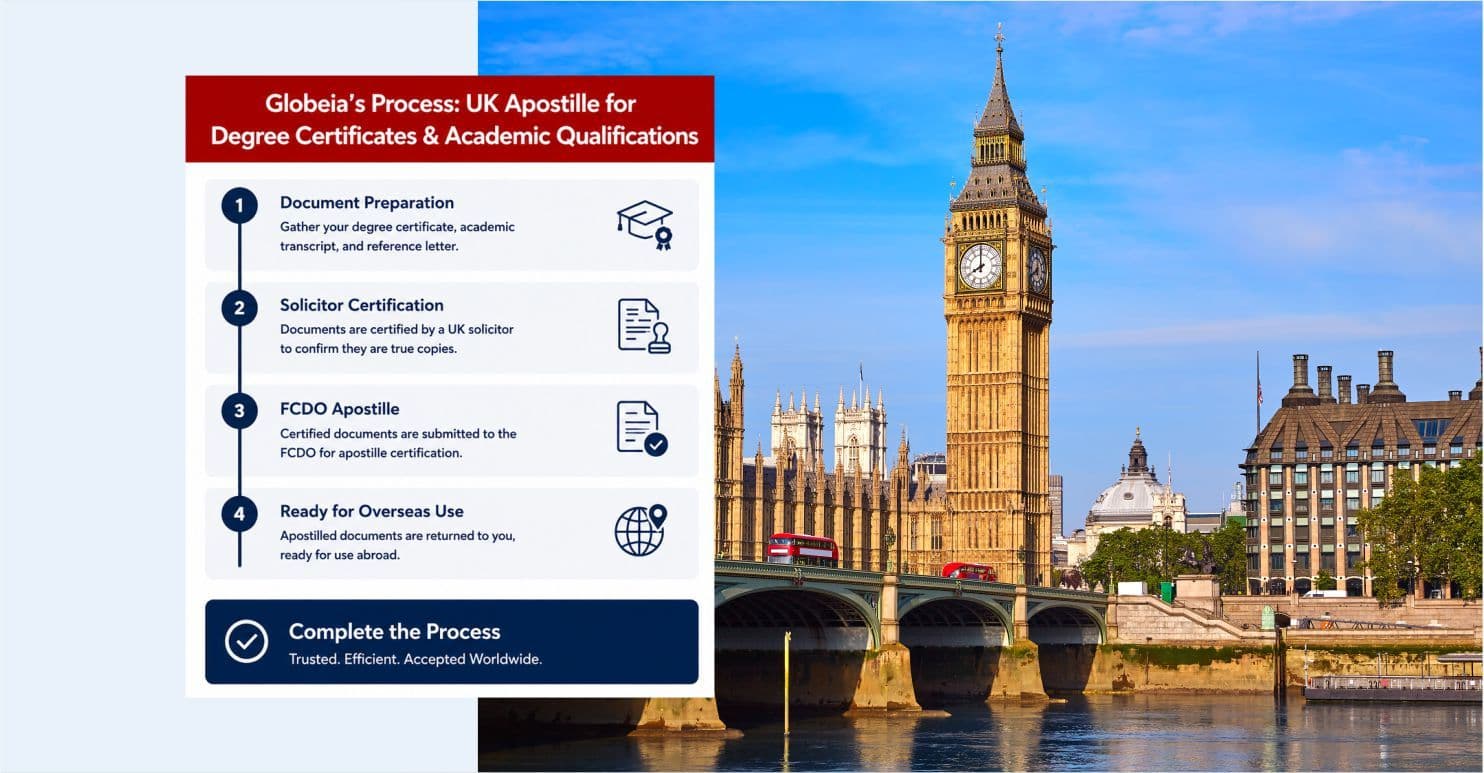
The FCDO apostille on a degree certificate confirms the document is genuinely from the university that issued it. It does not assess whether the qualification is equivalent to the foreign country's own educational standard. Those are two separate things handled by two different processes.
Applying an apostille and submitting the degree assuming the foreign employer or university will automatically recognise it as equivalent is a common mistake. The receiving institution's own recognition body handles equivalence. ENIC (formerly UK NARIC) provides this service in the UK.
Most foreign universities and professional bodies require three documents together. First, the degree certificate itself, solicitor-certified copy submitted to the FCDO. Second, the official academic transcript, which is a separate document from the degree certificate, issued by the university's registry with a different signature, needing its own solicitor certification and apostille. Third, an academic reference letter from a faculty member, which if it carries an official university signature can be apostilled after solicitor certification.
These three can be prepared as a bound set for a single apostille submission, or separately depending on what the receiving institution requires.
QTS certificates from the Teaching Regulation Agency go to the FCDO after solicitor certification. PGCE certificates from universities follow the standard degree certificate route.
The Teaching Regulation Agency offers a direct verification service for some receiving countries. If the overseas authority accepts TRA online verification, an apostilled QTS certificate may not be needed.
Healthcare professionals, lawyers, and engineers registering with overseas professional bodies typically need an apostilled professional registration certificate, an apostilled degree, and an apostilled academic transcript, plus language proficiency evidence (not apostilled), and a completed application to the foreign professional body.
GMC registration certificates go through solicitor certification then FCDO. NMC certificates follow the same route.
This is the section that competitor guides get consistently wrong or skip entirely. ACRO and DBS are different documents, issued by different bodies, for different purposes, and they are not interchangeable for international use.
The ACRO Criminal Records Office operates under the National Police Chiefs' Council and issues Police Certificates specifically for international use. This is the document that most overseas authorities, embassies, immigration departments, and professional registration bodies are asking for when they request a UK criminal record check.
An ACRO certificate shows whether the applicant has convictions, cautions, reprimands, or warnings recorded on the Police National Computer. It covers England and Wales.
How to apply: go to acro.police.uk and complete the online application. There is a fee (verify the current amount at acro.police.uk). There is no priority or expedited service. Processing takes between 10 and 30 working days from submission.
The certificate goes directly to the FCDO for apostille with no solicitor preparation step required. Most overseas authorities require it to have been issued within 3 to 6 months of the application date.
A DBS (Disclosure and Barring Service) check is issued by a Home Office body for UK domestic employment and volunteering purposes, particularly for roles involving children or vulnerable adults. There are three levels.
When an overseas authority asks for a UK police certificate or certificate of good character, they want the ACRO certificate. They do not want a DBS check, even if the DBS covers similar content. The DBS is a UK employment document and most foreign immigration authorities do not recognise it as an equivalent police clearance.
When a specific overseas employer or institution is requesting a DBS check by name and will accept it, a solicitor must certify a copy of the original DBS certificate before it goes to the FCDO.
Scotland uses Disclosure Scotland for criminal record checks. Applications are made at mygov.scot/organisations/disclosure-scotland. From 1 April 2026, PVG scheme membership runs for five years from the date of joining.
Disclosure Scotland certificates are not recognised as equivalent to ACRO certificates by most international authorities. Someone who has lived in Scotland and needs to prove their UK criminal record status internationally will usually need an ACRO certificate, which covers Police National Computer records across the UK.
Northern Ireland uses AccessNI for criminal record checks. Similar limitations to Disclosure Scotland apply for international use.
This document category is one of the least well explained in any guide and one of the most commonly needed for overseas healthcare employment, professional registration, and visa applications.
Whether an NHS letter can be apostilled depends entirely on who signed it.
A GP letter signed by a GMC-registered general practitioner follows the same rule: direct route to the FCDO if original, solicitor certification if a copy. Confirm the GP is currently registered at gmc-uk.org before submitting.
A private medical certificate from a private clinic or private GP follows the same path, provided the signing doctor is GMC-registered.
Healthcare professionals registering with overseas bodies typically need a package that includes several apostilled documents.
For UK vaccination documentation and health certificates requested by overseas authorities, the key question is whether the document carries a verifiable official signature. UKHSA-issued documentation and letters confirming vaccination status may carry official signatures and go to the FCDO, but the exact route depends on the specific document format. Contact the issuing health authority for confirmation.
Yellow fever vaccination certificates are issued on the International Certificate of Vaccination or Prophylaxis. These are not typically apostilled. Countries that require yellow fever certificates accept the ICVP directly.
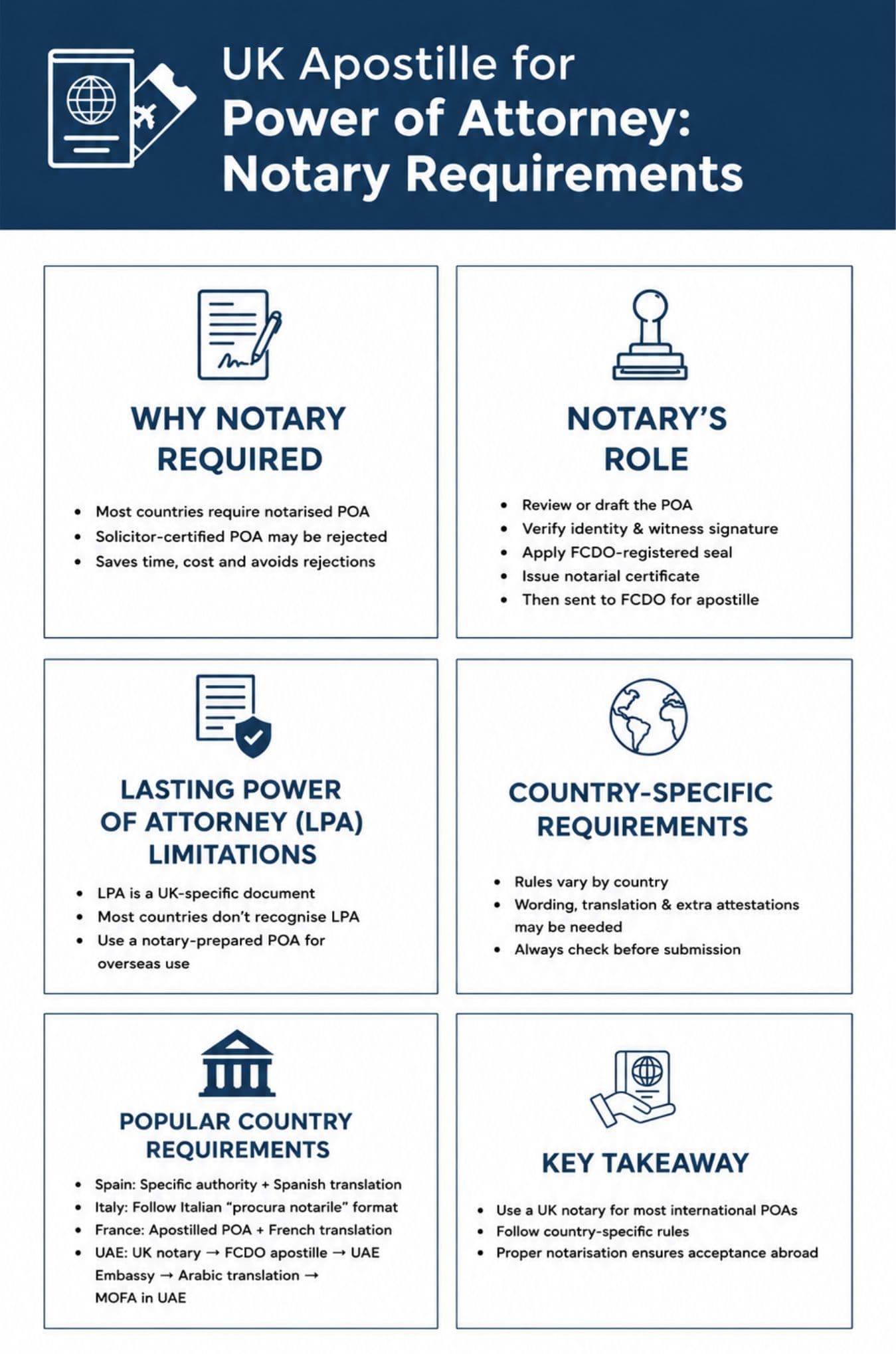
A Power of Attorney for use abroad must be executed before a UK notary public in the vast majority of cases. Most foreign legal systems specifically require the higher certification that only a notary public provides. Submitting a solicitor-certified POA where a notarised one is required results in rejection at the foreign end after the FCDO has already issued the apostille, which means the fee is lost and the process must restart.
The notary's role covers several steps. They will review or draft the document to ensure it is legally effective for its intended purpose in the destination jurisdiction. They verify the identity of the person granting the authority. They witness the execution of the document. They apply their FCDO-registered notarial seal. They issue a notarial certificate confirming that all steps were properly carried out.
After notarisation, the document goes to the FCDO. The FCDO verifies the notary's seal against its database and attaches the apostille.
A Lasting Power of Attorney registered with the Office of the Public Guardian operates under the Mental Capacity Act 2005. It is a UK-specific legal instrument. Office copies sealed by the OPG can go to the FCDO directly. However, most foreign legal systems do not have an equivalent concept. A Spanish notario, a French notaire, or a UAE property conveyancer may simply not know what to do with an LPA document.
For overseas property transactions, banking, business representation, or legal proceedings, a separately executed standard Power of Attorney prepared by a UK notary public is more reliably accepted internationally than an LPA.
Spain: The Spanish notario requires the UK POA to authorise specifically the transaction in question, not act as a general authority. The wording must be precise. A certified Spanish translation is required.
Italy: The procura notarile is the Italian equivalent. The UK notary should prepare a document that mirrors Italian requirements.
France: French authorities accept a UK apostilled POA with a certified French translation.
UAE: The full attestation chain applies: notarisation by UK notary, FCDO paper apostille, UAE Embassy attestation in London, Arabic translation, and MOFA attestation in the UAE.
When someone dies leaving assets in another country, the executors will almost always need to present apostilled UK documents to foreign authorities before those assets can be released or transferred.
Issued by the GRO, NRS, or GRONI depending on where the death was registered. Goes directly to the FCDO. No solicitor preparation needed.
The Grant of Probate is issued by the Probate Registry confirming that the executors named in the will have legal authority to administer the estate. For overseas use, an official sealed copy from the Probate Registry is needed. Solicitor certification is required before FCDO submission. Office copies cost £1.50 per copy from the Probate Registry.
For Hague Convention countries, the FCDO apostille is the final step. For non-Hague countries, embassy attestation follows.
Where the deceased left no valid will, Letters of Administration are issued instead. They follow the same apostille route as a Grant of Probate.
The FCDO accepts a will in three formats: an original witnessed in the UK by a solicitor or notary, a court-deposited copy with a court officer's wet-ink seal, or a copy certified by a solicitor or notary. A home-prepared will that has not been witnessed by a solicitor or deposited with a court cannot be apostilled in a useful form.
Before sending the original will overseas, confirm with the receiving foreign authority whether an official certified copy would suffice.
Foreign banks require specific documentation before releasing funds from a deceased's account. This commonly includes an apostilled death certificate, an apostilled Grant of Probate, a certified copy of the executor's passport (notarised), and proof of the executor's address (certified). Confirm each document's specific format requirement with the foreign bank in writing before preparing anything.
Buying, selling, or inheriting property abroad is one of the most common reasons UK nationals need apostilled documents.
A Power of Attorney is needed when the UK buyer or seller cannot attend the property transaction in person. The POA must be notarised by a UK notary, apostilled, and in most cases translated. The POA must be specific to the transaction.
Proof of identity is usually required in the form of a notarised copy of the passport, apostilled. Some countries also require proof of marital status, particularly where property ownership rules differ for married and unmarried buyers.
Where property is inherited, the apostilled death certificate, Grant of Probate, and the will are typically required by the foreign land registry.
The Certificate of Incorporation confirms the company exists and records its registration number, date of incorporation, and registered name. The original from Companies House goes directly to the FCDO.
The Certificate of Good Standing confirms the company is active and not struck off, dissolved, or in administration. It must be ordered specifically from Companies House at companieshouse.gov.uk. Once ordered, it goes directly to the FCDO.
The Memorandum and Articles of Association requires solicitor certification before FCDO submission.
A Company Power of Attorney requires a notary public rather than a solicitor. The notary must confirm the company has authority under its Articles to grant the Power of Attorney.
The Certificate of Residence (RES1) from HMRC confirms a UK company or individual is UK tax resident for the purposes of double taxation treaty relief. HMRC-issued originals go directly to the FCDO. HMRC can take several weeks to process the application, so apply for the RES1 before any other part of the business documentation package.
Foreign banks apply their own anti-money laundering and know-your-customer checks to UK applicants. Whether an apostille is required depends on the specific bank and country. Confirm requirements with the bank directly before preparing documents.
A notarised copy of the UK passport is the most widely accepted identity document. A plain photocopy or scan will not be accepted by any reputable foreign bank.
For proof of address, UK bank statements, utility bills, or council tax bills are commonly used. These are private commercial documents. Solicitor certification is needed before FCDO apostille. Most banks require proof of address dated within three months.
For company accounts, a Certificate of Incorporation, Certificate of Good Standing, and Memorandum and Articles of Association, all apostilled, are typically required.
Screenshots from banking apps are rejected by foreign banks. Use printed statements or downloaded PDFs that carry the bank's full account details, address, and date.Name consistency is important. If passport, bank statement, and company documents show different versions of a name, the bank will request additional documentation. An apostilled marriage certificate or name change deed addresses this.
International adoption involves two separate Hague Conventions. The 1961 Apostille Convention governs the authentication of supporting documents. The 1993 Hague Convention on Intercountry Adoption governs the adoption process itself. Both may be relevant in the same case but they cover different things.
When an intercountry adoption completes and the child's adoption is registered in England and Wales, the GRO issues a UK adoption certificate. If this certificate is subsequently needed abroad for citizenship registration, school enrolment, or estate matters, it goes directly to the FCDO for apostille following the same route as a birth certificate.
For non-Hague Convention countries, the FCDO apostille starts the process but does not complete it. Embassy attestation through the relevant embassy or high commission in London is required after the apostille, and in some countries a further step inside the destination country follows.
Step one: FCDO Paper Apostille. Apply for the paper apostille in the standard way. E-apostille cannot be used because embassies require physical documents. Standard processing is 10 working days directly or 1 to 2 working days via a registered agent.
Step two: UAE Embassy Attestation in London. Book an appointment at the UAE Embassy. Walk-in submissions are not accepted. Bring the apostilled original document, a copy of the applicant's passport, the completed application form, and the embassy fee. Processing typically takes 3 to 5 working days after submission.
Step three: Arabic Translation. Arrange certified Arabic translation of the document after embassy attestation.
Step four: MOFA Attestation in the UAE. After the document arrives in the UAE, the Ministry of Foreign Affairs attests it locally. For employment purposes, the UAE employer often handles this step.
Total time from starting the FCDO application to MOFA completion: 8 to 12 weeks.The National Records of Scotland issues civil registration certificates for events registered in Scotland. These go to the FCDO directly. The NRS signature is in the FCDO database. The route is identical to GRO documents in England and Wales.
NRS also offers authenticated extracts for some records. This NRS authentication is a separate service and does not replace the FCDO apostille. The FCDO apostille is still required for international acceptance.
Educational documents from Scottish universities follow the standard degree certificate route: solicitor certification of a copy, then FCDO.
Disclosure Scotland handles criminal record checks for Scottish purposes. For international use, the ACRO certificate covering Police National Computer records is usually more appropriate.
GRONI issues civil registration documents for Northern Ireland, going to the FCDO directly. AccessNI handles criminal record checks for Northern Ireland.
The FCDO is the single competent authority for the entire United Kingdom. There is no separate Northern Irish apostille process.
Jersey, Guernsey, and the Isle of Man are not part of the United Kingdom. The FCDO cannot apostille documents issued by Crown Dependencies.
| Territory | Competent Authority for Apostilles |
| Jersey | Royal Court of Jersey |
| Guernsey | Royal Court of Guernsey |
| Isle of Man | Lieutenant-Governor's Office |
A Jersey-issued document must go to the Royal Court of Jersey for apostille. Sending it to the FCDO results in rejection.
Gibraltar, Bermuda, the Cayman Islands, and other British Overseas Territories have their own competent authorities. A Gibraltar-issued document goes to the Gibraltar Governor's Office for apostille.
For UK nationals living abroad, the practical solution is using a registered FCDO service provider in the UK. The agent receives the original documents from the applicant sent by international courier, handles any certification steps needed, submits to the FCDO, and forwards the apostilled documents internationally. Most established agents offer international forwarding as a standard service.
For posting original certificates internationally: use a tracked and insured courier service with a signature on delivery. Do not use standard airmail for original naturalisation certificates, birth certificates, or any document where the original is irreplaceable.
Nationality is irrelevant to the apostille process. A foreign national who holds a UK-issued document, whether a UK degree, a UK birth certificate for a child born in the UK, or a Companies House document, goes through exactly the same FCDO route as a British citizen.
If a person living in the UK needs a document from their own country apostilled for use in a third country, the FCDO has no role. The document must be sent to the competent authority in the country that issued it. A German birth certificate needs to go to a German authority. The FCDO only apostilles UK-issued documents.
When the FCDO rejects an application, it returns the original documents with a written explanation. The fee is not refunded. Read the rejection letter before doing anything else. The reason stated is precise.
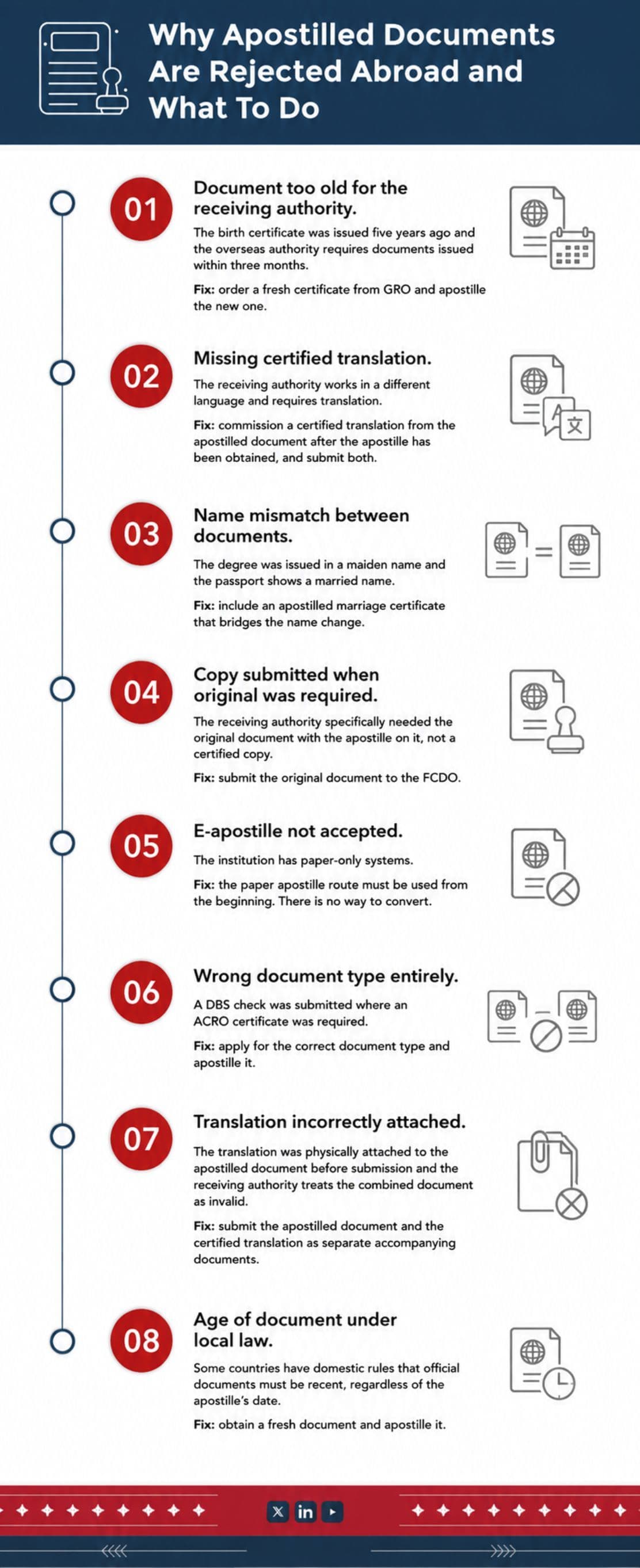
A valid FCDO apostille on a document does not guarantee the receiving authority abroad will accept the document. Rejection abroad means something separate from the apostille is wrong.
If a Hague Convention member country's institution demands embassy verification after a valid FCDO apostille, that demand is not legally required under the Convention. Provide the HCCH documentation confirming their country's membership and request escalation within the institution.
The FCDO cannot apostille a passport for use as a travel document. When a foreign authority asks for an apostilled passport, they mean a notarised copy of the passport that has been apostilled. The passport holder presents the passport to a UK notary. The notary makes a certified copy, applies their registered notarial seal, and certifies the copy. The notarised copy then goes to the FCDO. The apostille attaches to the notary's certification.
A DVLA-issued driving licence does not carry a government official's registered signature in the Hague Convention sense. A notarised copy of the driving licence, apostilled, is the correct format. Confirm the receiving authority will accept an apostilled licence copy before preparing this.
UK bank statements and bank letters are private commercial documents. They cannot go directly to the FCDO. Solicitor certification is the minimum preparation requirement. Screenshots from banking apps are rejected. Use printed statements or downloaded PDFs that carry the bank's full account details, address, and date.
UK-registered universities that offer distance learning programmes issue degree certificates that follow the same apostille route as any campus-based university: solicitor certification of a copy, then FCDO. The Open University is one of the most common examples. A course platform that is not a UK-registered awarding body may not produce a document the FCDO can apostille at all.
The apostille itself does not expire and cannot be re-apostilled to give it a more recent date. If a receiving authority has rejected an apostilled document because it is too old, the solution is to obtain a fresh underlying document and apostille that. A new apostille is placed on the new document. The old apostilled document plays no part in the process.
Occasionally a foreign authority will request apostille on a document that falls outside what the FCDO can process: a private contract, a company invoice, or a personal letter from a solicitor. The solution is to have a UK notary prepare a notarial certificate that incorporates or attaches to the document, and apostille the notarial certificate. The notary's seal is what the FCDO verifies.
The paper apostille certificate must be physically attached to the document. Lamination prevents this. Do not attempt to remove lamination. Order a replacement.
The apostille certificate itself has no expiry date. Once issued, it remains valid indefinitely.
The underlying document may be subject to age requirements set by the receiving authority. An ACRO certificate is only accepted by most overseas authorities if issued within three to six months of the application date. The receiving authority's rules about document age are entirely separate from the apostille's own validity.
Every FCDO apostille carries a unique certificate number. This number is how authenticity is checked.
The certificate number appears on the apostille certificate attached to the document. Enter the number at the official UK apostille verification portal. The service is publicly accessible and free. It confirms whether an apostille with that number was issued by the FCDO and on what date.
If a certificate number returns no result, the apostille is either fraudulent or the number was incorrectly transcribed. Report fraudulent documents to Action Fraud at actionfraud.police.uk and to the FCDO.
The verification uses the same portal and certificate number system. The verification only works with the original PDF file. A printed copy of an e-apostille cannot be verified.
When forwarding an e-apostille to a foreign authority, send the original PDF file, not a printed scan of it.
The GOV UK FCDO registered provider list is the only authoritative source for confirming whether an apostille service has business counter access. Do not rely on any service's own claim of FCDO registration.
A properly registered FCDO service provider will confirm their listing on the official page. They will break down their quote into the FCDO government fee and their own service charge. They will advise whether the document needs solicitor certification before they can submit it. They will give realistic turnaround estimates based on document type.
All figures are approximate and current as of July 2026. Verify all official fees at their respective sources before submitting.
Example: apostilling a birth certificate for a marriage registration in Spain.
GRO replacement certificate if needed: £11. FCDO postal fee: £45. Tracked return postage: approximately £8. Certified Spanish translation: £100 to £200. Total: approximately £160 to £264.
Using a registered agent reduces FCDO processing time by two to three weeks and typically adds £50 to £120 in service fee.
Example: degree certificate and academic transcript apostilled for an overseas job application.
Solicitor certification of two documents: £60 to £160. FCDO e-apostille for two documents at £35 each: £70. Certified translation if required: £200 to £600. Total: approximately £330 to £830.
Example: degree certificate and ACRO police certificate for UAE employment.
ACRO certificate application: verify current fee at acro.police.uk. Solicitor certification of degree: £40 to £80. FCDO paper apostille for two documents: £90. UAE Embassy attestation for two documents: £80 to £200 (verify with UAE Embassy). Arabic translation of both documents: £200 to £400. Return courier postage: £20 to £40. Total: approximately £500 to £880.
Example: Certificate of Incorporation, Certificate of Good Standing, Memorandum and Articles for a German branch registration.
Certificate of Good Standing from Companies House: £15. Solicitor certification of Memorandum and Articles: £40 to £80. FCDO apostille for three documents: £120 to £135. Certified German translation of three documents: £300 to £600. Total: approximately £475 to £830.
Example: death certificate, Grant of Probate, will for France.
GRO death certificate: £11. Sealed probate office copies: £1.50 per copy. Solicitor certification of Grant of Probate: £40 to £80. FCDO apostille for three documents: £120 to £135. Certified French translation: £300 to £500. Total: approximately £470 to £730, excluding French legal fees.
| Step | Minimum Time | Standard Time |
| Order GRO certificate | 2 working days (priority) | 5 to 10 working days |
| Apply for ACRO certificate | 10 working days | 15 to 30 working days |
| Obtain solicitor certification | Same day | 2 to 3 working days |
| Obtain notarisation | 1 working day | 2 to 5 working days (book ahead) |
| FCDO apostille via registered agent | 1 working day | 1 to 2 working days |
| FCDO apostille by direct postal service | 10 working days | 15 to 25 working days |
| FCDO e-apostille | 1 working day | 1 to 2 working days |
| UAE Embassy attestation | 3 working days | 5 to 10 working days |
| Pakistan High Commission attestation | 5 working days | 10 to 15 working days |
| Certified translation | 2 working days | 3 to 7 working days |
| International courier delivery | 3 working days | 5 to 14 working days |
Single personal document to a Hague country using a registered agent: GRO certificate 7 days, agent plus FCDO 2 days, translation 5 days, international delivery 7 days. Total: approximately 21 working days.
Employment package for UAE (degree and ACRO): ACRO application 20 days, solicitor certification 2 days, FCDO via agent 2 days, UAE Embassy appointment and processing 10 days, Arabic translation 5 days. Total: approximately 39 working days, plus MOFA processing in UAE.
International adoption document package: ACRO 20 days, Enhanced DBS 5 days, home study notarisation 3 days, FCDO apostille 10 days, translation and embassy attestation if applicable 14 days. Total: a minimum of 52 working days.
Practical planning rule: for any single personal document going to a Hague Convention country via a registered agent, allow 4 weeks from start to receipt abroad. For multi-document packages going to non-Hague countries or involving adoption, probate, or overseas property, allow 12 weeks and build in additional buffer.
An apostille means the document will be accepted anywhere it is sent. This is false. The apostille confirms the document is genuine. Whether the receiving authority accepts it for a specific purpose depends on that authority's own rules.
A solicitor can issue an apostille. This is false. Solicitors certify copies. The FCDO issues apostilles. These are different steps performed by different parties.
Brexit means UK apostilles are not accepted in Europe any more. This is false. The UK remains a member of the Hague Convention. Brexit did not affect this. UK apostilles are valid across all EU member states.
A printed e-apostille is the same as a paper apostille. This is false. A printed e-apostille cannot be verified. If a paper document is required, the paper route must be used from the start.
UK apostilles expire after a year. This is false. The apostille itself has no expiry date. Age requirements on the underlying document are set by the receiving authority.
The FCDO can apostille a foreign degree because the holder lives in the UK. This is false. The FCDO only apostilles documents issued in the United Kingdom.
A notarised document is already legalised. This is false. Notarisation is preparation. The FCDO apostille is legalisation. They are two separate steps from two separate parties.
Apostille services not on the GOV.UK list are still legitimate. This is misleading. If a provider is not on the GOV.UK FCDO registered provider list, they cannot access the business counter. They may still use the public postal route, which means they cannot deliver the 1 to 2 day turnaround they may be advertising.
Confirming requirements: Written confirmation from the foreign authority of exactly which documents they require. Destination country Hague Convention membership confirmed at hcch.net today. Confirmed whether e-apostille or paper apostille is accepted by the receiving institution. Confirmed whether embassy legalisation is required after the apostille. Confirmed whether certified translation is required and at which stage.
Document preparation: Documents are UK-issued originals or correctly certified copies. Documents are not faded, torn, or laminated. Solicitor certification includes the exact required wording, full name, SRA registration number, firm name and address, date, and signature. Notarisation completed by Faculty Office-regulated notary with currently FCDO-registered seal if required. Document type confirmed as eligible for e-apostille if using that route.
FCDO submission: Online application completed at gov.uk/get-document-legalised. Correct service selected: paper or e-apostille. Fee paid at current rate (verify at gov.uk before paying). For paper postal: return A4 envelope included with UK address and return postage. Documents posted by tracked and insured service. Application reference number retained.
After receiving the apostille: Scanned copies of apostilled documents made and saved before forwarding. Translation arranged after apostilling, not before. Embassy legalisation appointment booked if required for a non-Hague destination. Documents sent to destination by tracked and insured courier.
Applying for a Schengen visa from India in 2026? Get the full process, document checklist, fees, processing times, and rejection-proof tips in one guide.

Planning a move to Portugal from the USA? Learn about visas, documents, housing, banking, taxes, healthcare, and settling in with a step-by-step guide.

Complete 2026 guide to US apostilles: state vs. federal authorities, fees by state, processing times, document requirements, and step-by-step instructions.
Need help with your application or background check?
Contact us now and speak with a dedicated Globeia expert today.