By Sejal Jain · Updated July 28, 2026
Canada apostille is one of those topics where the information you find online is often wrong, outdated, or written for a different country's system. A large number of articles still describe the old two-step authentication-and-legalization process that Canada replaced in 2024. Several US-based apostille websites list Canada as a country that does not issue apostilles at all. That is no longer true.
This guide explains the Canada apostille process as it works in 2026. It covers the documents that can be apostilled, the authorities responsible for issuing apostilles, fees, processing times, and the requirements that vary by province and territory. You'll also learn when an apostille is enough, when additional steps may be required, and how to avoid delays.
Whether you're handling personal, educational, legal, or business documents, this guide gives you the information you need to complete the process correctly the first time.
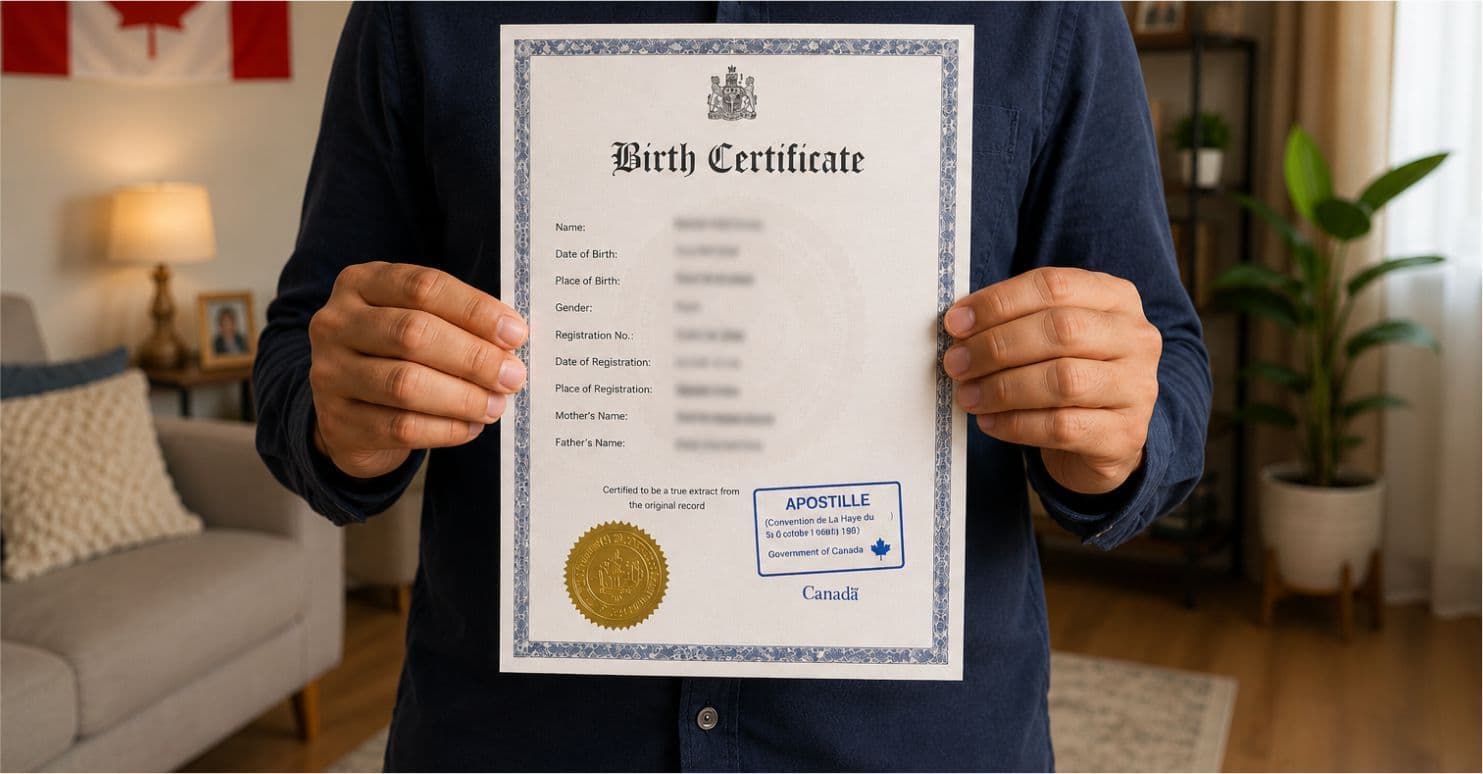
An apostille is a certificate issued by a designated government authority. It confirms that a public document's signature, seal, and issuing official are legitimate so a foreign country accepts the document without requiring embassy involvement.
The word comes from French. It means "notation." The certificate format was established by the Hague Convention of October 5, 1961.
An apostille confirms the origin of a document. It does not confirm the content.
When Global Affairs Canada issues an apostille on a birth certificate, it is stating: this signature is genuine, this seal belongs to this authority, this official had the capacity to issue this document. It is not saying the information inside the certificate is accurate. The receiving institution still assesses the content on its own.
This distinction matters practically. A fraudulent birth certificate with a genuine apostille is still fraudulent. The apostille only covers the authenticity of the signature.
In Canada, the apostille takes the form of an allonge, a separate certificate page securely attached to the front of the document. Depending on the issuing authority, attachment is done by riveting, hole-punching, or a similar fastening method. It is not a stamp on the document itself.
The allonge is printed in both English and French. This is the Convention standard. You do not need to translate the apostille certificate even if your destination country uses a different language. The underlying document may still need translation but the apostille itself does not.
Under Article 1 of the Convention, public documents include:
A purely private document an unsigned contract, a personal letter does not qualify on its own. It must first be notarized, at which point the notary's signature becomes the element the authority can verify.
One firm boundary
Only Canadian documents can be apostilled in Canada. A foreign document must go back to the country that issued it for apostille through that country's own authority.
Before 2024, Canadians who needed documents accepted abroad had to complete a two-step process:
Each step meant separate fees, separate wait times, and physical submissions to separate offices. For a document going to Italy, the chain went: Canadian notary → Global Affairs Canada → Italian Consulate → back to the applicant. Total time: often two to three months.
Canada announced its accession to the Convention on May 16, 2023. The Convention entered into force for Canada on January 11, 2024.
From that date, the two steps collapsed into one. A single apostille from a Canadian competent authority now replaces the authentication-and-legalization chain for any of the 130 countries that are also Convention members. Embassies in
Canada no longer legalize Canadian documents for those countries.
Canada processes over 200,000 public documents for international use annually. The Convention simplified that process significantly for Hague member destinations.Many websites, mostly US-based apostille services, still list Canada as a non-Hague country requiring embassy legalization. Some list China the same way. Both are wrong.
China joined the Convention on November 7, 2023. Canada joined on January 11, 2024. If a website is telling you to go to the embassy for a Hague-member destination, the information is outdated.
Non-Hague countries still follow the old two-step process. The Convention only applies between member countries. If your destination is the UAE, Saudi Arabia, Vietnam, or another non-member country, authentication plus embassy legalization is still required.
These three terms appear constantly in apostille-related materials. They are not interchangeable.
| Term | What it means | When it applies in 2026 | Who does it |
| Authentication | Verifying that a signature, seal, or stamp on a document is genuine | The base step in both processes applies whether the destination is Hague or non-Hague | Canadian competent authority |
| Apostille | The certificate issued after authentication for Hague member destinations | Document is going to a country that has joined the Convention | Canadian competent authority |
| Legalization / Attestation | A stamp from the destination country's embassy or consulate confirming the Canadian authentication | Document is going to a country that has NOT joined the Convention | The destination country's embassy or consulate in Canada |
Authentication is the process. Apostille and certificate of authentication are the two possible outputs. Ontario's ODS issues an apostille when the destination is a Hague member, and a "certificate of authentication" when the destination is non-Hague. The same office, the same verification step - two different certificates depending on where the document is going.
This creates confusion when someone asks for "a Canadian authentication" without specifying the destination. For EU countries, the answer is an apostille. For the UAE, the answer is an authentication plus embassy attestation. Confirming the destination's Hague membership before submitting anything prevents this mistake.
Sending a document to the wrong authority is the most common reason Canadian apostille requests are returned unprocessed. Canada splits jurisdiction between one federal authority and five provincial ones.
The authority that handles your document is determined by where the document was issued or where it was notarized - not where you live, not where you are sending the document.
| Document origin | Authority |
| Federal government - RCMP, citizenship, federal courts, federal departments | Global Affairs Canada - Ottawa |
| Ontario | Official Documents Services (ODS) - Toronto |
| British Columbia | Ministry of Attorney General of British Columbia |
| Alberta | Ministry of Justice, Official Documents and Appointments - Edmonton |
| Saskatchewan | Ministry of Justice and Attorney General, Authentication Services - Regina |
| Quebec | Ministère de la Justice, Direction générale des registres et de la certification |
| Manitoba, New Brunswick,Newfoundland and Labrador, Nova Scotia, Prince Edward Island, Northwest Territories, Nunavut, Yukon | Global Affairs Canada |
Two things worth noting before you submit: First, the list of provinces routing through GAC can change. The federal government can designate new provincial authorities at any time. Confirm the current list on the GAC website before mailing.
Second, some destination countries only accept federal apostilles from Global Affairs Canada and will not accept provincial apostilles. If your destination has this requirement, route everything through GAC regardless of which province issued the document.
The routing table above covers where issued documents go. When a document has been notarized, the routing rules change - and this is where most failed submissions originate.
The rules differ significantly depending on which province the notarization happened in.
These go to that province's competent authority - regardless of where the original document was issued.
Example: a Manitoba-issued document notarized by an Ontario notary goes to ODS in Toronto, not to Global Affairs Canada.
These provincial authorities can only process the notarized document if the original was also issued in that province.
A document issued in Nova Scotia and notarized in BC falls into a gap: BC will not process it (original not from BC), and GAC may return it (notarized in a province with its own competent authority). This is a real failure case, not a theoretical one.
Manitoba, Nova Scotia, NB, PEI, Newfoundland, NWT, Nunavut, Yukon - notarizations from these go to Global Affairs Canada.
Plan the notarization before booking a notary. If your document is from a non-authority province and you want the faster Ontario ODS route, use an Ontario notary to certify the copy. If you want the federal route, notarize in a non-authority province and submit to GAC.
When the correct route is unclear, use GAC's free triage portal. It asks a few questions about your document and tells you where to send it. It takes under two minutes.
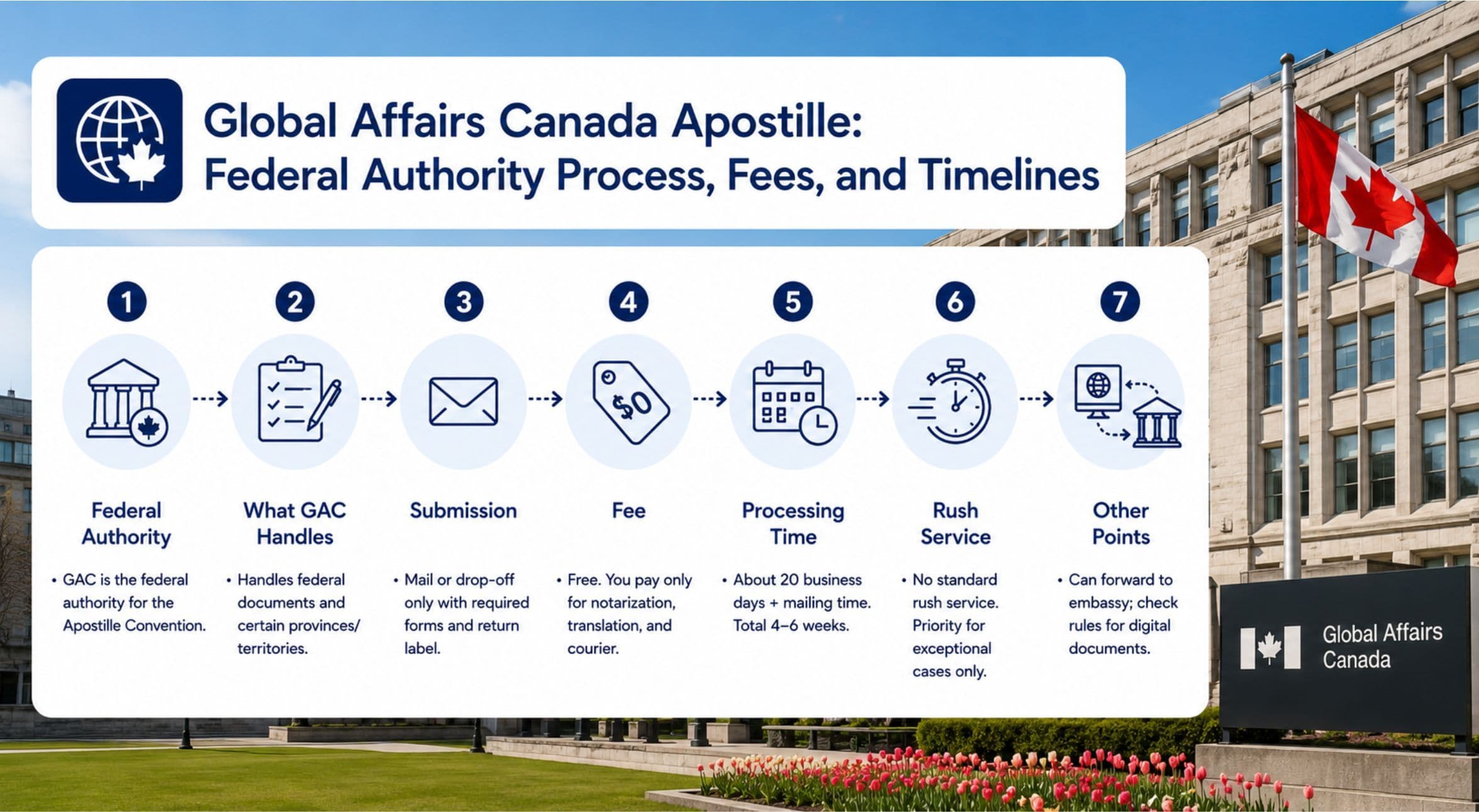
Global Affairs Canada operates the Authentication Services Section in Ottawa. This is the federal competent authority for the Convention and Canada's national contact point with the Hague Conference on Private International Law (HCCH).
Free. The GAC does not charge for apostille issuance. Your costs are notarization (if required), certified translation (if the document is not in English or French), and courier both ways.
GAC publishes a live "now processing" date on its website showing the date of submissions currently being worked. As of mid-2026, processing runs approximately 20 business days from receipt. Add 5 to 10 business days for mailing each direction. Total end-to-end: roughly four to six weeks from the day you post the package.
That figure fluctuates during peak periods. No guarantee is given on the stated timeline.
GAC does not offer expedited processing as a standard option. Priority processing is reserved for exceptional circumstances outside the applicant's control where no alternative exists. It is not a paid lane. If your deadline requires faster processing than the queue allows, the only lawful option is Ontario ODS in-person (if your document qualifies) or earlier planning.
On request, GAC can forward authenticated documents directly to a foreign embassy or high commission in Ottawa for legalization. This is useful for non-Hague destinations. Embassy fees are paid directly to the embassy - not through GAC.
Unlike Ontario ODS, GAC does not have a blanket wet-ink requirement. Contact the Authentication Services Section directly before sending a digital or electronically signed document. The treatment depends on the document type.
The mail-only format combined with a 4-to-6-week timeline is the primary complaint, particularly from applicants on visa or immigration deadlines. The second most common issue: sending a document to GAC that belongs to a provincial authority. GAC returns those unprocessed after the queue reaches them - weeks later.
Using a third-party service does not change GAC's processing timeline. The queue is the same regardless of who submits.
Ontario's competent authority is Official Documents Services (ODS), operated under the Ministry of Public and Business Service Delivery. ODS verifies signatures and seals on Ontario documents against its registry and issues either an apostille (Hague destinations) or a certificate of authentication (non-Hague destinations). You can check more details at the official page.
ODS relocated on April 28, 2025. The current address is:
Official Documents Services 777 Bay Street, Lower Level Toronto, ON M7A 2J8
The Jarvis Street location is permanently closed. Many online guides still list that address. Mailing there causes your package to be returned or lost. This is one of the most preventable delays in the Ontario apostille process.
In-person service is available at five locations:
Mail-in requests are processed through Toronto only.
Four categories of Ontario-issued documents can go directly to ODS without prior notarization:
For court documents issued before July 10, 2023 - including older divorce certificates - the document must either be notarized or reissued. Reissued certificates from the originating court carry a new signature and qualify without notarization.
Mail: up to 15 business days from receipt in Toronto. Not including mailing time in both directions.
In-person: same day. Documents are often processed within a few hours of submission. This is the only same-day apostille option in Canada.
ODS requires physical, hard-copy documents with wet-ink signatures. It does not accept digitally signed or Remote Online Notarization (RON) documents. A PDF with an e-signature, a diploma emailed from a registrar, or a document signed via DocuSign - none of these can be submitted to ODS directly.
The fix: print the document, have an Ontario notary certify it as a true copy with wet ink and an embossed seal, and submit the physical paper copy.
Non-English/French documents require certified translation before ODS can process them. Translation must be provided by a member of a recognized provincial translators' association (under CTTIC) or by an Ontario notary who speaks both languages and includes the required attestation.
Because ODS accepts any document notarized by an Ontario notary - regardless of where the original was issued - it is sometimes possible to use ODS for documents from other provinces. A document from Manitoba or Nova Scotia, notarized as a certified true copy by an Ontario notary, can be submitted to ODS.
The apostille attaches to the notarized copy, not the original. This only works if the destination country accepts an apostille on a notarized copy. Many countries require originals. Confirm with the consulate or receiving institution before relying on this route.
British Columbia's competent authority is the BC Authentication Program, administered by the Order in Council (OIC) Administration Office within the Ministry of Attorney General. The office is based in Victoria.
Ministry of Attorney General OIC Administration Office - BC Authentication Program 1001 Douglas Street Victoria, BC V8W 2C5
Documents notarized in BC where the original was issued outside BC are not processed by this office.
Mail or courier only. No in-person counter. No rush or while-you-wait service.
To check which date is currently being processed, send a blank email to BCAuthentication@gov.bc.ca. The automated reply states the current processing date. This is the only status-check method available without calling the office.
$20 per document. This covers return by regular Canada Post. For courier return with tracking, include a prepaid label in a minimum 8.5 × 11 inch envelope.
2 to 4 weeks from receipt. At capacity, the target is 14 business days.
BC uses riveting - a physical hole-punch-and-rivet method. The apostille certificate is permanently attached to the front of the document. Recipients abroad will see a metal rivet through the corner.
BC can verify BC notary signatures. It cannot verify the signature of an RCMP officer on an original federal criminal record check. If the destination country requires the RCMP signatory verified directly, the document must go to Global Affairs Canada, not BC.
Processing time stretches beyond the stated window during peak periods. No rush option. The auto-reply date-check email is the most-shared workaround.
Alberta's competent authority is the Ministry of Justice, Operating through the Official Documents and Appointments branch in Edmonton.
Official Documents and Appointments #111, 9833 109 Street Edmonton, Alberta T5K 2E8
Mail or courier only. The front counter is closed - no walk-in or in-person service.
Include:
Handwritten waybills are not accepted. If you include one, Alberta returns your documents by untracked Canada Post without notice. Use electronic prepaid waybills only.
Documents over 10 pages must be printed double-sided.
$25 per document. One payment per submission - five documents in one package: $125. No cash.
After electronic payment, you receive a receipt by email. Print it and include it with your package.
7 to 10 business days from receipt of a complete, correct package.
Alberta's 7-to-10 business day turnaround is reliable and well-regarded relative to BC and GAC. The closed counter surprises people expecting to walk in. Laminated certificates are the most common rejection cause.
Saskatchewan's competent authority is Authentication Services within the Ministry of Justice and Attorney General, based in Regina.
Ministry of Justice and Attorney General Authentication Services 101-1855 Victoria Avenue Regina, SK S4P 3T2
Saskatchewan public documents and documents notarized by a Saskatchewan notary or commissioner.
Mail or in-person drop-off at the Regina address. In-person payment by Visa, Mastercard, or debit is accepted. For mail: personal cheque or money order payable to "Minister of Finance," or include contact information for credit card payment.
$50 per document. The higher fee per document relative to BC and Alberta reflects the faster turnaround.
3 to 5 business days from receipt - the fastest documented turnaround of any Canadian competent authority for mail-in submissions.
Applicants report satisfaction with Saskatchewan's speed and the clear submission checklist on the government website. The $50 fee is the most-noted downside. For packages with multiple documents, include clear bundling instructions in case documents need to be separated.
Quebec's competent authority is the Ministère de la Justice. The process here is more complex than any other province - and for good reason.
Quebec is a civil-law jurisdiction. Quebec notaries are legal professionals governed under the Notaries Act, not common-law notary publics like those in other provinces. Their acts have the status of authentic public records under Quebec civil law.
Because of that status, the Ministère de la Justice requires signature verification from the notary's governing body before issuing an apostille on any notarized document.
For documents signed by a Quebec notary: verification must come from the Chambre des notaires du Québec (CNQ)
For documents signed by a Quebec lawyer: verification must come from the Barreau du Québec
This verification step must be completed before the package goes to the Ministère de la Justice.
Documents issued directly by a Quebec public body - birth, marriage, and death certificates from the Directeur de l'état civil; Quebec court rulings; recognized Quebec postsecondary credentials - go directly to the Ministère de la Justice without CNQ or Barreau verification.
$66.50 per document - the highest provincial base fee. Payable to the Register Fund of the Ministère de la Justice. Personal cheques are not accepted. Use credit card, money order, or bank draft.
The Ministère de la Justice website shows a live "currently being processed" date. The apostille step runs 5 to 10 business days at the base level. For notarized documents, add the CNQ or Barreau verification time before that. Total for a notarized document: 4 to 8 weeks, sometimes longer.
Quebec refuses: laminated, glued, unsigned, or card-format documents. Return courier envelopes must be minimum 8.5 by 11 inches, unfolded, with a prepaid label.
Some applicants with Quebec-issued notarized documents need a faster path. If an Ontario notary certifies a true copy of the Quebec document, that notarized copy can go to ODS in Toronto instead of Quebec - avoiding the CNQ step. The apostille attaches to the notarized copy, not the Quebec original. This only works if the destination accepts an apostille on a notarized copy. Many civil-status purposes require the original. Confirm before using this route.
The CNQ or Barreau verification step is the most-complained-about provincial requirement in Canada. Most applicants encountering it for the first time do not expect it. The additional 3 to 4 weeks and $75 to $201 in fees are a consistent source of frustration for estate, property, and corporate transactions.
These eight provinces and territories do not have their own designated competent authority. All documents from these regions route through Global Affairs Canada:
This means a Manitoba birth certificate, a Nova Scotia diploma, or a PEI marriage certificate all follow the GAC mail-in process - approximately 20 business days from receipt plus mailing time in both directions.
One edge case: if a document from one of these regions has been notarized by a notary in Ontario, Alberta, or Saskatchewan, the routing changes. The notarizing province - not the issuing province - controls the route for those three provinces. An NB document notarized in Ontario goes to ODS, not GAC. Use GAC's triage portal to confirm the correct route when documents have crossed provincial lines.
The list above can change. The federal government can designate new provincial authorities. Verify the current list before submitting.
Government fees only - add notarization, translation, and courier to reach your actual cost.
| Authority | Fee | Processing from receipt | Submission | In-person? | Rush? |
| Global Affairs Canada | Free | ~20 business days | Mail only | No | Priority only for exceptional cases |
| Ontario ODS | $16 (notarized) / $32 (official) | 15 business days mail; same-day in person | Mail + in person | Yes - Toronto + 4 Service Ontario locations | Effectively yes via in-person |
| British Columbia | $20 | 2–4 weeks | Mail/courier only | No | No |
| Alberta | $25 | 7–10 business days | Mail/courier only | No | No |
| Saskatchewan | $50 | 3–5 business days | Mail + drop-off | Drop-off in Regina | No |
| Quebec | $66.50 (+ CNQ/Barreau for notarized docs) | 5–10 days base; 4–8 weeks with notary verification | Mail only | No | CNQ rush (72 hrs) for verification step |
Note: Verify fees and timelines on each authority's official website before submitting - both change without advance notice.
Before any apostille is issued, the competent authority checks for a verifiable signature. That is the foundational requirement. Which document category you submit determines whose signature is being verified.
An original carries the issuing authority's own signature and official seal - a birth certificate from a Vital Statistics office, a court document with the clerk's signature and embossed seal, a transcript certified by the registrar. The authority can verify these signatures directly because it holds records of official signatories from its jurisdiction.
Originals are the preferred format for apostille submissions. The apostille attaches to the original, and the receiving party abroad gets the actual government record plus the apostille certificate.
You can order multiple originals. Vital Statistics offices issue as many certified copies as you request and pay for. Each carries its own serial number and is equally valid. If you need one for a visa and one for a foreign registry, order both at the outset.
A certified true copy is a copy that a notary public has examined against the original and certified as accurate. The notary signs with wet ink, applies their stamp or embossed seal, adds the date, and includes a statement such as: "I certify this to be a true copy of the original document presented to me."
The competent authority does not see the original. It sees the notarized copy and checks whether the notary's signature matches its registry.
A certified true copy is used when the original cannot be surrendered, does not carry a government-verifiable signature on its own, or is a private document. A foreign birth certificate, a diploma you intend to keep, a contract - these fall into this category.
Not accepted. No Canadian competent authority apostilles a photocopy or scan without notarization. There is no verifiable signature or seal on a photocopy, so there is nothing for the authority to authenticate.
The route follows a simple decision:
The physical format of a vital statistics document determines whether it can be apostilled at all. Format-related rejections are preventable with a simple check before you do anything else.
Most Canadian provinces now issue vital statistics certificates on polymer - a durable, plastic-based material with embedded security features, an official seal, and the registrar's original signature. Polymer is the standard format that competent authorities expect.
Alberta apostilles original polymer birth certificates issued after February 1, 2008, and original marriage or death certificates issued after January 1, 1999. Ontario apostilles polymer birth certificates directly without notarization. Other provinces have equivalent arrangements for their polymer records.
Polymer certificates are full-size - roughly letter-sized (8.5 × 11 inches) or half-letter-sized (8.5 × 5.5 inches). The official signature and seal are on the face of the document.
Vital statistics offices issue birth and marriage certificates in two versions:
Long-form: includes full registration details: the registrant's name, date and place of birth, and both parents' names. Required for citizenship applications, family-law matters, foreign marriage registration, dual-citizenship claims, and inheritance filings in many countries.
Short-form: shows name, date of birth, and sex but omits parental information. Acceptable for some visa applications where only identity and age need confirmation.
Submitting a short form when a long form is required means starting over. Confirm which version the receiving country requires before ordering.
These cannot be apostilled. They are too small for the allonge to be attached and lack the full signature and security features competent authorities require. If the only certificate you have is a wallet-size card, order a full-size original from the provincial Vital Statistics office before submitting anything.
Once laminated, a certificate is permanently ineligible for apostille. Lamination seals the surface, making it impossible to attach the allonge and raising questions about potential alterations inside the plastic. Do not attempt to remove lamination - it damages the document. Order a fresh original.
Before notarizing or mailing anything, run through these five points for vital statistics documents:
A fresh original from a Vital Statistics office costs $25 to $50 and arrives in one to three weeks by mail. Order it first, before doing anything else.
Notarization is the bridge between private or uncertified documents and the apostille system. When a document does not carry a government-verifiable signature, a notary adds their own verifiable signature and seal.

A notary public is a government-authorized professional licensed to: witness signatures, administer oaths and declarations, certify copies of documents, and authenticate copies. For apostille purposes, the key function is producing a certified true copy.
The process: the notary examines the original document, makes or confirms a copy, signs the copy with wet ink, applies their official stamp or embossed seal, adds the date, and writes the certification statement.
The competent authority never sees the original the notary examined. It sees the notarized copy and checks whether the notary's signature and seal match its registry.
For the competent authority to process a notarized document, all of the following must be present and legible:
Missing or illegible elements result in the document being returned unprocessed.
This is a common substitution that causes rejections.
A commissioner of oaths can witness signatures and administer oaths in limited contexts - employment forms, insurance documents, some government applications. Commissioners are not authorized to certify true copies for apostille-bound documents.
For apostille submissions, the certifying professional must be a notary public (common-law provinces) or a civil-law notary (Quebec). Submitting a document certified only by a commissioner of oaths is a rejection cause in every Canadian jurisdiction.
Quebec notaries are legal professionals under the Notaries Act - not common-law notary publics. Their acts have the standing of authentic public records under Quebec civil law. This is why the Chambre des notaires must verify the notary's identity before the Ministère de la Justice will apostille the document. The verification step is not a bureaucratic redundancy - it reflects the legal weight of a Quebec notarial act.
A document signed by a Quebec civil-law notary is treated differently from a document signed by a common-law notary public, even if the document types look the same.
RON allows a notary and client to connect by video with digital signatures applied electronically. This is now legal in Ontario and some other provinces. However:
Ontario's ODS requires physical, wet-ink documents. A document notarized remotely as a PDF cannot be submitted to ODS. The fix: print the document and have a licensed Ontario notary certify the printed copy as a true copy with wet ink and embossed seal.
For GAC, the position differs. Contact the Authentication Services Section before sending a digitally signed document - the treatment depends on the specific document.
When notarization is not required
Not all documents need notarization before apostille. Government-issued originals with verifiable official signatures go directly to the competent authority in many cases:
Check the specific eligibility requirements on each provincial government website before booking a notary. Notarizing something that does not need it costs money and time with no benefit.
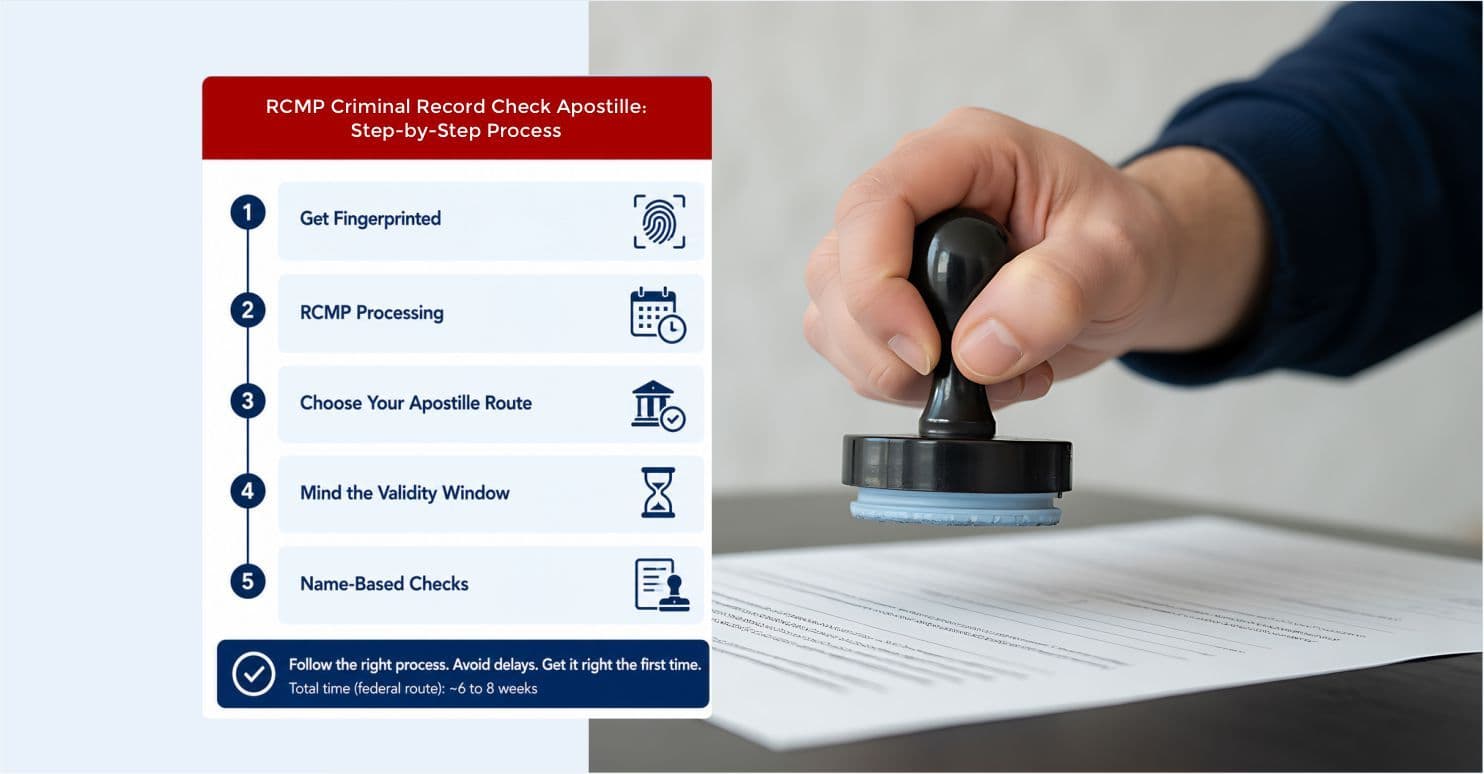
Getting an RCMP check apostilled for international use is among the most common Canada apostille requests, and consistently among the most mishandled. This section covers the full process - from which type of check to order, to the routing decision, to the validity-window problem.
Name-based check Issued by a local police service using name and date of birth only. No fingerprints. Faster and cheaper to obtain, but most foreign authorities - visa offices, immigration departments, foreign employers - do not accept it for official international purposes. If the receiving country asks for a "certified" or "fingerprint-based" check, a name-based check will be rejected.
Fingerprint-based Criminal Record Check (RCMP check) Issued by the RCMP's Canadian Criminal Real Time Identification Services (CCRTIS) in Ottawa using the C-216C fingerprint form. This is the type required for:
Identity is confirmed biometrically, making it the authoritative option for international use.
In Canada:
Outside Canada:
No criminal record match → CCRTIS mails the original certificate within approximately 3 business days of receiving the electronic prints.
Potential match or manual review required → processing can take up to 120 days or longer.
The RCMP mails results via regular untracked Canada Post. Your name on the check must exactly match your passport. Any discrepancy is grounds for rejection abroad.
This is where most applicants are not well-informed.
Federal route - Global Affairs Canada
Send the original, un-notarized RCMP check to GAC. GAC can directly verify the RCMP's signature and seal. Processing: approximately 20 business days plus mail time. Government fee: free.
Result: an apostille on the original RCMP-issued certificate.
Provincial route - Ontario ODS
To use Ontario ODS, the RCMP check must first be notarized as a certified true copy by a licensed Ontario notary. ODS then apostilles the notarized copy - it is verifying the Ontario notary's signature, not the RCMP's. In-person processing: same day.
Result: an apostille on a notarized copy of the check.
Some destination countries require the RCMP signatory itself to be verified - not a notary's signature over a copy. If your destination has that requirement, the provincial route does not satisfy it. Only the GAC apostille on the original works.
BC's own documentation states this explicitly: BC cannot verify the federal RCMP signatory. For destinations that insist on the original RCMP signature being apostilled, the document must go to GAC.
For Korea's E-2 teaching visa, the confirmed standard path is:
Confirm with the consulate or receiving institution which route they accept before choosing.
The apostille itself has no expiry date. The RCMP check behind it does, in practice.
Korea requires the check to have been issued within 6 months of the visa application. Other countries vary - 3 months is common for some immigration filings. If the check is apostilled but the visa application takes months to file, the check may expire before submission.
Plan the sequence tightly: fingerprinting → RCMP processing → GAC apostille → submission to the destination - all within the required window.
For applicants who are job-hunting before having a confirmed offer: begin the fingerprinting process immediately on deciding to work abroad, but time the GAC submission to land within a window where the result stays fresh for the likely application date.
A name-based criminal record check can be apostilled but must first be notarized. The route follows the notarization-routing rules. Before spending on this, confirm with the destination whether a name-based check is acceptable - many foreign authorities will not accept it regardless of whether it is apostilled.
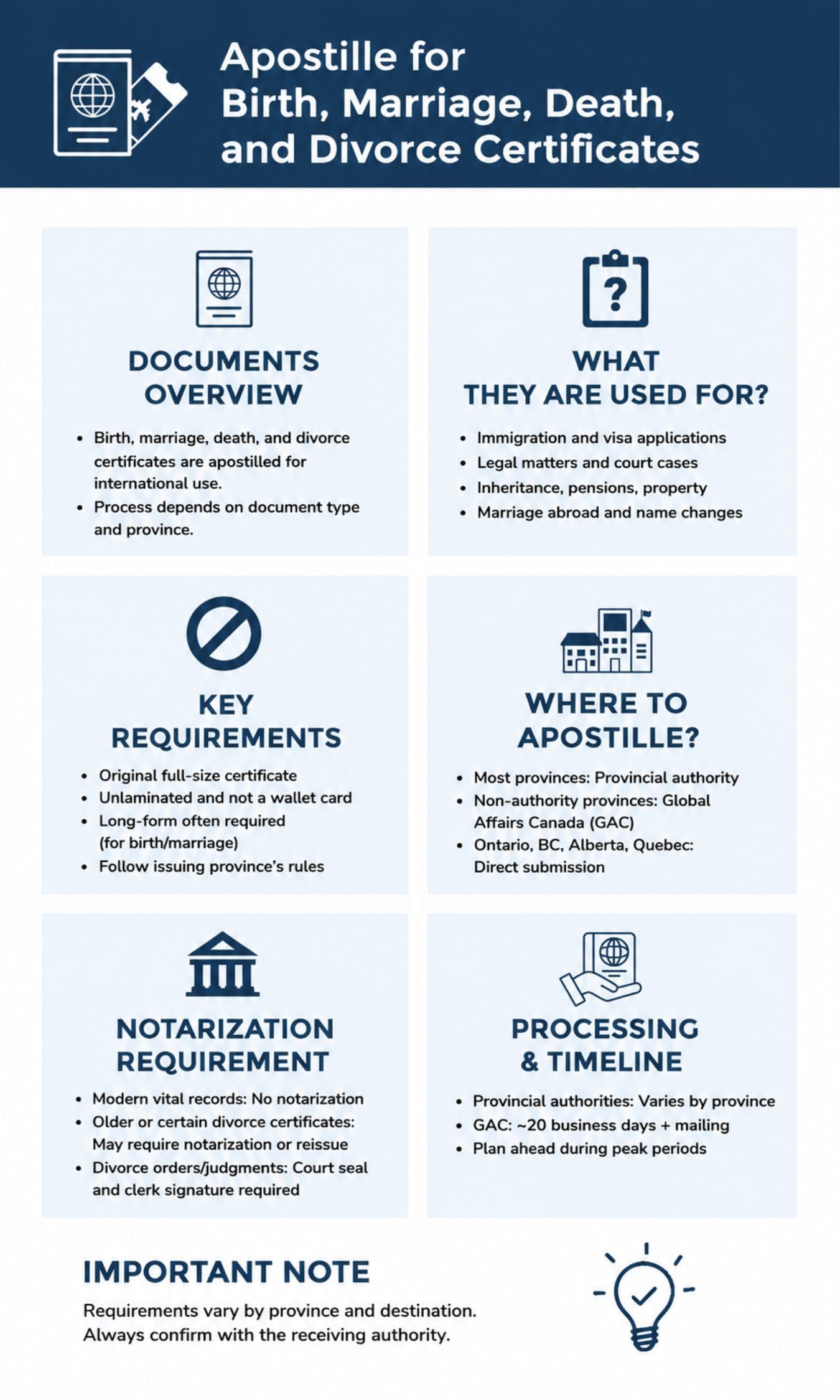
Vital statistics documents are the most frequently apostilled Canadian records. The process for each type has distinctions based on format, province of issue, and destination requirements.
Order the original from the provincial Vital Statistics office that issued it. The relevant office is in the province where the birth was registered - not where you currently live.
Ontario birth → ServiceOntario
BC birth → BC Vital Statistics
Alberta birth → Service Alberta (registry agent)
Quebec birth → Directeur de l'état civil
Decide between long-form and short-form based on what the destination requires:
The certificate must be full-size and unlaminated. If the only copy you have is a wallet card or a laminated certificate, order a new original before doing anything else.
Modern polymer vital statistics originals in Ontario, Alberta (within date cutoffs), BC, Saskatchewan, and Quebec go directly to the relevant provincial authority without notarization.
Follow the same process as birth certificates - submit the civil registration original to the relevant authority. Religious-ceremony-only marriage certificates (church, mosque, synagogue, temple records that were not also registered with the provincial government) are not apostilleable. They are not public documents under the Convention. The apostilleable record is the civil registration issued by the provincial government.
Required for international estate settlements, inheritance claims, pension transfers, and marriage applications where a previous spouse has died. Submit the Vital Statistics original to the appropriate authority.
Funeral home death certificates differ from Vital Statistics registrations. BC accepts funeral home documents if signed by a funeral home employee. Not all provinces do. Check the specific provincial authority's guidance.
Divorce documents sit at the intersection of vital records and court documents.
In Ontario:Reissued divorce certificates carry a new signature and date. They are eligible without notarization. Request a reissue from the court where the divorce was originally filed.
In other provinces: divorce certificates go to the relevant provincial authority or GAC (for non-authority provinces), with notarization requirements depending on how the certificate is signed and the issuing court.
Divorce orders and judgments (the full document setting out divorce terms) are court documents. They require the court clerk's original signature and an embossed court seal before apostille submission.
Education documents are apostilled for study abroad, foreign credential recognition, teaching visa applications, and skilled-migration assessments.
Education institutions are not government bodies. A diploma carries the president's and registrar's signatures. A transcript carries the registrar's. These are institutional officials - their signatures are not in the provincial government's signature registry. That is why education documents require an extra step before the apostille.
Ontario created a direct-apostille category for postsecondary credentials from Ontario public institutions issued since January 1, 2019. These go straight to ODS without notarization. ODS has made arrangements to verify certain institutional signatures directly.
This applies to: degrees, diplomas, and transcripts from Ontario public colleges and universities issued on or after January 1, 2019.
For documents issued before the January 2019 cutoff in Ontario, or from any institution in other provinces, the path is:
Some institutions will issue multiple certified originals with fresh official signatures on request - this eliminates the notarization step if the authority accepts registrar-certified originals directly. Ask the registrar before booking a notary.
Sealed envelopes from the registrar are accepted by many authorities. The institutional stamp on the seal demonstrates authenticity. Do not open the sealed envelope - a broken seal makes the transcript ineligible.
Letters from a registrar or dean confirming enrolment or graduation are not standardized public records. They need notarization before apostille, as the authority cannot independently verify the institutional signatory.
Certificates of good standing, business name registrations, and corporate extracts from Ontario Business Registry (issued since 1991) or equivalent provincial registries are public records with registry signatures. Ontario ODS handles these directly. Other provinces follow their standard provincial routes.
Corporate documents involving private parties - board resolutions, shareholder agreements, powers of attorney - need notarization before apostille. An Ontario notary certifies the document, and the notarized copy goes to ODS.
Powers of attorney (POA) are private documents that must be notarized before apostille. The notary witnesses the signatures of the parties granting the power, applies their seal, and includes a formal notarial statement. The notarized POA goes to the competent authority in the province where the notarization occurred.
Common rejection points for POAs:
For POAs related to real estate in Spain or Italy, confirm whether those countries require a specific notarial certificate format - some do, and it differs from the standard Canadian notarial statement.
The Hague Convention explicitly excludes documents dealing directly with commercial or customs operations. Commercial invoices, customs declarations, certificates of origin for import/export, and bills of lading fall outside the Convention's scope.
If a trading partner asks for an apostille on a commercial invoice, clarify whether they actually mean a certificate of good standing or a different public document. The apostille is not available for trade-specific customs paperwork.
Many countries ask for a "certificate of non-impediment to marriage" before registering a foreign marriage - a document confirming the applicant has no legal bar to marrying (no current spouse, no restriction). Canada does not issue one.
Canada manages civil status provincially. There is no central national marriage registry. The federal government has no mechanism to certify someone's marital status the way other countries' foreign affairs ministries do.
Global Affairs Canada issues a Statement in Lieu of Certificate of Non-Impediment to Marriage Abroad. This document states that Canada does not produce certificates of non-impediment. It does not confirm your personal marital status.
To request it, complete Section 3 of form EXT2165 and submit with:
The statement in lieu is issued and signed by the Authentication Services Section. It already carries a GAC signature and does not itself need a further apostille.
The statement is generic. It does not confirm your specific situation. Most foreign registries require personal proof paired with the statement. The strongest package combines:
Where the destination country's official language is not English or French, each document above will need certified translation. Confirm the translation certification standard with the specific consulate or registry before ordering translations.
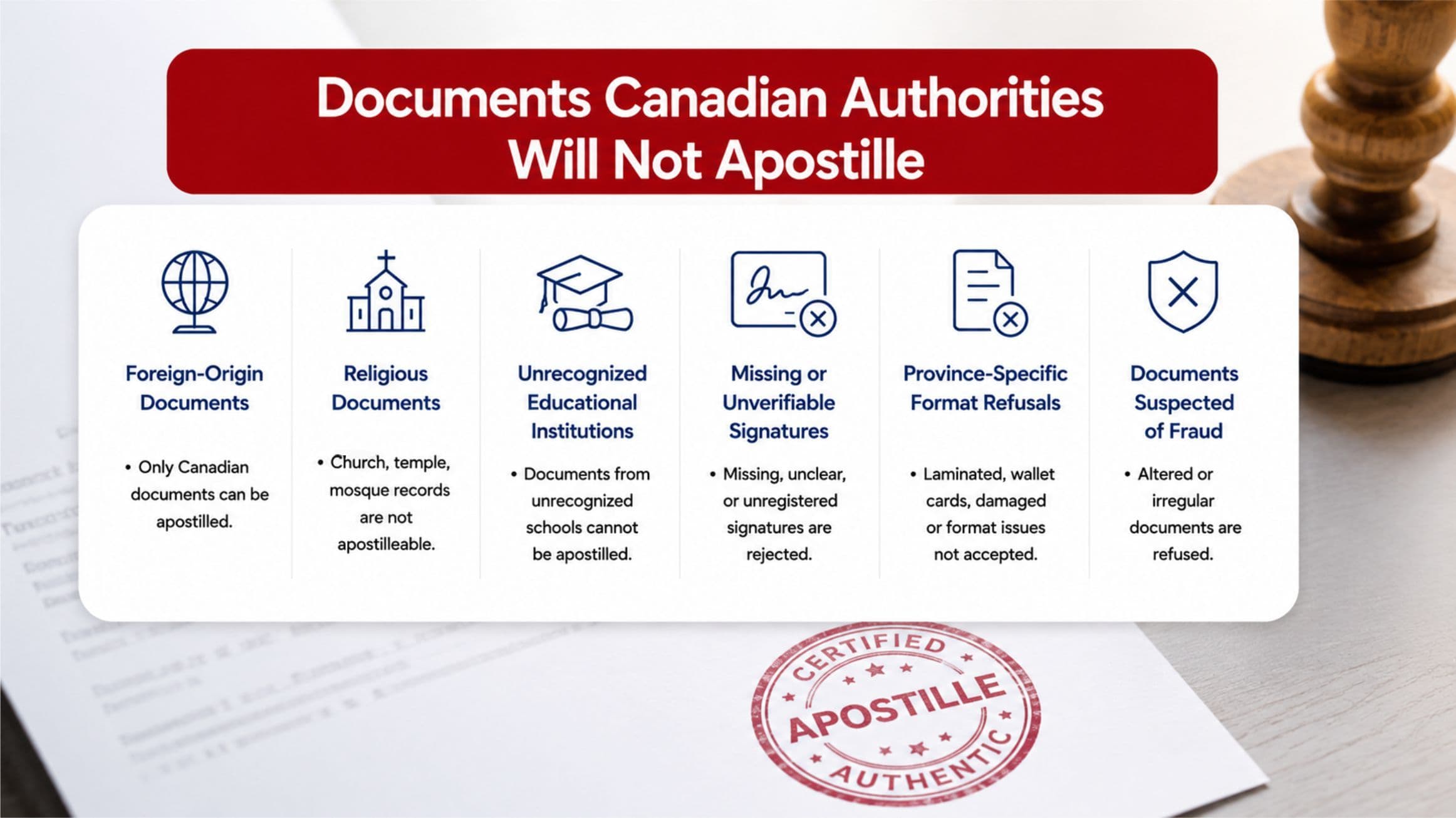
Knowing what the authorities exclude prevents wasted submissions and notarization costs.
Canadian competent authorities only apostille Canadian documents. A US birth certificate, an Indian university degree, a UAE tenancy agreement - none of these can be apostilled in Canada. They must go back to the country that issued them.
Baptismal certificates, religious marriage certificates, confirmation records, and documents issued by churches, mosques, temples, or other religious institutions are not apostilleable. They are not public documents under the Convention. If a foreign authority needs proof of a religious marriage, they need the civil marriage certificate - the government-registered record.
Diplomas or transcripts from institutions not recognized by the relevant provincial education authority cannot be apostilled. The competent authority cannot verify the signatory if the institution is not in its registry.
Any document where the required signature is missing, illegible, or not in the competent authority's registry is returned. This applies to notarized documents where:
Authorities reserve the right to refuse authentication if a document appears altered, the notarial act is irregular, or the apostille would facilitate illegal activity. Suspected documents may be flagged as well as returned.
Translation intersects with the apostille process at two distinct points: what the Canadian authority needs to process your submission, and what the foreign recipient needs to use the document.
All documents submitted to a Canadian competent authority must be in English or French. A document in Spanish, Chinese, Arabic, or any other language needs a certified translation accompanying it before the authority will review the submission.
That translation must come from a translator who is a member of a recognized provincial translators' association (under CTTIC - the Canadian Translators, Terminologists and Interpreters Council), or from an Ontario notary who attests to speaking both languages and includes the required statement.
The allonge is printed in English and French per the Convention standard. It does not need translation. Receiving parties internationally recognize the standardized 10-field format without translation.
After the apostille is issued, the underlying document may also need translation into the destination country's language. Italian immigration needs Italian translations. Korean immigration needs Koreans.
The standard sequence is:
Some countries require the translation to be apostilled as well. In that case:
The Italian Consulate General of Toronto accepts a translation notarized by an Ontario notary and then apostilled, as an alternative to their own certification process. Confirm the specific requirement with the receiving authority before choosing which path to follow.
| Jurisdiction | Recognized translation route |
| Quebec | OTTIAQ-certified translator (Ordre des traducteurs, terminologues et interprètes agréés du Québec) |
| Ontario and other common-law province | CTTIC-member provincial association translator, or qualifying notary attestation |
| For Italian consular submissions | ATIO-certified translator listed with the consulate, or notarized + apostilled translation |
As of 2026, the Hague Convention has approximately 130 contracting states. An apostille from any Canadian competent authority is accepted in all of them without embassy involvement.
The US joined the Convention in 1981. A Canadian apostille is sufficient for US use - no Canadian embassy step, no US consulate step. Before January 2024, US recording authorities that required authentication had to deal with a separate Canadian consular process. That step is now eliminated.
UK authorities accept Canadian apostilles directly. The UK's own apostille authority - the Foreign, Commonwealth and Development Office (FCDO) - only issues apostilles for UK documents going abroad, not for Canadian documents.
Common uses: Skilled Worker visas, professional registration with UK regulatory bodies (nursing, medicine, engineering), and property matters.
Italy accepts Canadian apostilles. The consulates in Canada stopped legalizing Canadian documents after January 11, 2024.
Spain's consulates confirmed that Canadian documents must carry Canadian apostilles, and that the consulate no longer handles legalization of Canadian documents.
Spain's requirement is explicit: only original apostilled documents are admissible. An apostilled photocopy is not a substitute for an apostilled original.
All Convention members. Canadian apostilles accepted directly. A certified translation into the destination language may still be required by the specific institution.
Convention member. Canadian apostilles accepted for immigration applications, skilled migration, partner visas, professional registration, and study abroad. DFAT issues apostilles for Australian documents - relevant only for Australian documents going elsewhere.
China joined the Convention on November 7, 2023 - roughly two months before Canada. Canadian apostilles are now accepted in China without embassy legalization. Many older guides and some US apostille service websites have not updated this information. If a website says documents for China require embassy legalization, that guidance is outdated for Hague-eligible documents.
Convention member. Korean immigration requires the RCMP fingerprint-based check plus apostilled academic credentials. Korea's E-2 visa requires the RCMP check issued within 6 months of application.
Both Convention members. Receiving institutions may have specific format or translation requirements beyond the apostille - confirm with the institution directly.
All Convention members. Canadian apostilles are sufficient for the authentication layer. Translation and format requirements vary by country and institution.
For countries that have not joined the Convention, the two-step process still applies. The list changes as countries accede - verify current membership on hcch.net before treating any country as non-Hague.
Same offices, same process, same fees. The output is a certificate of authentication. Some authorities issue an apostille-format certificate regardless - the embassy in step 2 will review and stamp it either way.
The embassy or consulate in Canada adds its own stamp confirming the Canadian authentication. Each embassy sets its own:
There is no standardized step 2. Contact the specific embassy before sending anything. The order is fixed: Canadian authority first, then embassy. Do not send the document directly to the embassy before the Canadian authentication is complete.
| Country | Embassy in Canada | Notes |
| United Arab Emirates | UAE Embassy, Ottawa | May also require in-country MOFA attestation after arrival |
| Qatar | Embassy of Qatar, Ottawa | |
| Kuwait | Embassy of Kuwait, Ottawa | |
| Egypt | Embassy of Egypt, Ottawa | |
| Vietnam | Embassy of Vietnam, Ottawa | |
| Iraq, Lebanon, Jordan | Respective embassies, Ottawa |
Thailand approved its accession to the Convention in late 2025. Confirm its current status on hcch.net before treating it as non-Hague.
Timeline for non-Hague submissions
Full chain - notarization (if required), Canadian authority authentication, embassy attestation, and potentially in-country MOFA attestation - can take six to ten weeks. For employment start dates or visa deadlines, begin as early as possible.
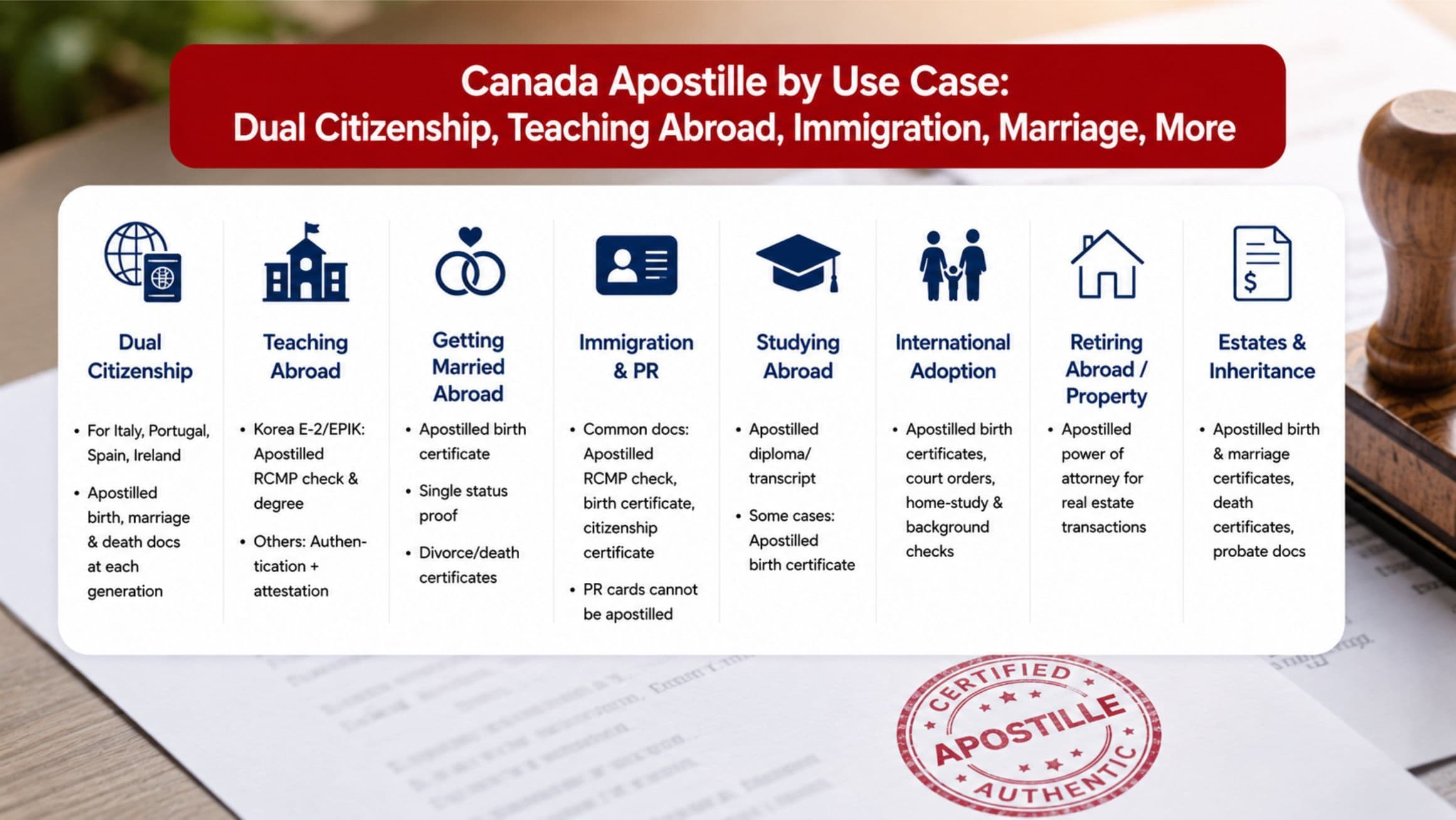
Countries granting citizenship to descendants require a complete chain of civil-status documents tracing the lineage from ancestor to applicant - birth, marriage, and death certificates at each generation.
For Italy every civil-status document must be an apostilled original with a certified Italian translation. Documents are not returned after submission to the Italian consulate. Order originals in multiples before submitting.
Italy's 2025–2026 jure sanguinis changes- new eligibility restrictions and per-consulate annual caps mean applicants must verify current eligibility before spending on document preparation. The document costs - notarization, apostille fees, translations - can reach several thousand dollars across a multi-generation chain.
For Portugal, Spain, and Ireland: confirm document requirements with the relevant consulate. Requirements differ by country and sometimes by how far back the lineage runs.
Korea E-2/EPIK standard package:
For UAE, Saudi Arabia, and other non-Hague teaching markets:
Core document package:
Confirm the full list with the specific municipality or registry where the marriage will be registered. Requirements vary not just by country but sometimes by region within a country.
IRCC does not apostille foreign documents for Canadian immigration applicants. It requires applicants to submit foreign documents apostilled by the country that issued them.
Common Canadian documents submitted for foreign immigration applications: apostilled RCMP check, apostilled Canadian birth certificate, apostilled citizenship certificate. PR cards cannot themselves be apostilled - contact the specific receiving authority about acceptable proof-of-status formats.
Apostilled diploma or transcript from Canadian postsecondary institution; sometimes an apostilled birth certificate. Ontario postsecondary credentials issued since January 2019 go directly to ODS without notarization. For other provinces or older credentials, allow notarization time.
Both the sending and receiving countries require apostilled civil documents. Canadian outgoing adoption files include: apostilled birth certificates, court orders, home-study documents, and background checks (RCMP fingerprint-based process). Incoming adoption files require the sending country to apostille its own records through its own authority - this cannot be done in Canada.
Powers of attorney for real-estate transactions abroad are the most common legal document in this category. An Ontario or provincial notary prepares the POA, the notarized original goes to the relevant provincial authority or GAC, and the apostille is issued. Confirm the POA format accepted in the destination country before drafting - some European countries have specific wording requirements.
Common documents required: apostilled birth and marriage certificates (proof of relationship), apostilled death certificates, court-issued probate documents. Each is apostilled separately. Italian inheritance proceedings, for example, require apostilled birth and death certificates for both the deceased and the heirs, each with Italian translations.
When the question is reversed - a foreign document needed inside Canada - different rules apply. Canadian competent authorities do not apostille foreign documents. Global Affairs Canada's Authentication Services Section cannot authenticate a document issued in another country.
Because Canada joined the Convention, foreign documents from other member countries should carry a single apostille from the issuing country's authority. A US birth certificate with a state apostille from a US Secretary of State, or a UK document with an FCDO apostille, is accepted by Canadian authorities under the Convention.
The entity receiving the foreign apostilled document may be: IRCC for immigration applications, a provincial licensing body for credential recognition, a Canadian court, a Canadian university, or a financial institution. Each sets its own rules on whether an apostille satisfies its requirements. The Convention does not require every private Canadian institution to accept one automatically. Confirm with the specific recipient.
Many Canadian bodies operate in English or French. A foreign apostilled document in another language may still need a certified translation for the Canadian recipient - even though the apostille certificate itself is in English and French.
IRCC requires certified translations of all foreign documents not in English or French.
Documents from UAE, Saudi Arabia, Vietnam, and other non-Hague countries must go through authentication and legalization in their country of origin first - authenticated by that country's own authority, then legalized by the Canadian Embassy or High Commission in that country. This is the mirror of what Canadians do for documents going to non-Hague countries.
The government fee is one line item in the total cost of an apostille. For realistic budgeting, here are all the components.
| Authority | Fee |
| Global Affairs Canada | Free |
| Ontario ODS | $16 (notarized document) / $32 (government-issued document) |
| British Columbia | $20 per document |
| Alberta | $25 per document |
| Saskatchewan | $50 per document |
| Quebec | $66.50 per document |
When required: $25 to $75 per document for simple certified true copies. $100 to $200 for sworn declarations, powers of attorney, or multi-page packages. Rates vary by province and notary.
$50 to $90 per page for legal/government translations from most CTTIC-member translators. A birth certificate is one to two pages. A multi-document citizenship application package with translations can total several hundred dollars.
Canada Post Xpresspost or private courier: $15 to $30 per direction within Canada. Two-way courier on a single package: $30 to $60. From western Canada to GAC in Ottawa via standard tracked mail: allow 5 to 7 business days per direction.
Ontario birth certificate apostilled for use in Italy
Federal RCMP check apostilled for Korea teaching visa (applicant outside Ontario)
One cost-reduction note
Order multiple originals of any document you expect to submit to multiple authorities or institutions. The incremental cost from a Vital Statistics office is $20 to $50 per additional original. One extra original ordered upfront costs less than restarting the entire apostille process because a single copy was not returned - as happens routinely with Italian citizenship submissions.
Processing windows as of mid-2026
| Authority | Processing from receipt | Rush available? |
| Global Affairs Canada | ~20 business days | No |
| Ontario ODS - mail | Up to 15 business days | No (in-person is same-day) |
| Ontario ODS - in person | Same day | Yes, effectively |
| British Columbia | 2–4 weeks | No |
| Alberta | 7–10 business days | No |
| Saskatchewan | 3–5 business days | No |
| Quebec - apostille step | ~5–10 business days | No |
| Quebec - CNQ verification (notarized docs) | ~20 business days (standard); ~72 hours (rush) | Rush at CNQ only |
Verify each figure on the authority's website at the time of submission. These numbers change
Italian consulate appointment in 10 weeks. Need an apostilled Ontario birth certificate with Italian translation.
Total: 9 to 11 weeks. With 10 weeks until the appointment and no certificate in hand, the in-person ODS route (same-day processing) is the only path that fits.
For Korea's E-2 visa (check must be issued within 6 months of application):
For a firm job-start date, 7 weeks matters. For an uncertain offer timeline, starting fingerprinting early and timing the GAC submission to coincide with a likely application window is the practical approach.
In June 2025, Canada launched an online apostille verification register. The register allows any party - a foreign institution, employer, or embassy - to confirm the authenticity of a Canadian apostille without contacting the issuing office.
Apostilles issued by these authorities can be verified through the Canadian apostille verification portal:
Ontario ODS and Quebec's Ministère de la Justice apostilles are not yet in the register as of mid-2026. An Ontario or Quebec apostille cannot currently be verified through the portal. The receiving party must contact ODS or the Ministère directly to verify.
Check current coverage before relying on online verification for a time-sensitive submission.
Apostille fraud has occurred in international document contexts. The register makes fabrication or alteration significantly harder - receiving parties can confirm the apostille reference number against the issuing authority's record in real time. Some foreign authorities now require online verification as part of their standard document intake.
Canada currently issues apostilles in physical paper format only. GAC referenced e-apostille development in its initial 2023 Convention announcement. No implementation date has been set as of mid-2026. When e-apostilles become available, the physical process will remain available - e-apostilles will be an additional option, not a replacement for the existing method.
Every rejection in this table is preventable. Each one is documented from official authority guidance, applicant accounts, and service-provider experience.
| Rejection reason | Prevention |
| Sent to the wrong authority | Use the routing table in Section 5 and the notarization rules in Section 6 |
| Wallet-size or laminated document | Order a full-size, unlaminated original from Vital Statistics |
| Short-form submitted when long-form required | Order the long-form with parents' names |
| Photocopy without notarization | Have a notary certify a true copy with wet ink and seal |
| Digital/RON document submitted to Ontario ODS | Print and have an Ontario notary certify a wet-ink true copy |
| Missing or illegible notary seal | Use a notary with a clear stamp or embossed seal; re-notarize if in doubt |
| No return envelope or prepaid waybill (for GAC) | Always include a prepaid return label or self-addressed prepaid envelope |
| Handwritten waybill submitted to Alberta | Use electronic prepaid waybills only |
| No certified translation for a non-EN/FR document | Obtain a CTTIC-member certified translation or qualifying notary attestation |
| Package mailed to ODS's old Jarvis Street address | Current address: 777 Bay Street, Lower Level, Toronto - confirmed July 2026 |
| Notarized RCMP copy sent to GAC expecting a federal apostille | GAC apostilles original RCMP checks; route notarized copies to a provincial authority |
| RCMP check name does not match passport | Order the RCMP check using the exact name on the passport |
| RCMP check outside the validity window at time of submission | Sequence fingerprinting → apostille → submission so the check stays within the required window |
| Documents over 10 pages submitted single-sided to Alberta | Alberta requires double-sided printing for documents over 10 pages |
| Quebec notarial act submitted without CNQ certificate | Obtain Chambre des notaires verification before submitting to the Ministère de la Justice |
The Canadian apostille process does not require a third-party service. Global Affairs Canada states clearly on its website that you do not need an agent, and that processing times are identical whether you submit directly or through a company.
A service cannot move the government queue faster. It cannot make a non-qualifying document qualify. It cannot fix a laminated certificate or make a digitally signed document acceptable to ODS. A service's value is in preparing and routing a correct submission efficiently - not in having privileged access to the government.
Across expatriate communities, teaching-abroad forums, immigration discussion boards, and document-service Q&A threads, a consistent set of problems appears repeatedly. These are synthesized from that collective reporting.
The most frequent pattern: an Ontario-issued document mailed to Global Affairs Canada in Ottawa. GAC processes the package through its queue, finds it belongs to ODS, and returns it - two to four weeks later. By that point, the original deadline may have passed or compressed significantly.
The second most common: mailing to BC when the document was notarized in Ontario (routing-trap failure).
ODS moved from Jarvis Street to 777 Bay Street in April 2025. Dozens of online guides still list the old address. Packages mailed to Jarvis Street are returned or lost. The Bay Street address is current as of July 2026, but given the number of outdated resources online, confirming the address directly on Ontario.ca at the time of submission is the right practice.
For immigration windows, visa application deadlines, and time-sensitive corporate transactions, the GAC queue is a real constraint. No expedited option. No guarantee the stated processing date will not extend. When a deadline is six weeks away and the total round-trip time via GAC is four to six weeks, the margin is thin or nonexistent.
The consistent advice from experienced applicants: treat the GAC timeline as a minimum, not a guarantee, and start earlier than you think necessary.
Among applicants who need an apostille quickly, ODS in-person at 777 Bay Street is the most-recommended option. No appointment needed. Often processed within hours. For anyone within reasonable travel distance of Toronto or the other four ServiceOntario locations, in-person submission is the practical fix for deadline pressure.
Many applicants now receive documents digitally - an emailed university diploma, a certificate issued as a PDF, a contract signed via DocuSign. The assumption that these are ready for apostille is common. ODS's wet-ink requirement is the frequent corrective. The fix - print and have an Ontario notary certify a wet-ink true copy - is simple once known.
Korea E-2/EPIK communities discuss the 6-month validity window regularly. A check that lapses during a job search or employer approval delay requires a complete restart - fingerprinting, RCMP processing, GAC apostille, the full sequence again.
Community consensus: start fingerprinting as soon as the intention to work abroad is firm. Time the GAC apostille submission to align with a concrete, near-term application window rather than submitting speculatively while the job search is still open.
People dealing with Quebec notarial acts for estate, property, or corporate transactions frequently do not anticipate the CNQ step. The additional three to four weeks and $75 to $201 in verification fees are a consistent shock. The Ontario notarized-copy workaround is discussed, with appropriate caution: it only works when the destination country accepts an apostilled copy rather than the original Quebec notarial act.
Multiple applicants across forums flag the problem of guides that predate January 2024 still circulating. Pre-2024 guides describe the two-step authentication-and-legalization process as current. Some list Canada and China as non-Hague. Some still reference the Jarvis Street address. Cross-referencing any procedural step against the official government website at submission time is the reliable practice.
A significant number of Canadians who need apostilles are not currently in Canada. Teaching in Korea, working in the UAE, studying in Europe, or living abroad long-term - these applicants need to run a Canadian government process from the other side of the world.
Most Canadian competent authorities accept international courier submissions. GAC, BC's OIC Administration Office, Alberta's Ministry of Justice, and Saskatchewan's Authentication Services all accept packages from abroad. You courier the documents to the authority from wherever you are. They mail or courier the completed documents to whatever address you provide - including international addresses.
The risk: sending original government documents internationally by courier. Use fully tracked services with insurance. A lost original birth certificate or RCMP check requires restarting from the beginning - reordering, reprocessing, and losing weeks.
When documents need to be notarized by a Canadian notary but you are not in Canada, options include:
An RCMP check can be initiated from abroad. An RCMP-accredited fingerprinting agency in Canada accepts ink prints taken by an authorized overseas provider, digitizes them via card-scan, and submits electronically. CCRTIS mails results to the address you specify - including international.
For applicants outside Canada who cannot manage the physical logistics, a Canadian document-service company can act as the local presence - receiving originals, taking them to a notary, submitting to the authority, and couriering completed documents internationally. The service adds cost, but eliminates logistics burden and reduces the risk of a packaging or routing error that causes a rejection.
The Gulf region - UAE, Qatar, Kuwait, Bahrain, and Oman - is one of the largest non-Hague clusters for Canadian documents. Tens of thousands of Canadians work in these countries at any given time. Document requirements for employment, professional licensing, family matters, and credential recognition there are among the most demanding internationally.
None of these countries are Convention members. An apostille alone is not sufficient. The full authentication-plus-embassy chain is required.
The document goes to the appropriate Canadian competent authority first. Federal documents to GAC. Ontario documents to ODS. Alberta documents to the Alberta Ministry of Justice. And so on. The output is a certificate of authentication.
After Canadian authentication, the document goes to the destination country's embassy or consulate:
Each embassy charges its own fee, requires its own document format, may require Arabic-certified translations, and operates on its own timeline.
For the UAE: documents may also require MOFA (Ministry of Foreign Affairs) attestation inside the UAE after they arrive in-country. This is a third step, entirely separate from the Canadian authentication and embassy attestation.
Full chain: notarization (if required) → Canadian authority → embassy attestation → in-country MOFA or equivalent → receiving institution. Six to ten weeks is a realistic minimum. For employment start dates, begin the process as early as possible.
Gulf countries require official documents in Arabic for most purposes. Certified Arabic translations - by a translator approved by or listed with the relevant embassy - are needed before the embassy will complete its attestation step.
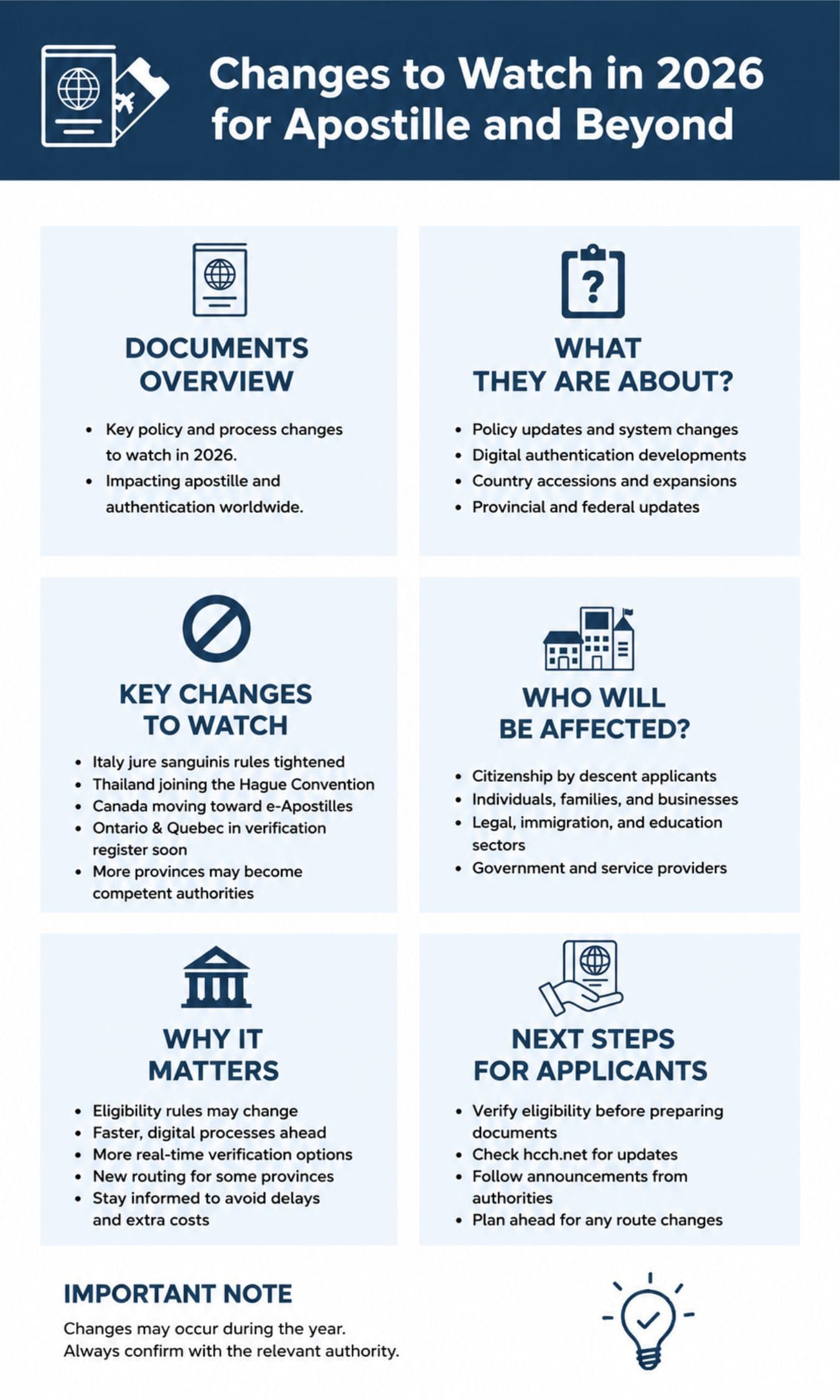
Italy tightened citizenship-by-descent eligibility rules in early 2025. New conditions were introduced and each consulate now has annual caps on adult citizenship applications. Before preparing apostilled documents for an Italian citizenship file, verify current eligibility and appointment availability with the relevant Italian consulate. Document preparation costs - apostille fees, notarization, translations - can total several thousand dollars. Spending that on a file that does not currently qualify is a preventable loss.
Thailand approved accession to the Convention in late 2025. Confirm its formal entry-into-force date on hcch.net before treating it as a Hague-member destination. Additional countries have expressed interest in joining. The list at hcch.net is the authoritative source - check it at the time of submission.
Canada's apostille authorities have indicated future development of electronic apostille issuance. No implementation date has been announced as of mid-2026. When it becomes available, the physical process will remain available. e-Apostilles will be an additional option in the initial rollout.
The online verification register launched in 2025 covers GAC, Alberta, Saskatchewan, and BC. Ontario ODS and Quebec's Ministère de la Justice are not yet included. Watch for announcements about their inclusion - it will enable receiving parties in other countries to verify Ontario and Quebec apostilles in real time without contacting the issuing office.
The federal government can designate additional provincial competent authorities at any time. Nova Scotia, Manitoba, and New Brunswick may eventually build out their own offices. If a province gains its own designation, documents from that province that currently route through GAC will need to go to the new provincial authority. Check GAC's authentication page for the current list at the time of any submission.
Not every international document submission requires an apostille. Before spending on the process, confirm whether it is actually needed.
The definitive source is the institution actually requesting your document in the destination country - the university admissions office, the immigration authority, the foreign registry, the employer's HR department. Ask directly: "Do you require an apostille on this Canadian document, or is a certified original sufficient?"
Many receiving institutions in Hague member countries accept Canadian documents without apostille for routine submissions. The Convention gives countries the option to require apostilles - it does not compel them to.
The Hague Conference on Private International Law maintains a country-by-country database at hcch.net. Under each country profile is information about which types of documents they require apostilles for and any specific instructions. Free to access, and it is the most authoritative source for this information.
Some bilateral agreements between Canada and specific countries remove apostille requirements for certain document types in certain contexts. These exemptions are the receiving country's decision. When a receiving institution tells you no apostille is needed, verify that the exemption applies to your specific document type and purpose before assuming it is broadly applicable.
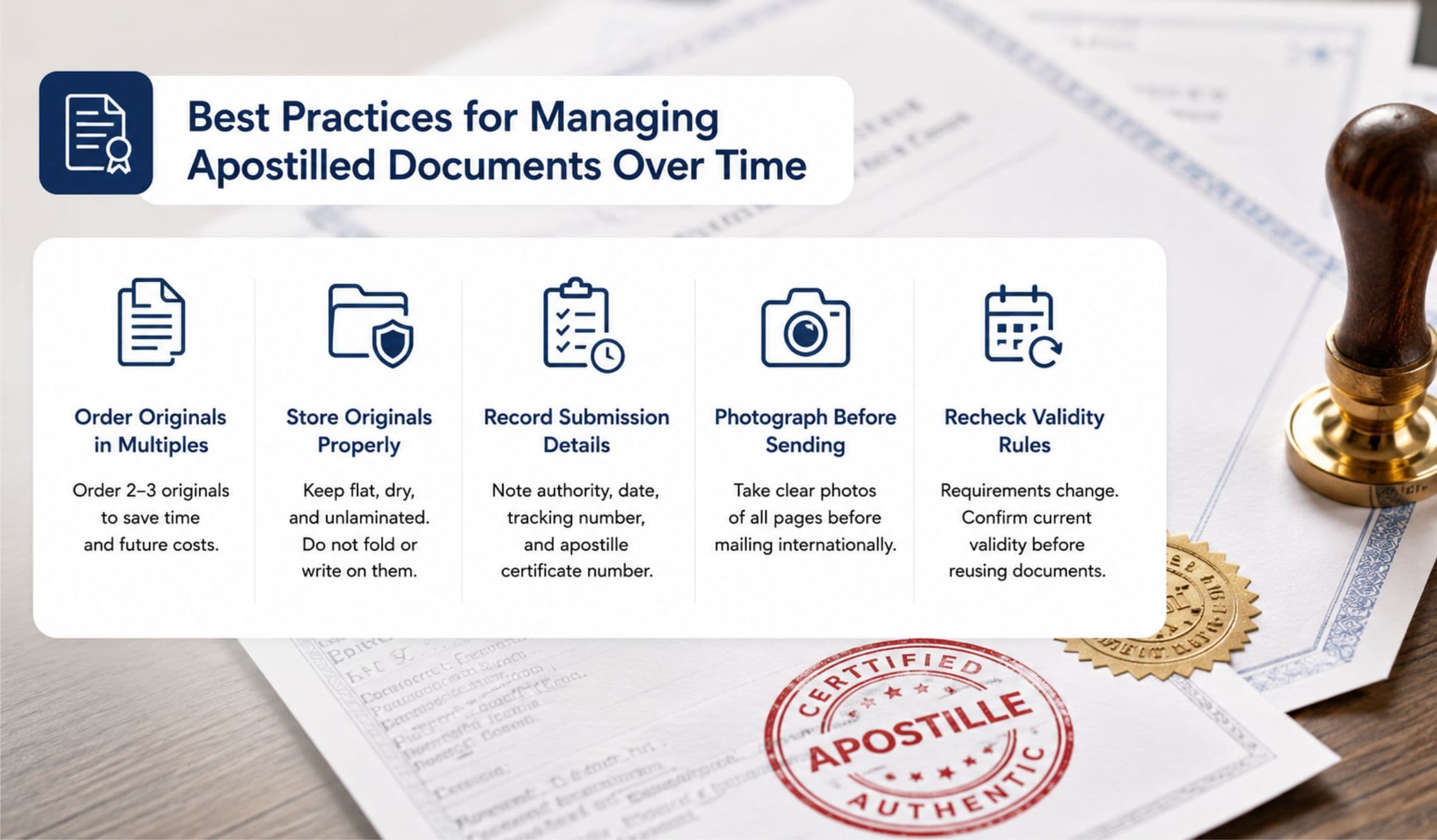
Many applicants who need an apostille once find they need one again within a few years - for a different country, a different purpose, or a renewed criminal record check. A few practices at the outset reduce the cost and complexity of future requests.
When ordering a birth or marriage certificate for one apostille submission, order two or three originals at the same time. The incremental cost at a Vital Statistics office is $20 to $50 per additional original. Having extras in hand eliminates the need to restart from the Vital Statistics application when the next need arises. Italian citizenship submissions require originals that are not returned - applicants who ordered only one copy before discovering this must reorder and re-apostille the entire set.
Once laminated, a certificate is permanently ineligible. Keep originals in an acid-free flat folder. Do not fold, punch holes in, or write on vital records.
Note: the authority used, the submission date, the tracking number, and the apostille certificate number when the document returns. If a foreign authority requests verification later, having the certificate number enables rapid confirmation through the online register.
If an apostilled document is lost in international transit, a photograph provides the certificate number for online verification and documentation of what was sent. Some applicants photograph every page of the apostilled package before it leaves their hands.
A criminal record check apostilled two years ago for one application may not satisfy a new application's 6-month recency requirement. The apostille remains valid - the check behind it may not be fresh enough. Check the receiving party's current requirements each time a document is submitted, even if it was previously accepted elsewhere.
The in-person ODS office at 777 Bay Street, Lower Level is the only same-day apostille option in Canada. No appointment needed. Monday to Friday, 8:30 a.m. to 5:00 p.m. Open to anyone submitting Ontario-issued documents or Ontario-notarized documents. The travel cost is worth it for applicants on deadline who qualify for ODS.
Second in-person ODS location. 4th Floor, 161 Elgin Street. Accepts in-person Ontario apostille submissions.
Sault Ste. Marie, Windsor, and Thunder Bay
No in-person public service. Even if you are physically in Ottawa, you mail your package. Priority processing for genuine emergencies is available by contacting the Authentication Services Section directly, but it is not a standard option.
Mail and courier only. No in-person counter.
Mail and courier only. No walk-in counter.
Mail and in-person drop-off. In-person card payment accepted.
Mail-in only. No in-person counter.
Every major Canadian city has notaries public for apostille-related certifications. In Ontario, registered notaries serve Toronto, Mississauga, Brampton, Ottawa, Hamilton, and surrounding areas. In BC, notaries (and lawyers registered with the OIC Administration Office) are available throughout the Lower Mainland and across the province. In Alberta, any Alberta notary public can certify documents for the Ministry of Justice submission.
A record suspension in Canada removes a criminal record from the active national database. A fingerprint-based RCMP check obtained after a record suspension is granted should return no criminal record. This is what most foreign authorities want to see.
However, some destinations require a statutory declaration confirming the applicant's status rather than simply a "no record" check result. Others ask about prior suspensions specifically. Confirm what level of disclosure the destination country requires before ordering the check - a "no record" result is not the same as a declaration that no record has ever existed.
When the name on a current passport differs from the name on a birth certificate or other record - due to marriage, divorce, or a formal name change - foreign authorities may question whether the documents refer to the same person. Include an apostilled name-change certificate or a notarized statutory declaration explaining the discrepancy alongside the other documents. Some receiving authorities specifically require this supplementary evidence.
Apostilling documents for minors follows the same provincial routing as adult documents. A parent or legal guardian may need to provide written authorization for a notary to certify documents on behalf of a minor. Travel consent letters - confirming that a minor is authorized to travel with one parent or a third party - can be apostilled, which is useful for international travel arrangements where one parent is remaining in Canada.
Some documents carry signatures from both a provincial official and a federal one. The routing is determined by the primary issuing authority. When the correct route is unclear, contact the authority you plan to submit to first and describe the specific document - they will confirm whether they can process it or whether it should go to GAC.
Status cards issued under the Indian Act are federal documents. Apostilles for these, where required, go through GAC. Band council resolutions and First Nations administrative records may require specific guidance. Contact the Authentication Services Section directly for documents of this type before submitting.
A document signed by a Quebec civil-law notary but intended for use in an Ontario transaction - a power of attorney for Ontario real estate, for example - raises the question of which province's authority should apostille it. If the document is governed by Quebec civil law, it may need to go through Quebec's verification chain. If it was created under Ontario law but signed by a Quebec notary working in Ontario, the province of the notarial act's governing law determines the route. When in doubt, describe the document to the authority before submitting.
A certificate of good standing (or certificate of compliance in Quebec) from a provincial corporate registry confirms a corporation is validly constituted and in good standing. These are public records with the registrar's signature and seal.
In Ontario: business registry documents issued since 1991 are in the direct-apostille category at ODS - no notarization required, submit directly.
For federally incorporated companies: the relevant document is a certificate issued by Corporations Canada under the Canada Business Corporations Act. This is a federal document and goes to GAC.
Not government certificates - copies of the corporate constitutional documents. These need notarization first (a notary certifies a true copy of the articles), then apostille through the appropriate provincial or federal authority.
Private documents. Require notarization before apostille. The notary witnesses the authorized signatories, certifies the resolution or agreement, and the notarized document goes to the relevant competent authority by province of notarization.
Private documents requiring notarized true copies. Some foreign investment and immigration applications require bank statements issued within the last 3 months - factor the timing of requesting fresh statements into the sequence.
The Convention explicitly excludes administrative documents dealing directly with commercial or customs operations. Commercial invoices, customs declarations, certificates of origin for import/export purposes, and bills of lading fall outside the Convention. If a counterpart abroad is asking for an apostille on what is functionally a trade document, clarify whether they actually need a corporate certificate (which can be apostilled) or a customs record (which cannot).
Once the apostilled package returns to you, there are a few steps to handle before submitting the documents to the foreign authority.
The allonge must be securely attached. If the fastening - rivet, hole-punch, or seal - has come loose in transit, contact the issuing authority before submitting abroad. A detached apostille may be refused by the receiving party.
Laminating an apostilled document or making any alteration to the attachment invalidates it. Store it flat, dry, and unmodified.
If translation is needed and was not done before the apostille, arrange it now. Have the translated document certified as required by the destination country's standards. If the translation itself needs apostille , submit the translation for notarization and then apostille through the appropriate authority.
Before mailing internationally, photograph every page - the apostille allonge, the document itself, and any accompanying translations or certifications. Store the copies. If the package is lost in transit, the photographs provide documentation and the apostille certificate number for potential re-verification.
For documents with a validity period (criminal record checks, some financial records), submit to the foreign authority promptly after receiving the apostilled package. Do not leave apostilled documents sitting for months.
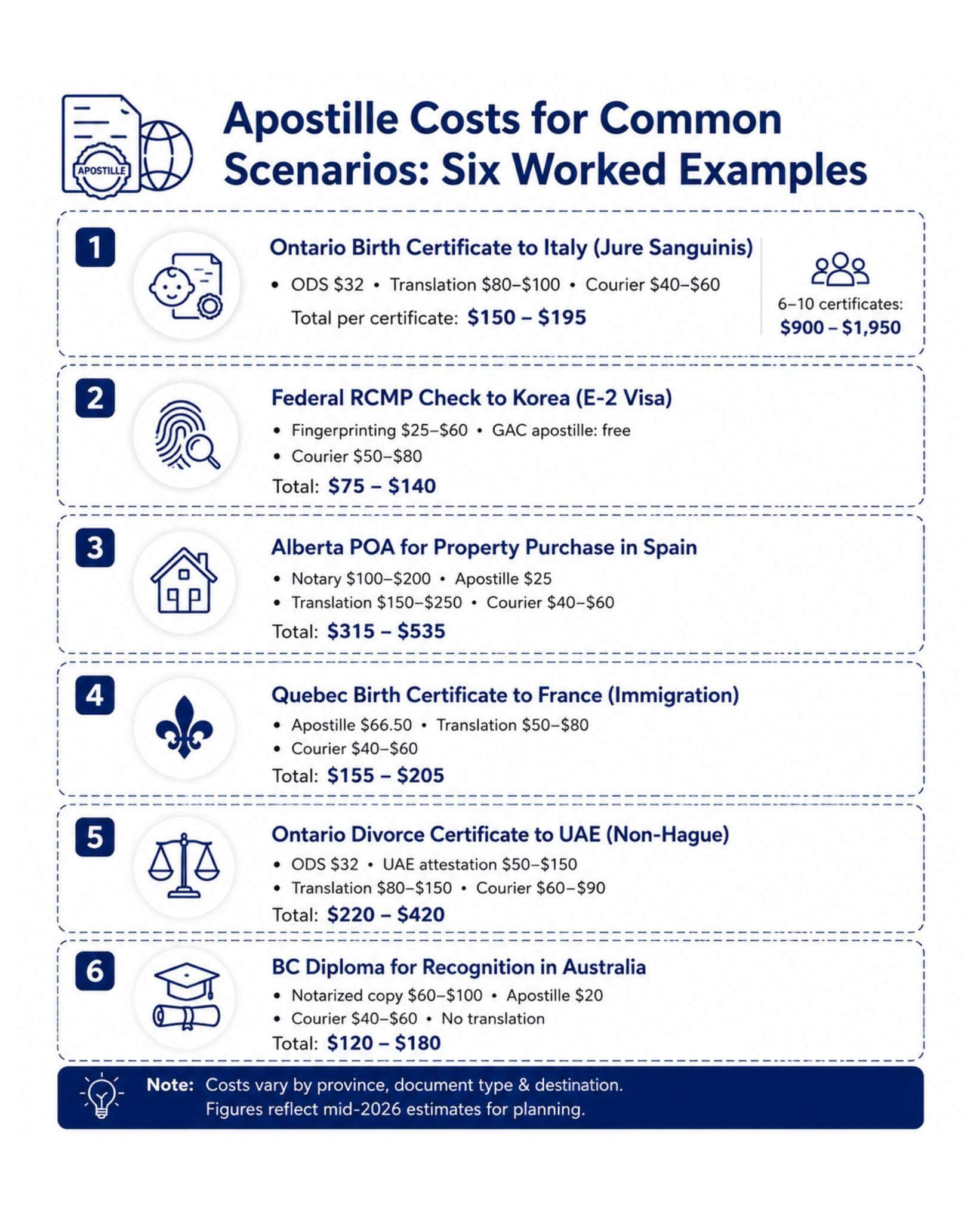
Exact costs vary by province, document type, and destination. These examples use mid-2026 figures as a planning baseline.
For a multi-generation Italian citizenship file with 6 to 10 certificates: $900 to $1,950 in document costs, before legal assistance.
The allonge - the physical apostille certificate - follows the standardized format set by the Convention. Every apostille issued anywhere in the world contains the same 10 fields:
In Canada, the allonge is printed on a separate sheet in both English and French. It is attached to the front of the document - never stamped onto the document itself. The attachment method varies: Global Affairs Canada and some provinces use hole-punch rivets; others use staples with a seal over the fastening.
The certificate number on the allonge is the reference used for online verification in the apostille register. Keep a record of this number for any document you apostille.
The standardized format means a receiving party in Italy, Korea, Australia, or Brazil does not need to translate the apostille. The 10 fields are internationally recognized. Their job is to check that the number, the authority, and the date match what is in the Canadian verification register - and increasingly, they do this in real time through the online portal.
Each province issues its own vital statistics records. Contact the correct office based on where the event was registered - not where you currently live.
| Province | Office | What they issue |
| Ontario | ServiceOntario | Birth, marriage, death certificates |
| British Columbia | BC Vital Statistics Agency | Birth, marriage, death certificates |
| Alberta | Service Alberta (registry agents) | Birth, marriage, death certificates |
| Saskatchewan | eHealth Saskatchewan (Vital Statistics) | Birth, marriage, death certificates |
| Manitoba | Vital Statistics Agency of Manitoba | Birth, marriage, death certificates |
| Quebec | Directeur de l'état civil | Birth (Copy of an Act of Birth), marriage, death |
| New Brunswick | Service New Brunswick, Vital Statistics | Birth, marriage, death certificates |
| Nova Scotia | Vital Statistics, Service Nova Scotia | Birth, marriage, death certificates |
| Newfoundland and Labrador | Vital Statistics Division | Birth, marriage, death certificates |
| PEI | Vital Statistics, Health PEI | Birth, marriage, death certificates |
| Yukon | Health and Social Services Yukon Vital Statistics | Birth, marriage, death certificates |
| NWT | Health and Social Services, NWT Vital Statistics | Birth, marriage, death certificates |
| Nunavut | Vital Statistics, Government of Nunavut | Birth, marriage, death certificates |
Divorce certificates are issued by the court that granted the divorce - not by Vital Statistics. Contact the court where the divorce proceedings were filed to request a certificate or reissued copy.
Canadian citizenship certificates are federal documents, so apostilles go through Global Affairs Canada regardless of which province the holder lives in. A few practical points apply specifically to these documents.
Citizenship Canada has issued certificates in different formats over the years. Older paper certificates and newer credit-card-size certificates are both federal records, but the format matters for apostille purposes. Contact GAC directly before submitting an older or non-standard format certificate to confirm it will be processed.
Citizenship certificates are frequently apostilled for:
PR cards cannot themselves be apostilled - the card format does not accommodate an allonge attachment. Confirmations of Permanent Residence (COPR) are paper documents and can be processed by GAC. If a foreign institution requests proof of Canadian permanent residency in apostilled form, confirm with the institution whether a COPR or an alternative document satisfies their requirement. Contact GAC for guidance specific to the document type.
Foreign professional licensing bodies - for engineers, nurses, doctors, teachers, architects, and others - commonly require apostilled Canadian credentials as part of their application process. The documents required vary by profession and destination.
Professional engineers applying for licensure in European countries, Australia, or elsewhere abroad need: apostilled degree transcripts, apostilled professional engineering licence certificate (from the relevant provincial association), and sometimes reference letters or work experience documentation. The provincial professional engineering licence is issued by a provincial body (PEO in Ontario, APEGA in Alberta, Engineers and Geoscientists BC, and so on). These are provincial documents and go through the relevant provincial competent authority.
Healthcare professionals registering abroad need apostilled: nursing school transcripts and diplomas, nursing registration certificates from the provincial regulatory college, and RCMP fingerprint-based criminal record checks. Registration certificates from provincial nursing colleges (CNO in Ontario, CRNBC in BC, and so on) are not government documents - they need notarization before apostille. Follow the notarization-routing rules for the province.
In addition to the teaching-visa documents covered in the use-cases section, teacher certification documents from provincial ministries of education are government-issued records. These go directly to the provincial competent authority without notarization. Confirm with the specific authority whether the ministry's signature is in its registry.
For credential recognition in non-English-speaking countries - France, Germany, Italy, Spain - the apostilled documents will also need certified translations. Some credential evaluation bodies accept the apostille plus translation as a complete package. Others require the translation to be separately notarized and apostilled. Confirm the specific requirement with the credentialing body before ordering translations.
Family law matters generate some of the most urgent and complex apostille requests.
When a custody or access order from a Canadian court needs to be enforced or recognized in another country, an apostilled copy of the court order is the standard starting point. The process: obtain a certified copy of the order from the court clerk (with the clerk's signature and court seal), submit it to the relevant competent authority for apostille, then submit to the foreign court or authority.
For Hague Child Abduction Convention cases (a separate treaty from the Apostille Convention), the relevant Canadian authority is the Central Authority in the province where the child is located.
Canadian outgoing adoption files include: apostilled birth certificate of the adoptive parent(s), apostilled criminal record checks (RCMP fingerprint-based), court-issued adoption orders (apostilled), and home study documents. Each document follows its own apostille route based on the province of issue or notarization.
For a Canadian divorcee seeking to remarry in a foreign country, the foreign registry needs proof that the Canadian divorce is legally valid. An apostilled divorce certificate or court divorce order is the standard document. Some countries also require a certified statement that the decree of divorce is final and that no appeals are pending - this comes from the court and must also be apostilled.
Immigration consultants and lawyers in Canada regularly manage apostille requests on behalf of their clients. The process is the same for agents as it is for individuals - the queue at GAC and the fees at provincial authorities do not change based on who submits.
They cannot access a faster government queue. They cannot authenticate a document that does not meet the authority's requirements. They cannot fix a laminated certificate or make a digitally notarized PDF acceptable to ODS. Their value is in preparation, routing, and logistics - not in government access.
For immigration-related apostille requests, Regulated Canadian Immigration Consultants are licensed through the College of Immigration and Citizenship Consultants (CICC). Lawyers who practise immigration law are licensed through their provincial law societies.
For non-immigration-related apostille needs - corporate, estate, credentialing - any authorized notary or law firm can manage the process. There is no licensing requirement specific to apostille services in Canada. Use a known, accountable professional and confirm that they understand the current rules before engaging them for a high-value submission.
Canadians purchasing or selling property in foreign countries regularly encounter apostille requirements. The documents vary by country and transaction type, but several categories appear across most jurisdictions.
The most common document. When a Canadian buyer cannot be physically present in the destination country to sign closing documents, a power of attorney authorizes a local representative to act on their behalf. The POA must be:
For some countries, the property registry or notarial office at the destination will also want to see that the POA was drawn up by a person with legal standing. A certificate from the relevant Canadian law society confirming the notary's standing may be required. Confirm this with the property lawyer in the destination country before the Canadian notary drafts anything.
Many countries require proof of identity and marital status from foreign buyers before registering property. For a married couple, this means apostilled birth certificates and a marriage certificate - long-form in most jurisdictions. For a divorced buyer acting alone, an apostilled divorce certificate confirming single status is required. Some jurisdictions also ask for an apostilled marriage search record from the provincial Vital Statistics office.
Bank statements, account certifications, or financial summaries showing the source of purchase funds are sometimes required by anti-money-laundering procedures at foreign notarial offices. These are private documents and need notarization before apostille. Request fresh statements immediately before submission - many destination notaries want documentation dated within 3 months.
Property closings in some countries - Portugal, Spain, Italy - can be set months in advance. Use that lead time. A POA that expires before the closing date (some countries limit POA validity) requires a complete restart. Order the POA well in advance, apostille it, and confirm with the destination lawyer that it will remain valid through the expected closing window.
Students applying for study abroad programs, exchange semesters, or international scholarships regularly need apostilled Canadian documents. The requirements vary significantly by destination and institution.
Ontario students have a practical benefit: transcripts and credentials from Ontario public postsecondary institutions issued since January 1, 2019 qualify for direct apostille at ODS without notarization. This cuts out the notary step and the associated cost and time.
Students at institutions in other provinces need to follow the notarization route - registrar-certified copy, then notarized true copy, then provincial apostille - unless their institution and provincial authority have made equivalent arrangements.
EU destination institutions may accept apostilled documents for admission but then also require certified translations. Some Erasmus and bilateral exchange agreements simplify documentation requirements - check with the receiving institution's international office whether apostilles are required at all before ordering them.
International scholarship bodies - some government-funded, some private - often require apostilled secondary or postsecondary credentials. Canadian scholarship applicants should request the required document list from the scholarship administrator early, because document preparation times (especially for international RCMP checks or multi-province document chains) can extend past application deadlines.
The legal foundation of the entire Canadian apostille process sits in the Hague Convention of October 5, 1961, specifically Article 1. Understanding what it covers - and what it excludes - clarifies why some documents qualify and others do not.
The Convention applies to public documents that have been executed in the territory of one contracting state and have to be produced in the territory of another contracting state. The term "public documents" covers:
What Article 1 explicitly excludes
The Convention does not apply to:
The first exclusion means that a document issued by a Canadian embassy or consulate in a foreign country cannot receive a Canadian apostille. The second exclusion means that commercial invoices, bills of lading, customs declarations, and similar trade documents fall entirely outside the apostille system.
In Canada, the competent authorities apply this definition to include:
This is why purely private documents (unsigned contracts, personal letters, unwitnessed private agreements) cannot be apostilled without first being notarized. The notarization converts the private document into one carrying an official certificate - the notary's certification - which falls within the Convention's scope.
Requirements vary enough between provinces to warrant a consolidated summary. This is particularly useful for applicants whose documents cross provincial lines.
Notary public or lawyer licensed in Ontario. Wet-ink signature required. Official stamp (rubber) or embossed seal required. Date required. For certified true copies: "true copy" wording required in the notarial statement.
ODS does not accept digitally signed or RON-notarized documents. The notarized copy must be a physical paper document.
Documents requiring notarization before ODS: anything not in the direct-apostille category (pre-January 2019 postsecondary credentials, pre-July 2023 court documents, private documents, foreign documents presented as copies).
Notary public or lawyer registered in BC. Same wet-ink and seal requirements. For documents going to BC's OIC Administration Office: the original document must also have been issued in BC - out-of-province originals notarized in BC require GAC or another authority depending on routing rules.
BC-specific: the OIC Administration Office verifies signatures against its registry of BC notaries and lawyers. A notary from another province whose name is not in that registry cannot produce a document BC will apostille.
Notary public licensed in Alberta. Alberta's Ministry of Justice explicitly requires documents to be notarized by an Alberta notary public only for certain categories (private documents, copies of corporate records, powers of attorney). Wet ink, stamp or seal, and date required.
Notary public or commissioner licensed in Saskatchewan for documents going to Saskatchewan Authentication Services.
Civil-law notary licensed under the Notaries Act of Quebec for notarial acts. Lawyer licensed by the Barreau du Québec for lawyer-signed documents. Both categories require prior verification by CNQ or Barreau respectively before the Ministère de la Justice apostilles the document.
For documents going to GAC: the notary must be licensed in the province where the notarization occurred. GAC checks the notary's name against the registry it holds for that province. For private documents from non-authority provinces, the notary must be licensed in that province.
Canadians who move internationally with regularity - diplomatic families, international business executives, long-term expats, international educators - accumulate apostilled documents over time. Organized record-keeping reduces cost and time on future requests.
Maintain a simple log with these fields for each apostilled document:
When a foreign authority asks for verification of a past apostille, the certificate number and issuing authority are all that is needed for the online register check. Without a record, re-verifying means tracking down the original package.
Before sending any apostilled document internationally, scan or photograph the complete set - the apostille, the document, and any accompanying translations or certifications. Store copies in a cloud service accessible from any location.
Italy, for example, keeps original apostilled documents submitted for citizenship applications. Portugal and Spain sometimes do as well, depending on the filing. Note which originals were submitted and not returned. When you need the same document apostilled for a different purpose, you must order a fresh original from the Vital Statistics office - having a record of which originals were surrendered prevents unnecessary searches.
The apostille does not expire. The underlying document may. Criminal record checks, financial statements, and some official letters have recency requirements set by receiving institutions. Maintain a separate note of any validity windows that applied to documents you submitted, so you know when a fresh check or statement will be needed for future applications.
Certain rules about Canadian apostilles are consistently misread or misreported online. These direct clarifications address the most common ones.
Wrong. Where you live is irrelevant to routing. The document goes to the authority of the province where it was issued or notarized. If you live in Ontario but hold a BC-issued birth certificate, it goes to the BC Authentication Program - not ODS.
Only partly correct. BC processes documents notarized by BC notaries - but only if the original document was also issued in BC. A Nova Scotia birth certificate notarized by a BC notary cannot be processed by BC's office. It falls into a routing gap - BC cannot handle it, and depending on how the notarization is recorded, GAC may also decline it. The correct approach is to plan the notarization in a province whose authority can handle the specific document's origin.
Incorrect. The apostille confirms the signature, capacity of the signer, and seal are genuine. It says nothing about the accuracy or truth of the content. A birth certificate with a genuine apostille may still contain errors if the underlying registration was incorrect. The receiving authority assesses content independently.
Not accepted. Certified true copies for apostille require a notary public (or civil-law notary in Quebec). A commissioner of oaths has a more limited authority and their certifications are not accepted by Canadian competent authorities for apostille submissions.
No. ODS requires wet-ink, physical-paper documents. A document notarized remotely via video with a digital signature does not meet ODS's requirements. Print the document and have an Ontario notary certify a wet-ink true copy before submitting.
Priority processing at GAC is reserved for exceptional, out-of-your-control circumstances where no alternative exists. A missed deadline due to late planning does not qualify. If the standard queue does not fit your timeline and your document qualifies for ODS, use Ontario's in-person route instead.
It does not. The government queue is the same regardless of who submits. Services add value through preparation, routing, and logistics - not through government access.
Outdated. China joined the Hague Apostille Convention on November 7, 2023. Canadian apostilles are accepted in China without embassy legalization for documents falling within the Convention's scope.
No. The allonge is printed in English and French per the Convention standard. The receiving country's authorities recognize the standardized format. Only the underlying document needs translation into the destination language.
Allonge - The physical form of the apostille certificate in Canada. A separate sheet securely attached to the underlying document, printed in English and French.
Apostille - A standardized certificate issued under the 1961 Hague Convention confirming the origin of a public document. Accepted across all Convention member countries.
Authentication - The process of verifying a signature, seal, or stamp on a document. The base step for both apostille (Hague) and certificate of authentication (non-Hague) outputs.
C-216C - The RCMP fingerprint form used for Criminal Record Check applications.
CCRTIS - Canadian Criminal Real Time Identification Services. The RCMP unit in Ottawa that processes fingerprint-based criminal record checks.
Certificate of authentication - The output of the authentication process when the destination country is not a Hague member. Equivalent to an apostille in function but used for non-Convention destinations.
Certified true copy - A copy of a document examined by a notary public and certified as accurate, with wet-ink signature, stamp or seal, and date.
Chambre des notaires du Québec (CNQ) - The professional governing body for Quebec civil-law notaries. Required to verify Quebec notary signatures before the Ministère de la Justice will apostille a Quebec notarial act.
Commissioner of oaths - A professional authorized to witness signatures and administer oaths in limited contexts. Not a substitute for a notary public for apostille submissions.
Competent authority - The government body designated to issue apostilles in a jurisdiction. Canada has six: one federal (GAC) and five provincial.
CTTIC - Canadian Translators, Terminologists and Interpreters Council. The national umbrella organization whose member provincial associations certify translators recognized by Canadian authorities.
Embassy legalization / attestation - The step required for non-Hague country destinations. The destination country's embassy in Canada stamps the authenticated document.
GAC - Global Affairs Canada. The federal competent authority and Canada's national contact point with the HCCH.
Hague Apostille Convention - The Convention of October 5, 1961 Abolishing the Requirement of Legalisation for Foreign Public Documents. Canada joined January 11, 2024.
HCCH - Hague Conference on Private International Law. The international organization that administers the Convention and maintains the list of member states.
Jure sanguinis - Citizenship by descent ("by right of blood"). Several countries grant citizenship to descendants of nationals who emigrated; apostilled Canadian civil records are commonly required.
Long-form birth certificate - A birth certificate that includes both parents' names and full registration details. Often required for citizenship, dual-citizenship, and marriage-abroad applications.
Ministère de la Justice - Quebec's competent authority for apostilles. Full name: Direction générale des registres et de la certification.
Notary public - A government-authorized professional who witnesses signatures, administers oaths, and certifies copies of documents. In Quebec, this role belongs to a civil-law notary, a distinct legal professional under the Notaries Act.
ODS - Official Documents Services. Ontario's provincial competent authority for apostilles and certificates of authentication. Located at 777 Bay Street, Lower Level, Toronto.
OIC Administration Office - Order in Council Administration Office. The BC government office that administers the BC Authentication Program.
OTTIAQ - Ordre des traducteurs, terminologues et interprètes agréés du Québec. The Quebec professional association for certified translators recognized for apostille-related submissions.
Polymer certificate - A vital statistics certificate issued on durable polymer (plastic-based) material with embedded security features. The standard format accepted by Canadian competent authorities.
Public document - Under the Convention: documents from courts and tribunals, administrative documents, notarial acts, and official certificates placed on privately signed documents.
RON (Remote Online Notarization) - Notarization conducted by video with digital signatures. Legal in some provinces but not accepted by Ontario ODS, which requires wet-ink physical documents.
Short-form birth certificate - A birth certificate showing essential personal data without parents' names. Acceptable for some purposes; not sufficient for citizenship, dual-citizenship, or most marriage-abroad applications.
Statement in lieu - Global Affairs Canada's document confirming Canada does not issue certificates of non-impediment to marriage. Does not confirm personal marital status.
Triage portal - GAC's online tool that identifies which authority should handle a specific document, based on a short series of questions.
Validity window - The period within which a document - not the apostille - must have been issued to be acceptable to the receiving authority. Commonly 3 to 6 months for criminal record checks.
Wet-ink signature - A handwritten signature applied in physical ink on a paper document. Required by Ontario ODS and most Canadian competent authorities for apostille submissions.
Before mailing any apostille package, confirm every item below.
Canada joined the Hague Apostille Convention on January 11, 2024. A single apostille from a Canadian competent authority now replaces the old two-step authentication and embassy legalization process for documents going to the 130 Convention member countries.
Six authorities issue Canadian apostilles: Global Affairs Canada (federal), and five provincial authorities - Ontario ODS, BC's OIC Administration Office, Alberta's Ministry of Justice, Saskatchewan's Ministry of Justice, and Quebec's Ministère de la Justice. The correct authority depends on where the document was issued or notarized, not where the applicant lives.
Government fees range from free (GAC) to $66.50 per document (Quebec). Processing times range from 3 to 5 business days (Saskatchewan) to 20 business days plus mail time (GAC). Ontario ODS in-person is the only same-day option in Canada.
Government-issued originals with verifiable official signatures go directly to the competent authority in most provinces. Private documents and copies need notarization by a licensed Canadian notary public first. Wallet-size and laminated certificates are ineligible - order a full-size, unlaminated original before submitting.
For non-Hague countries - UAE, Qatar, Vietnam, and others - authentication by a Canadian authority is still followed by legalization at the destination country's embassy in Canada.
Verify fees, processing times, addresses, and Hague membership status at official government sources before submitting. They change without advance public notice.

Everything you need for a UK apostille in 2026 - FCDO process, fees, timelines, document types, non-Hague countries, and common rejection fixes.
Your complete guide to fingerprinting in India, covering Aadhaar, passports, background checks, immigration, property registration, and your legal rights.

Everything Indians need to move to New Zealand in 2026 - visas, Green List occupations, taxes, healthcare, schools, jobs, and a full moving checklist.
Need help with your application or background check?
Contact us now and speak with a dedicated Globeia expert today.